
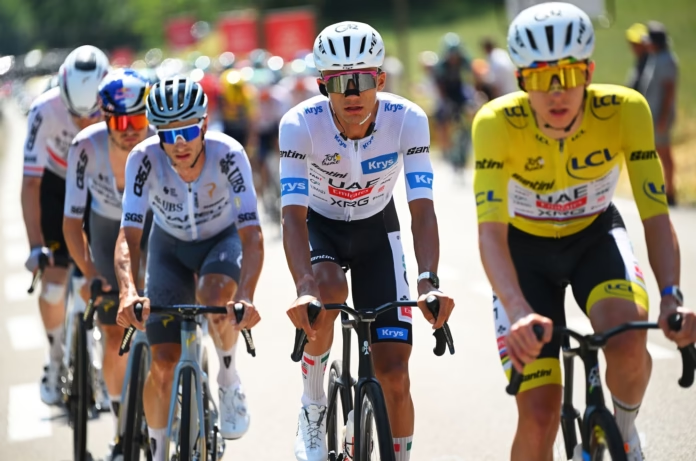
UAE Team Emirates-XRG head into the final mountain stage of the 2026 Tour de France with Tadej Pogačar still looking healthy, but with genuine concerns about the strength of the team around him.
The situation was described ahead of Stage 19 as broadly unchanged, effectively “pretty much status quo” after illness affected several riders during the final week.
The important distinction is that there is no clear evidence Pogačar himself is ill.
His performance on Alpe d’Huez on Friday certainly did not suggest it. The concern is instead about the riders expected to protect him through the hardest stage of the race.
Which UAE riders have been ill?
Brandon McNulty is the biggest confirmed loss.
The American abandoned Stage 18 through illness, removing one of UAE’s most versatile mountain domestiques immediately before the double Alpe d’Huez finale.
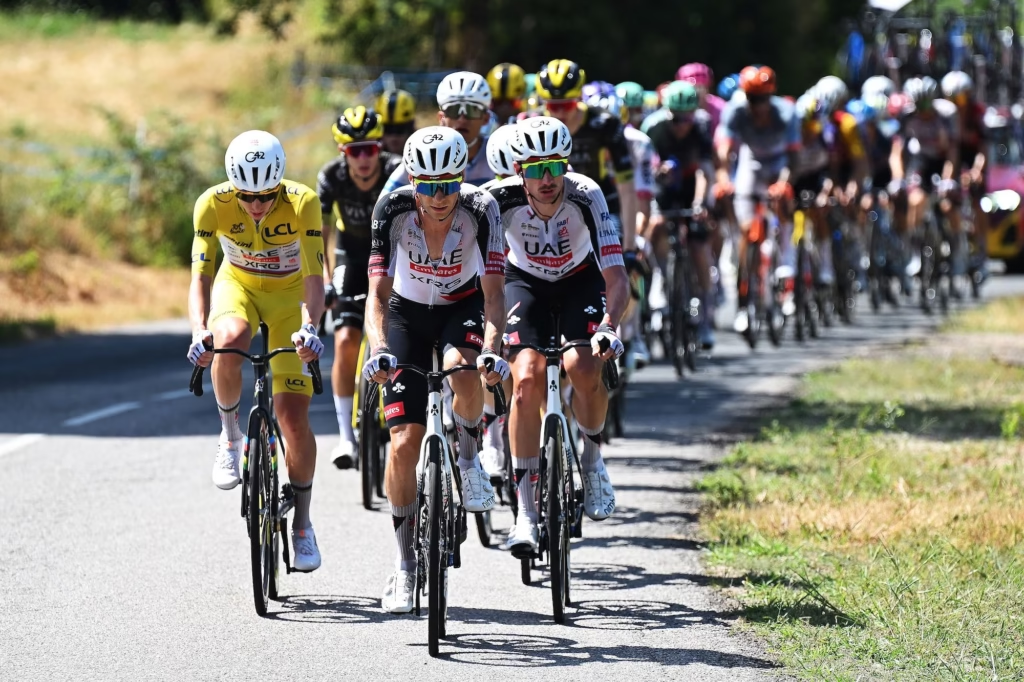
Adam Yates and Tim Wellens have also been affected by illness during the final week.
That does not mean the entire UAE team is sick.
Pogačar has continued to perform at his normal level, while Isaac del Toro remains strong enough to sit third overall. Felix Großschartner, Nils Politt and Florian Vermeersch also remain available.
The more accurate description is that UAE are weakened rather than incapacitated.
That was already evident after Stage 18, when Pogačar retained yellow but the team reached the final mountain weekend with reduced depth.
Pogačar himself does not appear to be affected
The biggest question is inevitably whether the illness has reached Pogačar.
So far, there is little evidence that it has.
He came through Stage 18 without showing any obvious weakness and then reinforced that impression on Alpe d’Huez during Stage 19.
A rider significantly affected by the same illness that forced McNulty out would be unlikely to be producing the strongest climbing performances of the race.
For now, the problem is therefore not Pogačar’s health.
It is how many healthy riders UAE can keep around him when Stage 20 becomes difficult.
Why Stage 20 makes the illness more important
Stage 20 presents a much bigger tactical problem than Friday.
The riders face the Croix de Fer, Télégraphe, Galibier and Col de Sarenne before returning to Alpe d’Huez, with around 5,450 metres of climbing across the day.
That creates far more opportunities for Pogačar to become isolated.
The tactical consequences of McNulty’s withdrawal are particularly significant here. McNulty could control a valley, chase an attack, work on a major climb or remain available late enough to support Pogačar after other domestiques had disappeared.
Without him, UAE have fewer ways to repair a bad situation.
That becomes even more important if Yates and Wellens are still operating below their normal level.
The Croix de Fer is the obvious place to test UAE
Rivals have little reason to wait until Alpe d’Huez.
The Croix de Fer arrives early enough in Stage 20 that another team can immediately test how much strength UAE actually have left.
A hard pace does not necessarily need to drop Pogačar.
It can simply remove the riders around him.
Politt and Vermeersch are unlikely to survive deep into a serious mountain battle. If Yates or Wellens are also dropped earlier than expected, much of the burden quickly falls on Großschartner and Del Toro.
That is where UAE’s illness problem starts to become tactically important.
Pogačar may still be the strongest rider in the race, but the team do not want him having to manage every attack personally with 100 kilometres still remaining.
 Photo Credit: Getty
Del Toro cannot simply become another domestique
UAE also have another problem that healthy legs alone would not solve.
Isaac del Toro is third overall.
He therefore cannot automatically be sacrificed to protect Pogačar in the way a normal mountain domestique could.
The situation became even more complicated after Stage 19, with Del Toro still locked into a close battle with Paul Seixas for the podium and white jersey.
That means UAE effectively have two races to control.
They must protect Pogačar’s yellow jersey while also preserving Del Toro’s position.
Earlier in the Tour, UAE had the depth to cover both objectives comfortably.
With McNulty gone and questions around Yates and Wellens, those decisions become much harder.
-
 Photo Credit: A.S.O./Gaëtan Flamme

Rain could make a weakened team more vulnerable
The possibility of wet roads during Stage 20 adds another concern.
On a dry mountain stage, UAE can often control the race simply by setting the pace and keeping Pogačar well positioned.
Rain makes that less reliable.
If the Galibier descent becomes slippery, Pogačar benefits from having teammates around him. A mechanical problem, split or moment of hesitation becomes much easier to solve when another UAE rider is immediately available.
The same applies around the Col de Sarenne.
A healthy McNulty would have been particularly valuable in exactly that kind of race.
Without him, UAE have less insurance if the stage becomes chaotic.
Is Pogačar’s team sick?
Parts of it clearly have been.
McNulty has already left the race through illness, while Yates and Wellens have also been affected during the third week.
But there is an important distinction between a team suffering illness and Pogačar himself being sick.
At the moment, the latter is not supported by what we have seen on the road.
Pogačar still looks strong.
The question is whether the team around him can keep functioning at the same level.
UAE were already weakened rather than exposed after McNulty’s abandonment. Stage 20 is the day most likely to reveal how significant that weakening actually is.
If rivals make the Croix de Fer hard, force the domestiques into the red and then continue attacking across the Télégraphe and Galibier, Pogačar may spend far more of the final mountain stage racing without his usual protection.
That still does not make him an obvious candidate to lose the Tour.
It does make Stage 20 considerably less comfortable for UAE than the yellow jersey standings alone suggest.

