
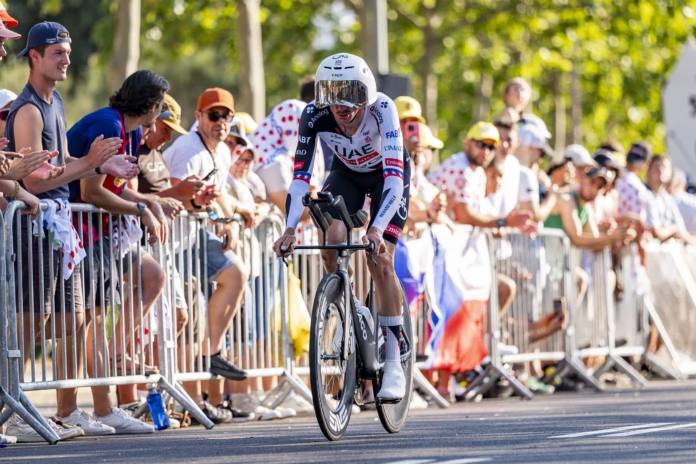
Brandon McNulty’s abandonment on stage 18 leaves UAE Team Emirates-XRG with one fewer rider to protect Tadej Pogačar across the Tour de France’s decisive double visit to Alpe d’Huez.
The American withdrew with illness during the stage to Orcières-Merlette, reducing UAE to seven riders for the final three days. McNulty’s exit becomes more significant because Adam Yates and Tim Wellens have also been managing illness during the third week.
Pogačar still leads Remco Evenepoel by 4:32. Isaac del Toro remains third overall, giving UAE the strongest position in the race as well as another elite climber.
The team is weakened rather than exposed.
McNulty’s absence removes one of UAE’s most versatile mountain domestiques. He could control a valley, chase an attack, set a hard pace on a category-one climb or remain close enough to Pogačar to provide support late in a stage.
On stage 19, UAE must protect yellow across a short and potentially explosive route ending on Alpe d’Huez. The following day brings the much harder queen stage over the Croix de Fer, Télégraphe, Galibier and Col de Sarenne before a second ascent to the resort.
The team still has enough strength to control the Tour. It may no longer have enough healthy riders to control every moment of it.
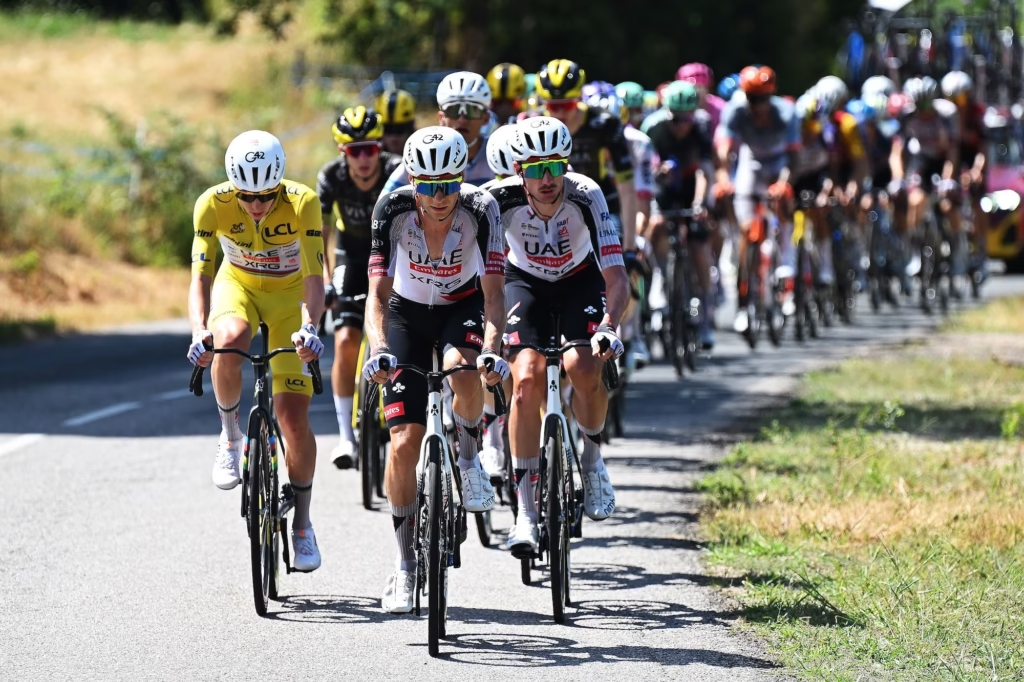
What happened to Brandon McNulty?
McNulty abandoned during stage 18 from Voiron to Orcières-Merlette because of illness.
His withdrawal came two days after an incident involving a vehicle before the stage 16 time trial. UAE reported that he had escaped serious injury and he completed the stage, but his Tour subsequently ended through illness rather than a confirmed consequence of that collision.
The timing is particularly damaging.
McNulty had survived the opening 17 stages and reached the point where his value to Pogačar was likely to be greatest. Stages 19 and 20 contain the Tour’s final major climbing tests, including two consecutive finishes on Alpe d’Huez.
He was not simply another rider who could set tempo at the start of a climb.
McNulty could perform several jobs within the same stage:
- Control a dangerous breakaway
- Work across flat or exposed roads
- Follow attacks from rival domestiques
- Set a high pace on medium mountains
- Remain available late enough to support Pogačar
- Drop back from an advance group if the leader became isolated
Removing that flexibility makes UAE’s tactical decisions more difficult.
McNulty’s withdrawal can also be followed through our live Tour de France 2026 abandonment list.
UAE’s remaining Tour de France riders
| Rider | Likely role on stages 19 and 20 |
|---|---|
| Tadej Pogačar | Yellow jersey and protected leader |
| Isaac del Toro | Podium contender and final mountain support |
| Adam Yates | Senior mountain domestique, fitness dependent |
| Felix Großschartner | Mountain pacing and late support |
| Tim Wellens | Break control and medium-climb work, fitness dependent |
| Nils Politt | Flat-road control and valley chasing |
| Florian Vermeersch | Early control, break management and positioning |
The original eight-rider squad was built around Pogačar, Del Toro, Yates and McNulty providing exceptional climbing depth, with Großschartner adding another experienced mountain worker. Politt, Vermeersch and Wellens could manage the flatter roads and earlier climbs.
The wider plan UAE brought into the race is covered in the Tour de France 2026 team-by-team guide.
McNulty’s withdrawal reduces the team to Pogačar and six supporting riders.
Even that description is slightly misleading.
Del Toro is third overall, only 20 seconds ahead of Paul Seixas. He cannot always be used as an ordinary domestique without risking his own podium and white jersey.
Yates and Wellens have been affected by illness. Their presence in the race does not guarantee they can perform their intended work at full capacity.
UAE officially have six riders available to support Pogačar. Their effective mountain train may be considerably smaller.
Why McNulty matters more than a normal mountain domestique
McNulty’s greatest value is not that he is UAE’s best pure climber.
Pogačar, Del Toro and a healthy Yates all possess greater high-mountain ability. Großschartner is also an established specialist in sustained climbing support.
McNulty bridges the space between those roles.
Politt and Vermeersch are best suited to the opening phase of a stage, controlling attacks and protecting Pogačar through valleys. Yates and Del Toro are riders UAE would prefer to preserve for the decisive climbs.
McNulty could work between them.
He was capable of riding hard over the Col d’Ornon, descending towards Bourg-d’Oisans and still beginning Alpe d’Huez near Pogačar. On stage 20, he could have helped across the long transitions between the Galibier, Sarenne and final climb.
Without him, UAE must ask one rider to begin working earlier than planned.
That may be Großschartner, who would then be less likely to remain on Alpe d’Huez. It may be Yates, whose health remains uncertain. It could even be Del Toro, forcing UAE to place Pogačar’s yellow jersey ahead of their second podium position.
McNulty’s absence does not remove one fixed link from the chain. It forces the entire chain to move forward.
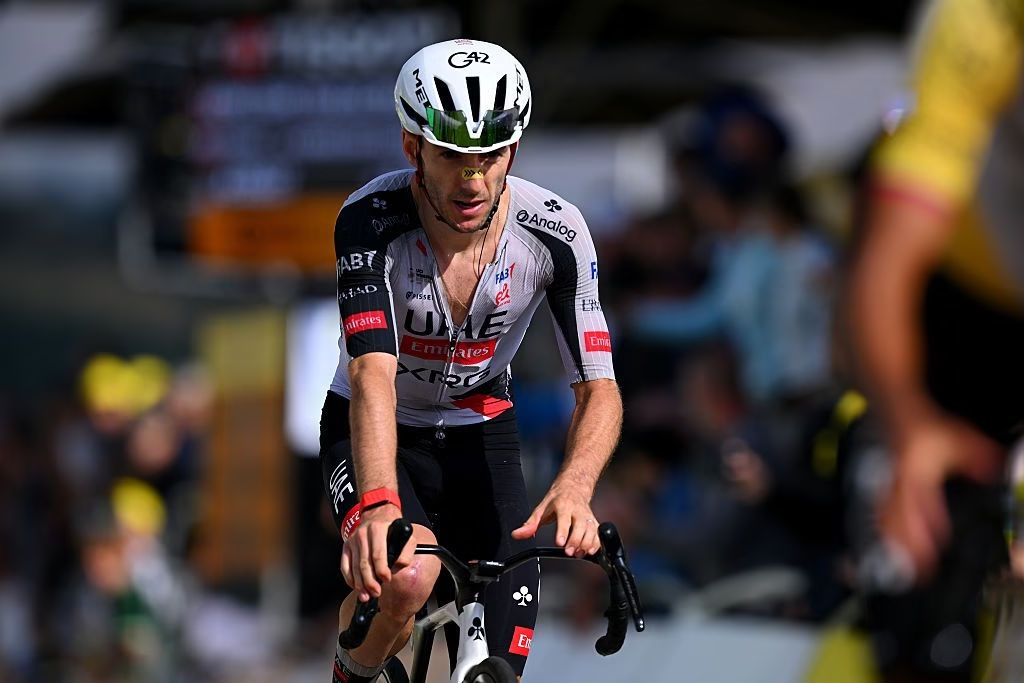
Adam Yates becomes the biggest uncertainty
Yates was supposed to be Pogačar’s final specialist mountain domestique.
At his best, he can remain in a group containing only the leading general classification riders. He can respond to attacks, establish a difficult pace and provide Pogačar with tactical cover deep into a summit finish.
His illness changes the calculation.
Yates struggled during stage 17 and completed stage 18, but UAE will not know his true condition until the intensity rises again on Alpe d’Huez.
A recovering Yates does not need to be capable of winning a stage to remain useful.
Even 20 minutes of hard work can matter. If he reaches Alpe d’Huez with Pogačar and controls the opening slopes, he can remove opportunities for Evenepoel, Seixas and Lidl-Trek to attack while the yellow jersey settles into the climb.
The concern is what happens if he is dropped on the Col du Noyer or Col d’Ornon.
UAE would then reach Alpe d’Huez without the rider originally selected to provide their final layer of protection. Großschartner may already have worked, while Del Toro will be monitoring Seixas.
At that point, Pogačar may effectively be racing alone.
Tim Wellens may have to work earlier than planned
Wellens normally gives UAE control across rolling and medium-mountain terrain.
Stage 19 appears well suited to that role. The Col Bayard and Col du Noyer arrive almost immediately, followed by a long central section before the Col d’Ornon.
A healthy Wellens could enter the early break, follow dangerous moves or help Politt and Vermeersch keep the race manageable.
His recent illness reduces the certainty.
UAE may decide that using Wellens briefly is safer than asking him to survive until the final hour. He can contribute during the aggressive opening before dropping back once the break has been established.
That would preserve Großschartner and Yates for later.
The alternative is to allow a large breakaway to go and avoid chasing it entirely. Pogačar does not need the stage victory, and riders far behind overall pose no threat to yellow.
This is likely to become UAE’s preferred approach.
They can allow the stage hunters to take several minutes, use Wellens only where necessary and reserve their remaining climbers for attacks involving Evenepoel, Seixas or Lidl-Trek.
Nils Politt and Florian Vermeersch become more important
Politt and Vermeersch are unlikely to remain with Pogačar on the decisive slopes of Alpe d’Huez.
Their work before the final climb may determine whether UAE need them there.
Both riders can control the breakaway battle, maintain a steady pace through the valley and protect Pogačar from positioning problems. Politt is particularly valuable when the road flattens and a strong group needs to be held at a manageable distance.
Stage 19 contains more than 60km between the Col du Noyer and Col d’Ornon.
That section works in UAE’s favour. Politt and Vermeersch can use their power to discourage tactical attacks and prevent rival domestiques building a dangerous advantage.
The key is avoiding unnecessary work.
UAE do not need to keep a stage-winning break within two minutes. They only need to monitor riders who could influence the general classification or provide later support to Evenepoel.
A group containing Richard Carapaz, Valentin Paret-Peintre and other stage hunters can be allowed freedom.
A group containing Jai Hindley, Maxim Van Gils or Mattia Cattaneo requires more attention because those riders could later wait for Evenepoel.
Politt and Vermeersch are now responsible for identifying that difference.
Felix Großschartner becomes the bridge to Alpe d’Huez
Großschartner’s role becomes especially important without McNulty.
He is the most natural rider to connect UAE’s early workers with Yates, Del Toro and Pogačar.
On stage 19, that probably means setting the pace on the Col d’Ornon or through the approach to Bourg-d’Oisans. His work should prevent attacks from gaining enough distance to become tactically useful on Alpe d’Huez.
Großschartner does not need to remove every rival.
His task is to deliver Pogačar to the final climb without forcing Yates or Del Toro to begin working too early.
If Großschartner is used on the Col du Noyer, the team may have no equivalent rider available for the Col d’Ornon. If UAE preserve him until the final climb, rival teams could place several riders ahead during the opening phase.
The team must choose where his effort has the greatest value.
Stage 19’s long valley suggests waiting is the better option. Politt and Vermeersch can manage much of the middle section, allowing Großschartner to remain protected until the final 35km.
Stage 20 will be harder to organise. There may be no point at which UAE can comfortably save him.
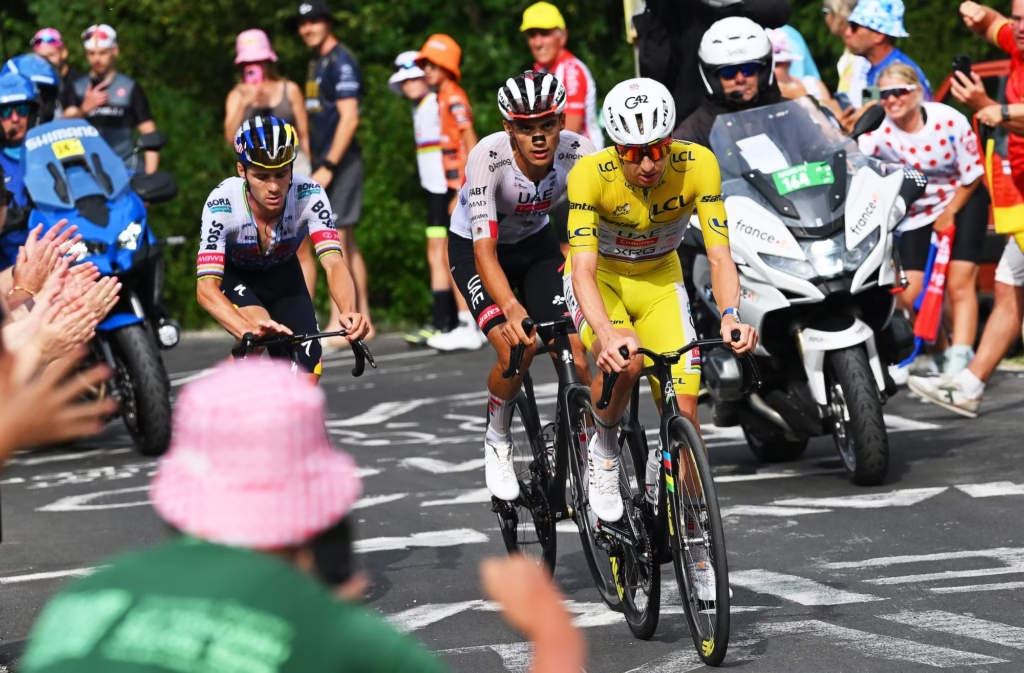 Photo Credit: Getty
Del Toro is both protection and a tactical complication
Del Toro is theoretically UAE’s strongest remaining support rider.
He is also third overall.
That creates a problem McNulty’s presence would have helped solve.
If Seixas attacks, Del Toro must respond to protect his podium and white jersey. That response may also help Pogačar because the Mexican can follow a dangerous move without requiring the yellow jersey to chase.
If Evenepoel attacks alone, the situation is different.
Del Toro can allow Pogačar to respond because the move does not immediately threaten his third place. Asking Del Toro to chase would spend energy needed to defend against Seixas.
The most difficult scenario is an attack involving both Evenepoel and Seixas.
Del Toro then has personal and team reasons to follow. If he succeeds, Pogačar gains a teammate in the move. If he cannot, UAE may need Yates or Großschartner to close the gap before Pogačar responds himself.
Del Toro gives UAE a second elite card, but his podium ambitions limit how freely they can play it.
The tension between his two objectives is central to the white jersey battle with Paul Seixas.
Does Pogačar actually need a full mountain train?
Probably not on stage 19.
Pogačar leads Evenepoel by 4:32. He does not need UAE to control the stage for a victory, isolate every rival or set a punishing tempo on Alpe d’Huez.
He needs to remain close to Evenepoel.
That changes the purpose of his domestiques.
Rather than preparing a Pogačar attack, they can focus on positioning, covering tactical moves and ensuring the leader reaches the final climb without wasting energy.
Once Alpe d’Huez begins, Pogačar can mark Evenepoel directly.
Even if the Belgian attacks and gains 30 seconds, the yellow jersey remains secure. Pogačar does not have to react instantly to every acceleration.
This is the main reason McNulty’s abandonment is not a race-changing event by itself.
A depleted team becomes most vulnerable when its leader must take time. Pogačar already possesses more than enough.
He can race defensively in a way UAE rarely choose to do.
The route and tactical options are covered in the Tour de France 2026 stage 19 preview.
Why stage 20 presents a greater danger
Stage 19 is short, with one major final climb and a long section where Politt and Vermeersch can control the race.
Stage 20 contains approximately 5,450 metres of climbing across the Croix de Fer, Télégraphe, Galibier, Col de Sarenne and Alpe d’Huez.
That is where McNulty’s absence could become far more significant.
The climbs are too long and too numerous for one rider to cover several roles comfortably. Once Politt and Vermeersch have been dropped, UAE may need Großschartner, Yates and Del Toro to survive for hours rather than one final ascent.
An attack on the Galibier would leave a long distance to the finish.
McNulty would have been particularly useful there. He could have ridden ahead, waited after the summit or helped Pogačar across a valley if the race fragmented.
Without him, UAE have fewer ways to repair a bad situation.
Stage 19 should therefore be ridden with stage 20 in mind. The team cannot spend every healthy climber chasing an Alpe d’Huez victory when the following day presents the greater threat to yellow.
The complete route is examined in the Tour de France 2026 queen stage guide.
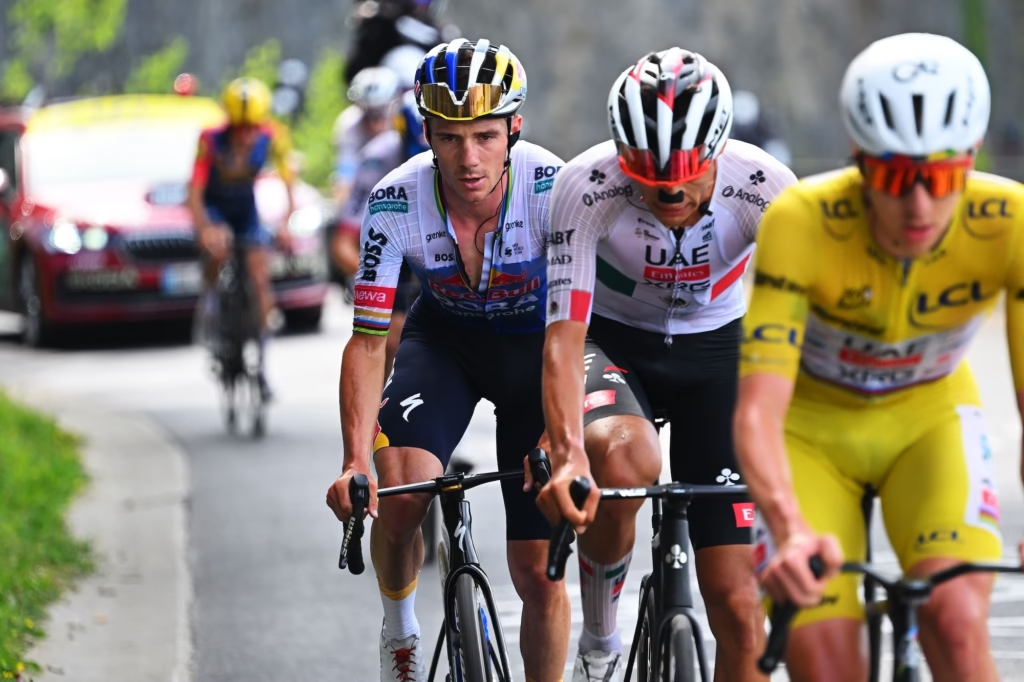 Photo Credit: Getty
How Red Bull-Bora-Hansgrohe can exploit the reduced squad
Red Bull-Bora-Hansgrohe also arrive with fewer options after Florian Lipowitz abandoned following his stage 16 time trial crash.
Evenepoel still has Jai Hindley, Maxim Van Gils, Mattia Cattaneo, Jan Tratnik, Nico Denz and Tim van Dijke available. The team has enough variety to pressure UAE, although it lacks the second high-ranking leader Lipowitz would have provided.
The consequences of that withdrawal are covered in our explainer on why Florian Lipowitz abandoned the Tour de France.
The most obvious strategy is placing riders in the breakaway.
Hindley, Van Gils or Cattaneo can move during the Col Bayard and Col du Noyer. UAE must then decide whether those riders are stage hunters or potential bridges for Evenepoel.
If UAE chase them, their remaining domestiques spend energy.
If UAE allow them to go, Evenepoel gains tactical support ahead of the final climb.
That does not automatically create a yellow jersey opportunity. Pogačar can still follow Evenepoel directly.
The purpose is to make UAE uncomfortable and remove their control over when the race becomes difficult.
Jai Hindley is Red Bull’s most useful tactical card
Hindley is the rider UAE should be least willing to place far up the road.
He is a Grand Tour winner with genuine high-mountain ability. Even if his own general classification position is no longer relevant, he can become enormously useful to Evenepoel late in the stage.
A breakaway Hindley could:
- Wait near the summit of the Col d’Ornon
- Pace Evenepoel towards Bourg-d’Oisans
- Lead into the foot of Alpe d’Huez
- Ride after an attack on the lower slopes
- Provide support if Evenepoel suffers a mechanical problem
- Force UAE to use Großschartner or Yates earlier
Red Bull do not need Hindley to win the stage.
They need him to exist as a threat UAE must account for.
The weakness in the plan is that the opening climbs may produce a breakaway too difficult for Hindley to enter without spending heavily. UAE can also allow him several minutes because he is not a direct yellow jersey threat.
His value depends on Evenepoel being able to bridge or attack later.
Maxim Van Gils can force UAE to chase medium-range moves
Van Gils offers a different kind of threat.
He is more explosive than Hindley and well suited to attacking on the Col d’Ornon. A move there could force UAE to decide whether he is preparing to help Evenepoel or pursuing the stage independently.
He can also set a high pace into the foot of Alpe d’Huez.
That matters because the steep opening kilometres are where Evenepoel’s rivals may be most vulnerable. Red Bull want to begin the climb at full speed rather than allow UAE to establish a controlled rhythm.
Van Gils cannot defeat Pogačar on his own.
He can remove the calm structure UAE would prefer.
 Photo Credit: Getty
Red Bull must avoid doing UAE’s work
There is a danger that Red Bull-Bora-Hansgrohe respond to McNulty’s exit by riding aggressively without a clear route to gaining time.
A hard pace on the Col d’Ornon could eliminate Politt and Vermeersch, but it may also carry Yates, Del Toro and Pogačar safely towards the final climb.
Once Evenepoel attacks, Pogačar can sit on his wheel.
Red Bull would then have spent several riders preparing a move that benefits the yellow jersey through drafting.
The team needs separation rather than simple difficulty.
Sending riders ahead is valuable. Repeated attacks from different teams are valuable. Forcing UAE to make decisions is valuable.
Setting a steady mountain tempo for Pogačar is not.
Evenepoel’s best opportunity depends on Lidl-Trek and Decathlon CMA CGM contributing to the disruption.
The scale of his overall challenge is analysed in can Remco Evenepoel win the Tour de France 2026?.
Lidl-Trek may be the team most capable of exposing UAE
Juan Ayuso and Mattias Skjelmose sit fifth and sixth overall.
Unlike Red Bull, Lidl-Trek have two protected riders who can attack in sequence. Unlike UAE, neither has a yellow jersey to defend.
They can use one rider on the Col d’Ornon and preserve the other for Alpe d’Huez.
If UAE ask Del Toro to follow Ayuso, Seixas may attack. If Pogačar remains with Evenepoel, Skjelmose can potentially gain time. Every response connects a different classification battle.
That is the type of racing in which McNulty would have been valuable.
He could have followed the first move, allowing Großschartner and Yates to wait. Without him, UAE may need to expose one of their remaining climbers earlier.
Red Bull should encourage that instability rather than attempt to create the whole race alone.
Evenepoel can benefit from attacks by Ayuso, Skjelmose and Seixas without immediately taking responsibility himself.
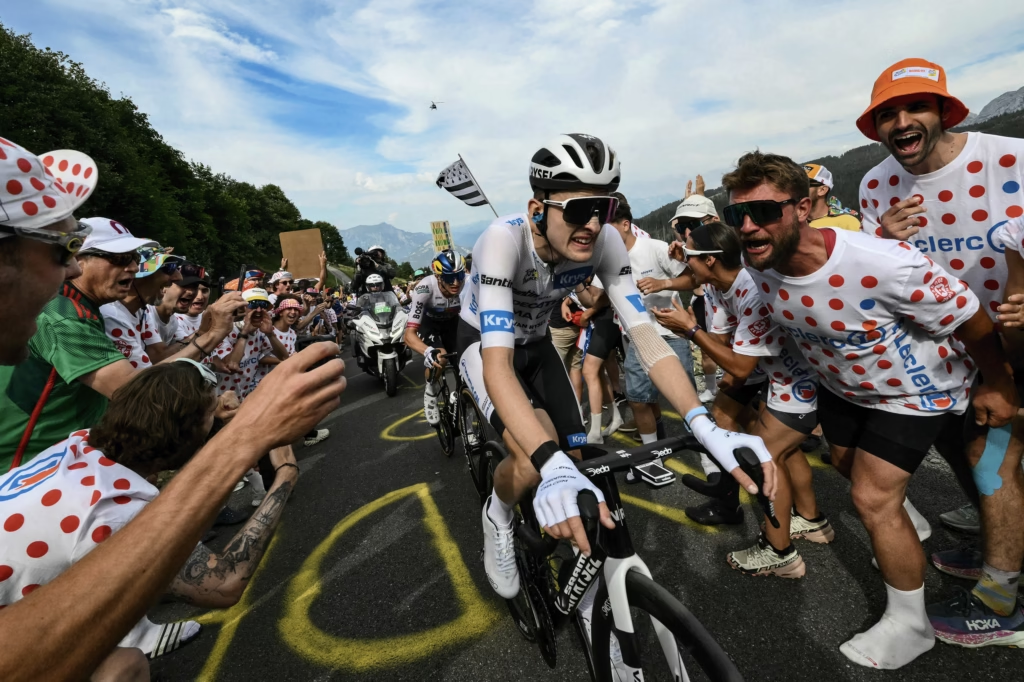 Photo Credit: Getty
Decathlon can use the white jersey fight to create pressure
Seixas begins stage 19 only 20 seconds behind Del Toro.
Decathlon therefore have a clear reason to attack UAE even if the yellow jersey is beyond reach.
That makes Seixas a potential tactical ally for Evenepoel.
If the Frenchman attacks on Alpe d’Huez, Del Toro must respond. UAE may hesitate to use him for Pogačar while the podium and white jersey remain at stake.
Evenepoel can then follow Seixas or counter once Del Toro has spent energy.
The interests are temporary rather than cooperative.
Seixas is also only 2:39 behind Evenepoel. A successful long-range attack could threaten second place, forcing the Belgian to chase.
That is the difficulty for Red Bull. The riders most capable of disrupting UAE are also trying to take Evenepoel’s podium position.
UAE’s safest stage 19 strategy
UAE should avoid treating stage 19 as a stage they need to win.
Their safest approach is straightforward:
- Allow a strong but harmless breakaway to form.
- Keep riders such as Hindley and Van Gils from gaining tactically useful positions.
- Use Politt and Vermeersch through the long central section.
- Preserve Großschartner until the Col d’Ornon.
- Keep Yates protected for Alpe d’Huez if his health allows.
- Let Del Toro monitor Seixas.
- Ask Pogačar to follow Evenepoel rather than attack him.
- Save as much energy as possible for stage 20.
A breakaway victory helps UAE.
It removes bonus seconds and reduces the temptation for Pogačar to chase a prestigious stage win. It also allows the team to ride at a controlled pace without appearing passive.
The main risk is allowing the wrong riders into that break.
A group of stage hunters can receive ten minutes. A group containing several Red Bull or Lidl-Trek domestiques cannot.
Why winning on Alpe d’Huez could become a tactical mistake
Pogačar is the strongest favourite if the general classification riders contest stage 19.
Winning would add one of cycling’s most prestigious finishes to his Tour and increase his mountains classification lead.
It could also require UAE to spend energy they do not need to spend.
Chasing a strong breakaway would place additional pressure on Politt, Vermeersch and Wellens. Bringing the stage back together may then force Großschartner and Yates to work before the final climb.
Pogačar could win and still weaken the squad ahead of stage 20.
The rational decision is to let the breakaway succeed and defend yellow.
Pogačar’s instincts do not always follow the most conservative calculation. If the stage victory remains available inside the final kilometres, he is unlikely to ignore it.
The key is ensuring UAE do not spend all day manufacturing that opportunity.
The significance of the repeated summit finishes is explored in why back-to-back Alpe d’Huez stages could define the Tour de France 2026.
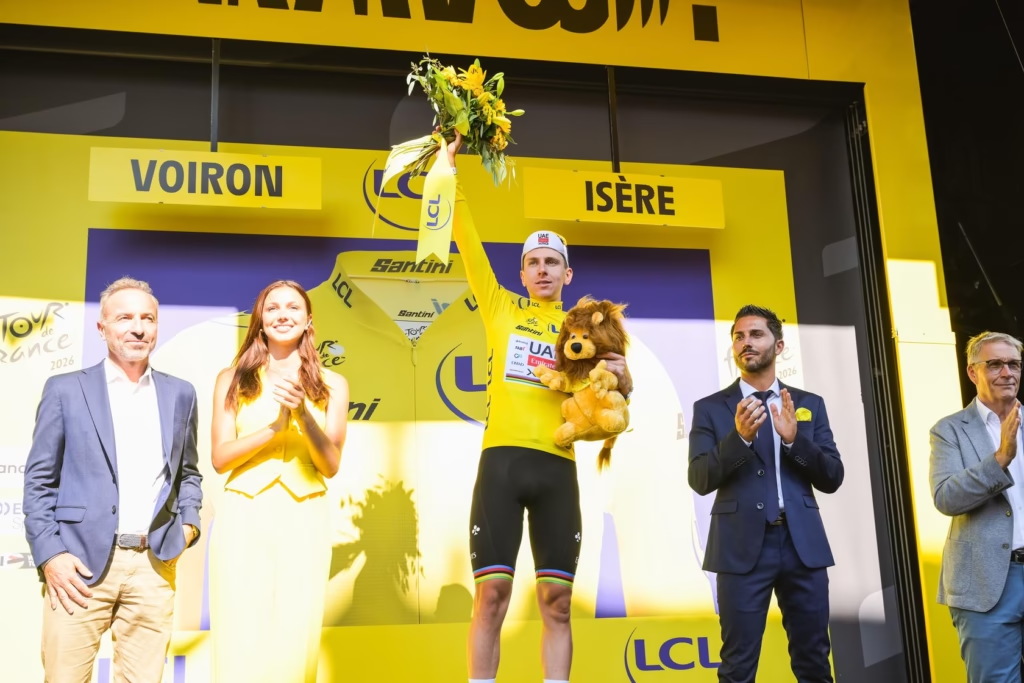
What happens if Pogačar is isolated?
Isolation would look dramatic without necessarily meaning the yellow jersey is in danger.
If Pogačar reaches the lower slopes of Alpe d’Huez without teammates, he can simply remain on Evenepoel’s wheel. Del Toro may be elsewhere following Seixas, while the other UAE riders ride at their own pace behind.
Evenepoel then has to create the difference himself.
Pogačar does not need a teammate to chase the Belgian if he can follow directly. He also has enough overall margin to allow a small gap without panicking.
The situation becomes dangerous only if several conditions occur together:
- Pogačar is isolated before Alpe d’Huez
- Evenepoel has a teammate waiting ahead
- Lidl-Trek or Decathlon continue attacking
- Pogačar shows physical weakness
- Del Toro cannot provide support
- The gap grows beyond what yellow can manage defensively
McNulty’s absence makes that sequence easier to imagine.
Pogačar’s form still makes it difficult to produce.
Can Evenepoel win the Tour by exploiting UAE’s weakness?
McNulty’s withdrawal does not transform Evenepoel’s overall chances.
The Belgian remains 4:32 behind with two mountain stages left. He needs Pogačar to show physical weakness rather than merely lose teammates.
A depleted team can help create the conditions for discovering that weakness.
Red Bull can place riders ahead, encourage attacks from Lidl-Trek and Decathlon, and force Pogačar to respond without a full group around him.
If Pogačar follows every move comfortably, the numerical problem becomes irrelevant.
If he hesitates or begins riding at his own pace, McNulty’s absence becomes significant because UAE have fewer riders capable of limiting the damage.
Stage 19 is therefore less about taking four minutes and more about gathering information.
Evenepoel needs to discover whether Pogačar can be isolated, whether Yates has recovered and whether Del Toro can protect his own podium while helping yellow.
A small crack on the first Alpe d’Huez stage could justify a much larger attack on stage 20.
Is UAE still the strongest team in the race?
Yes, although the gap has narrowed.
UAE still have the yellow jersey, the rider in third overall and several experienced domestiques. No rival team can match the combined climbing strength of Pogačar and Del Toro.
Their problem is distribution.
Politt and Vermeersch are valuable before the main mountains. Großschartner can bridge towards the finale. Yates should provide elite support but has been ill. Del Toro is strong enough to help but has his own podium to protect.
McNulty was the rider who connected those layers.
Without him, the team remains powerful but less adaptable. One badly timed attack, mechanical problem or moment of weakness becomes harder to solve without using a rider intended for a later role.
UAE can still dominate stage 19.
They may instead choose something less spectacular and more effective: allow the breakaway to win, preserve their remaining squad and trust Pogačar to deal with Evenepoel himself.
McNulty’s exit changes the method, not the favourite
Brandon McNulty’s abandonment is a genuine blow to UAE Team Emirates-XRG.
It removes a rider capable of working almost anywhere on the route and places greater responsibility on Großschartner, Yates and Del Toro. The illnesses affecting Yates and Wellens create further uncertainty before the hardest climbing block of the Tour.
Red Bull-Bora-Hansgrohe should test that reduced depth.
Hindley and Van Gils can enter tactical moves, Cattaneo can provide support ahead and Evenepoel can use the attacks of Seixas, Ayuso and Skjelmose to avoid taking responsibility for every acceleration.
The objective is to isolate Pogačar before Alpe d’Huez and force him to make decisions without a complete team around him.
Isolation alone is not enough.
Pogačar still leads by 4:32 and remains the strongest climber in the race. He can allow the stage victory to disappear, follow Evenepoel and conserve energy for the queen stage.
McNulty’s withdrawal makes UAE easier to pressure.
It does not make Pogačar easier to drop.

