
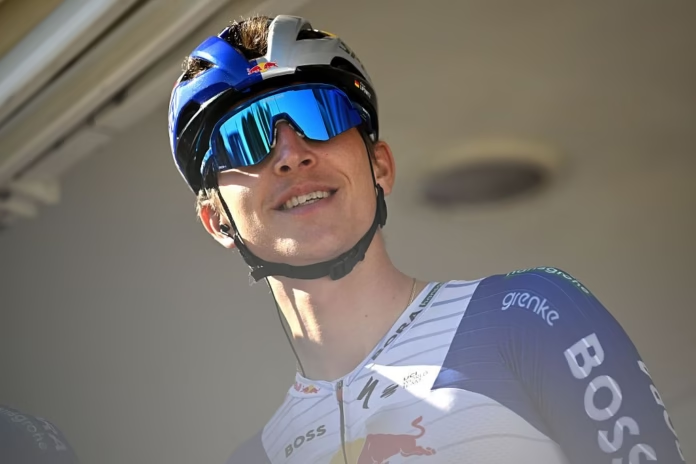
Florian Lipowitz abandoned the 2026 Tour de France after crashing heavily during the Stage 16 individual time trial from Évian-les-Bains to Thonon-les-Bains.
The Red Bull-Bora-Hansgrohe rider lost control on a bend during the descending section of the 26.1km course and landed heavily on his shoulder. Lipowitz was unable to continue and was recorded as a non-finisher, bringing his challenge for the final podium to an abrupt end.
No detailed medical diagnosis had been confirmed immediately after the crash. The force of the impact and Lipowitz’s inability to remount were enough to end his Tour before he reached the finish in Thonon-les-Bains.
His withdrawal has been added to the live list of riders who have abandoned the 2026 Tour de France.
 Photo Credit: Getty
What happened to Florian Lipowitz?
Lipowitz began the time trial fifth overall and only 50 seconds behind Isaac del Toro’s third place. He was therefore riding for considerably more than a respectable stage result.
The German had been expected to gain time in the fight for the podium. He combines strong climbing with greater time trial potential than several of the young riders around him, making the mixed Stage 16 course an important opportunity.
Lipowitz started at 17:07 local time, two minutes behind Juan Ayuso and two minutes ahead of Paul Seixas. The full sequence of riders is available in the Tour de France Stage 16 time trial starting order.
He completed the uphill portion of the course before losing control on a bend during the descent. His bike slid from beneath him and Lipowitz struck the road hard, with the initial impact appearing to centre on his shoulder.
The crash was serious enough that he could not remount and complete the stage. Because every rider must finish each stage to remain in the Tour, his inability to continue resulted in an immediate abandonment.
Why did Lipowitz abandon rather than continue?
Lipowitz did not abandon because of the time he had lost or because his podium challenge had become impossible. He stopped because the impact left him unable to continue safely.
A rider who crashes during an individual time trial is normally permitted to remount, receive a replacement bike and continue. The time lost does not force an abandonment, provided the rider reaches the finish within the stage’s time limit.
That was not possible in Lipowitz’s case. The heavy fall required medical attention and ended his ride before he reached Thonon-les-Bains.
The exact nature of the injury will depend on further examination. Until Red Bull-Bora-Hansgrohe provides a formal medical update, it would be premature to conclude that Lipowitz suffered a fracture, concussion or another specific injury.
The visible force of the crash and his inability to continue nevertheless explain why there was no attempt to restart. Protecting his general classification position immediately became secondary to assessing the extent of his injuries.
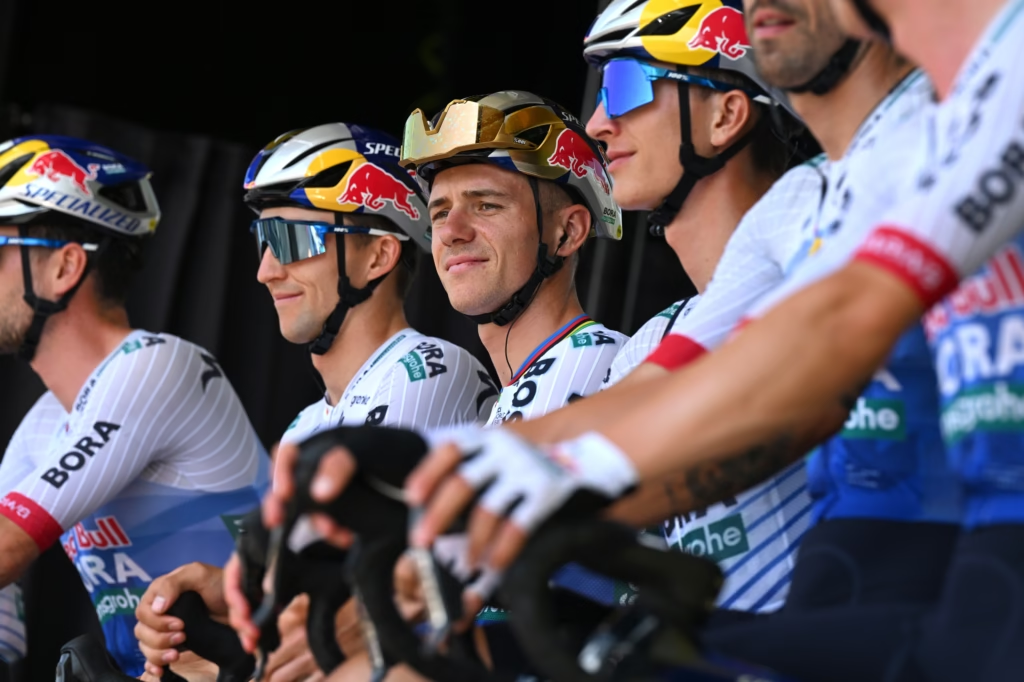 Photo Credit: Getty
Where did the Stage 16 crash happen?
The crash came after the main climbing section of the time trial, during the descent towards the flatter roads leading into Thonon-les-Bains.
Stage 16 began with a long rise away from Évian-les-Bains, including the Côte de Larringes, before sending riders onto a fast and more technical descent. The final section then became flatter as the course approached Lake Geneva and the finish.
The mixed nature of the route was one reason Lipowitz had been identified as a major threat in the Stage 16 time trial contenders guide. The climb rewarded strong general classification riders, while the descent and flatter finish placed greater emphasis on handling, aerodynamics and sustained power.
There was no contact with another competitor because riders were racing individually. No mechanical problem had been confirmed immediately after the incident.
Lipowitz appeared to lose grip while leaning through the bend. Small differences in braking, line choice, tyre loading or road surface can be decisive when riders are descending at racing speed on a time trial bike.
Why can time trial descents be dangerous?
Individual time trials can appear safer than normal road stages because riders are separated and do not have to compete for space inside a peloton.
The absence of other riders removes one source of danger, but it creates a different set of risks. Every competitor is attempting to complete the course as quickly as possible, with no opportunity to sit in a group or recover behind another rider.
Time trial bikes are designed primarily for aerodynamic efficiency. Their narrow extension bars allow riders to reduce drag, but offer less immediate control than the brake hoods or drops on a conventional road bike.
Riders move onto the base bars for technical corners and descents, but the bike still has different handling characteristics. The riding position distributes weight differently, deep-section or disc wheels can react more strongly to wind, and the equipment is generally less forgiving during sudden changes of direction.
The basic rules, equipment and pacing demands are explained in our guide to how a cycling time trial works.
The pressure was also greater for Lipowitz because he knew Stage 16 represented his clearest opportunity to move onto the podium. He could not afford to concede unnecessary seconds by descending too cautiously.
A rider may gain only a fraction of a second through one corner, but those fractions accumulate across a time trial. That encourages competitors to brake late, select the fastest possible line and accelerate immediately after the apex.
The consequences of exceeding the available grip are severe. There is no group speed to follow and no warning from riders immediately ahead. Each competitor must judge every corner independently while fatigued and operating close to maximum effort.
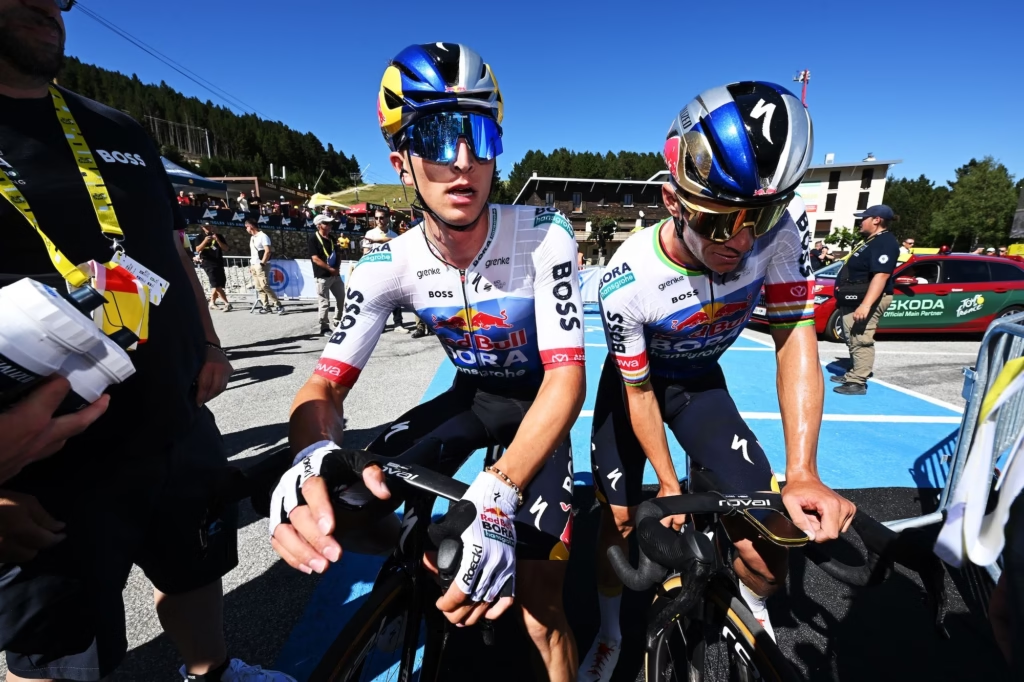
Lipowitz was riding towards the Tour podium
The timing of the crash made it particularly damaging for Lipowitz and Red Bull-Bora-Hansgrohe.
Lipowitz began Stage 16 fifth overall, 6:48 behind Tadej Pogačar but only 50 seconds behind Del Toro in third. Paul Seixas was 25 seconds ahead of him, while Ayuso started 37 seconds behind.
Those margins had made Lipowitz one of the most important riders in the time trial. He had a realistic opportunity to pass Seixas and potentially Del Toro, particularly on a course containing climbing, descending and a fast final section.
The close nature of that battle had been established in the general classification after Stage 15, when only 1:27 separated Del Toro, Seixas, Lipowitz and Ayuso.
Lipowitz appeared to have the greatest potential to move forward against the clock. A strong performance could have placed Red Bull-Bora-Hansgrohe second and third overall, with Remco Evenepoel already holding the provisional runner-up position behind Pogačar.
Instead, Lipowitz’s Tour ended before any comparison could be made at the finish.
What does the crash mean for Red Bull-Bora-Hansgrohe?
Red Bull-Bora-Hansgrohe entered Stage 16 with two riders capable of finishing on the final podium.
Evenepoel was focused on winning the time trial and consolidating second overall. Lipowitz offered the team a second general classification option, particularly if the race became tactical during the remaining Alpine stages.
The team now becomes far more dependent on Evenepoel.
That does not fundamentally alter its immediate ambition of defending second place. Evenepoel remains one of the strongest riders in the race and began the stage as the leading favourite for victory, as outlined in the full Tour de France Stage 16 preview.
It does remove considerable tactical flexibility in the mountains. Lipowitz could have followed attacks from Seixas, Del Toro or Ayuso without forcing Evenepoel to respond personally. He could also have attacked to place pressure on UAE Team Emirates-XRG and Decathlon CMA CGM.
Without him, Red Bull-Bora-Hansgrohe’s surviving riders will be used more conventionally around one clear leader. Jai Hindley, Mattia Cattaneo, Maxim Van Gils and the rest of the team must now concentrate on positioning, pacing and protecting Evenepoel.
The emotional impact should not be overlooked. Lipowitz was not a domestique whose main work had already been completed. He was racing for the podium and remained central to the team’s strategy for the final week.
How does Lipowitz’s abandonment change the podium fight?
Lipowitz’s withdrawal removes one of the four riders who began Stage 16 with a realistic chance of finishing third.
| Position before Stage 16 | Rider | Gap to third |
|---|---|---|
| 3 | Isaac del Toro | Leader |
| 4 | Paul Seixas | +25 seconds |
| 5 | Florian Lipowitz | +50 seconds |
| 6 | Juan Ayuso | +1:27 |
Lipowitz had appeared to possess the greatest time trial upside among the riders immediately behind Del Toro. His abandonment leaves Del Toro and Seixas as the central figures in the fight for third, while Ayuso, Mattias Skjelmose, Tom Pidcock and the riders below all gain one place in the virtual standings.
The consequences extend beyond simply removing the rider who had been fifth. Lipowitz would have been one of the most difficult podium contenders to drop in the Alps and one of the few capable of applying pressure both uphill and against the clock.
Del Toro and Seixas no longer need to monitor him during the remaining mountain stages. Ayuso also gains a clearer route back towards the podium, although his own time trial performance will determine whether that opportunity remains realistic.
For UAE Team Emirates-XRG, the crash makes defending Del Toro’s position slightly easier. The team can focus more directly on Seixas and Ayuso while continuing to protect Pogačar’s yellow jersey.
Does Lipowitz’s crash affect the white jersey?
Lipowitz’s abandonment does not directly remove a rider from the white jersey competition because he was no longer eligible for the young rider classification.
That battle remains centred on Del Toro, Seixas and Ayuso.
However, the crash changes the relationship between the white jersey and the overall podium. Del Toro and Seixas were not only the leading young riders but also third and fourth overall before Stage 16.
With Lipowitz out, the winner of their white jersey contest is now even more likely to occupy the final place on the Tour podium.
Time gained between Del Toro and Seixas during the remaining mountain stages could therefore decide both the youth classification and third place in Paris. Ayuso remains part of the same contest, but entered Stage 16 needing a strong performance to reverse the time lost at Plateau de Solaison.

A second major GC crash in consecutive stages
Lipowitz’s withdrawal continued a damaging sequence for the Tour’s leading riders.
Jonas Vingegaard had already abandoned after crashing during the approach to Plateau de Solaison on Stage 15. The details of that incident are covered in our explanation of why Jonas Vingegaard abandoned the Tour de France.
Vingegaard had started Stage 15 second overall. Lipowitz then left the race during the next competitive stage after the rest day while sitting fifth and within 50 seconds of the podium.
Two riders capable of finishing inside the top three have therefore disappeared from the race through crashes rather than being conclusively dropped in the mountains.
That has strengthened Pogačar’s control of yellow and reduced the number of tactical options available to teams attempting to challenge UAE Team Emirates-XRG.
Evenepoel remains firmly established in second, while the fight for third has become increasingly open.
What happens next for Florian Lipowitz?
Lipowitz’s immediate priority will be a complete medical assessment.
The impact appeared to centre on his shoulder, while any possible head impact will also require appropriate checks. Race doctors and the team will determine whether he needs hospital examination, scans or a longer period away from training.
Red Bull-Bora-Hansgrohe had not immediately confirmed a diagnosis or recovery timetable.
That means the only certain conclusion is that Lipowitz’s 2026 Tour de France is over. The seriousness of the injury and its effect on the remainder of his season will become clearer once the team releases its medical findings.
For now, the crash represents a sudden and deeply unfortunate end to one of the strongest podium challenges in the race.
Lipowitz started Stage 16 with a genuine chance to move into third place. He left it without reaching the finish, while Red Bull-Bora-Hansgrohe lost one of the two leaders around whom its Tour had been built.

