

Jonas Vingegaard abandoned the 2026 Tour de France after crashing with approximately 20km remaining on Stage 15 to Plateau de Solaison.
The Visma-Lease a Bike leader fell as the peloton negotiated a tight turn after exiting a roundabout in Bonneville. Vingegaard clipped the kerb and hit the ground heavily during a fast and increasingly tense approach to the final climb.
He was unable to continue and was placed into an ambulance with his right arm supported in a sling. His withdrawal was confirmed shortly afterwards, ending his Tour while he sat second in the general classification behind Tadej Pogačar.
The immediate images suggested an injury to Vingegaard’s right arm or shoulder, but no precise diagnosis had been confirmed by his team in the immediate aftermath of the stage.
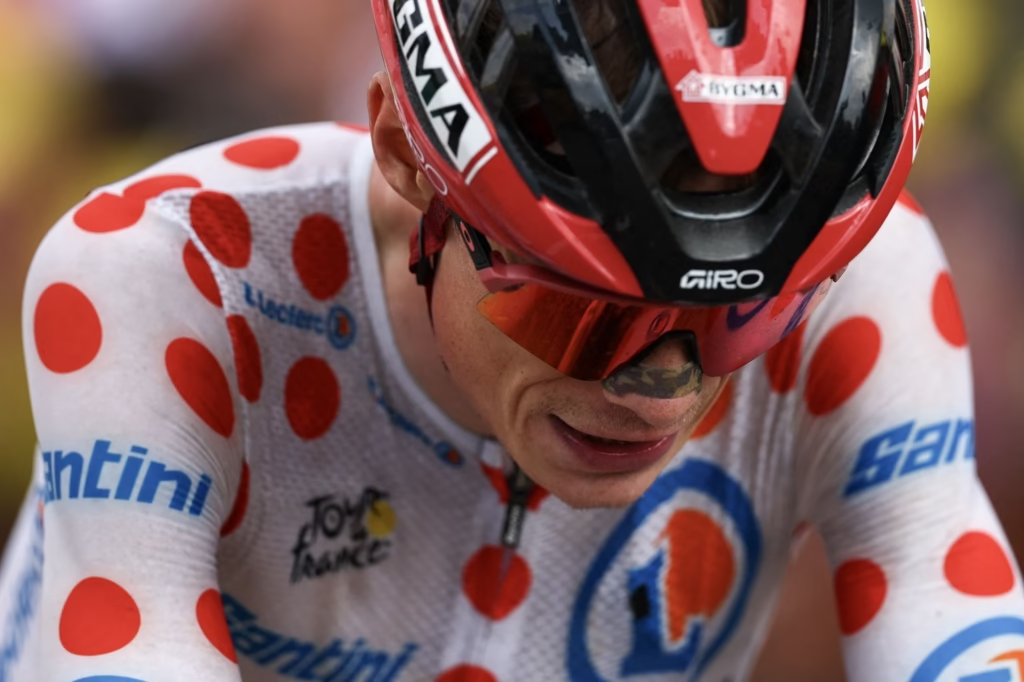 Photo Credit: Getty
What happened to Jonas Vingegaard on Stage 15?
Vingegaard crashed during the closing kilometres of the 183.9km mountain stage from Champagnole to Plateau de Solaison.
The incident happened in Bonneville with around 20km left to race, before the peloton reached the final hors catégorie climb.
The group was moving quickly through a technical section as teams attempted to position their leaders for the approach to Solaison. Vingegaard lost control on a tight corner after a roundabout and clipped the edge of the road.
Several riders were caught in the incident.
Vingegaard’s teammate Sepp Kuss went down, while UAE Team Emirates-XRG riders Isaac del Toro and Brandon McNulty were also involved. Del Toro was able to remount, regain contact with the leading group and eventually finish third on the stage.
Vingegaard remained on the ground and could not continue.
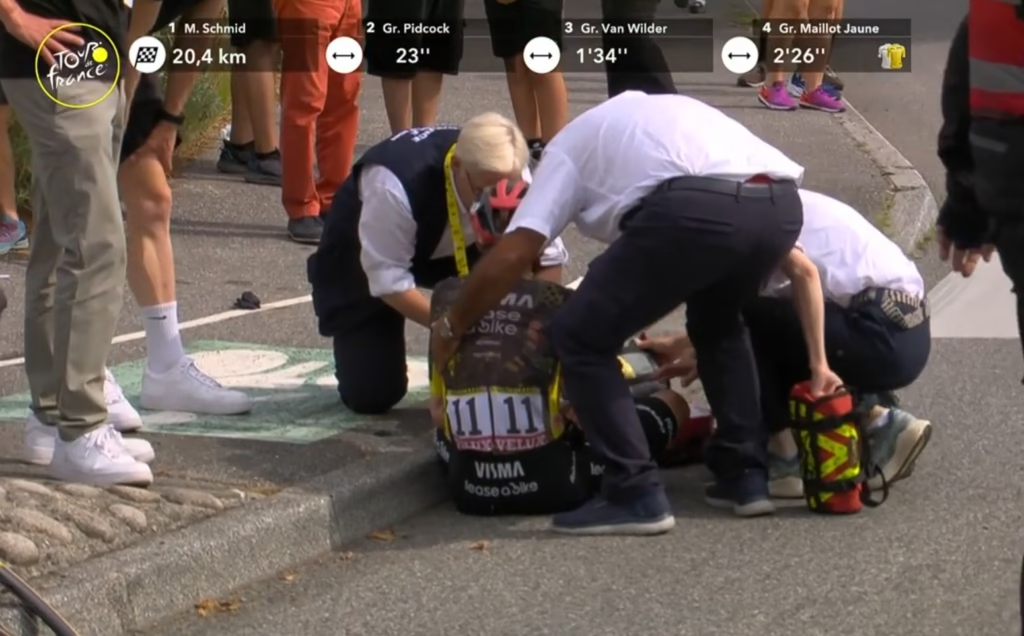
Medical staff attended to him before he was taken away in an ambulance. His right arm was visibly supported in a sling as he left the race.
The crash and the remainder of the stage are covered in our full report on Remco Evenepoel’s victory at Plateau de Solaison.
Why did Vingegaard abandon the Tour de France?
Vingegaard abandoned because the injuries sustained in the crash prevented him from continuing.
This was not a tactical withdrawal or a decision made because of his position in the general classification. He had started Stage 15 in second place overall and remained Pogačar’s closest challenger.
The crash happened too late in the stage for Vingegaard to receive treatment, change equipment and attempt to ride to the finish. The immediate concern was his health rather than any possible time loss.
Once he entered the ambulance, his Tour was over.
Under cycling’s rules, a rider who does not complete a stage cannot start again the following day. There is no provision allowing an injured rider to miss one stage and then rejoin the race.
Did Jonas Vingegaard crash?
Yes. Vingegaard crashed on a tight corner in Bonneville with approximately 20km remaining on Stage 15.
The incident occurred after the peloton exited a roundabout during the approach to Plateau de Solaison.
Reports from the stage indicated that he clipped a kerb before falling. The crash also brought down or delayed several riders around him.
It was immediately clear that Vingegaard had suffered more than a minor fall. He remained on the road while medical staff assessed him and was later taken away with his right arm immobilised.
Is Jonas Vingegaard out of the Tour de France?
Yes. Vingegaard has abandoned the 2026 Tour de France and will not take part in the final week.
Stage 15 was the final race day before the second rest day. Vingegaard had been expected to use the pause to prepare for the individual time trial between Évian-les-Bains and Thonon-les-Bains.
Instead, Visma-Lease a Bike must now continue without its overall leader.
The changed shape of the race is explored in our Tour de France 2026 Stage 16 preview, with Remco Evenepoel now beginning the final week as Pogačar’s nearest challenger.
Visma may provide a more detailed medical update after Vingegaard has undergone examinations. Until then, the exact nature and severity of his injuries should not be assumed from the television images alone.
What injuries did Jonas Vingegaard suffer?
The immediate information from the race indicated a suspected injury to Vingegaard’s right arm or shoulder.
His arm was placed in a sling before he entered the ambulance, but that does not by itself confirm a fracture or dislocation. A sling can be used to protect several different injuries while a rider is transferred for further assessment.
Visma-Lease a Bike had not initially confirmed a precise diagnosis.
That means reports of a broken collarbone or another specific fracture should be treated as unconfirmed until the team releases the findings of medical scans.
The only established facts immediately after the stage were that Vingegaard had crashed heavily, could not continue and required transportation away from the race.
Where did Vingegaard crash?
The crash occurred in Bonneville, a town in Haute-Savoie at the foot of the final climb to Plateau de Solaison.
The riders had already completed the steep Col de la Croisette and were travelling through the valley towards the final ascent.
Although this part of the stage was not categorised as a climb, it remained tactically important. Teams were fighting to place their leaders near the front before the narrow and steep road to Solaison.
That battle for position increased the speed and tension through the roundabouts and corners in Bonneville.
Vingegaard’s crash happened during that approach rather than on one of the major climbs or descents.
The stage’s closing terrain and the difficulty of the final ascent are explained in our guide to what makes Plateau de Solaison such a brutal Tour de France summit finish.
Was anyone else involved in the crash?
Several riders were affected.
Sepp Kuss fell alongside his Visma leader, while Del Toro and McNulty were caught for UAE Team Emirates-XRG.
The consequences were very different.
Del Toro returned to the front of the race and remained with Pogačar and Evenepoel on the final climb. He finished third at Plateau de Solaison despite the disruption.
Kuss was delayed and Visma’s planned attack on the final climb was effectively ended before it could begin.
Vingegaard was the only leading general classification rider forced to abandon because of the incident.
What did the crash mean for Stage 15?
Vingegaard’s withdrawal completely changed the expected final climb.
Visma-Lease a Bike had spent much of the Tour searching for a way to place Pogačar under sustained pressure. Plateau de Solaison, with its 11.3km ascent averaging around 9%, appeared to offer one of Vingegaard’s best remaining opportunities.
The Dane had previously won on Solaison at the 2022 Critérium du Dauphiné and understood the demands of the climb.
He never reached it in the race.
Without Vingegaard, the final ascent became a contest between Pogačar, Evenepoel and Del Toro. Evenepoel eventually beat the yellow jersey in the uphill finish to claim his first road stage victory of the race.
The result was significant for Evenepoel, but the lasting story of the day was Vingegaard’s departure.
What does Vingegaard’s crash mean for the general classification?
Vingegaard’s abandonment removes the rider who began Stage 15 second overall and closest to Pogačar.
Evenepoel moved into second place, with the battle behind him now involving Del Toro, Paul Seixas, Juan Ayuso and Florian Lipowitz. The Stage 16 individual time trial is likely to create further changes.
Pogačar’s position has become considerably stronger.
The Slovenian already held a lead of 4:30 over Vingegaard before Stage 15, but the Dane remained the only rider with a recent record of consistently challenging and beating him across a three-week Tour.
Evenepoel is one of the best time trial riders in the world and now has a major opportunity to consolidate second place. However, he must still overcome a substantial deficit and survive the final Alpine stages.
The central question of whether Vingegaard could find a way back into the yellow jersey contest has disappeared.
The wider standings can change quickly after a withdrawal, as Vingegaard is removed from the classification and every rider below him moves up one position. Our guide to how the Tour de France general classification works explains how the overall standings are calculated.
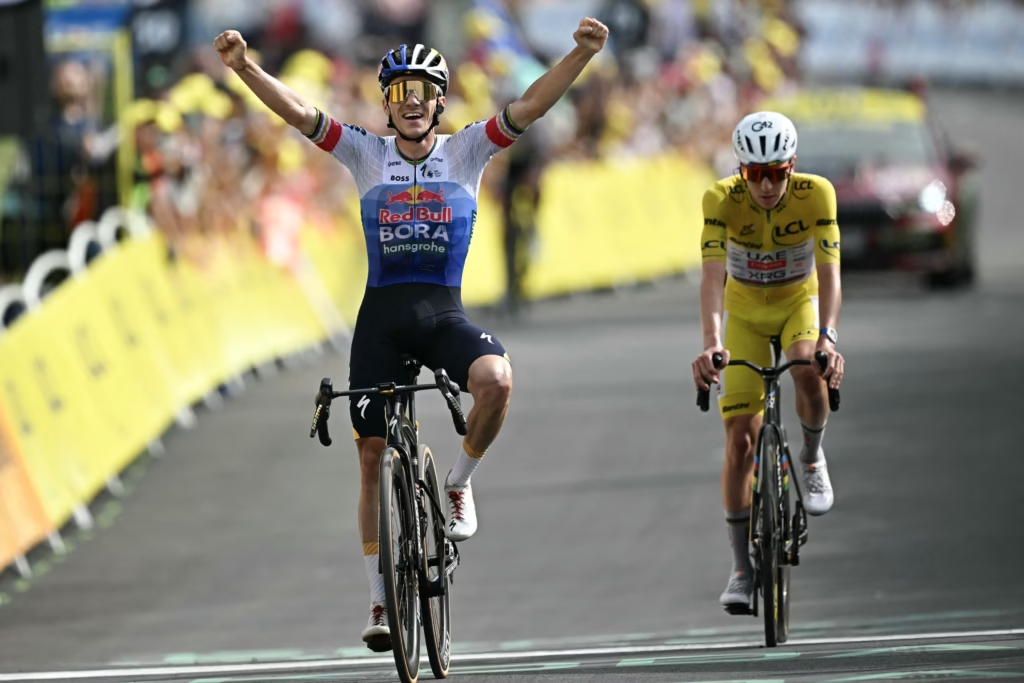 Photo Credit: Getty
Does this mean Pogačar has won the Tour?
Pogačar has not mathematically won the Tour de France.
Six stages remain, including the Stage 16 time trial and a demanding Alpine conclusion containing Orcières-Merlette and two finishes at Alpe d’Huez.
Crashes, illness and unexpected bad days remain possible.
However, his route towards overall victory has become much clearer.
Pogačar no longer needs to monitor Vingegaard’s attacks or the wider tactical strength of Visma-Lease a Bike. He can concentrate on controlling Evenepoel and the remaining podium contenders while avoiding unnecessary risks.
Vingegaard’s withdrawal does not guarantee yellow in Paris, but it removes the most credible long-term threat to Pogačar’s lead.
The remaining difficulties can be seen in the Tour de France 2026 full route guide, with the race still facing its most concentrated Alpine block.
How does the crash change Visma-Lease a Bike’s Tour?
Visma-Lease a Bike entered the Tour with one overriding objective: helping Vingegaard challenge Pogačar for the yellow jersey.
That project ended in Bonneville.
The team must now reassess its priorities during the second rest day. Stage victories, breakaways and the mountains classification could replace the general classification as its main targets.
Matteo Jorgenson and Sepp Kuss may receive greater freedom in the mountains, provided Kuss has recovered from the same crash. Other riders can target breakaways rather than remaining around an absent leader.
The emotional effect may be just as important as the tactical one.
Visma had spent months building its team and strategy around Vingegaard. Losing him immediately before the final week means abandoning a plan that influenced every selection and decision made during the race.
The team remains strong enough to affect stages, but its Tour now has a completely different purpose.
Vingegaard’s original path to victory, including the need to make the final Alpine block as difficult as possible, was set out in our pre-race analysis of whether Jonas Vingegaard could win the 2026 Tour de France.
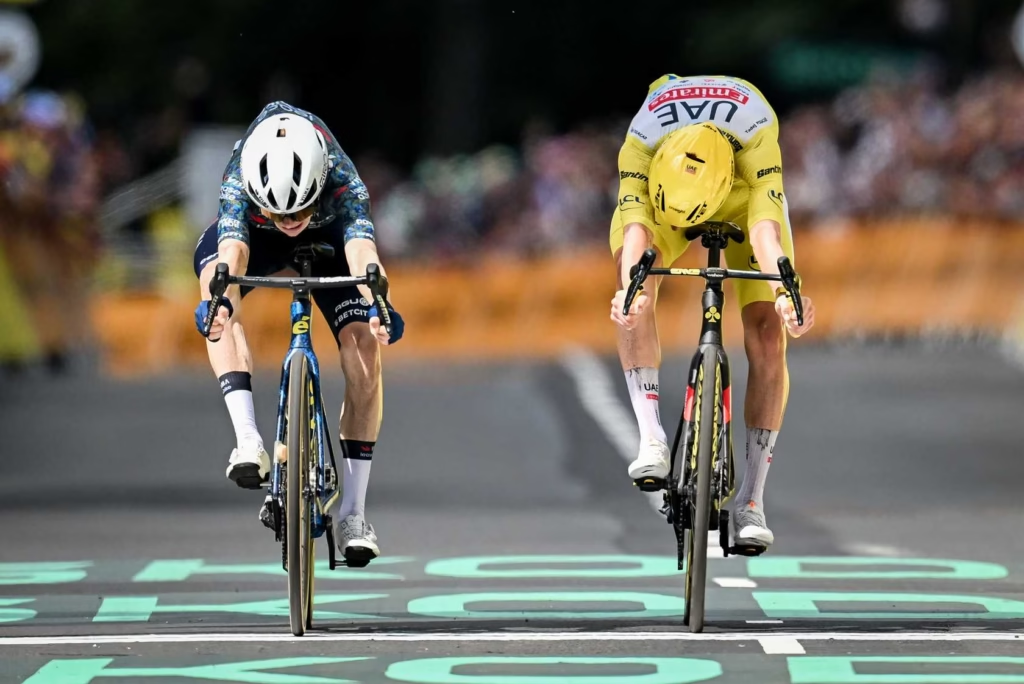
The Pogačar-Vingegaard rivalry ends before the final week
Vingegaard’s withdrawal removes the central rivalry of the modern Tour from the final six stages.
Pogačar and Vingegaard had finished first and second in four consecutive editions between 2021 and 2024, with each rider winning the Tour twice during that sequence.
Their contrasting strengths shaped the race.
Pogačar offered explosive acceleration, tactical aggression and an ability to win across almost every type of terrain. Vingegaard’s greatest weapon was sustained climbing strength, particularly on long mountains where Visma could make the race progressively harder.
The 2026 Tour had followed the same pattern.
Pogačar repeatedly created gaps, while Vingegaard continued searching for terrain and circumstances that might reverse the contest. Even after falling 4:30 behind at Le Markstein, he remained the rider most likely to force the yellow jersey into a genuinely defensive race.
The significance of that rivalry had been clear earlier in the Tour, including during the return to Le Lioran and the question of whether Vingegaard could recreate his previous success against Pogačar. That history is examined in our feature on why Le Lioran mattered again in the Pogačar-Vingegaard rivalry.
Plateau de Solaison was supposed to be another chapter in that battle.
Instead, the rivalry ended on the approach to the final climb.
Was this Vingegaard’s first Tour abandonment?
The Stage 15 crash brought an unusually abrupt end to Vingegaard’s Tour record.
He had completed each of his previous appearances and had established himself as one of the most consistent Grand Tour riders of his generation.
Since emerging as Pogačar’s main rival, Vingegaard had become almost inseparable from the fight for yellow. Even when he did not win, he remained central to how the Tour was raced.
That makes the 2026 withdrawal particularly significant.
Vingegaard was not eliminated by a mountain weakness or a decisive attack from Pogačar. His challenge ended because of a crash during a positioning battle before one of the stages he had targeted.
-
 Photo Credit: David Magalhães / Unsplash


What happens next for Jonas Vingegaard?
The immediate priority is establishing the extent of his injuries.
Medical examinations should determine whether Vingegaard has suffered a fracture, dislocation or soft-tissue injury and how long his recovery may take.
Any discussion of his return to racing must wait for that diagnosis.
The Vuelta a España may ordinarily have provided a later-season objective, but his participation will depend entirely on the seriousness of the injury and the recovery time required.
Visma-Lease a Bike is likely to provide further information once those examinations have been completed.
Until then, the cleanest summary is also the most important one: Vingegaard crashed heavily on Stage 15, could not continue and is out of the 2026 Tour de France.
Why did Jonas Vingegaard abandon the Tour de France?
Jonas Vingegaard abandoned the 2026 Tour de France because he was injured in a crash with approximately 20km remaining on Stage 15.
He clipped a kerb after the peloton exited a roundabout in Bonneville and fell during the approach to Plateau de Solaison.
Vingegaard received treatment at the roadside before being taken away in an ambulance with his right arm supported in a sling. No precise injury diagnosis was immediately confirmed.
His withdrawal promotes Remco Evenepoel into second place overall, leaves Tadej Pogačar in a much stronger position and removes the defining Pogačar-Vingegaard rivalry from the final week of the Tour.

