
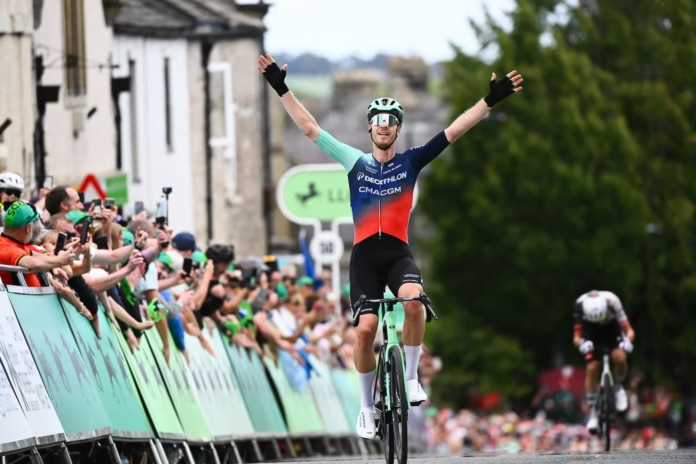
Cees Bol won stage 4 of the 2026 Lloyds Tour of Britain Men in Leyburn, turning the hardest day of the race into a surprise victory for Decathlon CMA CGM.
The Dutch rider was supposed to be part of the sprint structure around Olav Kooij this week, but after Kooij had already won stage 3 in Beverley, Decathlon found another way to win on a day that looked far too hard for the pure fast men.
Stage 4 had been billed as the decisive general classification stage, with 165.8 kilometres from Helmsley to Leyburn and 2,699 metres of climbing through North Yorkshire. The route brought Greenhow Bank, Kidstones, Greets Moss and Grinton Moor, making it the most sustained climbing test of the race and the day where Lewis Askey’s lead looked most vulnerable.
Instead, Bol survived. On a stage expected to belong to the puncheurs and GC contenders, he made it through the repeated climbs and finished the job in Leyburn, giving Decathlon CMA CGM back-to-back stage wins after Kooij’s success the previous day.
The hardest stage of the race
The Tour of Britain had reached its defining terrain.
After Askey’s Michaelgate win on stage 1, then two sprint finishes in Skegness and Beverley, stage 4 was the point where the overall contenders had to act. The route from Helmsley to Leyburn was not a summit finish, but it contained the most important climbing of the week.
That was the whole tension of the stage. The climbs were hard enough to make the race selective, but the finish was not at the top of one of them. Riders who wanted to take the race lead had to decide whether to attack early and risk being brought back, or wait and risk arriving with too many fast riders still attached.
In the stage 4 preview, the day looked made for Tim Wellens and UAE Team Emirates-XRG to test Askey properly. Wellens had started the stage 12 seconds behind the British race leader, with Matteo Trentin, Daan Hoole, Jasper Stuyven and Florian Vermeersch also close enough to keep the general classification tense.
The expectation was a GC fight. Bol’s victory was a reminder that this route could also reward survival and timing.
Decathlon bring more than Kooij
Decathlon CMA CGM had already had a successful race before stage 4 began.
Kooij had turned the sprint battle around in Beverley by beating Tim Merlier one day after Merlier had won in Skegness. That gave Decathlon the momentum in the fast finishes and confirmed the strength of a sprint unit built around the Dutchman.
Bol’s role in that structure has usually been clear. He is a big, experienced lead-out rider, signed to help position Kooij and keep him safe in the final kilometres. On a flat stage, that job is about protection, timing and delivery.
Stage 4 changed the equation. Kooij was unlikely to survive the deepest selection if the GC teams made the Yorkshire Dales as hard as expected. Bol, though, had a different profile. He is still quick, but he has enough strength to handle harder terrain when the race is ridden at the right rhythm.
That made him useful in more than one way. If Kooij was removed, Decathlon still had a rider who could finish from a reduced group. On a day where the climbers could not create the decisive separation they wanted, that became the race-winning detail.
The breakaway gives the stage its first shape
A day like this was always going to attract attackers.
The early breakaway had more hope than on the flat sprint stages. On stage 2 and stage 3, the fast teams could keep the race under control because the finish suited Merlier, Kooij, Ethan Vernon, Sam Bennett and Matteo Moschetti. In the Yorkshire Dales, the chase was less straightforward. Too much work early could leave a team exposed when the climbs began.
That gave the escape room to shape the first half of the stage, but the general classification kept the race under tension behind. Askey’s NSN Cycling Team did not have the luxury of treating the day as a simple breakaway stage. UAE Team Emirates-XRG, Tudor Pro Cycling Team, Soudal Quick-Step, Decathlon CMA CGM and Netcompany Ineos Cycling Team all had riders close enough overall to make the chase politically complicated.
Nobody wanted to do too much work for someone else. Nobody could afford to ignore the race completely.
That made the stage more subtle than a full mountain ambush. The breakaway could go, but the bigger story was always how the bunch would approach the decisive climbs.
Greenhow Bank starts the real test
Greenhow Bank was the first major point where the race had to become serious.
At 4 kilometres and around 7 per cent, it was the kind of climb that can change a British stage race quickly. It is long enough to make heavier riders uncomfortable and steep enough to encourage attacks, but not so long that a single move necessarily decides the stage.
That was the issue for the GC contenders. Attacking there would make the race hard, but it would also leave a long way to Leyburn. Waiting, though, risked allowing riders like Bol to keep believing.
As the peloton worked through the climb and the roads beyond, the selection began to develop by accumulation. This was never about one Alpine-style threshold effort. It was about repeated climbs, narrow roads, changes of rhythm and the constant cost of staying near the front.
Bol’s win was built in those kilometres. He did not need to attack with the climbers. He needed to avoid being dropped by them.
Kidstones and Greets Moss keep the pressure on
The middle section of the stage through the Yorkshire Dales carried the real weight of the day.
Kidstones and Greets Moss gave the strongest teams more terrain to use, while the roads between the climbs offered little chance for easy recovery. This was the part of the stage where UAE Team Emirates-XRG, Soudal Quick-Step and Tudor Pro Cycling Team needed to make the race difficult enough to remove the fast finishers.
The problem was that difficulty alone is not the same as separation.
In a five-day race without a time-trial or a summit finish, every GC rider knows bonus seconds and small gaps matter. But that can also make teams hesitate. If a move goes too early and brings a rival with it, the work can end up benefiting someone else. If the strongest teams mark each other too closely, riders with a faster finish can stay alive.
That was the trap. Bol did not have to dominate the climbs. He only had to stay within reach as the favourites watched each other.
The deeper the race went without a decisive GC split, the more dangerous he became.
Askey survives the day he had to fear
For Askey, stage 4 was always the biggest examination of his race lead.
The British rider had taken control of the Tour of Britain with a brilliant attack on Michaelgate, but defending across the Yorkshire Dales was a different test. NSN Cycling Team had to manage a stage where almost every rival had a reason to attack, and where the terrain offered repeated opportunities to put Askey under pressure.
The fact that the race did not explode completely was important for him. He did not need to win the stage. He did not need to chase every move personally. He needed to avoid the kind of collapse that would turn a 12-second advantage over Wellens into a deficit.
That is often the hidden work of a leader on a day like this. The stage winner takes the headline, but the race leader’s day is about positioning, composure and avoiding the wrong split at the wrong moment.
Askey came into Leyburn still central to the overall fight. The stage had been hard, but not destructive enough to remove him from the race picture.
UAE struggle to turn strength into the stage
UAE Team Emirates-XRG looked like the team with the clearest incentive to break the race.
Wellens had been close since stage 1, Vermeersch had already animated the race in Lincoln, and the team had enough depth to make the Dales difficult. The route looked like it had been drawn for repeated UAE pressure: one rider attacking, another marking, Wellens waiting for the final selection.
The difficulty was turning that pressure into a clean result. Without a summit finish, every acceleration needed follow-up. A gap on one climb could disappear on the valley road. A split on Greets Moss could be neutralised before Leyburn. A hard pace could hurt the peloton without removing all the riders UAE needed to drop.
That is where the day slipped away from the GC teams. The climbs selected the race, but they did not deliver the decisive finish the favourites needed.
Bol was still there. Once that happened, the stage had changed.
Bol turns survival into a winning position
Bol’s victory was not a normal sprinter’s win.
He did not arrive at the end of a controlled flat stage with a full train in front of him. He won after the hardest day of the race, after the climbs that were supposed to decide the general classification, and after a route that should have placed him under pressure long before the finish.
That made the result stand out. Bol has spent much of the year positioned as a support rider within Decathlon’s sprint project, but Leyburn gave him the chance to become the finisher himself. On a day where Kooij was always likely to find the climbing too selective, Bol became Decathlon’s late option.
He still needed the race to fall the right way. The strongest climbers had to fail to create a decisive gap. The reduced group had to arrive with enough riders still together. Bol had to survive the climbs without spending everything.
He did all of that, then used the finish that made him dangerous in the first place.
A missed chance for the GC rivals
Stage 4 may feel like a missed opportunity for the riders trying to dislodge Askey.
The stage was the obvious place to create time gaps. Stage 5 in the Scottish Borders is still awkward and hilly, but the Leyburn stage was the clearest chance to make the race genuinely selective. If the general classification remains tight going into the final day, the teams who wanted a harder stage 4 may look back at this as a moment that got away.
That does not mean nothing happened. The race was hard, the field was reduced, and the fatigue will carry into Scotland. But if the aim was to blow the race apart, the result tells its own story. A Decathlon sprinter won in Leyburn, not a lone GC attacker.
That matters. In a race with no time-trial and no summit finish, opportunities to create gaps are limited. The longer the best riders stay grouped, the more important bonus seconds, positioning and final-kilometre sharpness become.
Bol’s win was excellent for Decathlon. For the GC rivals, it was a warning that hard terrain alone does not guarantee meaningful separation.
-
 Photo Credit: Getty
Decathlon’s race keeps getting better
Decathlon CMA CGM have quietly turned this Tour of Britain into their race.
Kooij won in Beverley after being beaten by Merlier the previous day. Bol then won the hardest stage of the week in Leyburn. That is a very different kind of double. One came from the expected sprint leader, the other from the rider normally tasked with helping that sprint leader.
It speaks to the depth of Decathlon’s squad. Daan Hoole had already been prominent near the top of the overall standings after stage 1, Kooij delivered the sprint win on stage 3, and Bol then gave the team a victory from a stage that did not obviously suit the pure sprint structure.
That is exactly why the team’s recruitment around Kooij mattered. Bol is not simply a lead-out rider who disappears when his sprinter is gone. He can survive hard racing and still finish quickly.
In Leyburn, that made him the perfect plan B. By the line, he had become plan A.
The Tour of Britain heads to Scotland still alive
The final stage now carries more weight than it might have done if the Yorkshire Dales had fully settled the race.
Stage 4 was hard enough to test everyone, but not conclusive enough to close the overall battle. The race now heads to Earlston with fatigue in the legs, bonus seconds still important and several teams knowing they may need to attack earlier than they would like.
That keeps the Tour of Britain open. Askey has already shown he can win on sharp British climbs. Wellens and UAE Team Emirates-XRG still have the strength to force a race. Soudal Quick-Step, Tudor Pro Cycling Team and Decathlon CMA CGM all have riders capable of making the final day awkward.
Bol’s win also changes the emotional tone of the race. After three stages shaped by Askey, Merlier and Kooij, the hardest stage produced the most unexpected winner. It was not the clean GC showdown many anticipated. It was a day where the race refused to break quite enough, and where a rider known for helping others took the chance for himself.
Stage 4 was supposed to decide the Tour of Britain. Instead, Cees Bol won the day and kept the wider race alive.
Lloyds Tour of Britain Men 2026 stage 4 result
| Position | Rider | Team | Time/gap |
|---|---|---|---|
| 1 | Cees Bol | Decathlon CMA CGM | 4:00:39 |
| 2 | Tim Wellens | UAE Team Emirates-XRG | +0:03 |
| 3 | Fabio Christen | Pinarello-Q36.5 Pro Cycling Team | +0:21 |
| 4 | Filippo Ganna | Netcompany INEOS | +0:30 |
| 5 | Lewis Askey | NSN Cycling Team | +0:30 |
| 6 | Rick Pluimers | Tudor Pro Cycling Team | +0:30 |
| 7 | Axel Källberg | Lucky Sport Cycling Team | +0:30 |
| 8 | Matteo Trentin | Tudor Pro Cycling Team | +0:30 |
| 9 | Elliot Rowe | Great Britain | +0:30 |
| 10 | Jasper Stuyven | Soudal Quick-Step | +0:30 |
Main photo credit: Getty

