
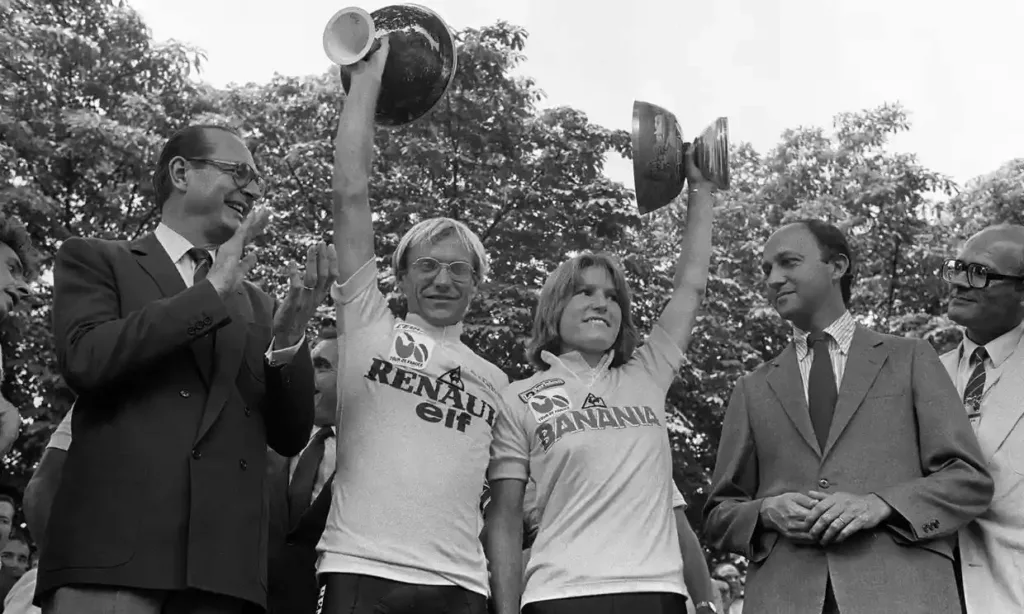
Marianne Martin’s place in cycling history is both enormous and strangely easy to overlook. In July 1984, the 26-year-old American arrived in France having only narrowly secured a place on the United States team, after spending the first part of the year struggling with severe anaemia. Three weeks later she stood on the Champs-Élysées in the yellow jersey alongside Laurent Fignon.
There is an important distinction to make when describing what Martin achieved. She was not the first woman ever to win a women’s Tour de France-style race. That honour belongs to Britain’s Millie Robinson, winner of the pioneering five-stage event held in Normandy in 1955. Martin instead became the first winner of the Tour de France Féminin launched by the Société du Tour de France in 1984, the first women’s race officially integrated into the Tour organisation. ProCyclingUK’s complete history of the Tour de France Femmes traces that complicated line from Robinson through Martin, Maria Canins and Jeannie Longo to the modern race.
That correction does not diminish Martin’s achievement. It makes its significance clearer. The women raced shortened versions of the men’s stages, used the same finish towns and travelled through the Tour’s enormous travelling infrastructure. There were 18 stages between 30 June and 22 July, including the Alps, a time trial and the final run into Paris.
Martin won two stages, took the mountains classification, helped the United States win the teams competition and beat Heleen Hage by 3:17 overall. She did all of it in what proved to be an exceptionally short elite cycling career.

From Fenton to Boulder rather than through a cycling academy
Martin was born in Fenton, Michigan, on 1 November 1957. Cycling was not the childhood project around which everything else had been organised.
She had danced when she was younger and then moved towards running and cycling while studying at the University of Colorado Boulder. Riding initially provided another way of keeping fit. She began joining friends on bikes around 1980, entered a race after being encouraged to compete and discovered very quickly that climbing came naturally.
That relatively late introduction is important. Martin did not spend her teenage years building towards the Olympics or European professional racing. Her progression came during her twenties, at a time when the American women’s racing scene offered far fewer established routes towards an international career.
Colorado nevertheless provided an excellent place to discover what kind of rider she was. Altitude and long climbs rewarded aerobic strength, and Martin began developing into an unusually effective climber.
The rise was rapid enough that by 1984 she was trying to make the United States Olympic team for the Los Angeles Games.
Then her body stopped cooperating.
Anaemia almost kept Marianne Martin away from France
Martin spent the early months of 1984 dealing with severe anaemia. Her form disappeared at almost exactly the wrong time.
She failed to finish among the top six at the Olympic trials and was not initially selected for the Tour de France Féminin either. By June she felt that her fitness was finally returning, but there was little recent evidence available to convince the national coaches.
One position on the Tour team remained open.
Her friend Steve Tilford drove her to Colorado Springs to see US national coach Edward Borysewicz. Martin argued for the final place and finished her case with a promise: “You won’t be disappointed.”
It is difficult to imagine a better piece of hindsight.
Martin was not arriving as the American team’s established leader. She had not spent an entire season preparing specifically to win the race and she had just failed to make the Olympic squad.
She was effectively the last rider onto the team.
Three weeks later, nobody in France was wondering whether she deserved the place.

The 1984 Tour was a real stage race, not a ceremonial attachment
The first official Tour de France Féminin had six national teams and an 18-stage programme. The women’s distances were substantially shorter than the men’s because of the regulations governing women’s racing, but they encountered many of the same roads, climbs and finish towns.
That is an important distinction when looking back at the event.
The women were not riding a handful of exhibition criteriums around the men’s Tour. They had a general classification, points competition, mountains jersey, team classification, time trial and mountain stages. They moved around France for three weeks while managing exactly the sort of accumulated fatigue that makes stage racing different from a collection of one-day events.
The Dutch team initially controlled much of the race. Mieke Havik, Connie Meijer and Heleen Hage all wore yellow during the opening stages, and Dutch riders eventually won 15 of the 18 stages.
Martin was competing against a team that could influence almost every type of stage.
She did not beat them through one lucky break.
She waited until the race reached the terrain where she could change it.
Grenoble revealed the rider who could win the Tour
Stage 12 ran 73km from La Chapelle-en-Vercors to Grenoble and took the race properly into the mountains.
Martin attacked.
What followed became the first major turning point of her Tour. She rode far enough clear that at one point her advantage on the road was enormous, yet she still had roughly 50 kilometres remaining and expected the group behind eventually to retrieve her.
They never did.
Martin won the stage by 1:33 over Hage, with British rider Judith Painter third.
The victory did not immediately give her yellow, but it transformed her position. More importantly, Martin had now shown that the Dutch team’s numerical superiority could be overcome if she made the difference on the climbs.
She also strengthened her position in the mountains classification, which had originally been one of her principal targets.
The GC fight was suddenly much simpler. Hage had the race lead and a powerful Dutch team. Martin had the mountains.
Two stages later came La Plagne.

La Plagne was where Marianne Martin took yellow
Stage 13 was a 23km individual time trial around Voreppe. Hage won it, while Martin finished third, 38 seconds behind.
For a rider trying to overthrow the yellow jersey, it could have been a damaging afternoon.
Instead, the race immediately headed for the Alps.
Stage 14 was only 32.7km from Moutiers to La Plagne, but the distance tells very little about its difficulty. The stage was built around the climb towards one of the Tour’s established Alpine finishes.
Martin was the strongest rider again.
She won in 1:33:29, finishing 1:48 ahead of Painter and 2:30 ahead of Christine Waller. Hage lost substantially more and Martin moved from second overall into the yellow jersey with an advantage of 3:44.
This was the point at which the Tour became Martin’s race to lose.
The significance of the performance goes beyond taking the jersey. Only the previous day Hage had beaten Martin decisively in the time trial. Martin responded not by limiting the damage or waiting for another opportunity, but by overturning the race on the next mountain.
That sequence captures what made her successful in France.
She was not the best at everything.
She was good enough everywhere and exceptionally good when the road climbed.
Heleen Hage did not stop racing when Martin took yellow
Yellow did not turn the final days into a procession.
Hage immediately won Stage 15 into Morzine, with Martin finishing second 22 seconds later. The Dutch rider reduced the advantage but could not produce the collapse she needed.
The final stage into Paris was still being raced for the general classification. Hage attacked repeatedly, trying to create the separation that could put Martin under pressure before the Champs-Élysées.
Martin simply followed.
That sounds uncomplicated when written four decades later. In reality, she was defending the most important result of her life against a Dutch team that had dominated almost every other part of the race.
Connie Meijer eventually won the stage.
Martin crossed the line with the overall title secure.
Her final time was 29 hours, 39 minutes and two seconds. Hage finished 3:17 behind, while Martin’s US team-mate Deborah Shumway completed the podium at 11:51.
Martin also won the polka-dot mountains jersey, while the United States topped the teams classification.

Marianne Martin and Laurent Fignon shared the podium in Paris
The image that gives the 1984 race much of its historical power came after the racing had finished.
Martin stood in yellow alongside Laurent Fignon, who had just won his second men’s Tour de France.
For once, the connection between the men’s and women’s Tour was impossible to disguise.
They had raced through the same France. They had worn the same symbolic jersey. They had arrived at the same final destination and were presented together in Paris.
The sporting circumstances were far from equal. The women’s race had shorter stages, a much smaller field, vastly less financial support and nothing approaching the commercial infrastructure available to the men’s peloton.
Yet there was Martin in yellow.
That is why the 1984-1989 Tour de France Féminin occupies such an important place in the history of women’s stage racing. It showed that a women’s Tour could exist within the machinery of the Tour itself, decades before organisers returned to the idea properly.
The Americans had arrived before Greg LeMond
There is another element of Martin’s victory that becomes particularly striking when placed within American cycling history.
Greg LeMond became the first American man to win the Tour de France in 1986.
Martin had already won the women’s race two years earlier.
The comparison does not require pretending the two events had equivalent status or resources. They plainly did not. What matters is that an American woman had already reached Paris in yellow before the victory normally treated as the beginning of America’s Tour de France success.
Martin’s result was also not an isolated individual performance by a weak national team.
Shumway finished third overall. Betty Wise was sixth. The United States won the team competition.
At a time when European nations still provided most of the established structure in women’s road racing, the American team produced the winner and two riders in the top three.
Martin happened to be the rider who turned that collective strength into yellow.
Maria Canins and Jeannie Longo followed, but Martin stayed unique
The Tour de France Féminin lasted another five editions.
Maria Canins won in 1985 and 1986 before Jeannie Longo took control, winning in 1987, 1988 and 1989.
Those two riders built much deeper careers at the top of women’s cycling than Martin. Canins became one of the defining stage racers of the 1980s, while Longo accumulated a palmarès whose scale remains difficult to compare with almost anybody else’s.
Martin never had that second act.
Instead, her career compressed almost everything for which she is remembered into one extraordinary summer.
That can make her easier to omit when histories are organised around sustained dominance. Longo appears everywhere. Canins reappears across the Giro, Tour and major one-day races.
Martin has 1984.
But having one year to point towards is rather different when that year contains the first official Tour de France Féminin.
Her professional career was almost over as soon as it had peaked
Martin continued racing after the Tour but left competition in 1986 as health problems persisted.
The financial reality was hardly easier.
Women’s elite racing offered little of the security associated with modern professional teams. Riders could be responsible for significant costs themselves, and Martin accumulated debt while pursuing her racing career. After stopping, she worked two jobs for two years to pay it down.
That part of the story is essential because otherwise her disappearance from the results can look inexplicable.
Why would the reigning Tour champion not build an entire career around the victory?
Because winning the Tour did not automatically provide a woman in 1984 with a sustainable profession.
Martin had reached the top of the sport without the sport being able to offer much stability once she got there.
The contrast with the modern Tour de France Femmes is enormous. Today’s winners race for major professional teams, command international media attention and return to a Women’s WorldTour calendar built around year-round contracts.
The modern Tour de France Femmes winners inherit a sporting platform that Martin’s generation helped prove was possible, but were never allowed to build for themselves.

Why Marianne Martin’s name became easier to lose
The Tour itself disappeared from women’s cycling.
After Longo’s third victory in 1989, the official Tour-linked race was removed. Other French stage races tried to preserve the idea under different names, including the Tour Cycliste Féminin and later the Grande Boucle Féminine Internationale, but none retained the same direct relationship with the Tour organisation.
By the time women’s cycling returned to the Tour through La Course in 2014, a generation of fans could be forgiven for thinking there had never been a proper women’s Tour in the first place.
That historical amnesia was sometimes reinforced by the way the return was promoted.
The riders from 1984 had already demonstrated that women could race across several weeks, over mountains, through bad weather and into Paris. The event had disappeared because the structure supporting it disappeared, not because the competitors had failed some sporting test.
Martin’s victory became collateral damage in that gap.
There was no annual Tour continually reminding audiences who the inaugural champion had been.
The modern Tour finally brought 1984 back into view
When the Tour de France Femmes was launched in 2022, Annemiek van Vleuten won the first edition of the modern race after decisive mountain performances in the Vosges.
Calling Van Vleuten simply the “first winner” would erase both Robinson and Martin, just as calling Martin the first woman ever to win a Tour-style race would erase Robinson.
The history is more interesting when those distinctions are preserved.
Robinson won the remarkable 1955 precursor.
Martin won the first official Tour de France Féminin in 1984.
Van Vleuten won the first Tour de France Femmes avec Zwift in 2022.
All three belong to the same broad story, but they occupy different beginnings within it. The full history from 1955 to the modern Tour is compelling precisely because the race repeatedly began again after women had already proved that it worked.
Photography became Martin’s life after racing
Martin eventually built a career far removed from professional cycling, working as a portrait photographer and running her own photography business.
For years, many of the people around her had little idea what she had done.
When she spoke to Cyclingnews around her induction into the US Bicycling Hall of Fame, one line captured that separation between the significance of the result and the place it occupied in her everyday life:
“Half my friends don’t even know that I was a cyclist.”
Martin was selected for the US Bicycling Hall of Fame’s class of 2020, with the delayed induction ceremony eventually held in 2021.
Recognition had taken a long time to catch up.
The revival of interest around the Tour de France Femmes subsequently pushed the 1984 story back towards public view. Interviews appeared, old photographs circulated again and Martin became part of a conversation about the women’s Tour that had too often begun in the present rather than examining what had existed before.
-
 Photo Credit: A.S.O./Billy Ceusters
A serious 2024 crash put her back on another long recovery
Cycling remained part of Martin’s life recreationally even after racing ceased to define it.
In October 2024, she suffered serious injuries in a road cycling crash while descending Sunshine Canyon in Colorado. The accident resulted in intensive hospital treatment and another substantial recovery.
By 2025, she was riding again.
There is an obvious temptation to turn that into a neat story about the toughness of a former Tour winner. Martin’s own history probably does not require the embellishment.
She had spent decades cycling because she enjoyed it long after it stopped being a profession.
That may be the more revealing connection between the woman who fought for a final national-team place in 1984 and the person who returned to a bike 40 years later.
Marianne Martin won the Tour the sport then allowed to disappear
Martin’s story does not need to be inflated into something it was not.
She did not have Longo’s longevity. She did not accumulate the enormous stage-race record of Canins. She was not the first woman to contest or win a French Tour-style stage race because Robinson had already done that in 1955.
What Martin did was specific, and extraordinary enough.
She recovered from severe anaemia, talked her way into the final place on the United States team and went to France without the status of an obvious overall favourite.
She attacked into Grenoble.
She took yellow at La Plagne.
She defended it against one of the strongest teams in the race.
She won two stages, the mountains classification and the general classification by 3:17.
Then she stood beside Laurent Fignon on the Champs-Élysées wearing the yellow jersey of the first official Tour de France Féminin.
The women’s Tour disappeared five years later, and Martin’s name spent far too long disappearing with it.
The race exists again now.
That makes remembering who came before much easier, and much harder to excuse getting wrong.

