Orcières-Merlette is remembered for one of the most extraordinary attacks in Tour de France history.
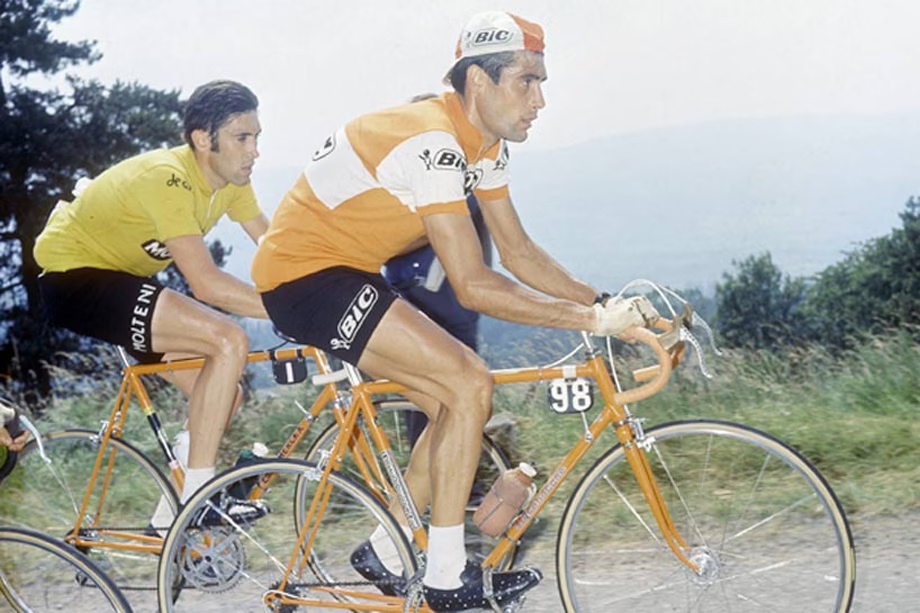
On 8 July 1971, Luis Ocaña rode alone for approximately 60km, won at the Alpine ski resort and finished 8 minutes and 42 seconds ahead of Eddy Merckx.
This was not Merckx near the end of his career. He was the 26-year-old defending champion, winner of the previous two Tours and already the dominant figure in world cycling.
Merckx had built his reputation around defeating every type of rival on every type of terrain. At Orcières-Merlette, he could not even keep Ocaña within sight.
The result appeared to have decided the 1971 Tour. Ocaña left the stage with an overall advantage of more than eight minutes, while Merckx publicly acknowledged the scale of his defeat.
Four days later, Ocaña crashed in a violent thunderstorm on the descent of the Col de Menté and abandoned the race. Merckx inherited yellow, initially declined to wear it out of respect and eventually won his third consecutive Tour.
More than half a century later, Orcières-Merlette remains inseparable from that unfinished contest.
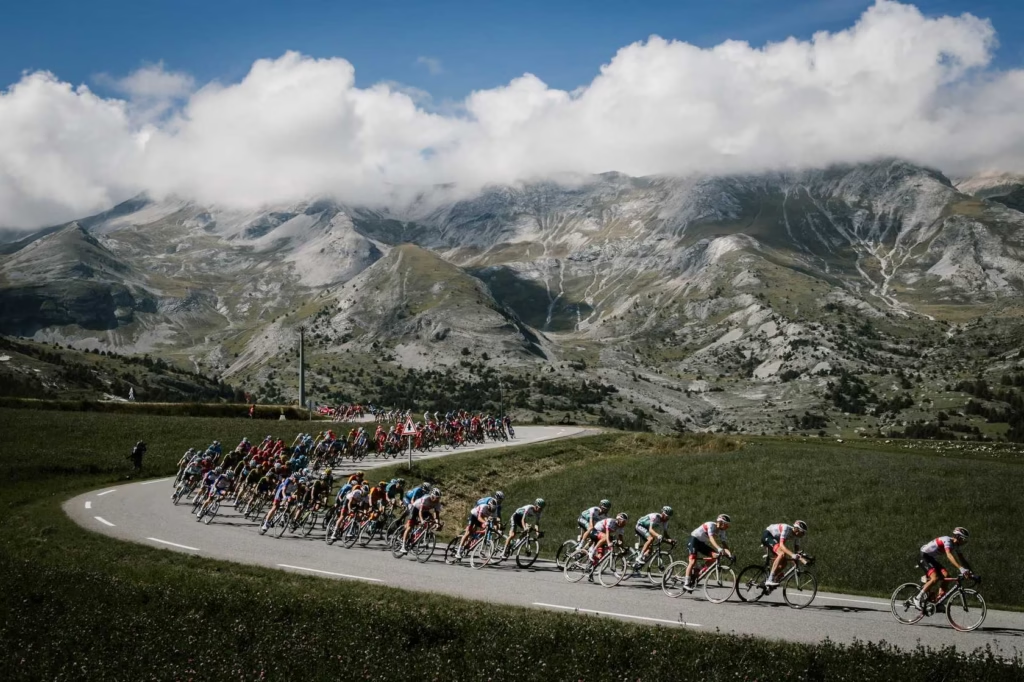 Photo Credit: A.S.O./Pauline Ballet
What happened at Orcières-Merlette in 1971?
| Detail | Information |
|---|---|
| Date | 8 July 1971 |
| Stage | Stage 11 |
| Route | Grenoble to Orcières-Merlette |
| Distance | 134km |
| Winner | Luis Ocaña |
| Second | Lucien Van Impe at 5:52 |
| Eddy Merckx | Third at 8:42 |
| Ocaña’s GC lead | More than eight minutes |
| Decisive move | Solo attack around the Col du Noyer |
| Distance ridden alone | Approximately 60km |
The stage was short by the standards of the period but contained three important climbs: the Côte de Laffrey, Col du Noyer and final ascent to Orcières-Merlette.
The race began breaking apart almost immediately.
Joaquim Agostinho attacked on the steep Côte de Laffrey and was joined by Ocaña, Lucien Van Impe, Gösta Pettersson and Joop Zoetemelk. Merckx, reportedly suffering from an upset stomach, was already around two minutes behind at the summit.
Ocaña continued driving the leading group along the Route Napoléon before dropping his remaining companions on the Col du Noyer with approximately 60km still to race.
He then rode alone to Orcières-Merlette.
This was not a late acceleration followed by a short effort to the finish. It was effectively a mountain time trial against Merckx, his Molteni team and every other general classification contender in the Tour.
The gap kept growing.
Van Impe finished 5:52 behind. Merckx led the other major favourites home at 8:42, having suffered the most severe mountain defeat of his Tour career.
Why Ocaña’s victory was so shocking
Modern Tour audiences are accustomed to seeing the leading contenders separated by seconds rather than minutes.
Even major mountain collapses rarely produce a gap approaching nine minutes between the two strongest riders in the race.
The scale of Ocaña’s victory was extraordinary even by the more aggressive racing standards of 1971.
Merckx was not simply the defending champion. He had won the 1969 Tour by almost 18 minutes and the 1970 edition by more than 12. He collected victories in sprints, mountains and time trials while also dominating the Classics and other Grand Tours.
His nickname, the Cannibal, reflected his refusal to leave victories for anyone else.
Many riders entered races against Merckx effectively competing for second place.
Ocaña was different.
He believed Merckx could be beaten and raced as though the Belgian’s reputation did not matter. At Orcières-Merlette, that conviction produced the strongest evidence yet that the Cannibal was vulnerable.
This was not a narrow defeat caused by bonuses or positioning. Ocaña comprehensively dismantled the Tour’s dominant rider.
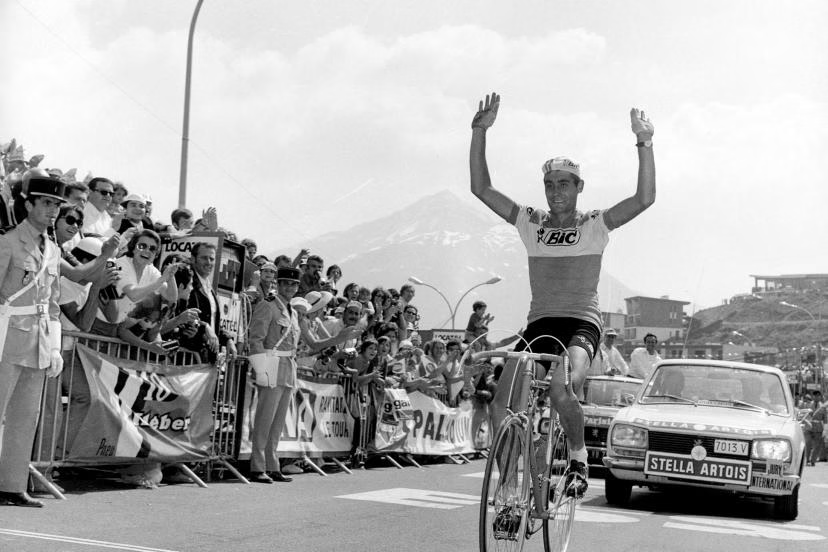
Ocaña had already started breaking Merckx
The Orcières-Merlette stage did not arrive without warning.
Ocaña had already attacked Merckx earlier in the race.
He gained time on the climb to Puy de Dôme and demonstrated that he could distance the defending champion uphill. The following Alpine stage into Grenoble created further problems for Merckx, who lost more than a minute and surrendered the yellow jersey to Zoetemelk.
Ocaña began stage 11 only one second behind the Dutchman.
The Tour was already becoming competitive, but Merckx remained the central reference point. Zoetemelk may have worn yellow, yet the defending champion was still expected to regain control before Paris.
Ocaña had no interest in waiting for a conventional summit-finish duel.
His aggression on the Côte de Laffrey helped create the initial separation, but the decisive moment came on the Col du Noyer. Rather than preserve energy for Orcières-Merlette, he accelerated away from the other leaders and committed to a solo effort with around 60km remaining.
It was an attack designed to destroy the race rather than gain a few seconds.
Did Ocaña attack on the descent of the Col du Noyer?
The story is sometimes simplified into Ocaña attacking on the descent from the Col du Noyer.
The decisive separation was made around the climb itself. Ocaña dropped the riders who had accompanied him, continued over the summit and extended his advantage on the descent and long road towards Orcières-Merlette.
The distinction matters because the performance was not based on one descending gamble.
Ocaña was stronger uphill, faster across the transition and still able to increase his lead on the final ascent.
He did not exploit one moment of hesitation before clinging to a narrow advantage. He defeated the entire Tour field across the final half of the stage.
The descent formed part of the attack, but it was not the whole explanation.
Ocaña nearly eliminated half the peloton
The scale of Ocaña’s performance created an organisational problem behind him.
Sixty-one riders originally finished outside the permitted time limit. Had the standard cutoff been enforced, only 39 riders would have remained in the Tour.
The organisers extended the limit and allowed all but three of the delayed riders to continue.
That decision illustrates the scale of the performance more clearly than Ocaña’s winning time alone.
He had not simply beaten Merckx. He had ridden so much faster than most of the peloton that the race risked losing the majority of its remaining field.
By the time Merckx arrived 8:42 later, Ocaña had transformed the presumed hierarchy of the Tour. Many more riders continued crossing the line several minutes after the defending champion.
A race expected to remain under Merckx’s control had been dismantled in one afternoon.
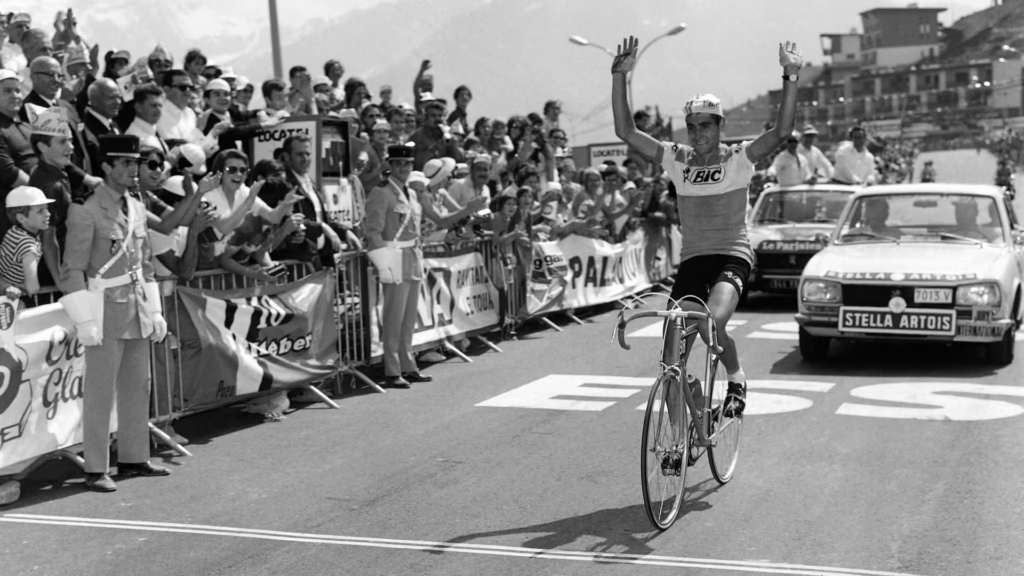
Merckx admitted the Tour appeared lost
Merckx rarely conceded anything while a race remained unfinished.
After Orcières-Merlette, even he recognised the scale of the problem.
Ocaña moved into yellow with an advantage of more than eight minutes. Merckx was no longer dealing with a deficit that could be retrieved through bonus seconds, one short attack or a slightly better time trial.
He needed Ocaña to lose minutes.
Merckx publicly acknowledged that the overall race appeared to have escaped him. Ocaña remained more cautious, understanding that the Belgian would continue searching for any opportunity to reverse the situation.
That caution proved justified immediately after the rest day.
Merckx responded on the road to Marseille
The day after the Orcières-Merlette rest day, the Tour travelled 251km to Marseille.
Ocaña expected a relatively straightforward transitional stage. Merckx and his Molteni team had other plans.
They attacked from the beginning.
Ocaña had arrived late to the start area and was poorly positioned near the back when the race split. Merckx drove the front group through an exceptionally fast stage and recovered almost two minutes.
The attack did not erase what happened at Orcières-Merlette, but it changed the emotional direction of the race.
Merckx had demonstrated that Ocaña could be placed under pressure away from the mountains. The Spaniard still possessed a commanding lead, but the Tour had become a continuous confrontation.
Every descent, crosswind and transition now carried significance.
Merckx gained another 11 seconds during the stage 13 individual time trial at Albi. Those were small recoveries compared with the original deficit, but they showed that he had not accepted defeat.
The storm on the Col de Menté
The tragedy arrived on 12 July during stage 14 from Revel to Luchon.
Ocaña began the day in yellow. Merckx attacked repeatedly over the Col de Portet-d’Aspet and continued his offensive on the Col de Menté.
The weather then changed dramatically.
A violent thunderstorm covered the road with torrential rain, hail, mud and running water. Visibility deteriorated, braking became extremely difficult and several riders crashed or punctured.
Merckx and Ocaña both overshot a flooded bend on the descent.
Merckx was able to remount. Ocaña was not.
As the race continued through the chaos, other riders collided with the fallen Spaniard. Ocaña was left injured, semi-conscious and unable to continue.
He was taken away by ambulance and later transported to hospital.
Four days after producing one of the greatest mountain performances in Tour history, the yellow jersey had abandoned the race.
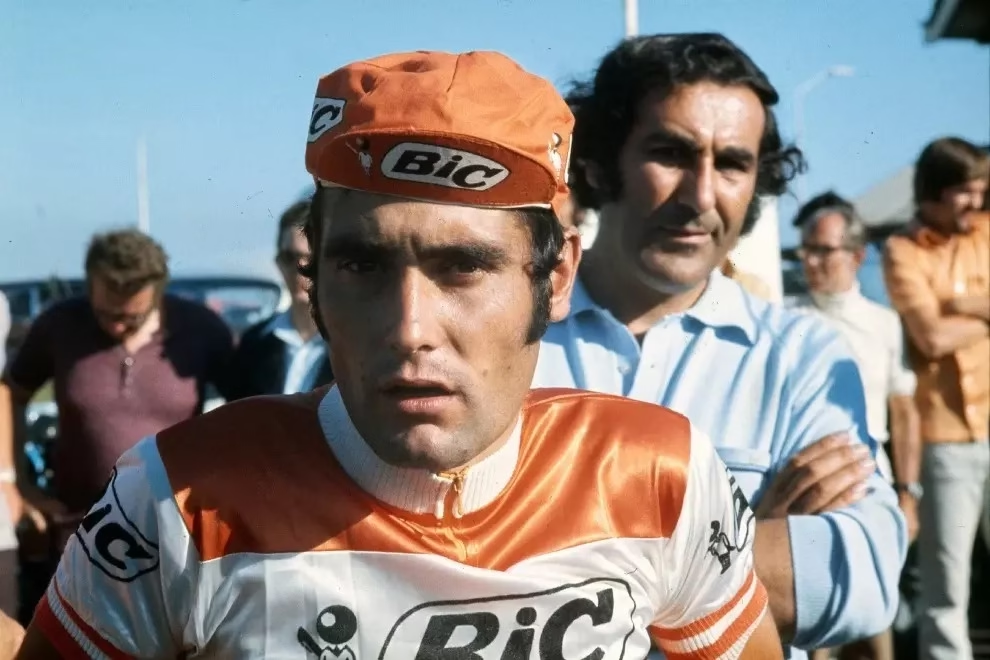
Did Merckx wait for Ocaña?
The idea that Merckx stopped and waited for Ocaña on the road has become part of some retellings, but it does not accurately describe what happened.
Merckx had also crashed on the descent. He remounted and continued in conditions where the riders ahead could not immediately know the full extent of Ocaña’s injuries.
His most significant gesture came after the stage.
Merckx refused to put on the yellow jersey during the podium ceremony and did not wear it on the following stage. He instead rode in the white jersey of the combination classification.
He reportedly considered leaving the Tour altogether, saying that he would rather finish second than win because of Ocaña’s misfortune. His team persuaded him to continue.
The gesture did not mean Merckx lacked the will to win. It showed that he understood the yellow jersey had returned to him through an accident rather than through defeating Ocaña on the road.
Was Merckx gifted the 1971 Tour?
Merckx eventually won the race by 9:51 over Zoetemelk.
The official result recorded his third consecutive Tour victory and another convincing winning margin.
The contest Ocaña had been riding no longer existed.
It is reasonable to say that Ocaña’s crash gave Merckx the opportunity to win. The Spaniard had built a lead of more than eight minutes and looked stronger in the mountains at Orcières-Merlette.
It is harder to claim with certainty that the Tour had already been won.
Merckx had recovered time on the road to Marseille and remained capable of creating unpredictable racing. Further mountain stages and a time trial were still to come. Ocaña’s own aggressive style could also create dangers for him as well as his rivals.
The unanswered question is part of the 1971 Tour’s enduring power.
Ocaña had proved that he could defeat Merckx. He never received the opportunity to prove that he could defend the advantage all the way to Paris.
Why the 1971 Tour became a tragedy
A conventional sporting story produces a contest and a result.
The 1971 Tour produced a contest without a proper conclusion.
Orcières-Merlette appeared to provide the decisive answer. Ocaña attacked the greatest rider of his generation, rode alone for 60km and gained almost nine minutes.
The Col de Menté then removed that answer from the race.
Merckx did not recover the yellow jersey by dropping Ocaña. Ocaña did not lose it through poor form or a tactical mistake. The rivalry was interrupted by a storm, a flooded road and a violent crash.
That left both riders with something they could never completely resolve.
Ocaña carried the knowledge that he had broken Merckx but had not completed the victory. Merckx won the Tour while knowing his strongest opponent had disappeared through misfortune.
The Belgian later maintained that he would have preferred to lose the race under normal circumstances.
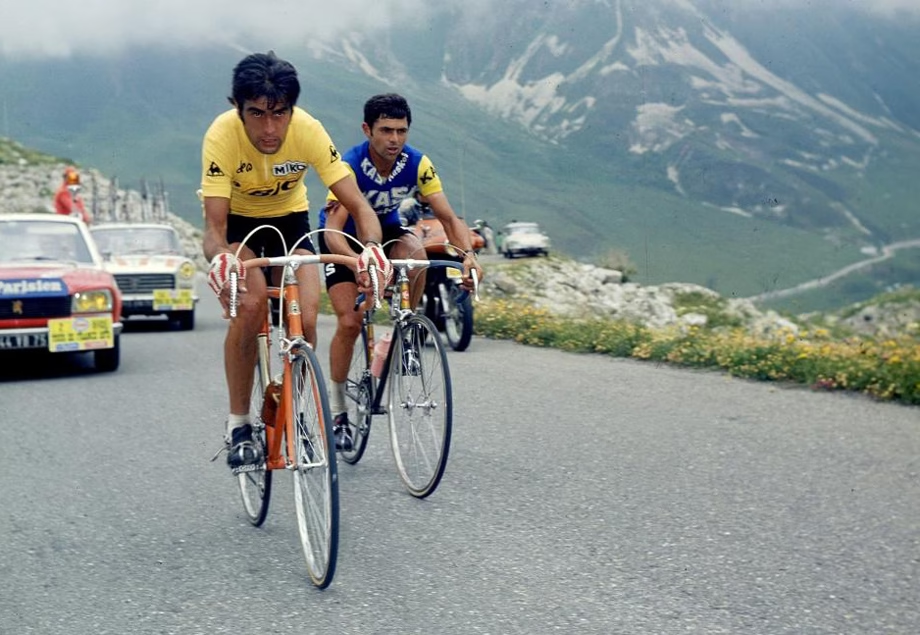
Ocaña finally won the Tour in 1973
Ocaña returned to win the Tour de France two years later.
His 1973 victory was emphatic. He won six stages and completed the race more than 15 minutes ahead of Bernard Thévenet.
Merckx did not start.
That absence ensured the central question from 1971 remained unanswered. Ocaña had become a Tour winner, but he had not defeated Merckx in a completed three-week contest.
Their relationship remained difficult for several years.
The rivalry had been intensified by personality, national loyalties and media coverage. Ocaña was presented as the volatile outsider prepared to challenge Merckx’s authority, while the Belgian received hostility from some spectators after benefiting from the crash.
They eventually reconciled.
Merckx later spoke warmly about Ocaña’s ability and remembered him as one of the few rivals who genuinely raced to win rather than accepting second place.
What is the Orcières-Merlette climb like?
The modern ascent to Orcières-Merlette is not among the Tour’s longest or steepest summit finishes.
For stage 18 of the 2026 race, it measures approximately 7.1km at 6.7%. The gradient is relatively steady, with no extended section comparable to the hardest slopes of Alpe d’Huez or the more severe ramps elsewhere in the Alps.
| Orcières-Merlette climb detail | Stage 18 figure |
|---|---|
| Length | 7.1km |
| Average gradient | 6.7% |
| Classification | Category 1 |
| Finish altitude | Around 1,850 metres |
| Mountains points for winner | 10 |
That profile can produce fast climbing rather than slow attrition.
Drafting remains useful on the gentler sections. Teams can maintain a high pace deep into the ascent, making it difficult for an attacker to establish an immediate gap.
The climb itself was only the final part of Ocaña’s 1971 masterpiece.
His enormous advantage had been created through the Côte de Laffrey, Col du Noyer and long solo approach. By the time he reached Orcières-Merlette, Merckx was already engaged in damage limitation.
That is why comparing only the finishing-climb statistics fails to explain the history.
Our Tour de France 2026 summit finishes guide places Orcières-Merlette in context alongside the more demanding finishes still to come.
How different is the 2026 route?
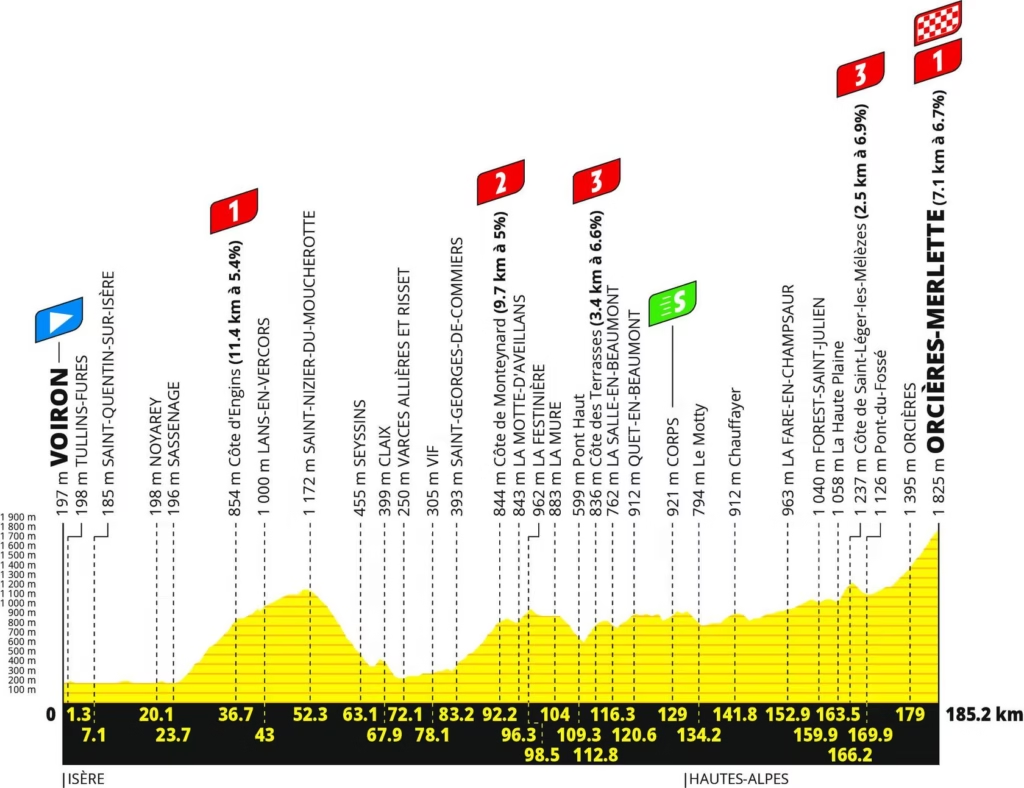
The 2026 stage approaches Orcières-Merlette from Voiron over 185.2km and approximately 3,900 metres of climbing.
It includes five categorised ascents:
- Côte d’Engins
- Côte de Monteynard
- Côte des Terrasses
- Côte de Saint-Léger-les-Mélèzes
- Orcières-Merlette
The early Côte d’Engins is long enough to help establish a strong breakaway, while the final 20km include the short climb through Saint-Léger-les-Mélèzes before the approach to Orcières-Merlette.
The route does not reproduce the 1971 stage.
There is no equivalent late passage over the Col du Noyer giving a GC contender the same obvious platform for a 60km solo attack. The 2026 course is more likely to produce a breakaway battle followed by direct racing on the final climb.
The complete route and expected tactics are covered in the Tour de France 2026 stage 18 preview.
Could Evenepoel repeat Ocaña’s attack?
Remco Evenepoel begins stage 18 in the position of challenger, but the comparison with Ocaña only goes so far.
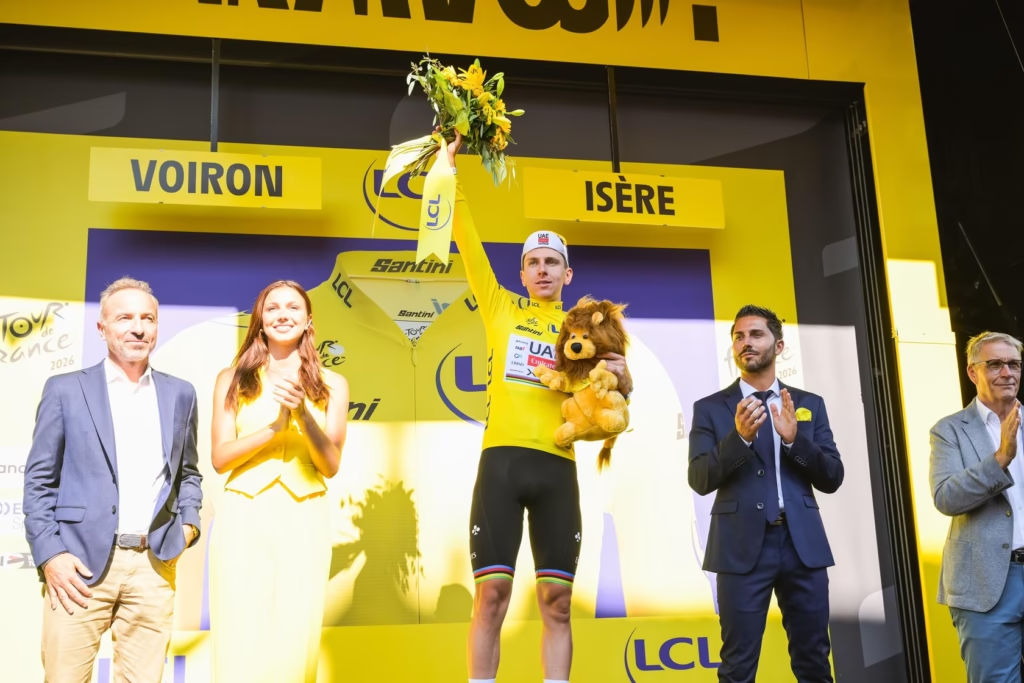
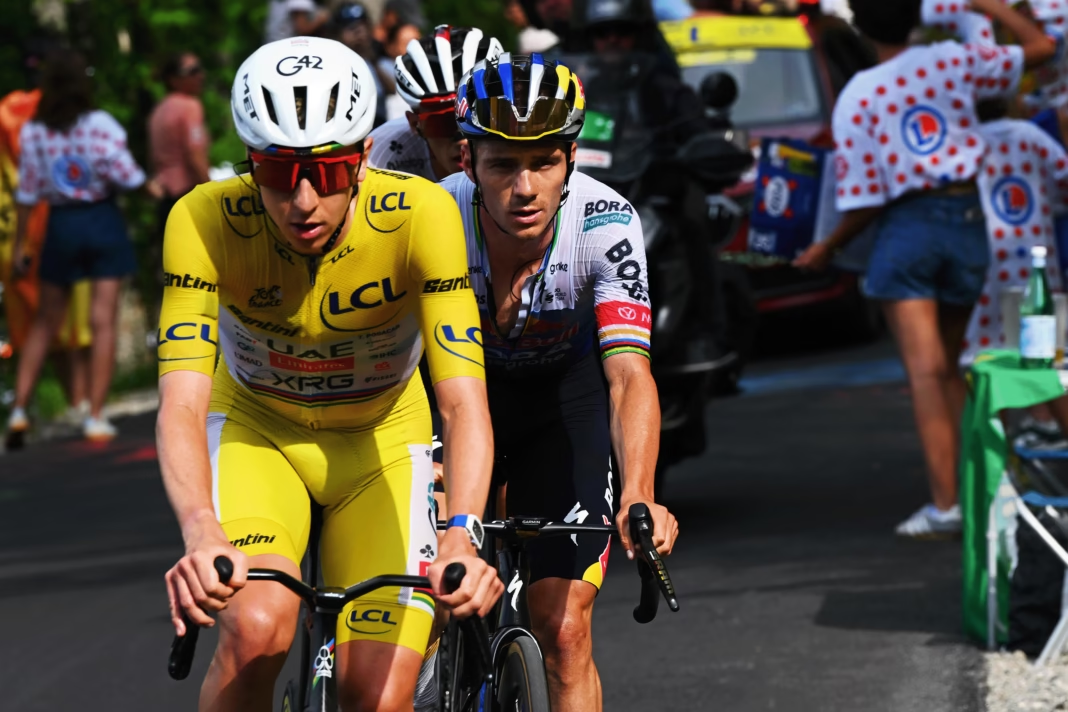
Evenepoel trails Tadej Pogačar by 4:32. He needs a large time gain and possesses the sustained power required to make a long-range move dangerous.
The route and structure of modern racing work against a direct repeat.
UAE Team Emirates-XRG receive detailed information about every gap. Team radios allow Pogačar to understand the situation immediately, while organised pacing makes it much harder for a leading contender to disappear without the yellow jersey team recognising the threat.
Evenepoel will not be granted freedom before the final climb. Any move involving him would provoke an immediate response.
His best chance is not to reproduce Ocaña’s exact attack but to reproduce its intention: make the race difficult before Orcières-Merlette and force the leader to respond earlier than expected.
The wider challenge is examined in can Remco Evenepoel win the Tour de France 2026?.
Why Pogačar’s position differs from Merckx’s
The historical parallel is appealing.
Pogačar is the dominant rider of his generation. Evenepoel is the challenger searching for a way to make him vulnerable. Orcières-Merlette is the place where another apparently unbeatable champion once lost almost nine minutes.
The race situations are different.
Merckx began the 1971 stage already under pressure, had lost yellow the previous day and was reportedly suffering from stomach trouble. Ocaña reached the decisive part of the stage with an advantage created through aggressive racing from the opening climb.
Pogačar enters stage 18 leading by 4:32 and has shown no comparable weakness.
He also does not need to chase every rider. A breakaway containing climbers far behind overall can gain several minutes without threatening yellow.
Only an attack from Evenepoel or another highly placed contender would force UAE into immediate action.
Orcières-Merlette proves that dominant champions can lose heavily. It does not provide evidence that Pogačar is about to do so.
Other Tour finishes at Orcières-Merlette
The Tour has returned to the resort several times since Ocaña’s victory.
| Year | Stage winner | Stage format |
|---|---|---|
| 1971 | Luis Ocaña | Mountain stage |
| 1972 | Lucien Van Impe | Mountain stage |
| 1982 | Pascal Simon | Mountain stage |
| 1989 | Steven Rooks | Mountain time trial |
| 2020 | Primož Roglič | Summit finish |
None has displaced 1971 as the climb’s defining story.
Lucien Van Impe won there in 1972, while Steven Rooks took a mountain time trial victory in 1989. Primož Roglič won the 2020 finish ahead of Pogačar during the opening week of a Tour that would later produce its own dramatic reversal.
The 2020 stage was tightly controlled, with the main GC contenders receiving the same time. It demonstrated how modern team pacing can neutralise a climb that once concluded one of the most destructive attacks in Tour history.
The mountain has not completely changed.
The way the Tour approaches and races it has.
Why Orcières-Merlette still matters
Orcières-Merlette is not famous because it is the longest, steepest or highest climb in France.
It is famous because of what happened before and upon it.
Ocaña turned a relatively moderate summit finish into the conclusion of a 60km attack. He did not wait for the final climb to create the race. He arrived there after already dismantling it.
That lesson remains relevant in 2026.
A rider trying to gain minutes on Pogačar is unlikely to achieve it through one acceleration inside the final kilometre. The leader must be placed under pressure earlier, his team must be weakened and the finishing climb must become the final part of an attack rather than its beginning.
The Tour de France 2026 Alps guide explains how Orcières-Merlette begins a three-stage sequence completed by two finishes at Alpe d’Huez.
Stage 18 may not reproduce 1971.
It returns the Tour to a place where the supposedly unbeatable was once made to look ordinary.
The victory that became an unfinished story
Luis Ocaña crossed the line at Orcières-Merlette having achieved what much of professional cycling considered impossible.
He had attacked Merckx, ridden away from the Tour and gained 8:42 on its dominant champion.
The performance should have become the foundation of his first Tour victory.
Instead, it became the first half of a tragedy.
Four days later, Ocaña lay injured on the flooded descent of the Col de Menté. Merckx inherited a race he believed he had already lost and eventually reached Paris in yellow.
The official record lists Merckx as the winner of the 1971 Tour.
Orcières-Merlette preserves the unresolved alternative: the afternoon when Ocaña broke the Cannibal and appeared to change cycling history, only for a storm in the Pyrenees to change it back.