
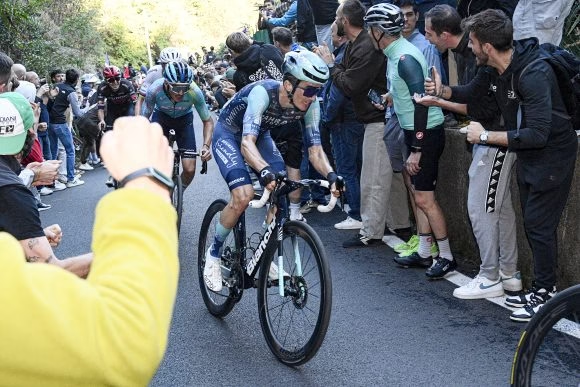
Pello Bilbao finished his professional career doing exactly what had kept him relevant for 16 seasons. At Il Lombardia, aged 36 and with retirement waiting at the finish in Como, he stayed with some of the best one-day racers in the world and came home seventh. There was no ceremonial roll across the line and no easing into the final afternoon. Bahrain Victorious had targeted a top 10 and Bilbao delivered it.
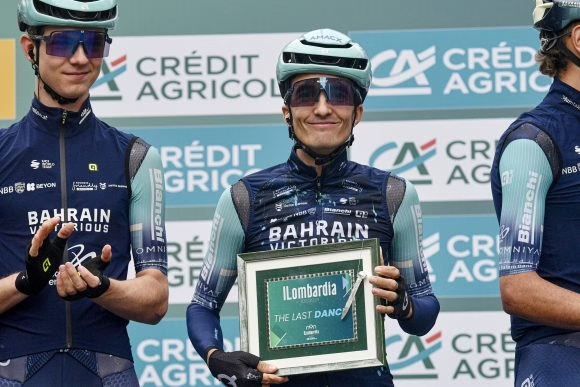
The day had started rather differently. His wife and children surprised him on the Bahrain Victorious bus before the race in Bergamo, an appearance that left him in tears before he had even pinned on a number for the final time. Once the race started, the emotion gave way to the familiar job: stay in position, read the race, help guide the team and then use whatever was left when the decisive climbs arrived.
Bilbao crossed the line 1 minute and 20 seconds behind Paul Seixas, who won the 2026 Il Lombardia, after surviving the Civiglio selection and fighting through the final San Fermo climb. “It was an unforgettable day,” he said afterwards. It was also a very Bilbao way to finish: not with the biggest result of the race, but with another performance that was better than many people might have expected.
From Euskaltel to a career built the hard way
Bilbao’s professional career began in 2011, first with Orbea before he moved into Euskaltel-Euskadi during the same season. For a rider from Gernika, it was the obvious place to learn the job. Euskaltel still represented a distinctly Basque route into the WorldTour, and Bilbao entered a team where climbing ability, stage-race awareness and racing on home roads mattered as much as raw results.
There was no instant rise to the top. His first professional victory did not arrive until 2014, after Euskaltel had disappeared and Bilbao had moved to Caja Rural-Seguros RGA. He won the Klasika Primavera in Amorebieta by beating Gorka Izagirre, giving him a first senior win at 24.
Those Caja Rural years were where the outline of the rider he would become started to form. Bilbao was good uphill without being a pure mountain specialist, fast enough to win from reduced groups and durable enough to keep producing results across stage races. Stage wins at the Vuelta a Castilla y León and Tour of Turkey followed, along with strong Vuelta a España performances that helped earn him a return to the WorldTour with Astana in 2017.
It was a career path based on accumulation rather than one sudden breakthrough. Bilbao improved by adding layers: better climbing, better positioning, stronger time-trialling and an increasingly good sense of when a breakaway or late attack was worth following. By the time he reached Astana, he was entering the years when those pieces began to produce much bigger results.
Astana turned Bilbao into a Grand Tour contender
Bilbao’s three seasons with Astana changed his standing in the peloton. In 2018 he won the opening stage of the Tour of the Alps and then a stage of the Critérium du Dauphiné before finishing sixth overall at the Giro d’Italia. That Giro result was important because it showed he could survive three weeks at a genuinely high level, even while working within a team built around other leaders.
The following Giro gave him his first Grand Tour stage wins. Bilbao won stage 7 into L’Aquila from the breakaway, timing his attack inside the final kilometre, and then won stage 20 in Croce d’Aune two weeks later. They were different victories but both suited him: long, selective days where strength mattered, but so did patience and judgement.
Those results made Bilbao more than a useful climbing domestique. He could now enter Grand Tours with his own general classification ambitions, while still being valuable enough to work for teammates when the race demanded it. That balance became one of the defining features of his career.
Bahrain years brought his most consistent run
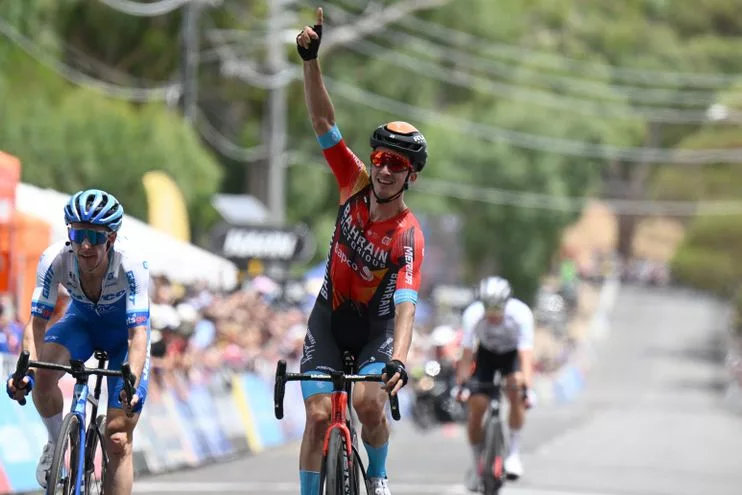
Bilbao joined Bahrain McLaren for 2020 and stayed with the organisation through every version that followed, completing seven seasons with Bahrain Victorious by the time he retired. His first year brought the Spanish time-trial title and fifth overall at the Giro, then ninth at the Tour de France in 2021.
He returned to the Giro in 2022 and finished fifth overall again. That season also included a stage win at Itzulia Basque Country, another at the Tour of the Alps and victory on the final stage of the Deutschland Tour. By his early 30s, Bilbao had become one of the most reliable stage-race riders in the WorldTour: rarely the outright favourite, but difficult to dislodge once he was near the front of a general classification.
Across his career Bilbao started 17 Grand Tours, including seven Giros, five Tours and five Vueltas. He recorded top-10 finishes in both the Giro and Tour, stood on the overall podium three times at the UAE Tour and won stages across the Giro, Tour de France, Dauphiné, Itzulia, Tour Down Under, Tour of the Alps and other week-long races.
That consistency was not built on dominating one type of terrain. Bilbao was compact and efficient enough in the mountains, technically strong on descents and quicker than many climbers in a reduced sprint. He could also time trial well enough to limit losses, which mattered enormously in the fight for fifth, sixth or ninth overall rather than first.

The Tour de France win that meant more than the result
The most memorable victory of Bilbao’s career came at the 2023 Tour de France. On stage 10 to Issoire he made a hard-fought breakaway, helped bring back Krists Neilands late in the stage and then beat Georg Zimmermann and Ben O’Connor in the sprint. It was his first Tour stage win after 13 years as a professional.
The timing gave it far more weight. Bahrain Victorious were racing only weeks after the death of Gino Mäder following his crash at the Tour de Suisse. Bilbao dedicated the victory to his teammate, saying after the finish that he had ridden the final kilometres remembering why he was there. ProCyclingUK covered Bilbao’s emotional stage 10 victory at the time.
He went on to finish sixth overall in Paris, his best Tour de France general classification result. It was a season that brought together the two versions of Bilbao that had developed over the previous decade: the rider capable of winning a major stage from a break and the rider consistent enough to stay high on GC for three weeks.
His 2023 season had already started well with a stage win at the Tour Down Under, and he later finished second at the Donostia San Sebastian Klasikoa. The Tour victory remained the result that carried the greatest emotional weight.
A one-day racer hiding inside a stage-race specialist
Bilbao’s Grand Tour record can obscure how good he became in hard one-day races. He was not built for the cobbled Monuments or flat Classics, but long races with sustained climbing suited him increasingly well as his career progressed.
He finished second at the 2023 San Sebastián Klasikoa, then second behind Tadej Pogačar at the 2024 Grand Prix Cycliste de Montréal after attacking from the chasing group. ProCyclingUK’s 2024 Montréal report captured another example of Bilbao turning a race dominated by a bigger favourite into a result of his own.
Even at 35 and 36, those performances continued. He finished fifth at Strade Bianche in 2025, while his final season included sixth at Liège-Bastogne-Liège, fourth at Eschborn-Frankfurt and another top-five ride at San Sebastián. There was no late-career collapse in level. Bilbao announced his retirement in April at Itzulia Basque Country because he had decided the moment was right, not because the peloton had passed him by.
That distinction mattered to him. He wanted his final season to contain real objectives rather than becoming a farewell tour, and the results supported the decision. Il Lombardia was the clearest final proof.
Il Lombardia gave him the ending he wanted
Bilbao had announced his retirement six months before Lombardia, on home roads at Itzulia. That gave him time to process the decision while still racing seriously. By October, he was clear about what he wanted from the final day: one more chance to compete rather than simply take part.
Bahrain Victorious entered Lombardia targeting a top-10 result. Antonio Tiberi went into the breakaway, while Bilbao stayed protected in the peloton and doubled as the team’s road captain. When the race reached the decisive finale, he was still there in the reduced group with Remco Evenepoel, Brandon McNulty, Tom Pidcock and other major contenders.
Seixas’s attack on Civiglio decided the race, but behind him Bilbao stayed inside the fight for the top places. He was close to his limit as the group split, yet still made it to Como in seventh. That was how much of his career worked: stay close enough when the race became difficult, then take the best result available.
The family surprise before the start made the day more emotional than he expected. Bilbao said he could not hold back the tears when his wife and children came onto the bus, but once the flag dropped he managed to compartmentalise it. The race was still a race until the line.
What Bilbao’s 17 wins do not show
Bilbao retires with 17 professional victories, including three Grand Tour stages and the Spanish time-trial title. Those are substantial results, but they do not fully explain why he remained so valuable across Euskaltel, Caja Rural, Astana and Bahrain.
His best seasons were built around being useful almost everywhere. He could lead at a Giro, support someone else at another Grand Tour, attack a week-long stage race, finish near the front of Liège or San Sebastián and still be trusted as the rider calling decisions from inside the bunch. That flexibility is difficult to reduce to a palmarès.
It also explains why his career lasted from the old Euskaltel era into a very different WorldTour. Bilbao adapted as teams became more specialised and racing became faster. He never needed to be the best climber, the best time triallist or the fastest finisher. He needed to be good enough at all three, and smart enough to know when each skill could make the difference.
He was also unmistakably a Basque rider throughout it. The retirement announcement came at Itzulia, his biggest Tour de France began in Bilbao, and the races around the Basque Country remained central reference points in his season even after years spent on international teams. That local identity sat comfortably alongside a career that eventually stretched to 17 Grand Tours and the biggest races in Europe.
After Lombardia, Bilbao thanked the teammates, staff and directors who had shared the journey and said cycling had given him more than he could repay. The result sheet ended with seventh in a Monument at 36. For a rider whose career was defined less by one peak than by how often he was still there when a race became hard, it was the right final line.

