
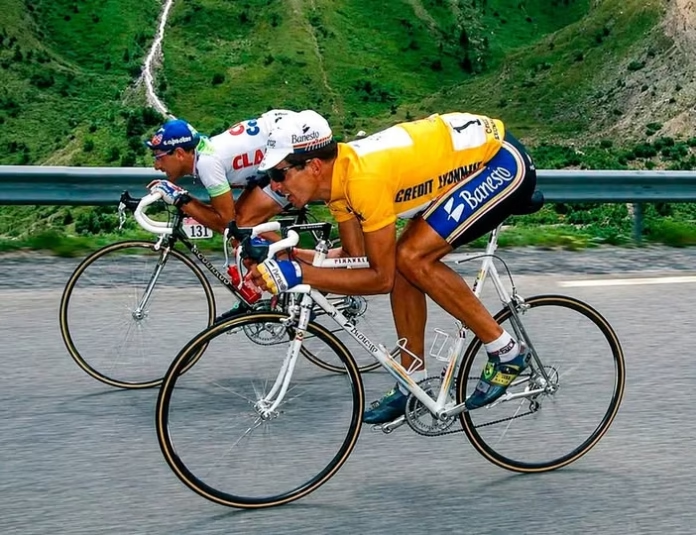
Tony Rominger built one of the strongest stage-racing records of the 1990s without ever becoming the rider most associated with the decade. He won the Vuelta a España three years in a row, took the Giro d’Italia in 1995, finished second at the Tour de France and twice broke the hour record. Yet much of his career unfolded alongside Miguel Indurain, whose five consecutive Tour victories turned almost every other Grand Tour contender into a supporting character.
Rominger deserves to be viewed on his own terms. He combined climbing with exceptional time-trial power, improved relatively late, raced aggressively in stage races that suited him and became especially dominant in Spain. His best seasons were not a footnote to Indurain. They formed a separate run of results that made him one of the most complete Grand Tour riders of his generation.
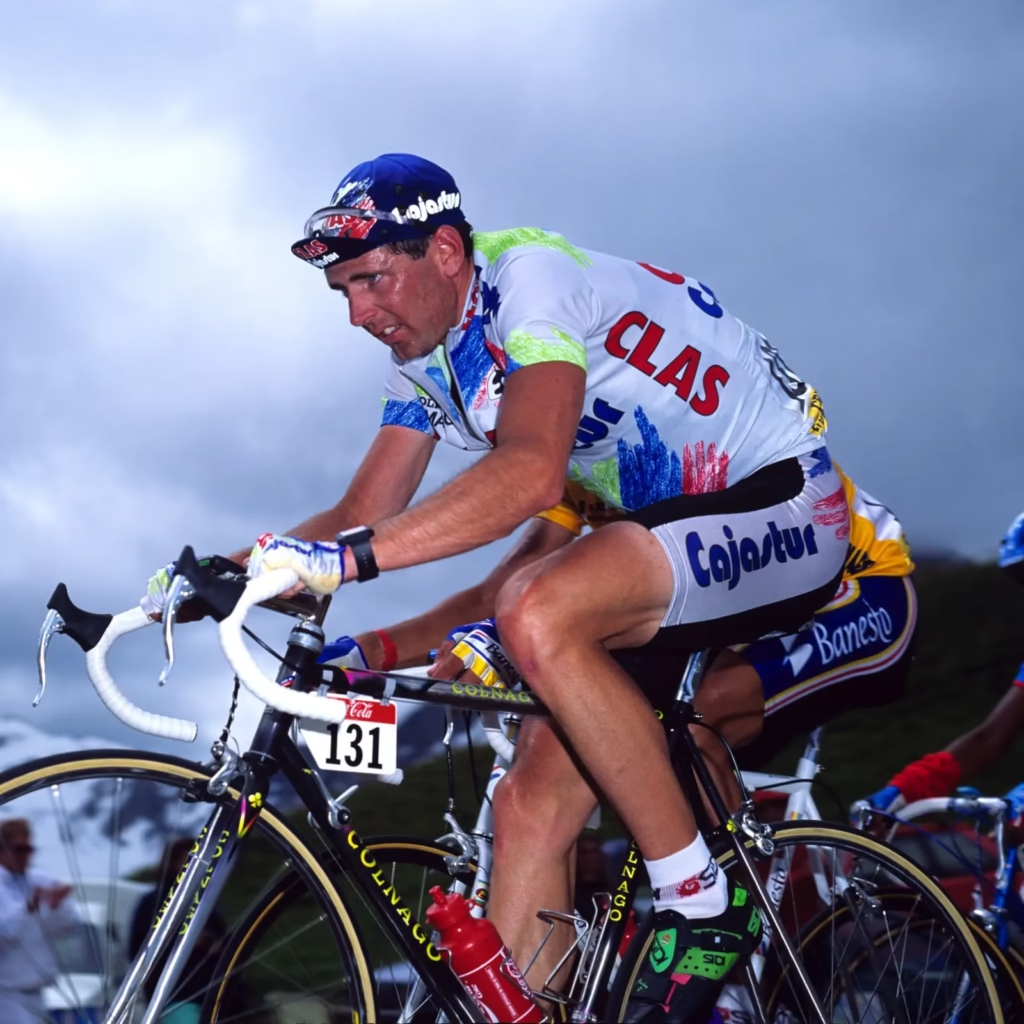
A late rise made Rominger’s peak unusually concentrated
Tony Rominger was born in 1961 but did not turn professional until 1986, later than many of the riders he would eventually challenge. His early seasons contained solid results rather than signs of imminent Grand Tour domination. The breakthrough came gradually as he developed into a rider who could combine long climbing efforts with increasingly strong performances against the clock.
By the end of the 1980s he was winning important stage races and one-day events. Victories in the Tour de Romandie and success in races such as Giro di Lombardia showed that he was not simply a three-week specialist waiting to emerge. The range mattered because Rominger’s later Grand Tour victories were built on the same mixture of sustained climbing and controlled power.
His route to the top was therefore different from a prodigy who enters the professional ranks already carrying Tour expectations. Rominger arrived at his prime with years of racing behind him and then compressed most of his greatest results into the period between 1992 and 1995. That shorter peak makes the volume of what he won during it more impressive.
Three straight Vueltas turned Spain into his defining Grand Tour
Rominger won the Vuelta a España in 1992, 1993 and 1994, becoming the first rider to win the race three consecutive times. The achievement is even more striking because the Vuelta was still held in spring. Riders arrived with different preparation from the modern late-summer race, and the timing allowed Rominger to build entire early seasons around being ready for Spain.
His style was particularly well suited to the Vuelta. The race rewarded riders capable of handling steep climbing while still gaining time in individual time trials, and Rominger could do both. He did not need every mountain stage to become a long-range attack. He could accumulate advantages through consistency, then reinforce them whenever the road or the clock offered the right opportunity.
The 1994 victory completed the sequence just before the Vuelta moved from spring to September the following year. ProCyclingUK’s history of the men’s Vuelta a España places those wins within a race that was about to change its calendar position and international profile. Rominger’s hat-trick belongs to the final chapter of the old spring Vuelta.
 Photo Credit: Graham Watson
The 1993 Tour was the closest Tony Rominger came to Indurain
Rominger’s strongest Tour de France came in 1993. He finished second overall behind Indurain, won three stages and took the mountains classification. The result showed how complete he had become: he could climb well enough to collect mountain points and stage wins while remaining consistent enough to finish second in the general classification.
The problem was the same one every serious Tour contender faced in that period. Indurain’s time-trial ability created margins that were difficult to recover in the mountains, and his Banesto team was strong enough to prevent rivals from turning every climb into chaos. Rominger was capable of attacking, but he also needed to limit losses in exactly the discipline where Indurain was most dominant.
Second place should not be read as evidence that Rominger lacked Tour-winning quality. His 1993 performance would have been enough to challenge seriously in many editions. The timing was simply unforgiving. Like Gianni Bugno and later Alex Zülle, Rominger encountered an opponent whose strengths matched the Tour’s structure almost perfectly.
The hour record showed just how large his engine was
Rominger’s 1994 hour-record attempts gave a different measure of the same physical qualities. Riding in Bordeaux, he covered 53.832 kilometres on 22 October, then returned only two weeks later and pushed the mark to 55.291 kilometres on 5 November. The second distance was extraordinary for the period and moved the record well beyond the mark Indurain had set earlier that year.
The hour record in the 1990s became closely tied to new positions, aerodynamic experimentation and rapid equipment development, so comparing raw distances across eras requires care. Even with that context, Rominger’s improvement within a fortnight was striking. It reinforced what stage racing had already shown: his ability to sustain very high power for long periods was among the best in the sport.
That quality explains why his climbing and time trialling worked so well together. Tony Rominger was not dependent on one explosive acceleration. His biggest advantage came when a race became a long physiological test, whether that meant an extended mountain effort, a forty-kilometre time trial or an hour alone on a velodrome.
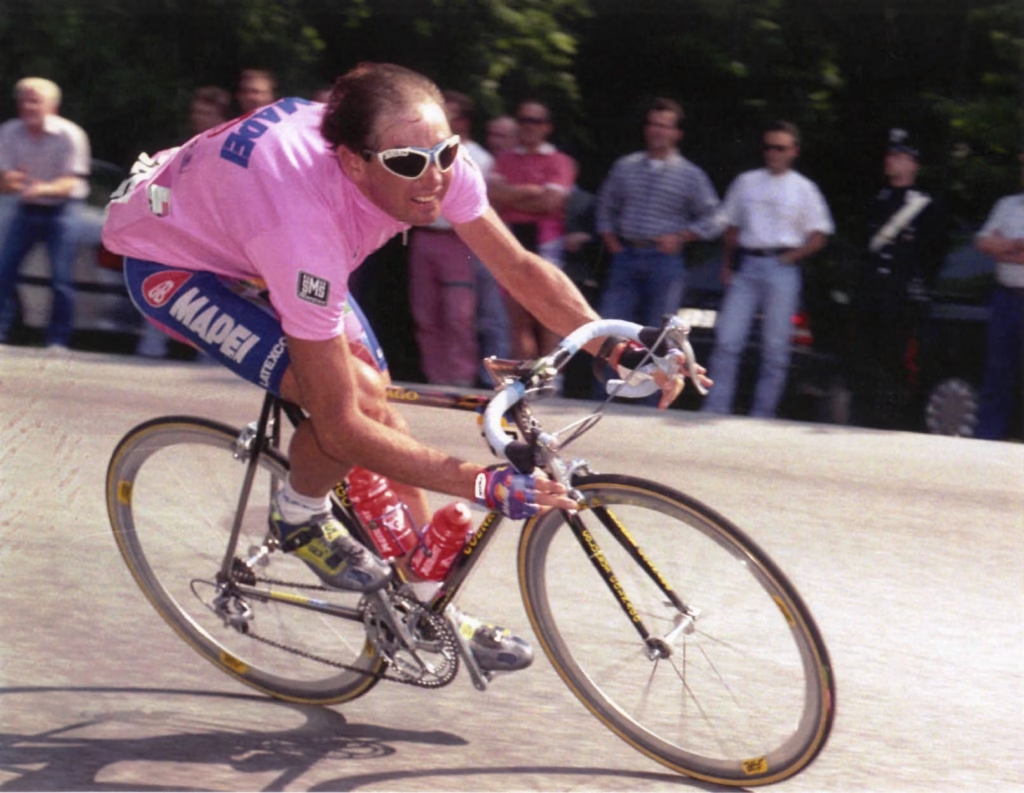
Winning the 1995 Giro completed his Grand Tour range
By 1995 Tony Rominger had already won the Vuelta three times and stood on the Tour podium. The Giro d’Italia gave him the remaining major stage-race victory. He won the overall classification and also took the points and Intergiro competitions, controlling a race in which his time-trial strength repeatedly separated him from his rivals.
Rominger won four stages during the Giro, including multiple individual time trials. That distribution made the overall victory feel characteristic rather than accidental. He did not need to reinvent himself as a pure mountain attacker. The race rewarded the same combination that had made him so successful in Spain: climbing well enough to stay with the best, then turning time trials into decisive opportunities.
The Giro also broadened the way his career could be judged. A fourth Grand Tour victory meant Rominger had won in both Spain and Italy and come second in France. He was no longer simply the Vuelta specialist who had once challenged Indurain. He had assembled one of the strongest multi-tour records of the decade.
His stage-race strength extended far beyond the Grand Tours
Rominger’s palmarès outside the three-week races is easy to overlook because the Grand Tour wins dominate it. He was a multiple winner of the Tour de Romandie, one of the races that best suited his mix of climbing and time trialling. He also won Paris-Nice and took major stage-race victories in Spain and the Basque Country.
ProCyclingUK’s Tour de Romandie history and Itzulia Basque Country history show why those results matter. Both races repeatedly reward riders who can climb, recover and perform against the clock over several demanding days. They were almost ideal tests of Rominger’s strengths.
He also won major one-day races, including Giro di Lombardia, which prevents the career from being reduced to stage racing alone. Rominger was not a Classics specialist in the manner of Johan Museeuw or Michele Bartoli, but on sufficiently selective terrain his endurance and climbing gave him another route to victory.
-
 Photo Credit: Canyon SRAM (supplied media release)
 -
 Photo Credit: Park Tool
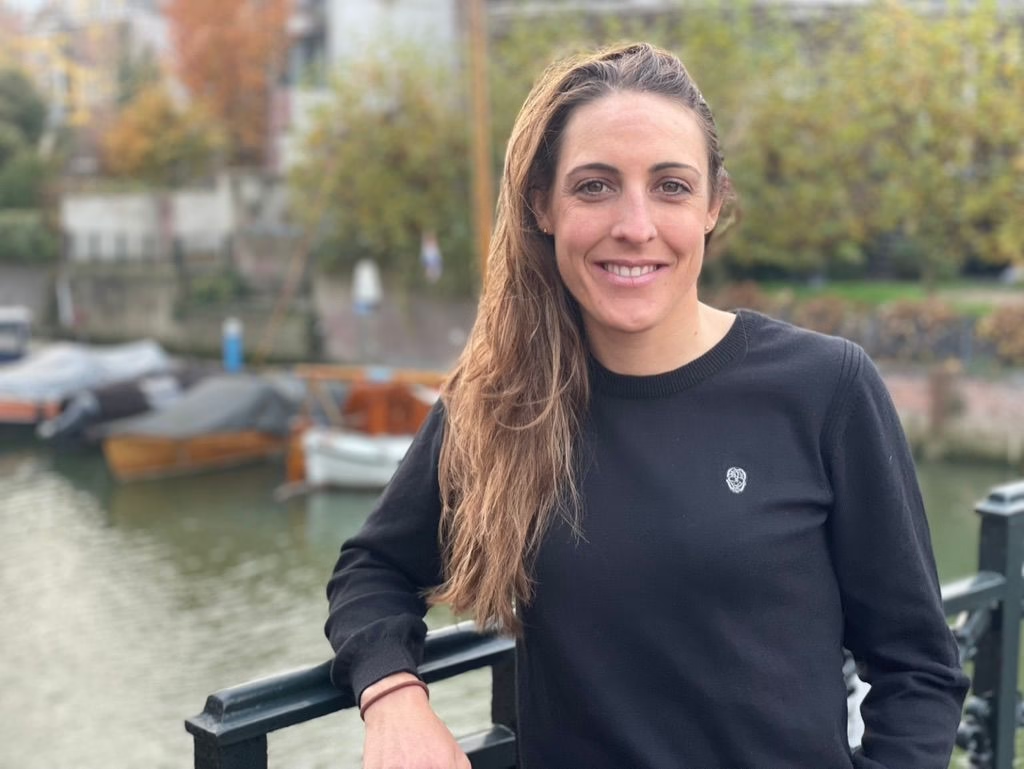
Zülle and the Swiss generation added another layer to the rivalry
Rominger was not the only Swiss Grand Tour contender of the period. Alex Zülle emerged as a younger, exceptionally powerful time triallist and won the Vuelta in 1996 and 1997. Their careers overlapped enough to create an interesting contrast: Rominger reached the top later and built his greatest run first, while Zülle arrived as the younger rider expected to carry Swiss stage-racing ambitions forward.
The comparison should not be forced into a simple succession. Their strengths overlapped but their careers developed differently, and both were competing in an era dominated by Indurain before the Tour hierarchy fractured later in the decade. ProCyclingUK’s Alex Zülle rider history covers the younger Swiss rider’s mixture of Grand Tour brilliance, crashes and missed opportunities.
Together, Rominger and Zülle made Switzerland unusually prominent in stage racing through much of the 1990s. Neither won the Tour, but between them they accumulated Vuelta victories, Giro success, Tour podiums and major time-trial performances that would define almost any national generation.
Rominger’s record stands without needing a Tour victory
The temptation with Tony Rominger is to begin with the race he did not win. The Tour carries so much weight that second place in 1993 can overshadow four Grand Tour victories elsewhere. That is a poor way to measure a rider whose success was unusually broad across stage racing.
Three consecutive Vueltas, a Giro, a Tour runner-up finish, a mountains jersey, major one-week stage races and two hour records form a career that requires no hypothetical Tour victory to validate it. The overlap with Indurain explains why Rominger was not the dominant public figure of the era, but it does not reduce the level he reached.
Tony Rominger retired in 1997 after a career whose peak had been intense rather than especially long. His best years demonstrated a combination that modern stage racing still values: climb strongly enough to stay in contention, recover consistently and make the time trial a weapon rather than a defensive exercise. In the early 1990s, very few riders did all three as effectively.

