
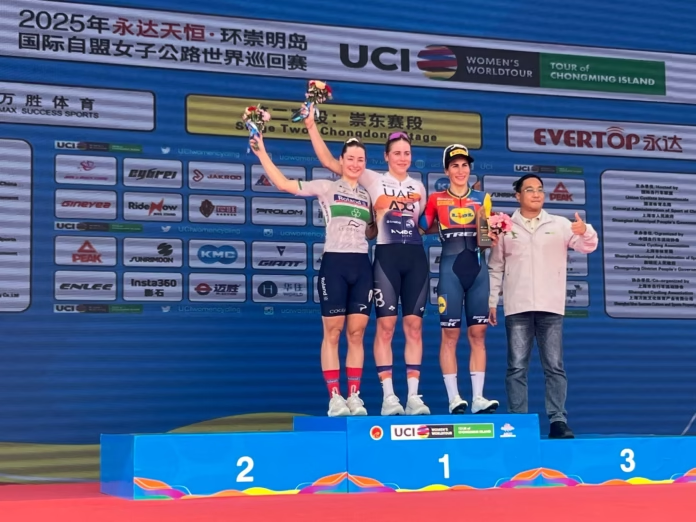
The Tour of Chongming Island occupies an unusual place in elite women’s cycling. It is a WorldTour stage race built on terrain that rarely looks decisive on a profile: flat roads, bridges, exposed sections and repeated sprint opportunities across Chongming Island in the Yangtze estuary. Since the first edition in 2007, that apparent simplicity has produced a race with a very clear identity. Chongming rewards speed, positioning and teams capable of controlling three days of nervous racing, while bonus seconds can keep the general classification alive until the final metres.
The race has also become one of the most important long-running fixtures for women’s professional cycling in China. Its place on the top-level calendar has survived changes to the sport’s structure, a three-year interruption during the pandemic and the increasingly international shape of the Women’s WorldTour. For new followers, our beginner’s guide to the Tour of Chongming Island 2026 explains how the modern race works. Its history shows why the event is about much more than three expected bunch sprints.
From a Chinese stage race to the top level
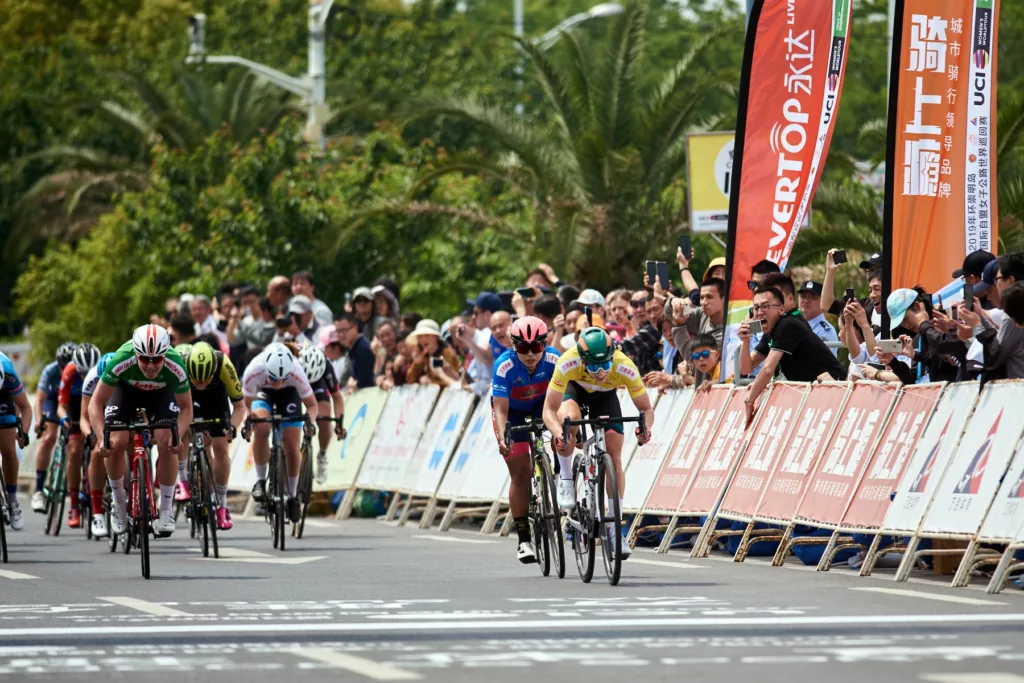
The Tour of Chongming Island began in 2007, initially developing as part of China’s push to establish international road racing around Shanghai. Chongming’s geography gave the organisers a recognisable setting. The island is largely flat, with broad roads and little sustained climbing, but the open landscape means wind, road furniture and the fight for position can matter as much as gradient.
For its first years the event existed alongside an associated one-day race. The format evolved as women’s professional cycling itself changed. The one-day event eventually became part of the UCI Women’s Road World Cup, while the stage race developed its own standing. When the Women’s WorldTour replaced the old World Cup structure in 2016, Chongming’s stage race was included on the new top-tier calendar. That was an important marker for an event still relatively young compared with the established European classics.
From 2016 onwards, the stage race became the central Chongming event. Its WorldTour position also gave the calendar a genuinely global dimension. European racing still dominates the women’s season, but Chongming offered top-level racing in East Asia and created opportunities for Chinese and other Asian riders and teams to compete in the same event as leading international squads.
Why sprinters have shaped the race
Chongming has long been described as a sprinters’ race, and the winners list supports that description. The roads do not provide the sort of long climb that can split a WorldTour field through pure climbing ability. Instead, selection comes through repeated accelerations, crosswinds, crashes, positioning and the accumulation of bonus seconds. A rider who can sprint consistently across several stages can win the overall without ever needing a conventional GC attack.
That has made the race particularly valuable to fast riders who are durable enough to survive three days near the front. It is not enough to have one excellent sprint. General classification contenders must repeatedly collect stage placings and bonuses while avoiding the sort of split that can erase several seconds in an instant. Teams also need enough strength to chase breakaways without exhausting the lead-out before the finish.
The result is a different type of stage-race tension. On mountainous tours, the hierarchy can be transformed by a single summit finish. Chongming often remains compressed, leaving several riders within seconds of the lead. Intermediate bonuses and finish-line seconds therefore become tactical objectives rather than small extras. A team can spend much of a stage controlling a move because even a modest gap threatens the overall classification.
A winners list built around speed and consistency
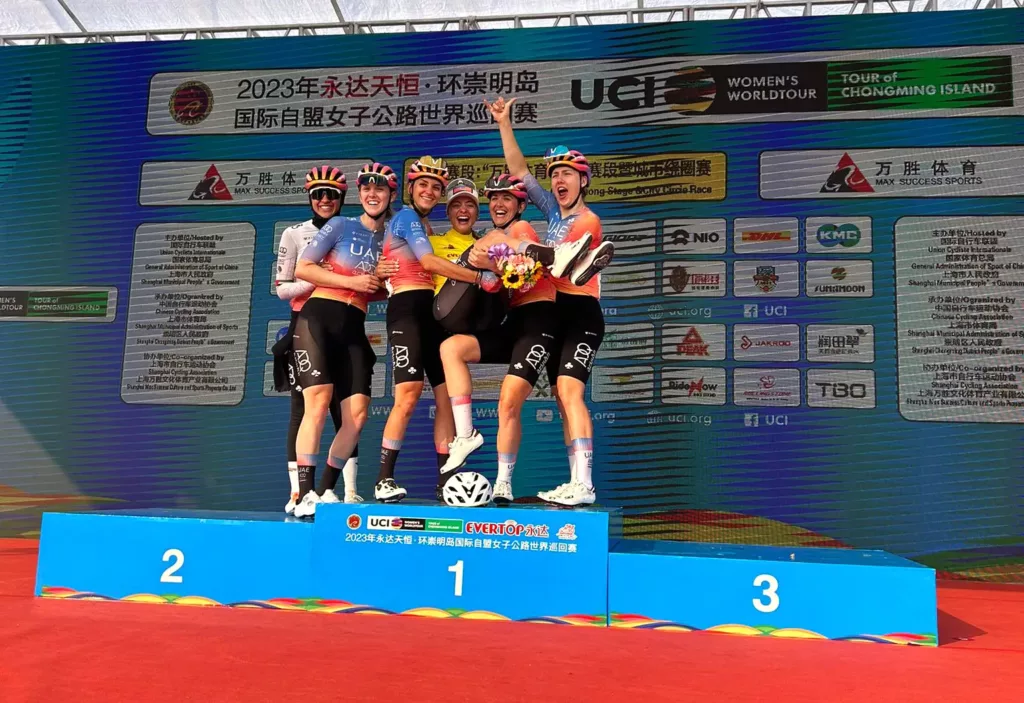
The race’s strongest periods have been defined by riders capable of turning repeated sprint opportunities into overall control. Kirsten Wild became one of the names most closely associated with Chongming during the earlier era, while later editions continued to favour riders with a fast finish and the ability to handle exposed, hectic racing. The pattern is important because it separates Chongming from most other stage races at WorldTour level. The yellow jersey here has often belonged to a sprinter rather than a climber or time trial specialist.
That does not mean every edition has followed a predictable script. Breakaways have repeatedly tested sprint teams, and the small GC margins mean an apparently harmless move can become decisive late in a stage. The race’s history is full of days when teams expected to organise a bunch finish but instead had to calculate time gaps, bonus seconds and the composition of a dangerous move.
The international nature of the winners also reflects how the women’s peloton expanded during Chongming’s lifetime. Dutch, European, Australian and Asian riders have all been prominent, while the race has provided a rare WorldTour platform in a region that otherwise has relatively few top-level women’s events. That makes the event significant beyond its sporting formula.
The pandemic interruption and the return
The biggest break in the race’s continuity came after 2019. The 2020, 2021 and 2022 editions were cancelled during the Covid-19 pandemic and the restrictions affecting international sport in China. For an event whose identity depended on bringing an international peloton to Shanghai, the interruption was unavoidable but substantial. Three seasons is a long absence in a rapidly changing women’s calendar.
When Chongming returned, it did so to a sport that looked different. Women’s WorldTeams had become more professional, minimum standards had risen and the depth of the international peloton was greater. The event nevertheless retained the basic character that had made it recognisable before the interruption: three compact stages, little climbing and a premium on speed.
The return mattered because several races disappeared or changed status during the same period. Chongming’s ability to re-establish itself preserved one of the longest-running Asian fixtures on the women’s top-tier calendar. It also restored a late-season race in which teams with sprint ambitions could pursue WorldTour success after the main European stage-race season had finished.
The remarkable 2025 edition
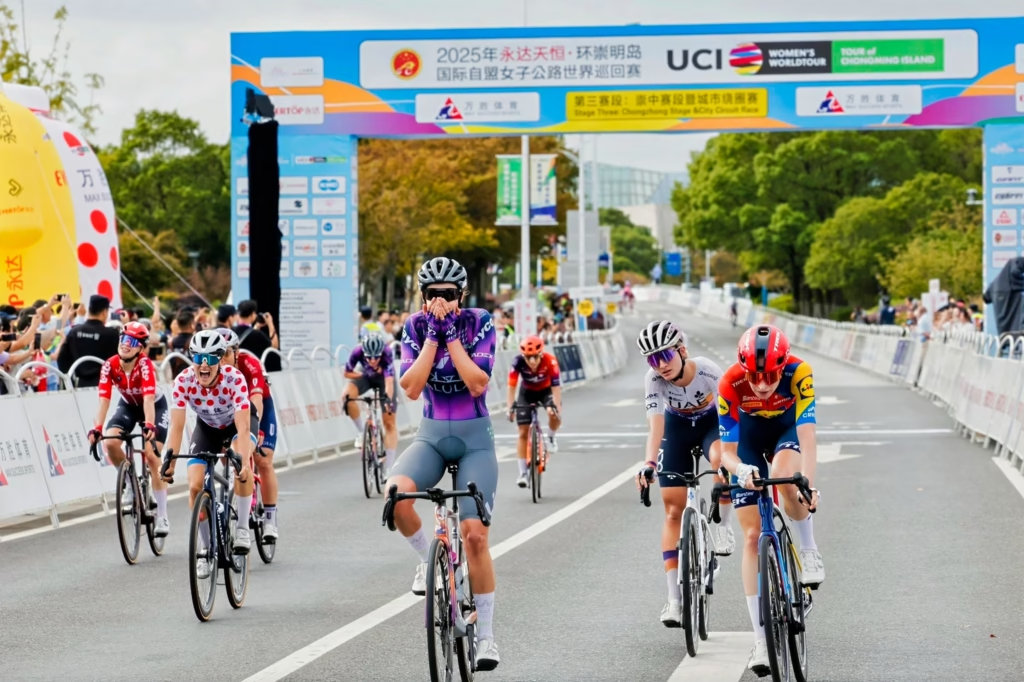
The 2025 Tour of Chongming Island demonstrated why the race cannot be reduced to a sequence of routine sprints. Georgia Baker was awarded stage 1 after Kathrin Schweinberger was relegated for an irregular sprint, while Sofie van Rooijen won stage 2 and appeared to have put herself in control of the general classification. Going into the final stage, Van Rooijen held a 16-second advantage over Anne Knijnenburg, who sat only seventh overall.
The final day overturned that position. A late group containing Knijnenburg escaped, with Josie Talbot eventually taking the stage victory ahead of Riejanne Markus and Knijnenburg. A crash involving Van Rooijen complicated the timing behind, and the race jury needed an extended calculation before confirming the final general classification. Knijnenburg’s third-place bonus seconds proved decisive and gave her the overall victory by a single second.
It was a particularly Chongming way to win a stage race. There was no mountain attack and no time trial. Instead, the race turned on a late move, a small time gap and the value of bonuses. Knijnenburg’s victory was her first at Women’s WorldTour level and reinforced the lesson that riders cannot treat the final flat stage as a formality simply because the profile looks benign.
-
 Photo Credit: Telenet Superprestige
 -
 Photo Credit: Nieuwsblad
 -
Photo Credit: Wahoo

What Chongming contributes to women’s cycling
The Tour of Chongming Island has never tried to imitate the major European stage races. Its importance comes partly from doing something different. It gives sprint teams a stage race in which their fastest rider can realistically target the overall classification, and it forces those teams to think about GC defence in a way they rarely need to during hillier events.
It also matters geographically. A WorldTour calendar that claims international reach needs races outside cycling’s traditional European centres. Chongming has provided that continuity in China since the 2000s, giving local spectators and riders direct contact with elite women’s racing and providing the international peloton with a very different late-season setting.
The event has also become a useful reference point for how sprint racing itself has changed. Lead-outs are now more specialised, teams arrive with deeper performance support and the fight for the final kilometre is increasingly organised, yet Chongming still leaves room for opportunism because the overall margins remain so small. Riders who can read wind, move before a sprint train is fully established and judge bonus seconds often gain as much as those with the highest outright speed. The compact format has another consequence: there is almost no room to recover from a mistake. A badly timed puncture, a missed split or one relegation can reshape the classification because there is no mountain stage later in the week where a favourite can simply regain half a minute.
That pressure is part of Chongming’s character and explains why experienced sprint teams place so much emphasis on keeping their leader near the front throughout each stage. By 2026, the race’s history is long enough for its identity to be firmly established. Flat does not mean simple. Chongming is a race of sprint craft, bonus seconds, exposed roads and relentless positional pressure, and its best editions have shown how quickly a three-day general classification can change when every second remains available until the finish.

