The Tour de France Femmes and the Tour de France share a name, an organiser, the yellow jersey and the basic logic of stage racing. Both reward the rider with the lowest cumulative time. Both have sprint stages, mountain stages, breakaways, team tactics and daily battles for jerseys. Both sit at the centre of the cycling calendar.
But they are not the same race with different pelotons.
The men’s Tour de France 2026 runs from 4-26 July, covering 3,320.7km across 21 stages, with two rest days, 23 teams and 184 riders. The Tour de France Femmes 2026 runs from 1-9 August, covering 1,175km across nine stages, with no rest day, 22 teams and 154 riders.
For the full route picture, see our Tour de France 2026 full route guide and our Tour de France Femmes 2026 route guide.
That difference changes everything: the tactics, the rhythm, the recovery demands, the commercial scale, the route design and the way the race is watched.

Quick answer: what is the difference between the Tour de France Femmes and the Tour de France?
The Tour de France is the men’s three-week Grand Tour, with 21 stages, two rest days and a much longer route. The Tour de France Femmes is the women’s Tour, currently run over nine consecutive stages as a shorter but still elite Women’s WorldTour race.
| Difference | Tour de France 2026 | Tour de France Femmes 2026 |
|---|---|---|
| Dates | 4-26 July | 1-9 August |
| Stages | 21 | 9 |
| Total distance | 3,320.7km | 1,175km |
| Rest days | 2 | 0 |
| Teams | 23 | 22 |
| Riders | 184 | 154 |
| Riders per team | 8 | 7 |
| Time-trials | 1 team time-trial, 1 individual time-trial | 1 individual time-trial |
| Mountain stages | 8 | 2 |
| Start | Barcelona | Lausanne |
| Finish | Paris Champs-Élysées | Nice |
| Race status | Men’s Grand Tour | Women’s WorldTour stage race |
The biggest difference is length
The most obvious difference is the number of stages.
The men’s Tour de France is a three-week race. In 2026, it has 21 stages, spread across more than three weeks with two rest days. It starts in Barcelona, returns to France, crosses the Pyrenees, Massif Central, Vosges, Jura and Alps, then finishes in Paris.
The Tour de France Femmes is much shorter. The 2026 race has nine stages, beginning in Lausanne and finishing in Nice. It crosses Switzerland and France, with stages in the Jura, Massif Central and Alps, but it does so in a compact nine-day block. The full stage list is covered in our Tour de France Femmes 2026 calendar.
That does not make the women’s race easy. It makes it different. A three-week Tour is about depth, resilience and long-term management. A nine-stage Tour is more compressed, with less room for recovery and fewer chances to correct a bad day.
 Photo Credit: A.S.O./Aurélien Vialatte
The men’s Tour has rest days, the Femmes does not
The men’s Tour de France 2026 has two rest days, on 13 July in Cantal and 20 July in Haute-Savoie. Those days are part of the structure of the race. They give riders a chance to recover, teams a chance to reset and the general classification battle a chance to move into a new phase.
That longer rhythm is explained in our guide to Tour de France 2026 rest days.
The Tour de France Femmes 2026 has no rest day. It runs for nine consecutive days from Saturday 1 August to Sunday 9 August. For more detail on the exact race format, see our guide to how long the Tour de France Femmes 2026 is.
That matters tactically. In the men’s race, a leader can sometimes ride defensively before a rest day, knowing there is a pause coming. In the women’s race, there is no full day to absorb the damage. Riders have to recover overnight, manage transfers efficiently and stay switched on from the opening stage to the final climb.
The route balance is different
The men’s Tour de France 2026 has a wide spread of stage types: seven flat stages, four hilly stages, eight mountain stages, one team time-trial and one individual time-trial. It also includes five summit finishes and two separate time-trial days.
The Tour de France Femmes 2026 has three flat stages, three hilly stages, two mountain stages and one individual time-trial. The headline features are the 21km time-trial from Gevrey-Chambertin to Dijon, the Mont Ventoux summit finish and the final mountain stage around Nice.
The men’s race can afford to build slowly. It has sprint blocks, mountain blocks, transition days and multiple GC checkpoints. The women’s race has to be more concentrated. Every stage needs a clear purpose because there are fewer days available.
That is one reason the 2026 Tour de France Femmes route looks so deliberate. Lausanne gives the race a Swiss Grand Départ, Dijon gives the GC riders an early time-trial test, Ventoux gives the race an iconic summit finish, and Nice gives it a final-day mountain showdown.
 Photo Credit: A.S.O./Fabien Boukla
Team size changes the racing
The men’s Tour de France has 23 teams of eight riders, giving a total of 184 riders. The Tour de France Femmes has 22 teams of seven riders, giving a total of 154 riders.
One rider per team may not sound like a huge difference, but it changes the feel of the race. An eight-rider team has more capacity to control a stage, chase a breakaway, protect a leader and still keep support riders available late in the day.
A seven-rider team has less margin. If one rider crashes, gets dropped, has a bad day or is committed early to chasing, the team structure can thin out quickly. That tends to make the Tour de France Femmes harder to control, especially on hilly and mountain stages.
It also gives breakaways a slightly different chance. With fewer domestiques available across the peloton, the responsibility for chasing can become more concentrated.
The tactical rhythm is not the same
The men’s Tour is often a race of phases. There is the Grand Départ, the first GC test, the sprint block, the first mountain range, the rest day, the second block, the final mountains and the Paris finish. A rider can lose time early and still have many stages to change the story.
The Tour de France Femmes is sharper. A split on stage 1, a poor time-trial, a missed feeding opportunity or a single weak climbing day can have a much bigger impact because the race does not have the same long recovery arc.
That makes the women’s Tour feel more immediate. There is less waiting. GC riders need to be alert from the beginning. Sprinters have fewer opportunities. Breakaway riders cannot waste the right day. Teams have to make decisions quickly because the race moves from opening tension to decisive terrain in a matter of days.
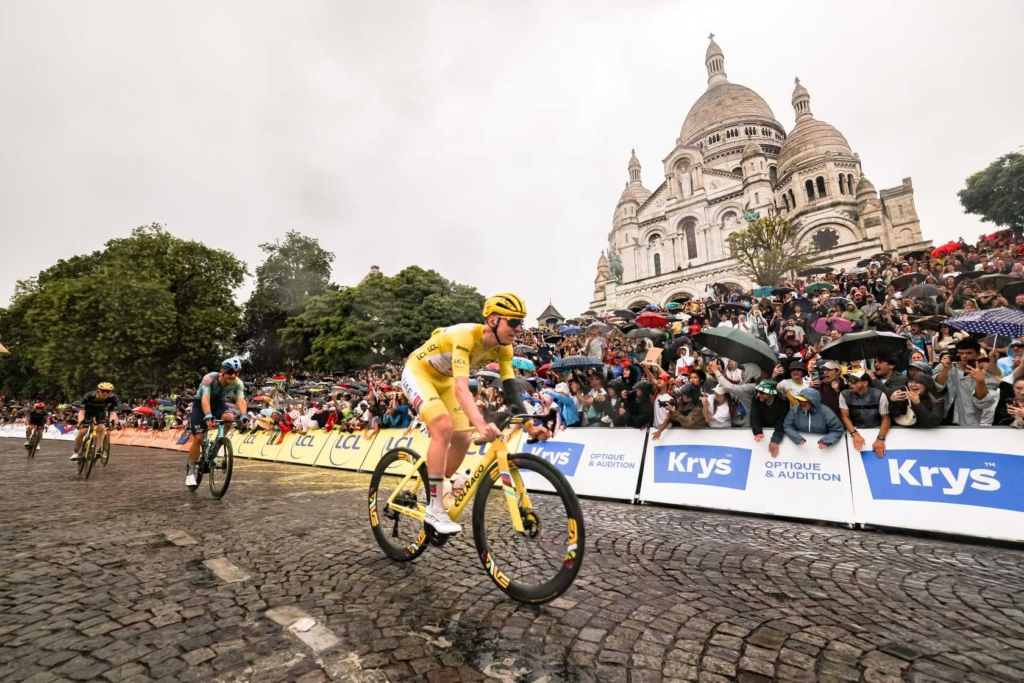 Photo Credit: A.S.O./Bastien Séon
The history is very different
The men’s Tour de France is one of sport’s longest-running institutions. The 2026 edition is the 113th Tour de France, with a route that reflects more than a century of accumulated tradition, politics, geography and myth.
The modern Tour de France Femmes is much younger. The 2026 race is the fifth edition of the current Tour de France Femmes avec Zwift, following its relaunch in 2022.
That matters because the men’s race inherited a fixed cultural position. The women’s race is still building one. It has already established itself as the most visible women’s stage race in the world, but its format is still developing.
The winners list is short but already significant. Our Tour de France Femmes winners list shows how each modern edition has produced a different kind of champion, from Annemiek van Vleuten’s mountain dominance to Pauline Ferrand-Prévot’s 2025 victory.
The Tour de France Femmes is not just a support race
This is the most important distinction.
The Tour de France Femmes is not a warm-up act, a shortened exhibition or a decorative version of the men’s race. It is a standalone elite race with its own route, own contenders, own tactical identity and own place in the Women’s WorldTour.
In 2026, the race begins a week after the men’s Tour finishes. That separation helps give the women’s race its own space. It is not fighting for attention on the same day as a men’s mountain stage or Champs-Élysées finale. It can build its own story from Lausanne to Nice.
That has been one of the biggest steps forward for the event. The name gives it instant recognition, but the race needs more than a borrowed brand. It needs its own sporting memory. Mont Ventoux, Dijon, Lausanne and Nice all help give the 2026 edition that identity.
For newer fans, our beginner’s guide to Tour de France Femmes 2026 explains the route, jerseys, contenders and race structure in more detail.
 Photo Credit: A.S.O./Pauline Ballet
The jerseys look familiar, but the battles feel different
Both races use the same basic visual language. The yellow jersey leads the general classification. The green jersey is for the points competition. The polka dot jersey rewards climbing points. The white jersey is for the best young rider.
The difference is how those contests unfold.
In the men’s race, the points competition can play out over three weeks, with sprinters collecting points across flat stages and intermediate sprints while trying to survive the mountains. In the Tour de France Femmes, the smaller number of stages means every sprint and every finish has more weight.
The mountains competition is also different. The men’s race has more climbing days, more high-altitude accumulation and more chances for a dedicated climber to build a points total. In the women’s race, the polka dot battle can turn more quickly because there are fewer mountain stages and fewer opportunities to recover lost ground.
The men’s Tour has more time to tell a long story
A three-week Tour can change personality several times. It can begin with chaos, settle into control, then explode in the mountains. It can create long-form tension around fatigue, illness, crashes, weather and accumulated pressure.
The Tour de France Femmes tells a shorter, tighter story. It has to establish its main plot quickly.
That is not a weakness. In many ways, it is one of the race’s strengths. A nine-stage format is easy for newer viewers to follow. There is a clear beginning, middle and end. There are fewer dead days. The race builds quickly, and when the key stages arrive, the consequences are immediate.
The men’s Tour rewards patience. The women’s Tour rewards attention.
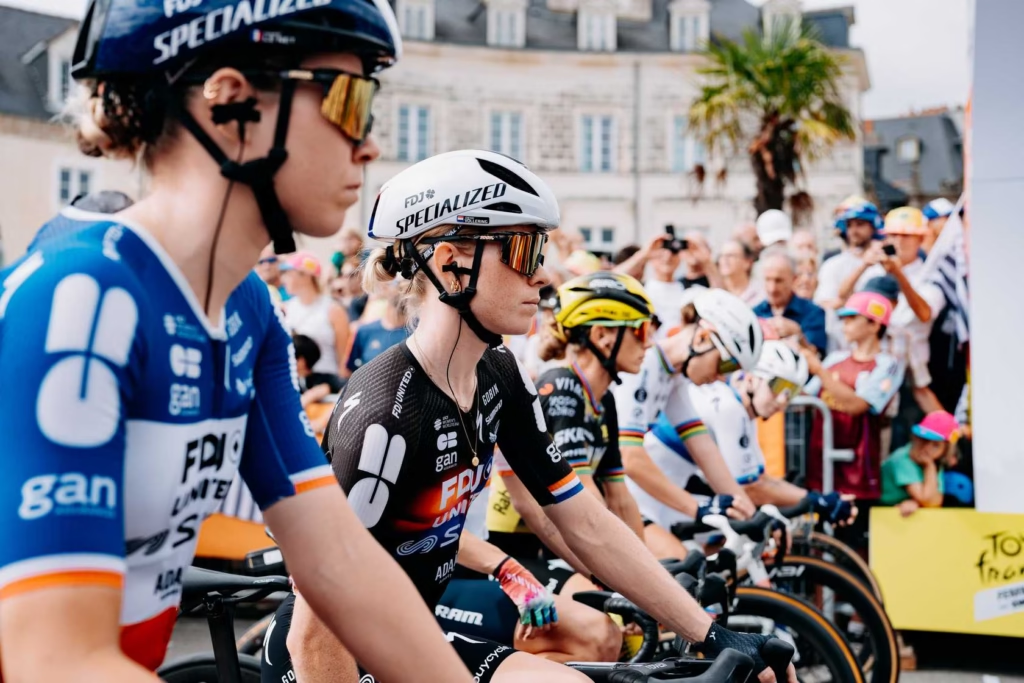 Photo Credit: A.S.O./Jennifer Lindini
The commercial scale is still different
The Tour de France is one of the biggest annual sporting events in the world. Its broadcast footprint, sponsor value, roadside crowds, municipal investment and historical prestige are enormous.
The Tour de France Femmes is growing from a different base. Its visibility has risen sharply, but women’s professional cycling still has smaller team budgets, smaller squads, less commercial depth and fewer long-established race structures than the men’s sport.
That is one reason the race is not simply 21 stages already. Adding days is not just a sporting decision. It means more staff, more vehicles, more hotel nights, more host towns, more broadcast production, more recovery pressure and more money across the whole ecosystem.
A longer Tour de France Femmes may come. But for the race to last, expansion needs to be sustainable rather than symbolic. The wider structure of top-level women’s racing is covered in our guide to the 2026 Women’s WorldTour.
Which race is harder?
This depends on what “harder” means.
The men’s Tour is harder in total volume. It is longer, covers more distance, has more mountain stages and lasts three weeks. The accumulated fatigue is extreme.
The Tour de France Femmes is harder in compression. It gives riders fewer days, fewer recovery windows and less tactical margin. A single bad day can carry more weight because there are fewer opportunities to repair the damage.
So the better answer is that they are hard in different ways. The men’s Tour is a test of endurance over time. The women’s Tour is a test of intensity, precision and recovery across a shorter but highly concentrated race.
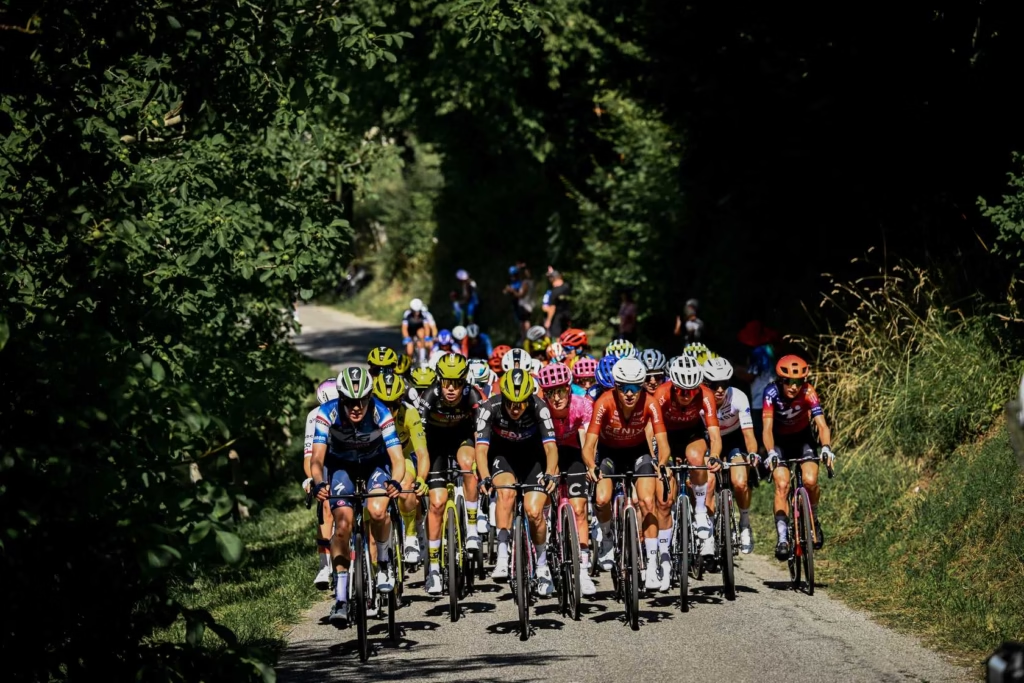 Photo Credit: A.S.O./Pauline Ballet
Watching the two races is different too
The men’s Tour de France asks viewers to follow a long narrative. There are quieter days, sprint stages, breakaway days, mountain blocks and rest-day resets. It rewards people who understand how three-week fatigue builds.
The Tour de France Femmes is more compact. It is easier to follow day by day because there are only nine stages and no rest day. That makes it especially useful for newer viewers who want a complete stage-race story without committing to three full weeks.
UK viewers can plan around the women’s race with our guide on how to watch Tour de France Femmes 2026 in the UK. For the men’s race, our Tour de France 2026 TV schedule and daily start times tracks the full three-week viewing picture.
Why the differences matter
The differences between the Tour de France and the Tour de France Femmes are not just about distance. They shape how each race is ridden.
The men’s Tour is built around the long arc of a Grand Tour. The women’s Tour is built around compressed drama. The men’s race has more room for gradual tactical development. The women’s race often forces decisions earlier. The men’s Tour has the weight of history. The women’s Tour has the energy of a race still defining what it can become.
Both matter. Both produce worthy winners. Both require teams to solve difficult tactical problems under pressure.
The mistake is to treat the Tour de France Femmes as incomplete because it is not the same as the men’s Tour. It is better understood as a different race, with its own demands and its own logic.
-
 Photo Credit: Getty

Tour de France Femmes vs Tour de France FAQs
Is the Tour de France Femmes the same as the Tour de France?
No. The Tour de France Femmes is the women’s race, while the Tour de France is the men’s race. They share the Tour de France name and organiser, but they have different dates, distances, team sizes and race formats.
Why is the Tour de France Femmes shorter?
The Tour de France Femmes is shorter because the modern women’s race is still developing within the Women’s WorldTour calendar. Team budgets, squad depth, broadcast growth, host-town investment and race logistics all affect how quickly the event can expand.
How many stages are in the Tour de France Femmes 2026?
There are nine stages in the Tour de France Femmes 2026.
How many stages are in the Tour de France 2026?
There are 21 stages in the men’s Tour de France 2026.
Does the Tour de France Femmes have rest days?
No. The 2026 Tour de France Femmes runs for nine consecutive days and has no rest day.
Do both races have a yellow jersey?
Yes. Both races award the yellow jersey to the leader of the general classification.
Is the Tour de France Femmes a Grand Tour?
It is often described as one of the women’s Grand Tours because of its prestige, but it is not the same length or structure as the men’s three-week Grand Tours.
Which race is harder?
The men’s Tour is harder by total distance and duration. The Tour de France Femmes is harder in a different way because it is shorter, more compressed and gives riders less time to recover from mistakes.