
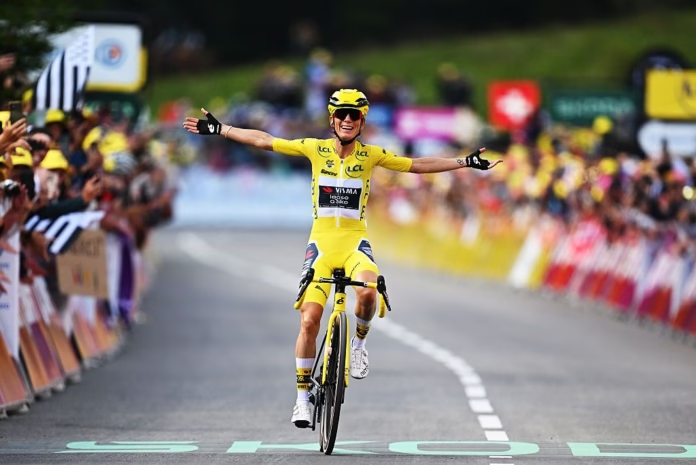
The yellow jersey is the simplest symbol in the Tour de France Femmes and, underneath it, one of the most complicated tactical problems in cycling.
The basic rule is straightforward. The rider with the lowest cumulative time across the race leads the general classification and wears yellow the following day. After the final stage in Nice, whoever still has the lowest total time wins the 2026 Tour de France Femmes.
Getting into yellow is only part of the job. Keeping it means surviving flat stages, crosswinds, the Stage 4 individual time trial, hilly days where bonus seconds are available and, eventually, the decisive mountain stages on Mont Ventoux and around Nice.
A rider can take yellow without winning a stage, lose it despite finishing with her main rivals, or even decide that taking the jersey too early creates more problems than it solves.
For a broader introduction to the standings, our guide to what GC means in the Tour de France Femmes explains how the overall race is calculated.
What does the yellow jersey mean?
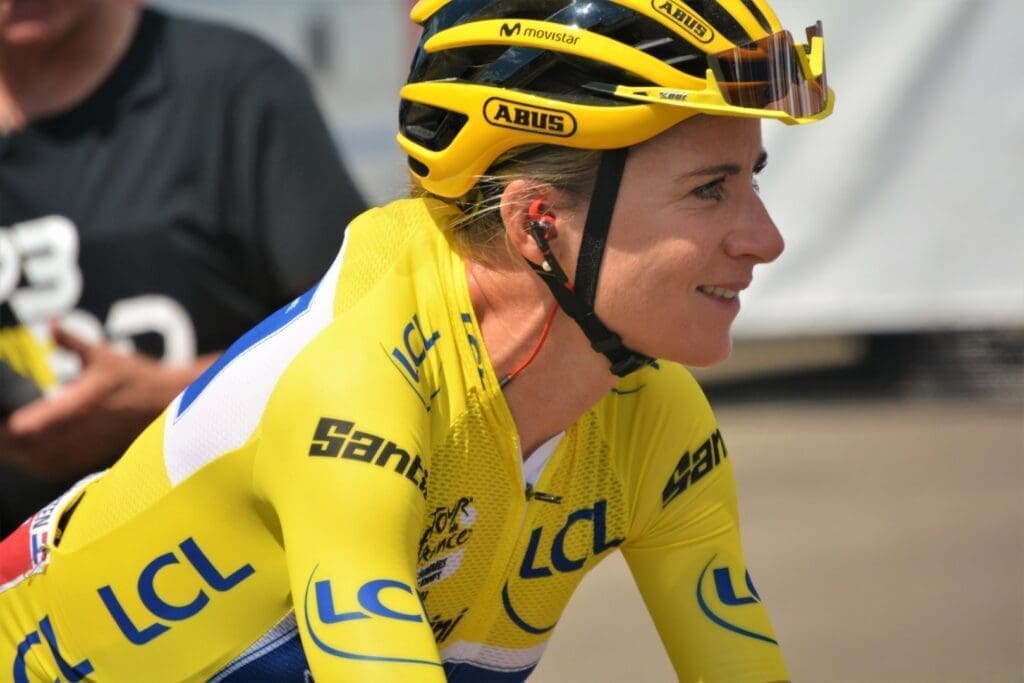
The yellow jersey, or maillot jaune, is worn by the rider leading the Tour de France Femmes general classification.
The GC is based on time rather than points. After every stage, each rider’s recorded time is added to her total from the previous days, with bonus seconds deducted and any time penalties added.
If one rider has completed the opening three stages in 10 hours and another has taken 10 hours and 20 seconds, the first rider leads the Tour by 20 seconds.
It does not matter how many stages either has won. Yellow is decided by total time across the race.
That distinction is important because the yellow jersey is only one of several competitions. The Tour de France Femmes jersey guide explains how yellow differs from the green points jersey, polka-dot mountains jersey and white young rider jersey.
How does a rider take the yellow jersey?
The most obvious way is to gain enough time on the current leader to overturn the existing deficit.
If Demi Vollering begins a stage 15 seconds behind yellow and finishes 25 seconds ahead of the leader, she moves ten seconds ahead on GC before any bonuses are considered.
A rider can also take yellow through an individual time trial. Stage 4 of the 2026 race covers 21km from Gevrey-Chambertin to Dijon, with every rider timed separately.
Then there are bonus seconds.
Those are especially important during the opening part of the race, when the best riders may still be separated by very small margins.
Can a rider take yellow through bonus seconds?
Yes.
On the eight road stages, the first three riders at the finish receive ten, six and four seconds in time bonuses.
Suppose two riders begin a stage on exactly the same GC time. They finish in the same group, so neither gains a physical time gap.
One wins the stage and receives ten bonus seconds. The other finishes fourth and gets nothing.
The stage winner now leads the Tour by ten seconds.
Physically, they finished together. In the general classification, they are no longer level.
The full system is covered in our Tour de France Femmes 2026 time bonuses guide.
How do intermediate bonuses affect yellow?
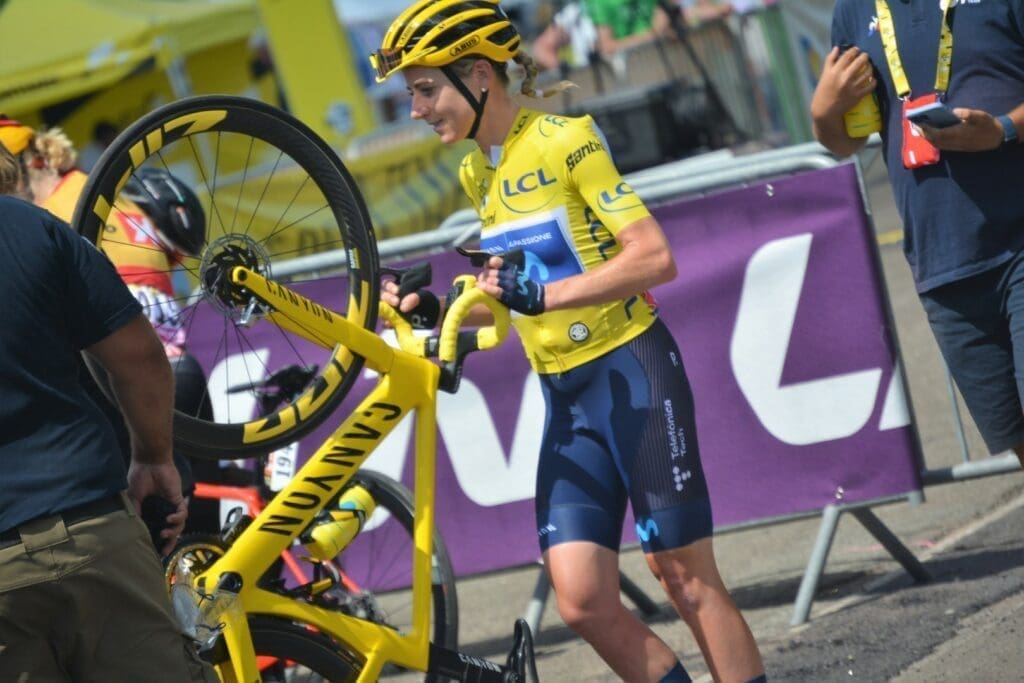
The 2026 Tour also includes designated Bonus Points on Stages 3, 5 and 6.
The first three riders receive six, four and two seconds towards the general classification.
These should not be confused with normal intermediate sprints, which primarily award points towards the green jersey. A Bonus Point directly reduces a rider’s GC time.
That can encourage the yellow jersey contenders to race much earlier than the finish.
A rider starting six seconds behind yellow could theoretically wipe out that deficit by winning one Bonus Point without creating any physical gap on the road.
Across a nine-stage Tour, those small gains can become tactically important.
Why the Stage 4 time trial can completely change yellow
The Stage 4 individual time trial is one of the clearest opportunities to change the race leadership.
Rather than starting together, riders leave individually and race the 21km course towards Dijon against the clock.
There are no finish bonuses. Every second gained is a genuine difference in performance.
If Marlen Reusser finishes 40 seconds faster than a GC rival, she gains 40 seconds on her.
That makes Dijon very different from the opening road stages, where positioning, teams and bonus seconds can keep several riders close together.
The strongest riders against the clock are assessed in our Tour de France Femmes 2026 time-trial contenders guide.
 Photo Credit: Getty
Can a rider take yellow without winning the stage?
Very easily.
Imagine the yellow jersey starts the day 30 seconds ahead of a rival.
A breakaway wins the stage several minutes ahead, but nobody in the move is close enough on GC to challenge for yellow.
Behind them, the GC rival attacks on the final climb and finishes 45 seconds ahead of the race leader.
She moves 15 seconds ahead overall despite not winning the stage.
This is common in mountain racing. The contest for the stage victory and the battle for the yellow jersey can be taking place in completely different groups.
Can someone win the Tour without winning a stage?
Yes.
Stage wins and general classification are separate achievements.
A rider who consistently finishes near the front, performs well in the time trial and never loses meaningful time could win the Tour without taking an individual stage victory.
For a GC contender, the important question is not always whether she can win the stage. It is whether she can gain time on the riders who matter.
Finishing fifth can be an excellent result if every major rival finishes behind.
The 2026 route makes that particularly relevant because different rider types should come to the front across the nine stages.
Why does the yellow jersey team have to control the race?
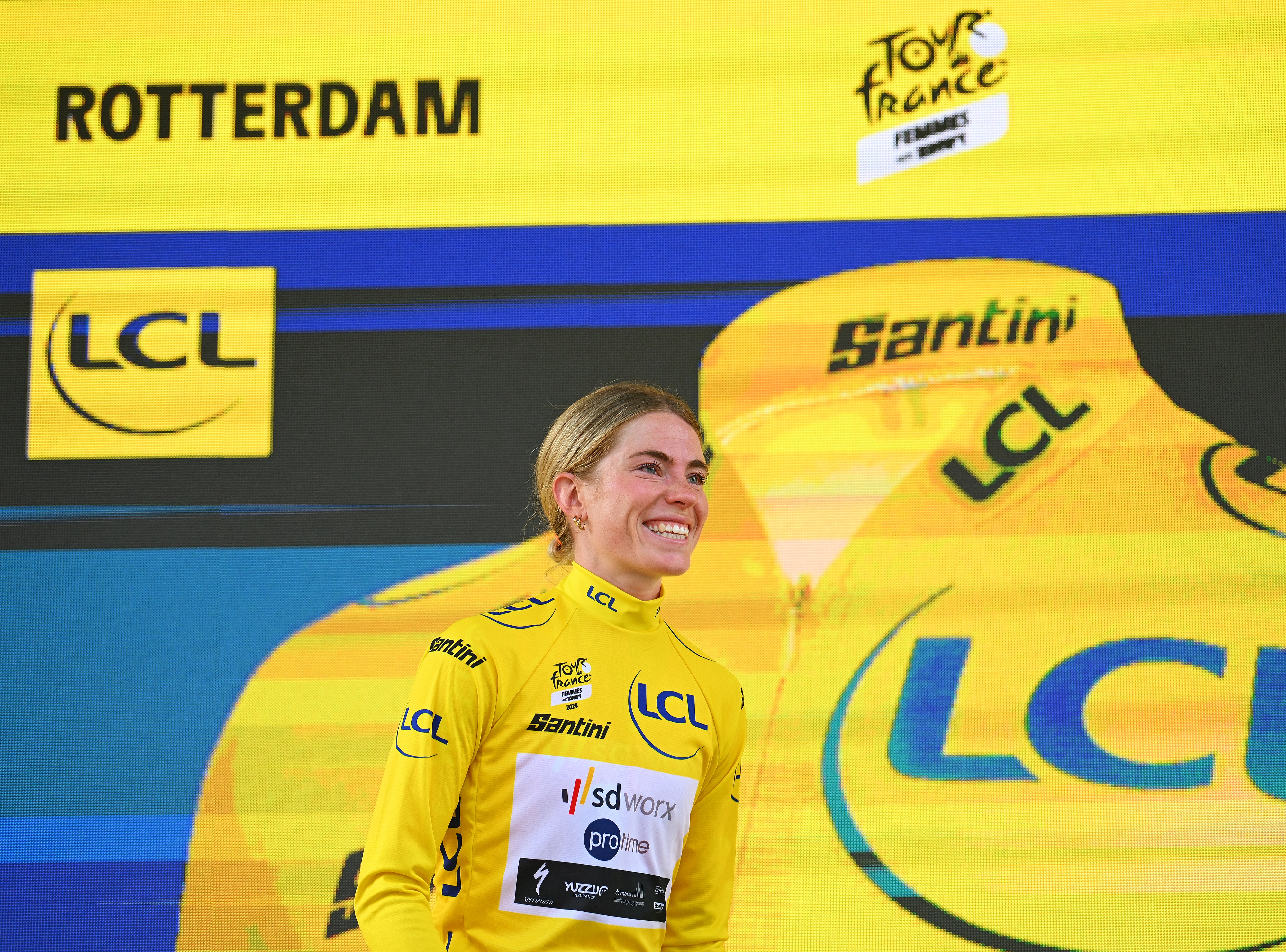
Once a rider takes yellow, tactical responsibility often shifts towards her team.
Suppose a breakaway containing riders more than half an hour down on GC escapes. The yellow jersey team may be happy to let it go because nobody in the move threatens the race lead.
If a rider only two minutes behind gets into the same move, the calculation changes.
Once the breakaway’s advantage exceeds that rider’s GC deficit, she becomes the virtual yellow jersey.
The leader’s team then has to decide whether to chase.
That is why wearing yellow can become expensive. Every dangerous attack potentially creates work for the team defending it.
What does virtual yellow jersey mean?
The virtual yellow jersey is the rider who would lead the Tour if the stage ended at that exact moment.
Imagine the race leader begins Stage 5 one minute ahead of another rider.
That rival enters a breakaway which gains two minutes.
On the road, she is now virtually one minute ahead overall.
She does not receive the yellow jersey during the stage, and the official standings do not change until the finish, but tactically she has become the race leader.
That forces the yellow jersey team to decide whether the move has to be controlled.
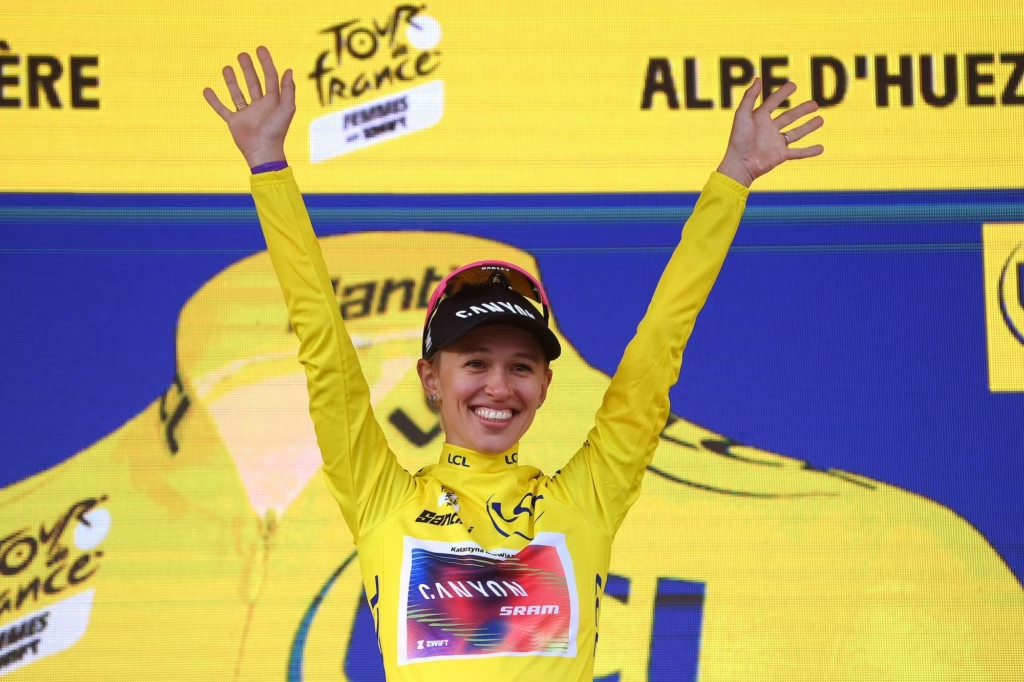
Why might a team deliberately give away yellow?
Because defending the jersey requires energy.
Early in the Tour, one of the main favourites may decide that protecting a small advantage is not worth asking her teammates to control breakaways for several hours every day.
If a rider who is not considered a serious long-term GC threat takes yellow, the favourite can stay close while transferring responsibility to another team.
The new leader’s squad then becomes the one expected to control dangerous moves.
This is sometimes described as giving away yellow.
It does not mean deliberately throwing away the Tour. It means recognising that wearing yellow after Stage 3 matters far less than wearing it after Stage 9.
How does a rider keep yellow on a flat stage?
Usually by avoiding trouble.
GC favourites are rarely trying to create large gaps on conventional sprint stages. Their priority is to finish safely alongside their rivals.
That becomes difficult once the pace rises late in the stage.
Sprint teams move towards the front. GC teams do the same. Narrow roads, road furniture and crosswinds all increase the risk of crashes and splits.
A yellow jersey contender can ride perfectly for four hours and then lose time through one badly timed echelon.
That is why flat stages are often about preventing losses rather than creating gains.
The Tour de France Femmes 2026 Grand Départ guide shows how even the opening Swiss stages contain enough terrain and positioning pressure to make the early yellow jersey battle more complicated than a straightforward sprint contest.
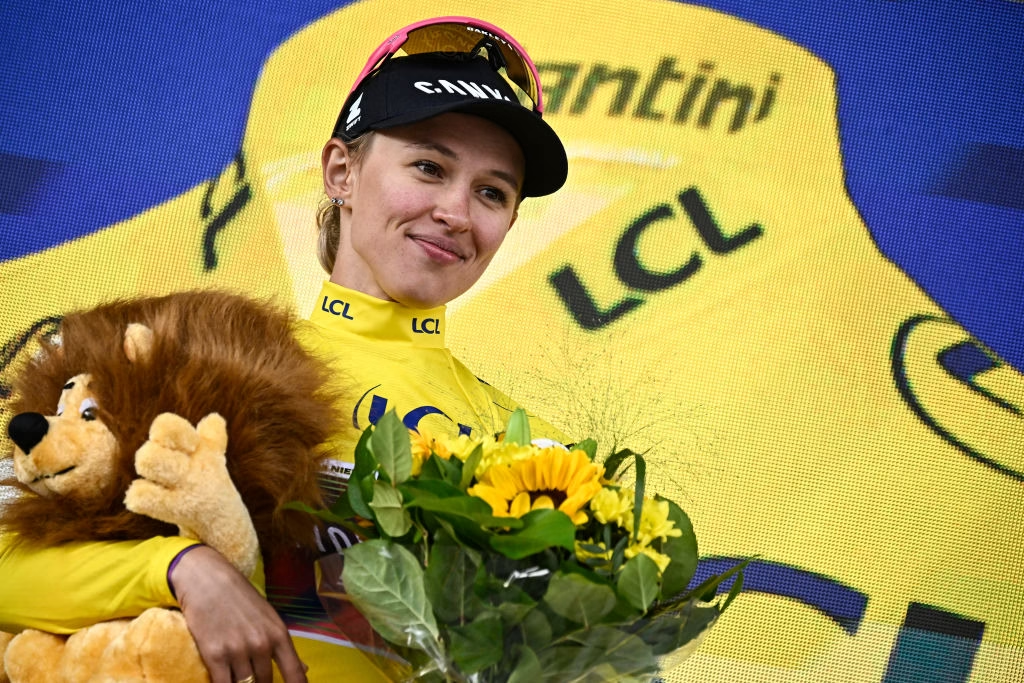
How does yellow change the race on hilly stages?
Hilly stages create more possible threats.
A GC rival can enter the breakaway. A short climb can split the bunch. Bonus seconds can encourage attacks even when nobody expects large physical time gaps.
The yellow jersey team therefore has to decide which moves matter.
Chasing everything wastes energy. Ignoring the wrong move can cost the lead.
Stages 3, 5 and 6 are particularly interesting in 2026 because their intermediate Bonus Points create opportunities to reduce a GC deficit without waiting for the finish.
A rival does not always have to drop yellow.
Sometimes she only has to beat her to the right point on the road.
How does a rider defend yellow in the mountains?
This is where team strength becomes particularly valuable.
The yellow jersey team will normally try to keep climbing domestiques around its leader for as long as possible. Those riders can set the pace, close attacks and protect the leader until the decisive part of a climb.
If yellow becomes isolated early, rivals know that every attack has to be answered personally.
One acceleration may be manageable. Repeated attacks can gradually wear a leader down.
Mont Ventoux is the most obvious test in 2026. The climb is long enough that tactics eventually give way to sustained climbing strength, particularly through the forest and exposed upper slopes.
Our Tour de France Femmes 2026 Mont Ventoux guide looks at why Stage 7 should become one of the defining days of the yellow jersey battle.
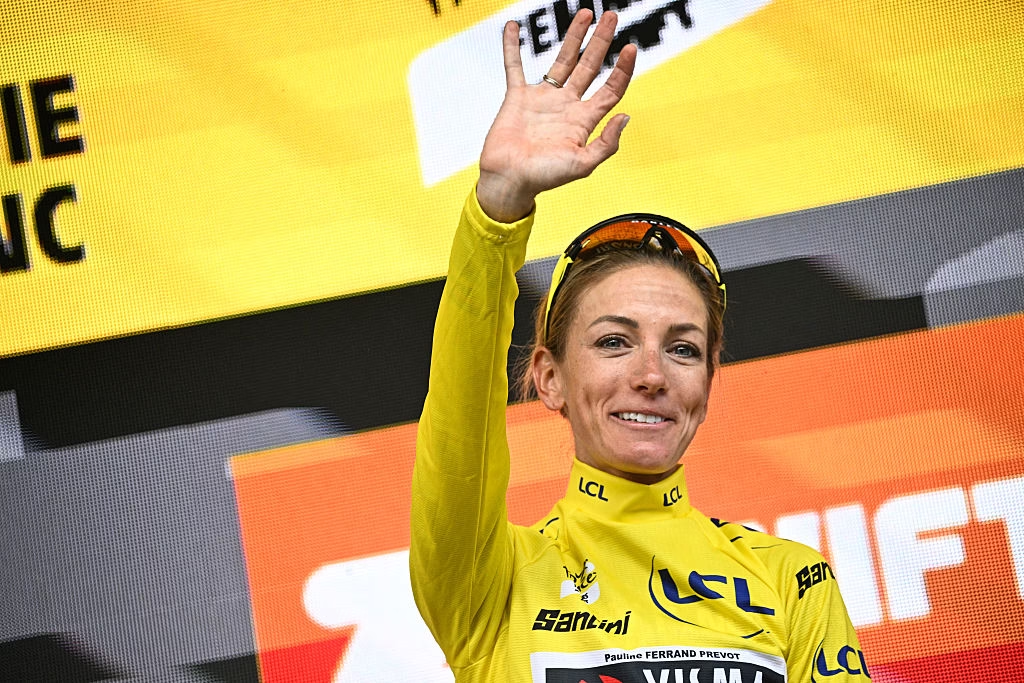 Photo Credit: Getty
Does the yellow jersey need to follow every attack?
No, and knowing which moves to ignore is one of the most important GC skills.
If a rider 35 minutes behind attacks, yellow usually has little reason to respond.
If second overall attacks, the calculation changes immediately.
Even then, the race leader does not necessarily have to jump onto the wheel herself. A strong team can maintain a controlled tempo and gradually bring the attacker back rather than forcing its leader into repeated accelerations.
This is why knowing the GC standings matters while watching a stage.
Two riders can make identical attacks but represent completely different threats.
What happens if the yellow jersey crashes?
It depends on where and when the crash occurs.
If the leader crashes well before the finish, racing normally continues and her team has to help her regain the peloton.
Rivals may choose not to attack immediately if the incident is clearly bad luck, but that is generally a matter of sporting convention rather than a rule requiring the race to stop.
Close to the finish on designated stages, specific regulations can protect riders affected by crashes or mechanical problems by giving them the same time as the group they were riding with.
Those rules are designed to stop the general classification being distorted by the chaotic positioning battle around sprint finishes.
They do not protect a rider who is genuinely dropped because she cannot follow the pace.
What if the yellow jersey has a mechanical problem?
Again, timing matters.
A puncture with 80km remaining usually means teammates drop back, help with the chase and bring the leader back into the peloton.
A mechanical problem immediately before a decisive climb can be much more serious.
There is no general rule saying the peloton must wait for yellow.
Sportsmanship can influence how other teams react, particularly if the problem occurs at a neutral moment, but keeping the jersey still requires positioning, team support and an element of luck.
Can penalties change who wears yellow?
Yes.
Time penalties are added to a rider’s general classification total.
A rider could therefore cross the line apparently having taken yellow, only for a commissaires’ decision to add enough time to change the classification.
Bonuses and penalties work in opposite directions.
Bonus seconds reduce a rider’s GC time. Time penalties increase it.
The official standings after the stage reflect both.
What happens if two riders have exactly the same time?
The Tour has tie-break rules for riders level on cumulative time.
Because the 2026 race includes an individual time trial, fractions of seconds recorded in Dijon can help separate riders who otherwise remain tied.
If riders are still level, cumulative stage placings can be used, with the rider recording the lower total ranked higher.
These rules are particularly relevant early in the Tour when many riders can remain on identical recorded times.
Somebody still has to wear yellow.
Does the rider in yellow have to be leading the stage?
No.
The yellow jersey reflects accumulated time across the Tour, not a rider’s position on the road during the current stage.
The race leader can spend almost the entire afternoon in the peloton while a breakaway sits several minutes ahead.
As long as nobody in that breakaway gains enough time to overtake her in the GC, she remains in yellow.
This distinction between stage position and overall position is fundamental to understanding stage racing.
The rider physically at the front may be nowhere near winning the Tour.
What happens if the yellow jersey also leads another classification?
A rider can lead several classifications at once but can wear only one leader’s jersey.
Yellow takes priority.
If the yellow jersey wearer also leads the green points classification, another rider may wear green during the next stage.
The same principle applies to the polka-dot and white jerseys.
The substitute wearer has not actually inherited the classification lead. The rider in yellow remains the official leader of both competitions.
The full hierarchy is explained in our Tour de France Femmes 2026 jerseys guide.
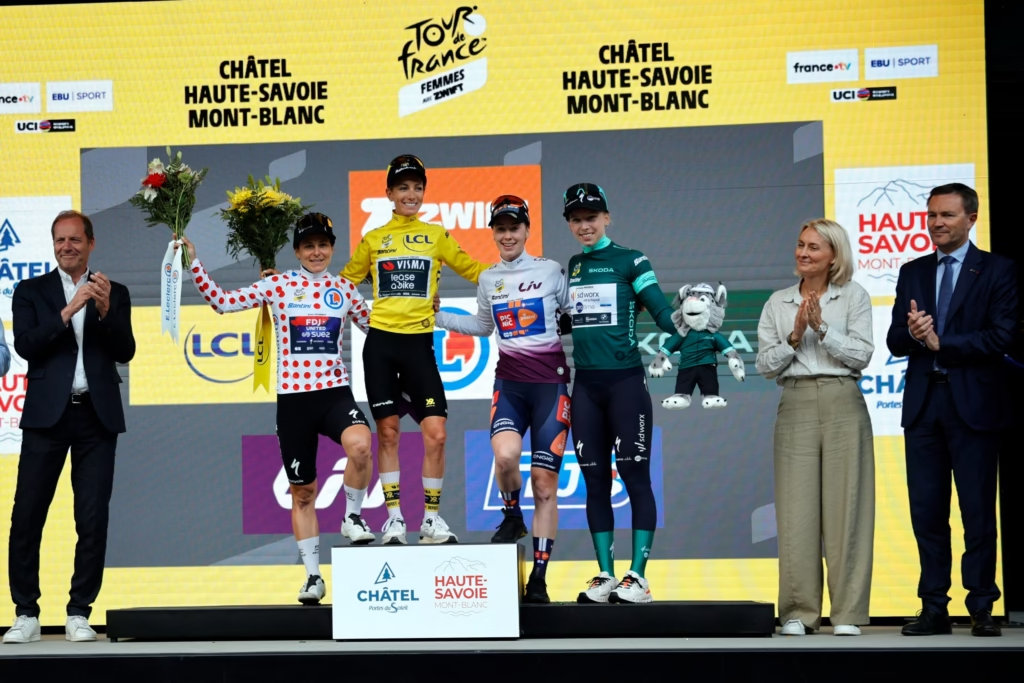
How long can a rider wear yellow?
Potentially one day or the entire Tour.
The Stage 1 winner has a strong chance of becoming the first yellow jersey because there is no existing general classification before the opening stage.
After that, the jersey can move between very different types of rider.
A fast finisher could take it through an early stage victory and bonuses. A time trial specialist could move ahead in Dijon. One of the major GC favourites could then take control on Mont Ventoux.
Or one rider could take yellow early and never surrender it.
Every day spent leading the race counts, even if that rider eventually loses the Tour.
Who are the main yellow jersey contenders in 2026?
The route rewards riders who can do more than simply climb.
Demi Vollering remains one of the most complete contenders because she combines climbing, time trialling and a fast finish capable of collecting bonuses. Defending champion Pauline Ferrand-Prévot has already shown that she can build her season around peaking for the Tour, while Paula Blasi enters after establishing herself as one of the strongest young stage racers in the peloton.
Marlen Reusser and Anna van der Breggen should be particularly dangerous in the Dijon time trial, while Kasia Niewiadoma, Elisa Longo Borghini and Antonia Niedermaier offer different routes into the GC battle.
The Tour de France Femmes 2026 riders to watch guide looks at the wider yellow jersey field and how the route suits each contender.

When is the yellow jersey finally won?
Only after Stage 9.
That matters more than usual in 2026 because the final stage around Nice is a genuine mountain stage rather than a ceremonial procession.
The last classified climb, the Col des Quatre Chemins, measures 6km at 7.6% and tops out with only 15.4km remaining. A rider defending a small lead can still lose the Tour there, while the descent and run towards the Promenade des Anglais add another layer of risk.
The Tour de France Femmes 2026 Nice finish guide explains why the GC can remain open until the final kilometres.
Normal road-stage finish bonuses are also still available, meaning ten, six and four seconds can theoretically influence the final result.
A rider in yellow on the morning of Stage 9 has not yet won the Tour.
She still has to reach Nice with the lowest total time.
Yellow jersey tactics at a glance
| Situation | What the yellow jersey team usually wants |
|---|---|
| Breakaway with riders far behind | Allow it freedom if nobody threatens GC |
| GC rival enters breakaway | Control the advantage or chase |
| Flat sprint stage | Keep the leader near the front and out of trouble |
| Crosswinds | Position early and avoid being caught behind a split |
| Hilly stage | Monitor GC attacks and bonus seconds |
| Individual time trial | Leader races entirely on her own performance |
| Mountain stage | Keep climbing support around the leader for as long as possible |
| Rival attacks | Decide whether to follow directly or control with teammates |
| Final stage | Protect every remaining second until the race is finished |
The yellow jersey is both a reward and a tactical responsibility.
Taking it means a rider has been the fastest across the Tour to that point. Keeping it means managing everything that comes afterwards, from bonus seconds and breakaways to crashes, crosswinds and the high mountains.
The obvious tests in 2026 are Dijon, Mont Ventoux and the final stage around Nice, but yellow can disappear almost anywhere. A six-second Bonus Point, a split on a supposedly straightforward stage or one badly timed mechanical can change the entire race.
The strongest rider does not simply need to be good enough to take the lead.
She has to know how to race once everybody else knows she has it.

