

Pauline Ferrand-Prévot starts the 2026 Tour de France Femmes in a very different position to the one she occupied 12 months ago.
In 2025 she arrived as one of the most fascinating riders in the race, newly returned to full-time road racing after years built around mountain biking. She left as Tour de France Femmes champion, having taken control in the Alps and eventually won by 3:42.
Now everybody knows what she can do.
Demi Vollering has produced the stronger 2026 season. Paula Blasi has emerged as a Grand Tour winner. Marlen Reusser has become an increasingly complete GC rider and Kasia Niewiadoma-Phinney remains one of the most consistent Tour performers in the peloton.
Ferrand-Prévot, meanwhile, reaches the Tour without a victory this season. She finished second at the Tour of Flanders, third at Paris-Roubaix and seventh at Flèche Wallonne, but her results have not provided the same emphatic evidence as Vollering’s.
Taken in isolation, that makes Vollering the more obvious favourite.
The problem with judging Ferrand-Prévot that way is that 2025 taught us exactly why her season cannot be read like everybody else’s.
The Tour is the target.
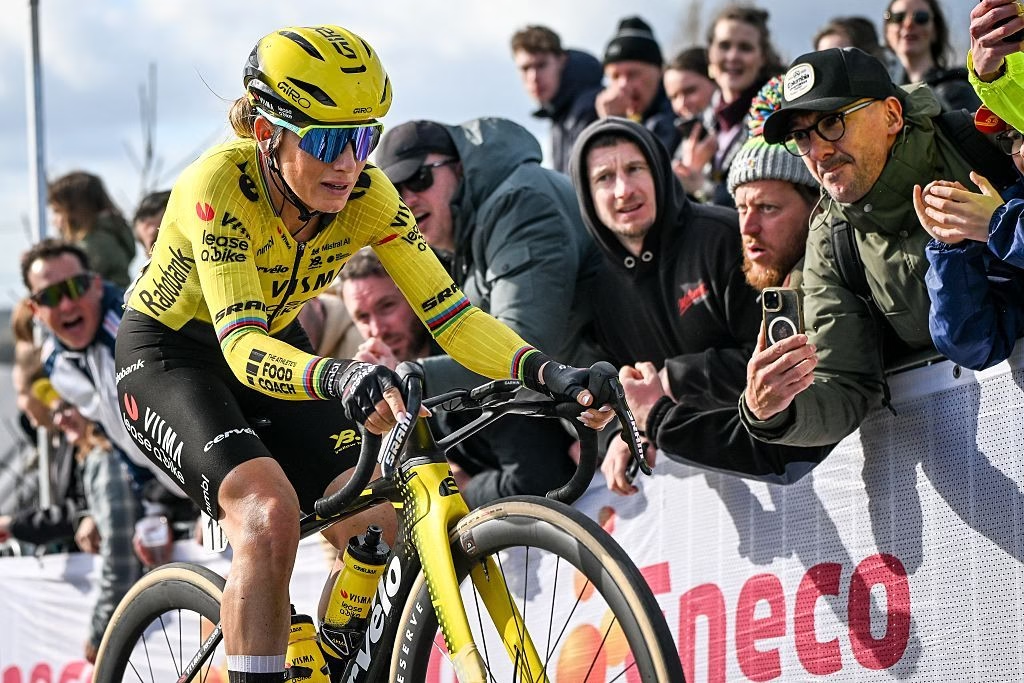
Ferrand-Prévot built 2026 around defending yellow
Ferrand-Prévot made her priorities clear before the season had properly begun.
After winning Paris-Roubaix and the 2025 Tour de France Femmes in her first full road season back, defending yellow became the obvious centre of the 2026 campaign. The dynamic would inevitably change. She could no longer arrive as the returning mountain-bike champion whose ability over nine road stages was still an unknown.
She starts this Tour as the defending champion.
That distinction matters when assessing everything Ferrand-Prévot has done in 2026. Her programme has not been constructed around accumulating victories from February through July. It has been about reaching August capable of reproducing the level that won the Tour last year, while improving the area where the 2026 Tour de France Femmes route threatens to expose her most clearly.
That is the time trial.
Stage 4 brings a 21km individual test from Gevrey-Chambertin to Dijon, long enough for riders such as Vollering and Reusser to create genuine GC differences. Ferrand-Prévot has made work on the TT bike part of her preparation because this year’s Tour may require her to win the race differently.
Whether that preparation has worked will not really become clear until Dijon.
Her spring was strong without producing a win
Ferrand-Prévot’s Classics results are easy to underestimate because there is no victory beside her name.
Second at the Tour of Flanders and third at Paris-Roubaix still represent an excellent spring.
At Flanders she was the closest finisher to Vollering after the eventual winner attacked on the Oude Kwaremont. A week later, Ferrand-Prévot returned to Paris-Roubaix as defending champion and again reached the podium, finishing third.
Neither was a win, but both showed that the physical level which made her so difficult to race against in 2025 had not disappeared.
There is also a Tour-relevant point beneath those results. Ferrand-Prévot is not dependent on a summit finish to influence a race. She can position herself through chaotic terrain, repeatedly accelerate over short climbs and remain effective deep into races where fatigue and tactical decisions matter as much as straightforward climbing numbers.
Those qualities should be useful during the first six stages of the Tour, when the GC favourites have plenty to lose before reaching Mont Ventoux.
What the spring did not provide was proof that Ferrand-Prévot has moved beyond her 2025 level.
Vollering has provided that sort of signal repeatedly.
Ferrand-Prévot has not.
That is why being defending champion does not automatically make her the pre-race favourite.
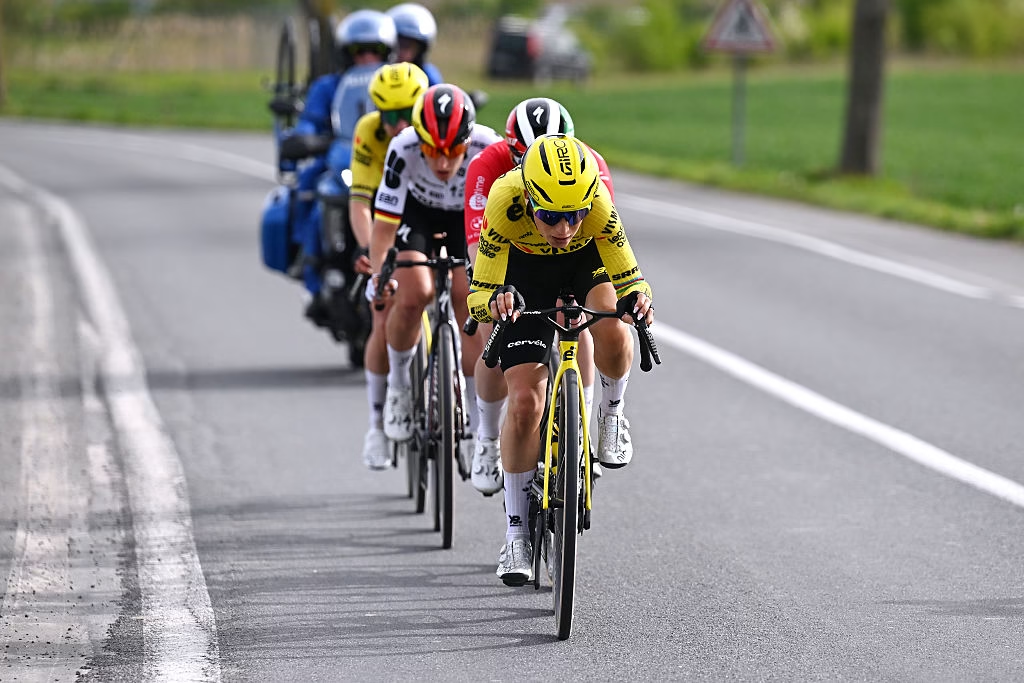
The Vuelta result matters less than it looks
Ferrand-Prévot’s La Vuelta Femenina did not resemble the campaign of a rider preparing to defend the Tour.
She finished well outside the GC battle while Paula Blasi emerged as the overall winner and Ferrand-Prévot’s Visma | Lease a Bike teammate Marion Bunel finished third.
Normally, that would be a significant warning sign.
With Ferrand-Prévot, the context is more complicated.
The Vuelta was part of the process rather than the destination. She was using the race to build the stage-racing rhythm and endurance required later in the summer, rather than attempting to produce her Tour peak in early May.
That does not make the result meaningless. Blasi was much stronger when the Vuelta reached its decisive mountains and Ferrand-Prévot did not provide evidence there that she was already operating at Tour-winning level.
But May and August were never supposed to represent the same version of Ferrand-Prévot.
Her 2025 season established the pattern. Few riders in the peloton are better at constructing their preparation around one major objective and reaching that race in dramatically stronger condition than their earlier results might suggest.
If Ferrand-Prévot struggles in August, the Vuelta will suddenly look like an early warning.
If she is attacking Vollering on Ventoux, it will look like preparation.
The 2026 route asks a different question
Ferrand-Prévot is not being asked simply to repeat the Tour she won last year.
The 2026 race covers nine stages from Lausanne to Nice, with the Dijon time trial arriving on Stage 4 before a progressively harder second half of the race. Stage 7 finishes on Mont Ventoux and the final day around Nice remains mountainous enough to change the general classification.
That creates a very different challenge.
In 2025 Ferrand-Prévot was able to turn the Tour into a climbing contest late in the race and then overwhelm her rivals when the mountains became decisive.
This year the stopwatch arrives first.
The 21km into Dijon is long enough for the strongest GC time triallists to gain much more than a handful of seconds. Reusser has the most obvious opportunity to transform the classification there, while Vollering could gain time over Ferrand-Prévot without giving anything away in the mountains that follow.
Ferrand-Prévot therefore faces a plausible scenario in which the decisive climbing stages begin with her already behind.
That changes how she may have to defend yellow.
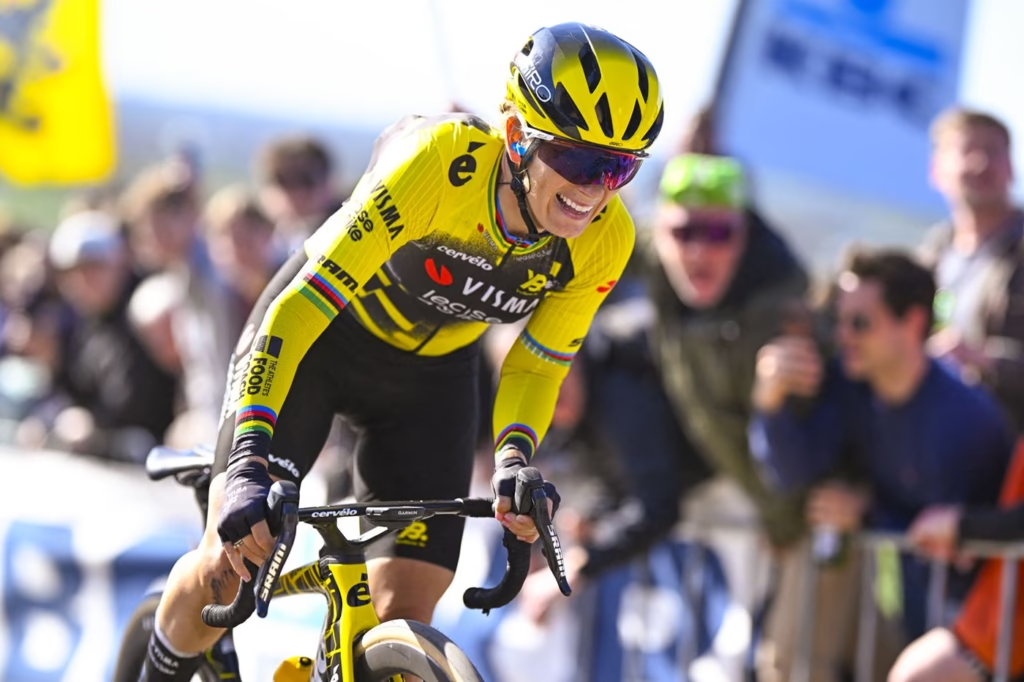
Dijon could turn the defending champion into the challenger
The most interesting question is not whether Ferrand-Prévot can ride a good time trial.
It is what happens if a good time trial is still not good enough.
She has specifically worked on the discipline and 21km is short enough that a strong performance should keep the damage manageable. But Vollering does not need to put minutes into her.
Thirty seconds could change the Tour.
If Ferrand-Prévot emerges from Dijon close to Vollering, Visma can remain patient. The race still moves towards terrain where the defending champion knows she can make a difference.
If she loses significantly more, the tactical roles change.
Ferrand-Prévot may arrive wearing number one, but she becomes the rider who has to take the race away from someone else.
That could actually suit her.
Her greatest performances have rarely been based on sitting behind rivals and calculating small margins. Ferrand-Prévot is at her most dangerous when the race provides a clear problem and she can commit fully to solving it.
A deficit after Dijon would give her exactly that.
Mont Ventoux is where she can reverse the Tour
Everything points towards Mont Ventoux on Stage 7 becoming the centre of Ferrand-Prévot’s title defence.
The stage covers 146.8km from La Voulte-sur-Rhône and finishes with the ascent from Bédoin. The officially categorised final climb is 15.7km at 8.8%, reaching 1,910 metres beside the summit observatory.
There is nowhere to hide there.
That is important for Ferrand-Prévot because a climb of that length strips away some of the tactical complexity that defines the earlier stages. Positioning still matters and team support can shape the approach, but eventually the strongest GC riders have to climb.
If Ferrand-Prévot loses time in Dijon, she does not necessarily need to spend Stages 5 and 6 throwing attacks into every piece of hilly terrain. The smarter approach may be to keep the deficit stable, make FDJ United-Suez accept responsibility for controlling the race and reach Ventoux with as much energy as possible.
Then the equation becomes simpler.
She needs to attack.
The size of the Dijon deficit determines when.
Ten or 15 seconds allows Ferrand-Prévot to remain patient and wait until the climb has already reduced the group.
Thirty or 40 seconds makes a meaningful attack necessary.
A minute would force her to create a genuinely significant mountain gap against Vollering, a rider who is herself capable of winning on terrain like Ventoux.
That is what makes Stage 4 so important to Stage 7. The time trial will not necessarily decide the Tour, but it could dictate exactly how Ferrand-Prévot has to race its biggest mountain.
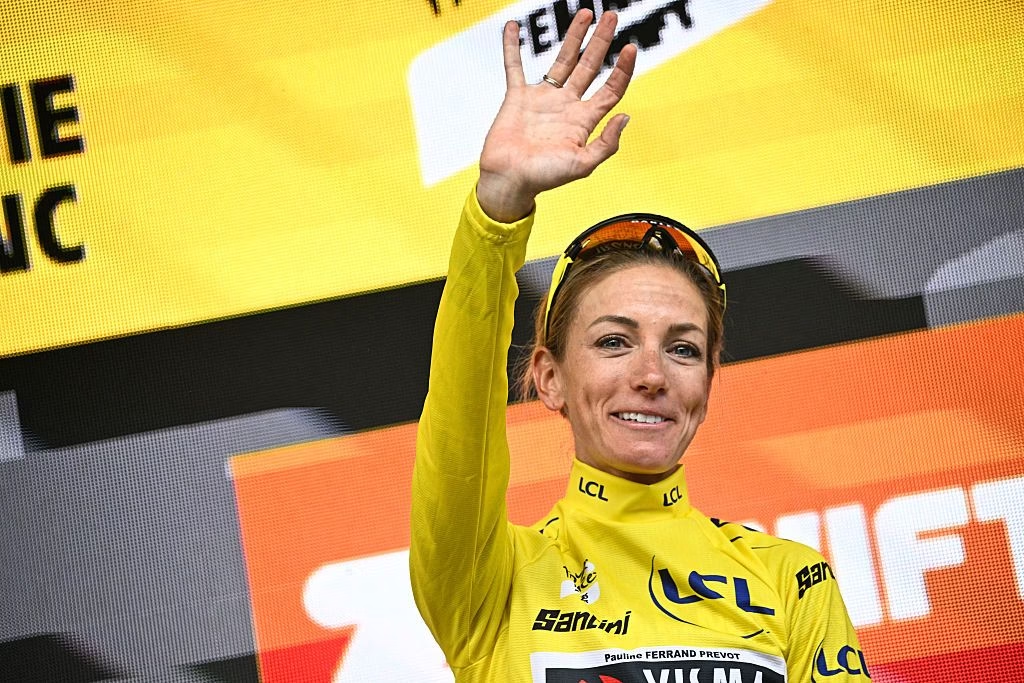
She cannot simply reproduce the 2025 formula
Ferrand-Prévot won the 2025 Tour by being overwhelmingly strong when the race finally reached its decisive Alpine terrain.
That does not mean doing exactly the same thing wins in 2026.
For one thing, the opposition has changed.
Blasi’s emergence gives Ferrand-Prévot another rider capable of making the hardest mountain stages genuinely selective. Reusser could arrive at Ventoux defending an advantage earned in Dijon. Niewiadoma-Phinney has repeatedly demonstrated how difficult she is to remove from Tour contention.
Most importantly, Vollering has a route which suits her.
She can take time in Dijon, but unlike a pure time triallist she does not then have to spend the mountains attempting to survive. Vollering can be one of the strongest riders on Ventoux herself.
Ferrand-Prévot therefore cannot assume that producing her 2025 climbing level will automatically create another decisive margin.
She may need to be even better.
Visma have more than one way to attack the GC
Ferrand-Prévot will not arrive at the mountains alone.
Visma | Lease a Bike bring Marion Bunel, Femke de Vries, Sarah van Dam, Marianne Vos, Lieke Nooijen and Daniek Hengeveld alongside the defending champion.
Bunel is particularly important.
Her third place at La Vuelta Femenina showed that she can remain competitive deep into a Grand Tour and gives Visma another rider who cannot simply be ignored once the race starts climbing.
That creates several possibilities.
If Bunel remains high on GC after Dijon, rival teams may have to account for two Visma riders. She can attack before Ferrand-Prévot, force another team to chase or stay with the favourites long enough to provide support deep into the mountain stages.
If Ferrand-Prévot is clearly the strongest Visma rider, the hierarchy is simple.
If she is not, Bunel gives them insurance.
Vos brings a different sort of value. Her opportunities come primarily through stages and selective finishes rather than the final GC battle, which means Visma do not need Ferrand-Prévot chasing every bonus second or involving herself in fights that do not directly improve her chances of defending yellow.
For Ferrand-Prévot, the objective can remain unusually narrow.
Stay safe. Save energy. Limit Dijon. Win the Tour in the mountains.
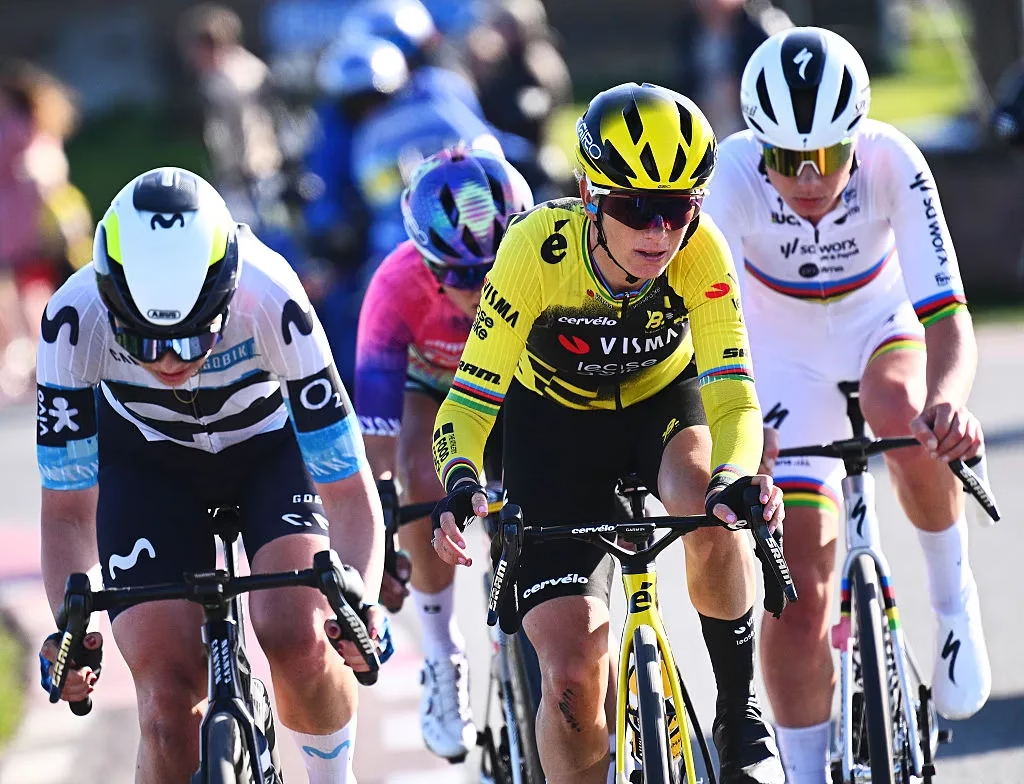
Vollering is the biggest difference from last year
The question surrounding Ferrand-Prévot is not really whether she can be as good as she was in 2025.
She may have to be better.
Vollering has produced the stronger body of form during 2026 and has a route which offers her a remarkably straightforward path to victory. She is strong enough against the clock to gain time in Dijon and strong enough in the mountains that Ferrand-Prévot cannot expect to erase that deficit simply by waiting for the road to rise.
That makes the expected duel between them particularly interesting.
Vollering can potentially race proactively in Dijon and defensively on Ventoux.
Ferrand-Prévot may have to do the opposite.
That contrast is central to the wider Tour de France Femmes 2026 GC battle. Ferrand-Prévot has the evidence of last year’s Tour. Vollering has the stronger 2026 form and perhaps the cleaner route to yellow.
Neither removes the other from the equation.
-
 Photo Credit: Getty
Nice means Ventoux does not have to decide everything
The amount of attention on Ventoux risks making Stage 7 look like the finish of the Tour.
It is not.
The race continues towards Nice before finishing with a short mountain stage around the city on Stage 9. That final day gives the GC riders one last opportunity after Ventoux has already exposed their relative strength.
For Ferrand-Prévot, that matters.
If she takes most of a Dijon deficit back on Ventoux without completely overturning the classification, she does not necessarily have to panic. A gap of 15 or 20 seconds remains attackable on the final day, particularly once accumulated fatigue has reduced the ability of teams to control the race.
Ferrand-Prévot also knows the terrain around Nice exceptionally well.
Local knowledge does not replace stronger legs, but on a short final mountain stage it can matter. Knowing where a climb changes character, where a descent can be pushed and where apparently harmless roads become difficult can influence the point at which an attack is made.
It means Ventoux can be the biggest move without necessarily being the final move.
Can Pauline Ferrand-Prévot win the Tour de France Femmes again?
Absolutely.
If Ferrand-Prévot successfully defends yellow, she will become the first rider to win the modern Tour de France Femmes twice. The four editions since the race returned in 2022 have produced four different champions, with Annemiek van Vleuten, Vollering, Niewiadoma-Phinney and Ferrand-Prévot each winning once.
She should not start 2026 as the outright favourite.
Vollering has produced the better season and the Dijon time trial gives her a route-specific advantage that Ferrand-Prévot has to overcome. Blasi’s emergence and Reusser’s development also make this a deeper GC contest than simply a repeat of last year’s race.
But there is a difference between placing Ferrand-Prévot narrowly behind Vollering and believing she is significantly less likely to win.
The gap is small.
Ferrand-Prévot has already demonstrated that she can shape an entire season around this race and reach the decisive mountains at a level her previous results did not fully predict. She has built her 2026 preparation around defending the Tour, worked specifically on the time trial and arrives with a team capable of supporting an aggressive mountain strategy.
Dijon will tell us how difficult the defence has become.
Ventoux will tell us whether Ferrand-Prévot can do something about it.
If she arrives at the Giant of Provence close enough to yellow and produces the climbing level that won the Tour in 2025, Vollering may once again find herself facing the same question as everyone else.
Can she follow Pauline Ferrand-Prévot when the defending champion finally attacks?

