

Kim Le Court-Pienaar begins Stage 2 of the 2026 Tour de France Femmes only four seconds away from the yellow jersey after finishing second behind Lorena Wiebes in Lausanne.
AG Insurance-Soudal positioned their leader near the front throughout the final kilometre, allowing Le Court-Pienaar to follow the decisive acceleration on the Côte Saint-François before producing the strongest sprint of the recognised general classification contenders.
Only Wiebes, the fastest pure sprinter in the race, finished ahead of her. Demi Vollering took third, leaving Le Court-Pienaar two seconds ahead of the former Tour winner and six seconds clear of Pauline Ferrand-Prévot, Kasia Niewiadoma-Phinney, Elisa Longo Borghini and Marlen Reusser in the overall standings.
For viewers less familiar with the Mauritian, this was not a sudden breakthrough from an unknown rider. Le Court-Pienaar is a Liège-Bastogne-Liège winner, a Tour de France Femmes stage winner and the first African woman to wear the yellow jersey in the modern race.
Stage 1 confirmed that she has returned to the Tour as a serious leader rather than a rider hoping to surprise the favourites again.
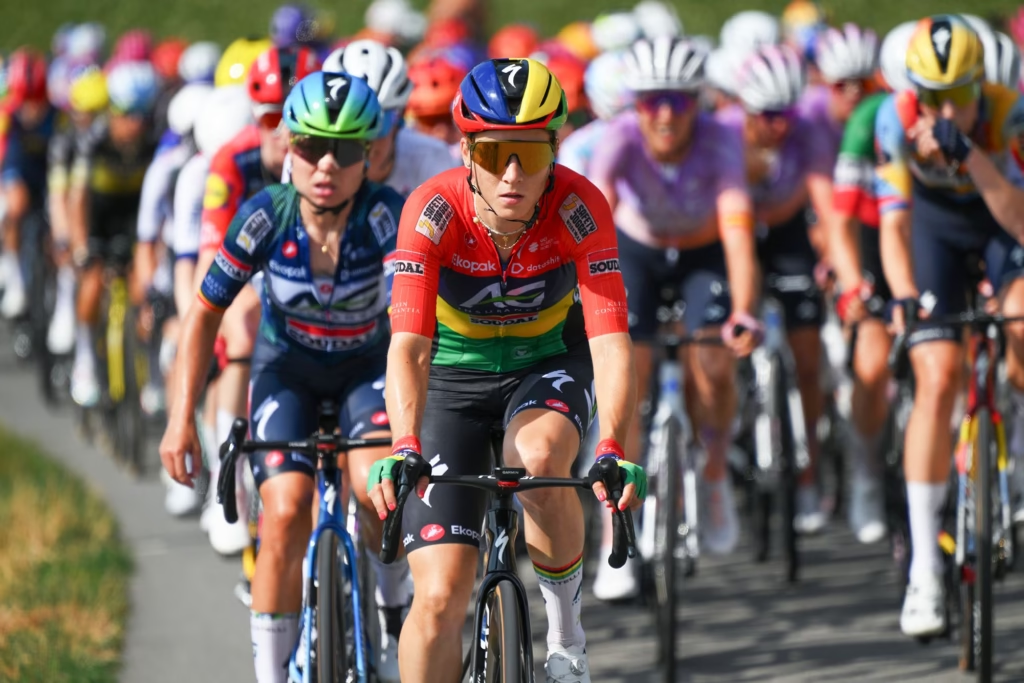
Where is Kim Le Court-Pienaar from?
Le Court-Pienaar is from Mauritius, the island nation in the Indian Ocean off the east coast of Africa.
Born on 23 March 1996, she is 30 years old and races in the colours of the Mauritian national champion. Her full name is Mary Patricia Kimberley Le Court de Billot-Pienaar, although she is normally listed by her team and in race coverage as Kim Le Court-Pienaar.
Her path to the Women’s WorldTour has been different from that followed by most leading European riders. Le Court-Pienaar did not progress entirely through the established junior and under-23 road system. She spent significant parts of her career racing mountain bikes and built much of her endurance base through off-road competition in Mauritius and South Africa.
That background helped develop the combination of climbing strength, bike handling and durability that now makes her such a difficult rider to categorise.
She is not a pure climber, sprinter or time triallist. She is an all-rounder who becomes particularly dangerous when a hard race ends with a reduced group.
Mountain biking helped rebuild her career
Le Court-Pienaar first attempted to establish herself in European road cycling during the middle of the previous decade but did not immediately secure a lasting place in the professional peloton.
She subsequently concentrated more heavily on mountain biking, competing across Africa and becoming a regular presence in major off-road events. Her achievements included success at the Cape Epic, one of the most demanding mountain-bike stage races in the world.
Rather than representing a diversion from her road career, those years became part of her development. Long off-road races improved her endurance, resilience and technical ability, while competing outside the European road structure allowed her to continue progressing when a conventional professional pathway was not available.
Le Court-Pienaar eventually returned her focus to road cycling and earned a move to AG Insurance-Soudal for the 2024 season.
The Belgian team initially gained a versatile rider capable of supporting several leaders. Within two seasons, they had developed one of the most important riders in the squad.
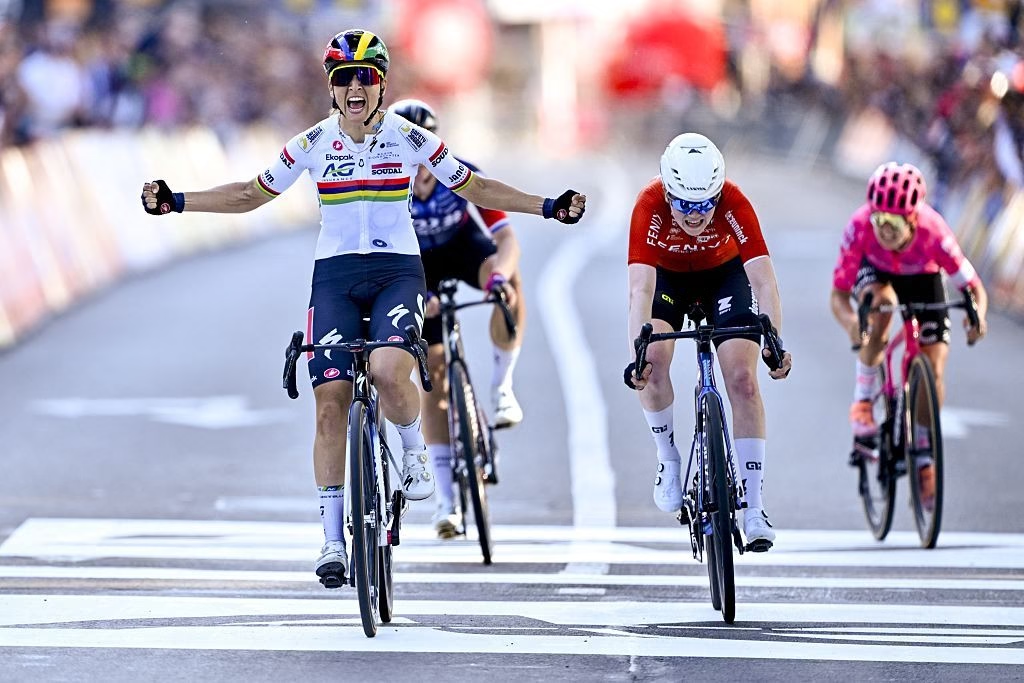
The 2025 season transformed her status
Le Court-Pienaar’s career changed during an exceptional 2025 campaign.
Her victory at Liège-Bastogne-Liège established her among the leading one-day riders in the women’s peloton. She survived one of the hardest races of the spring and still had enough speed to convert that strength into victory, becoming the first African cyclist to win one of the sport’s Monuments.
That result alone would have represented a major breakthrough. Her performances at the Tour de France Femmes made her rise even more significant.
Le Court-Pienaar finished second on the opening stage and moved into yellow after taking third on the following day. In doing so, she became the first African woman to lead a Grand Tour.
She later won the stage into Guéret and regained the yellow jersey, confirming that her early success had not simply been created by bonus seconds or favourable positioning. She had the strength to win a difficult Tour stage against many of the best riders in the world.
Her GC challenge eventually faded once the race reached the hardest mountain terrain, and AG Insurance-Soudal shifted more support towards Sarah Gigante. Le Court-Pienaar had nevertheless demonstrated that she could lead the Tour, win a stage and remain involved beyond the opening days.
Our report on Le Court-Pienaar extending with AG Insurance-Soudal through 2028 explains how those performances established her as a long-term leader within the team.
A broken wrist disrupted her 2026 spring
Le Court-Pienaar began 2026 with fourth place overall at the UAE Tour Women, providing an early indication that her stage-racing level remained high.
Her spring campaign was then interrupted by a crash at the Tour of Flanders. She fractured her wrist and required surgery, ruling her out of the Ardennes Classics and preventing her from defending the Liège-Bastogne-Liège title.
The injury cost her around two months of racing and training at an important point in the season. It also left AG Insurance-Soudal without their leading option for the races that best suit her strengths.
Le Court-Pienaar returned at the Tour de Suisse Women and immediately produced encouraging evidence that the lay-off had not removed her climbing level. She finished fourth overall against a field containing several of the riders expected to challenge for the Tour de France Femmes.
That result was particularly important because the Tour de Suisse combined climbing with an individual time trial. It gave Le Court-Pienaar and her team a clearer measure of her recovery than a single one-day result could have provided.
She then won both the road race and time trial at the Mauritian national championships before completing her final altitude preparation in Tignes.
Le Court-Pienaar therefore arrived in Lausanne without the uninterrupted spring she would have wanted, but with enough recent form to justify AG Insurance-Soudal’s top-five target.
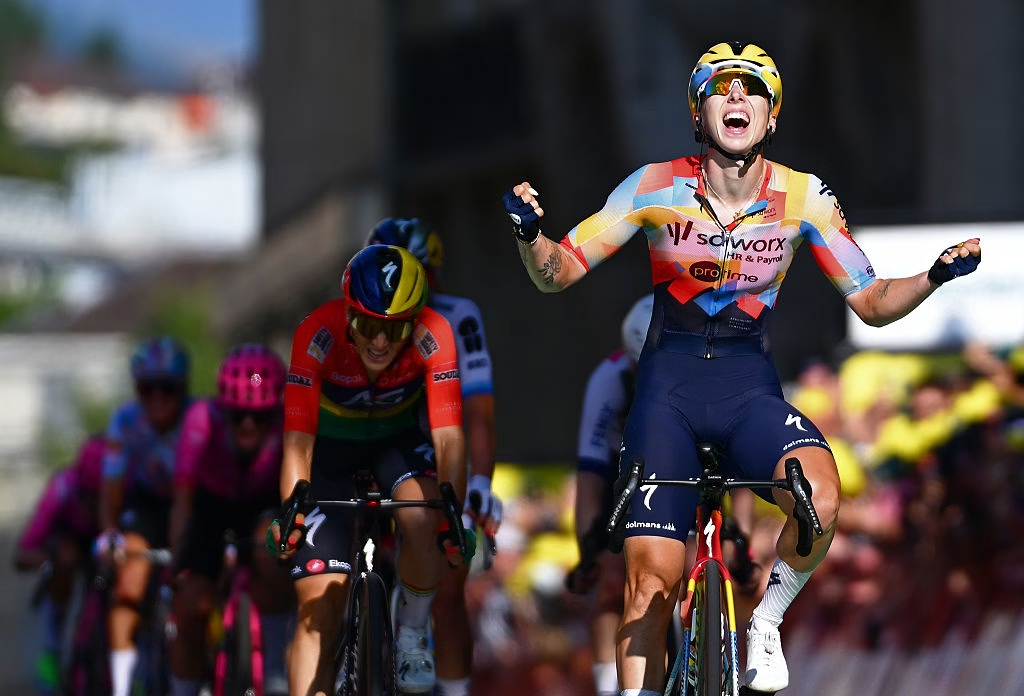
Why Le Court-Pienaar finished second on Stage 1
AG Insurance-Soudal rode the Lausanne finale around Le Court-Pienaar.
The team ensured that she entered the final climb near the front rather than wasting energy moving through traffic once the accelerations began. That positioning was essential on a finish where losing several places at the bottom could quickly become an unbridgeable gap.
Le Court-Pienaar followed the main changes of pace and remained close enough to challenge once the race became a sprint. Wiebes ultimately had too much outright speed, but the Mauritian finished ahead of Vollering, Puck Pieterse and every other major GC rider.
The result brought six bonus seconds and left her only four seconds behind Wiebes in the general classification after Stage 1.
It was almost the ideal start for a rider targeting the top five overall. Le Court-Pienaar gained time on most of her rivals without having to launch a long attack or expose herself unnecessarily.
The only rider she could not beat was one who is expected to dominate the pure sprints.
What type of rider is Kim Le Court-Pienaar?
Le Court-Pienaar is best described as a powerful all-rounder with a fast finish.
She climbs well enough to remain with leading GC riders on repeated short ascents and medium mountains, but she also possesses greater sprinting speed than most pure climbers. That makes her particularly dangerous on uphill finishes, selective one-day races and stages decided by a reduced group.
Her mountain-bike background contributes to her handling and comfort in unpredictable racing. She is capable of moving through technical sections, responding to attacks and maintaining power after a long, attritional day.
That versatility also creates tactical value for AG Insurance-Soudal. Le Court-Pienaar does not need every stage to be controlled around one narrow scenario. She can attack, sprint, follow the favourites or benefit from bonus seconds.
The limitations appear when the race becomes more specialised.
She is not expected to match Marlen Reusser in a flat individual time trial, nor has she yet shown that she can climb with the very best riders on the longest and steepest summit finishes. The 2026 Tour route will test both areas.

Dijon is the first major GC test
Stage 4 contains a 21km individual time trial from Gevrey-Chambertin to Dijon.
That stage should favour Reusser, Vollering and the strongest specialists against the clock. For Le Court-Pienaar, it is more likely to be about limiting losses than challenging for victory.
Her Stage 1 bonus seconds help. Beginning the Tour ahead of most of the GC favourites gives her a small buffer before a discipline in which several rivals should be stronger.
She does not need to match Reusser’s time to preserve a realistic top-five challenge. She needs a controlled ride that keeps her within reach of the strongest climbers before the Tour reaches Mont Ventoux and Nice.
The tactical importance of that stage is covered in our Tour de France Femmes 2026 time trial guide.
Mont Ventoux will define her overall ceiling
The most difficult question comes on Stage 7, when the Tour finishes on Mont Ventoux.
The final climb is long and consistently steep enough to reduce the importance of positioning and sprinting speed. It should reveal whether Le Court-Pienaar can remain with Vollering, Ferrand-Prévot, Niewiadoma-Phinney and the strongest pure climbers when the race becomes a sustained test of power-to-weight ratio.
Her fourth place at the Tour de Suisse suggests she has improved in the mountains. The 2025 Tour also showed that she can carry a high overall position deep into a stage race.
Ventoux is a different level of examination.
Le Court-Pienaar does not necessarily need to match every attack to achieve AG Insurance-Soudal’s top-five objective. A controlled climb that limits the damage could be enough, particularly if she continues gaining seconds and placings on the stages that suit her better.
Winning the Tour would require something more. She would need to perform above her established level in both the Dijon time trial and the longest mountain stages.

Can Kim Le Court-Pienaar win the Tour de France Femmes?
Le Court-Pienaar is a credible GC contender, but she is not yet one of the leading favourites to win the race.
Her strengths make her capable of gaining time in places where pure climbers may only be trying to survive. Stage 1 was a clear example. She collected six bonus seconds and finished ahead of nearly every rider expected to challenge on Ventoux.
The Tour will eventually place much greater emphasis on sustained climbing and time trialling, however. Those stages currently favour Vollering, Ferrand-Prévot, Reusser and several of the riders ranked above Le Court-Pienaar before the race.
A top-five finish is the more realistic objective and would still represent a major step in her development as a stage racer.
AG Insurance-Soudal have openly built their Tour around that target. Their 2026 Tour de France Femmes squad announcement explains how the supporting group has been selected to protect Le Court-Pienaar while retaining options for breakaways and stage victories.
Stage 1 showed that the plan is already functioning. The team delivered their leader into the correct position, and she converted that work into second place.
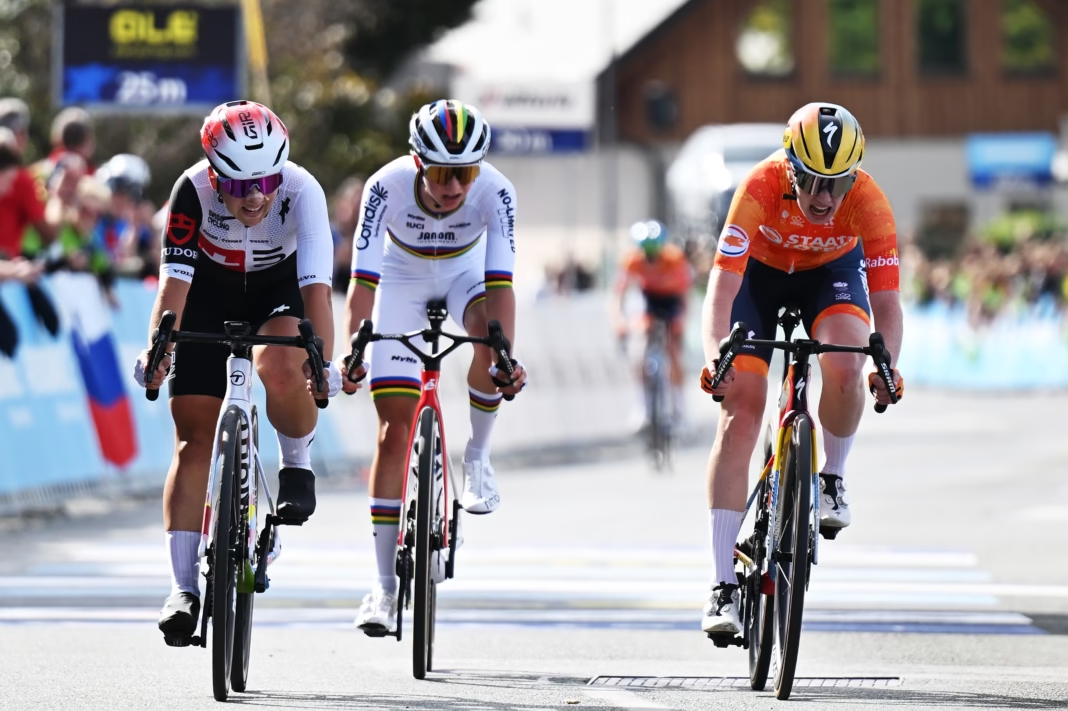
Could she take yellow on Stage 2?
Le Court-Pienaar starts Stage 2 only four seconds behind Wiebes, placing the yellow jersey within mathematical reach.
Ten, six and four bonus seconds are available at the finish in Geneva. A stage victory would place Le Court-Pienaar into yellow unless Wiebes finished close enough to retain her advantage through the remaining bonuses.
The difficulty is that Stage 2 suits Wiebes better than the Lausanne opener.
Five categorised climbs offer opportunities to make the race difficult, but the final summit comes around 47km from Geneva. That gives SD Worx-Protime and the other sprint teams time to regroup and return any distanced fast riders to the front.
Le Court-Pienaar’s clearest route to yellow may therefore involve an aggressive race through the climbs rather than attempting to beat Wiebes in a conventional bunch sprint.
Even without taking the jersey, another high finish could add more bonus seconds and strengthen her position before the time trial. The full route and tactical possibilities are covered in the Tour de France Femmes 2026 Stage 2 preview.
AG Insurance-Soudal have their leader
The opening stage removed any doubt about AG Insurance-Soudal’s central Tour objective.
The team retained other tactical options, particularly through Justine Ghekiere on the climbs and riders capable of entering breakaways. That depth allows them to race proactively rather than spending nine stages defending one position.
Le Court-Pienaar is still the rider around whom the wider plan is built.
Her rapid progression helps explain why some casual viewers are only now becoming familiar with her name. She did not spend a decade moving steadily through the established European system. Her rise from mountain-bike racing to Monument winner and Tour leader happened quickly.
The Lausanne result was not the emergence of an unknown rider. It was another demonstration of a level she first reached in 2025 and has carried into a more demanding leadership role this season.
Le Court-Pienaar has already won Liège-Bastogne-Liège, taken a Tour stage and worn yellow. After the opening day of the 2026 race, she is four seconds away from doing so again.

