

Two stages into the 2026 Tour de France Femmes, Lorena Wiebes has already won two very different versions of a sprint.
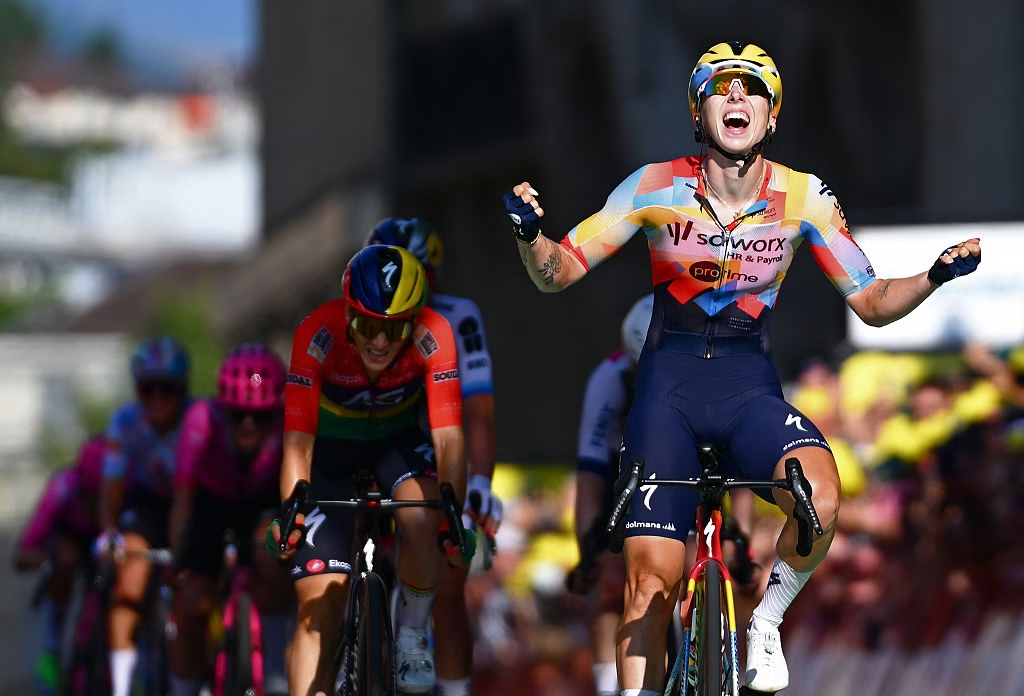
She survived the repeated climbing and uphill Côte Saint-François finish to win Stage 1 in Lausanne, then controlled the more conventional arrival in Geneva after a difficult day containing five categorised climbs. Rival teams had terrain on which to test SD Worx-Protime, but none managed to isolate Wiebes or weaken her enough to change the final hierarchy.
Elisa Balsamo finished second on Stage 2 and Marianne Vos took third, yet neither looked capable of passing Wiebes once the yellow jersey opened her sprint. She launched from around 250 metres, immediately created separation and crossed the line with a clear advantage.
Wiebes has now won every stage of this Tour that has offered the fast finishers a realistic chance. The emerging question is no longer whether she is the quickest sprinter in the race. It is whether anyone can create a scenario in which her outright speed does not decide the result.
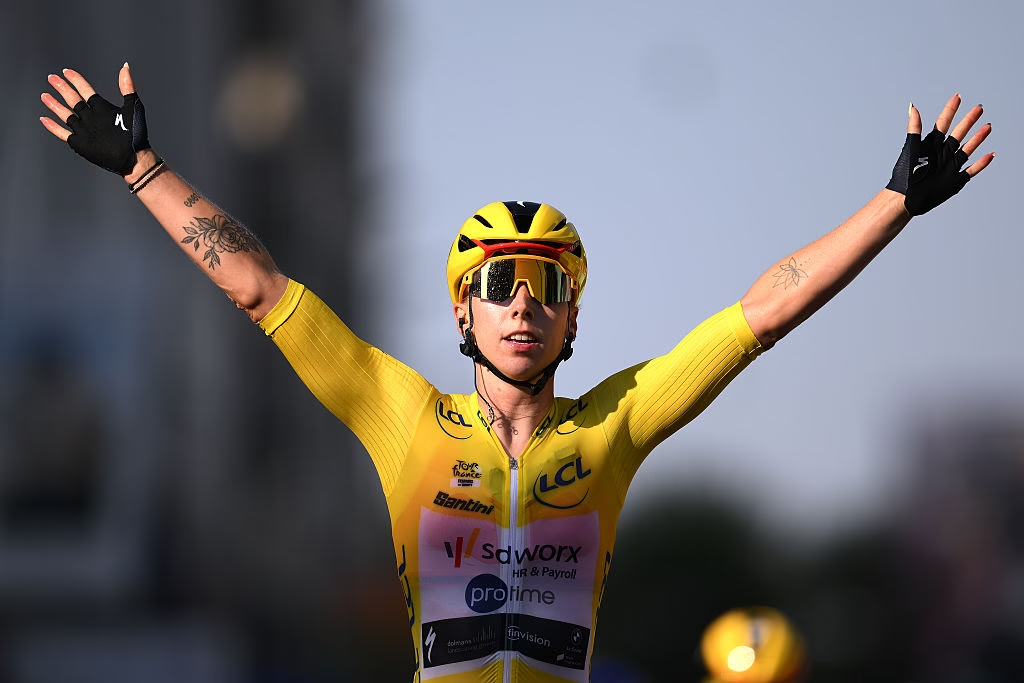 Photo Credit: Getty
Two victories on two different finishes
The worrying part for Wiebes’ rivals is not simply that she has won twice. It is the range of the victories.
Stage 1 was supposed to create a more balanced contest between sprinters, puncheurs and GC riders. The final kilometre climbed through Lausanne, while the approach contained enough repeated ascending to give teams an opportunity to wear Wiebes down.
She still won, beating Kim Le Court-Pienaar and Demi Vollering on a finish that should have reduced her advantage.
Stage 2 provided a different examination. The finish in Geneva was flat, but five categorised climbs and intense heat made the preceding 149km much harder than a conventional sprint stage. Wiebes remained comfortable enough through the climbing, while SD Worx-Protime retained sufficient strength to control the race.
Riejanne Markus came closer to preventing a Wiebes victory than any of the Dutchwoman’s direct sprint rivals. Her long solo attack survived until the final kilometre and forced the peloton into a committed chase.
Even that did not remove Wiebes from the winning position. She reached the finale without a perfectly intact lead-out, found her own route through the final kilometre and still produced the strongest sprint.
How many sprint chances remain?
The Tour de France Femmes 2026 route contains three stages officially classified as flat, but only the first two looked like clear conventional sprint opportunities before the race began.
Stage 3 crosses the Jura from Geneva to Poligny and begins with the 11.4km Col de la Faucille. Stage 4 is the individual time trial into Dijon, while Stages 5 and 6 contain repeated hilly terrain. Stage 7 finishes on Mont Ventoux and the final two days around Nice arrive after the race has already accumulated considerable fatigue.
Stage 8 from Sisteron to Nice is the remaining stage most likely to bring Wiebes back into contention. It is officially one of the race’s mountain stages rather than a conventional flat day, however, and its 171.9km distance follows immediately after Mont Ventoux.
That means Wiebes may already have completed her sweep of the clearest sprint stages. Her remaining opportunities depend on surviving harder terrain or returning to the front after the climbs.
The wider Tour de France Femmes sprint stages guide explains why the race offers the fast finishers relatively few straightforward days.
Balsamo remains the clearest direct challenger
Balsamo’s second place in Geneva confirmed that she remains the rider most likely to challenge Wiebes in a conventional bunch sprint.
Lidl-Trek delivered her into a competitive position, and she had a relatively clear route towards the line. The problem was not an obvious tactical mistake, poor timing or being trapped behind another rider. Wiebes simply accelerated more quickly and opened a gap that Balsamo could not close.
That is a harder problem to solve than imperfect positioning.
Balsamo can try to begin from Wiebes’ wheel, ask Lidl-Trek to take control later or force the Dutchwoman to launch from further out. None of those changes guarantees that she can pass a rider who currently appears faster from almost every comparable position.
Her best chance may come on a stage made difficult enough to reduce Wiebes’ acceleration without also removing Balsamo. The former world champion climbs well for a sprinter and can survive selective racing that eliminates more one-dimensional fast finishers.
The difficulty is that Wiebes has developed the same ability. Lausanne showed that terrain once considered favourable to Balsamo no longer automatically changes the result.
What did Marianne Vos show in Geneva?
Vos finished third without matching Wiebes’ maximum speed, but her performance confirmed that she remains dangerous whenever the finale becomes less controlled.
Her route to victory is unlikely to involve beating Wiebes in a direct sprint from identical positions. Vos instead needs to use her anticipation, positioning and tactical judgement to create a different contest.
Few riders are better at finding the correct wheel, moving through restricted space or recognising when a sprint is opening earlier than expected. Vos can win when the lead-outs become disorganised, when the road narrows or when the strongest rider becomes boxed in.
Geneva did not provide enough disorder.
Wiebes had space to launch, and once that happened Vos was effectively competing for the remaining podium positions. Visma | Lease a Bike need to place her ahead of Wiebes before the sprint begins or use the earlier terrain to remove more of the yellow jersey’s support.
Vos should become more dangerous on the harder stages. The Tour de France Femmes riders-to-watch guide identifies her selective sprinting and ability to survive repeated climbs as the main reasons she can still challenge for stages and the green jersey.
Charlotte Kool needs a near-perfect finale
Charlotte Kool possesses enough top speed to challenge Wiebes, but the opening weekend showed how difficult it is to reach the final 200 metres in the required condition and position.
Kool was one of the obvious alternatives in Geneva. The climbing and the work required before the finish made it harder for Fenix-Premier Tech to construct a clean lead-out, while the team had already lost Christina Schweinberger to a broken wrist.
That absence matters. Schweinberger was one of the riders best equipped to organise Kool’s position and preserve teammates for the closing kilometres.
Kool’s best chance now comes from a relatively uncomplicated finish in which Fenix-Premier Tech can keep her sheltered and deliver her late. She is unlikely to beat Wiebes after spending significant energy chasing back from a split or moving forward without support.
The margin for error is especially narrow because Wiebes has shown that she can still win when SD Worx-Protime’s plan becomes imperfect.
Chiara Consonni needs disorder rather than control
Chiara Consonni is another rider capable of benefiting when the strongest lead-out trains interfere with one another.
Canyon SRAM are not constructed primarily around sprint control because they must also protect Kasia Niewiadoma-Phinney and Antonia Niedermaier for the general classification. Consonni is therefore more likely to follow rival trains than receive a complete lead-out of her own.
That can work in a chaotic finish.
Consonni has the acceleration to move through small gaps and the confidence to launch from another rider’s wheel. What she lacks against Wiebes is the ability to dictate the final kilometre through team strength.
She needs SD Worx-Protime to lose control, Wiebes to become isolated and the sprint to open from several directions. A clean, straight drag race strongly favours the yellow jersey.
The best way to beat Wiebes may be not to sprint against her
Markus provided the most useful tactical lesson from Stage 2.
Her long attack forced SD Worx-Protime and the other sprint teams into a sustained pursuit. She was caught only inside the final kilometre, after several riders who would otherwise have contributed to the lead-outs had already been used.
The move did not prevent Wiebes winning, but it came closer than Balsamo, Vos or Kool managed in the sprint itself.
That is likely to remain the most credible approach.
A strong breakaway or late attack forces SD Worx-Protime to work, removes order from the finale and increases the chance that Wiebes must close gaps herself. The more energy her teammates spend chasing, the fewer remain to protect her position.
One rider is rarely enough. Markus nearly succeeded because she combined strength, commitment and hesitation behind, but the peloton still retained enough resources to close the gap.
A larger move containing riders from several leading teams would create a more difficult tactical problem. Lidl-Trek, Visma | Lease a Bike and Fenix-Premier Tech may need to resist contributing too early if they want SD Worx-Protime to pay the full cost of producing another sprint.
The riders most capable of creating those scenarios are covered in the Tour de France Femmes breakaway specialists guide.
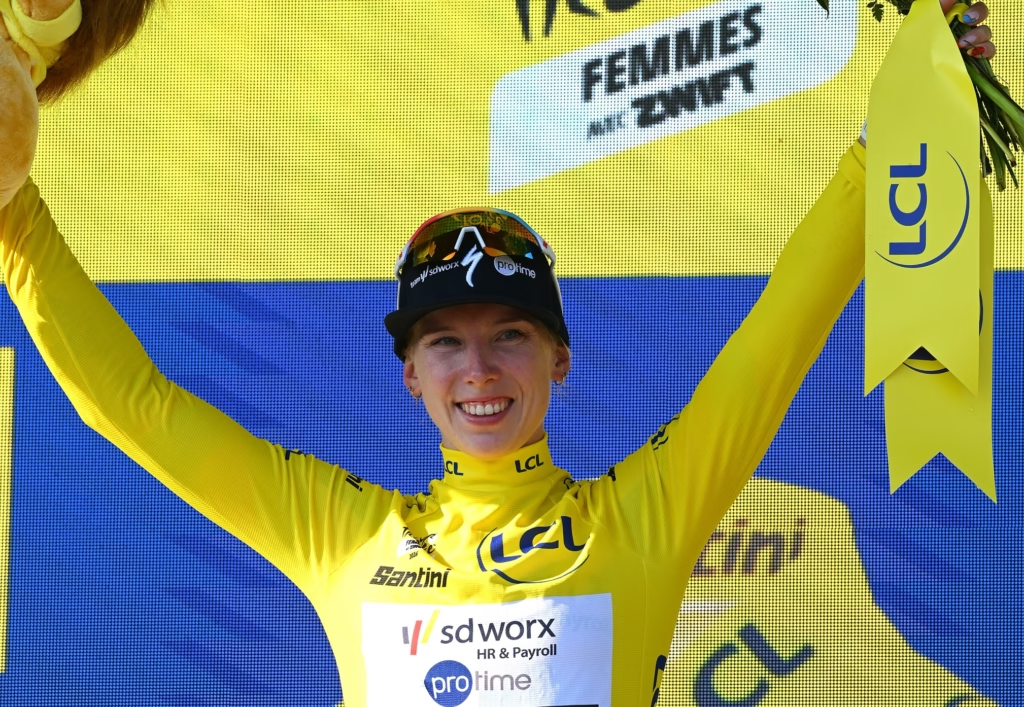 Photo Credit: Getty
Rival teams can help create another Wiebes victory
The sprint teams face an awkward calculation whenever an attack threatens to survive.
They want a chance to win, so they contribute to the chase. By doing that, they also help deliver the fastest rider in the race to the finish.
That happened in Geneva. SD Worx-Protime carried much of the responsibility, but other teams also had an incentive to catch Markus. Once the attack was neutralised, Wiebes remained the most likely winner.
Balsamo, Vos and Kool are unlikely to beat Wiebes if their teams spend the final hour helping to create her preferred scenario and then arrive with reduced lead-outs of their own.
At some point, one of those teams may need to accept the risk of losing to the breakaway rather than guarantee another sprint for Wiebes. That sounds negative, but it changes the tactical burden. SD Worx-Protime become solely responsible for the chase, and Wiebes reaches the finish with less support.
Her rivals need to make the yellow jersey’s team pay the full price for controlling the race.
Can the hills remove Wiebes?
Wiebes is no longer a rider who requires the flattest possible route.
She can survive repeated short climbs and recover after difficult sections without losing the acceleration that makes her dominant at the finish. Lausanne showed that she can win uphill, while Geneva demonstrated that accumulated climbing does not automatically weaken her enough.
The longer mountains remain beyond her range. She is unlikely to stay with the strongest riders over the Col de la Faucille if Stage 3 is raced aggressively, while Mont Ventoux and the final mountain stages are built for completely different types of rider.
That does not necessarily help her sprint rivals because Balsamo, Kool and Consonni may also be distanced.
To beat Wiebes in a sprint, teams need terrain hard enough to reduce her top speed but not so hard that her main challengers disappear first. That is a very specific balance, and the 2026 route provides relatively few chances to find it.


Wiebes already controls the green jersey battle
The two victories have placed Wiebes in a commanding early position in the points classification.
She has collected the maximum finish points on both stages and shown that she can score on more than one type of terrain. Her rivals now need to beat her at finishes while also pursuing intermediate sprints and stages where Wiebes cannot remain with the front group.
Vos may have the strongest route towards applying pressure across varied terrain. She can score on hilly stages where Wiebes is dropped, while Balsamo’s challenge depends more heavily on the faster finishes.
The problem is the limited number of stages.
Wiebes has already collected heavily from the terrain that suits her best. She does not need to survive Mont Ventoux or challenge on the final Nice circuit. She needs to continue scoring often enough before those stages to place the points lead beyond reach.
The rules behind the competition are covered in the Tour de France Femmes jerseys guide.
Stage 3 should finally remove the sprint question
The route from Geneva to Poligny gives the rest of the race a chance to move beyond Wiebes.
The Col de la Faucille begins early and is long enough to drop the yellow jersey if the strongest teams commit to the pace. Even if she returns later, the repeated Jura climbing gives attackers further opportunities to prevent another controlled sprint.
The Tour de France Femmes 2026 Stage 3 preview explains why Puck Pieterse, Le Court-Pienaar, Noemi Rüegg, Vos and Lotte Kopecky should become more relevant on the road to Poligny.
That does not answer whether anyone can beat Wiebes in a sprint. It may simply prevent a sprint from occurring.
For the rest of the peloton, that currently appears the more realistic solution.
Can Wiebes complete a sprint sweep?
Wiebes has an excellent chance of winning every stage at the 2026 Tour de France Femmes that reaches a conventional bunch sprint.
Nothing from Lausanne or Geneva suggests that another rider can beat her consistently through speed alone.
Balsamo came closest in the direct sprint but was clearly second. Vos used her experience to finish third without threatening the victory. Kool and Consonni require better positioning and a less controlled finale.
The strongest opposition may therefore come from the race itself. A breakaway can survive, the hills can split the peloton, fatigue can reduce Wiebes’ acceleration or a chaotic approach can leave her trapped behind other riders.
Those possibilities mean she is not unbeatable. They do not change the central lesson from the opening weekend.
When the peloton arrives together and Lorena Wiebes has room to sprint, nobody at this Tour currently looks fast enough to stop her.

