
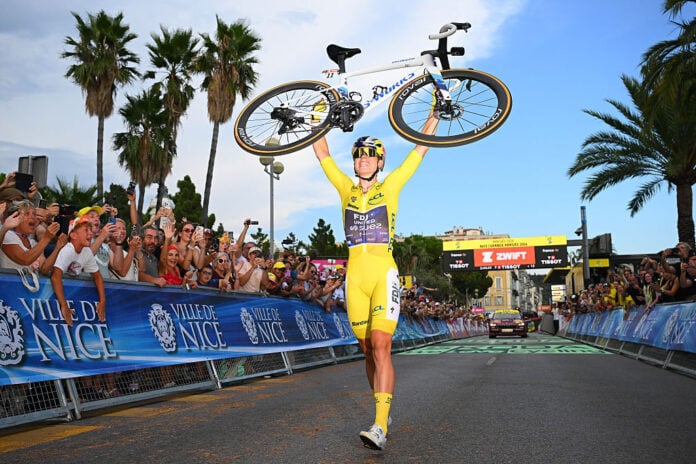
Demi Vollering did not win the 2026 Tour de France Femmes with one overwhelming mountain attack or by controlling the race from the first decisive stage to the last. She won it by repeatedly repairing the race when it threatened to move away from her, then finishing with a final-day performance emphatic enough to make the previous 48 hours of calculation look almost irrelevant.
There was Dijon, where the time trial gave her a valuable buffer over Kasia Niewiadoma-Phinney. There was Stage 5, where she confirmed that she could still beat the strongest riders in a selective uphill finish. There was Mont Ventoux, where she got the tactics wrong and watched Niewiadoma-Phinney ride into yellow. Then came Stage 8 into Nice, when she corrected that mistake with exactly the aggression she had lacked a day earlier.
And finally there was Stage 9. Vollering began the final afternoon only eight seconds ahead of Niewiadoma-Phinney, the smallest lead ever carried into the last stage of the modern Tour de France Femmes. By the finish, she had won the stage by 1:04 and the Tour by 1:18.
That is what ultimately defined her second Tour victory. It was not a race of uninterrupted superiority. It was a race in which Vollering kept finding another way to put herself back in control.
Dijon gave Vollering an advantage that mattered later
The first substantial GC separation came in the Stage 4 time trial into Dijon.
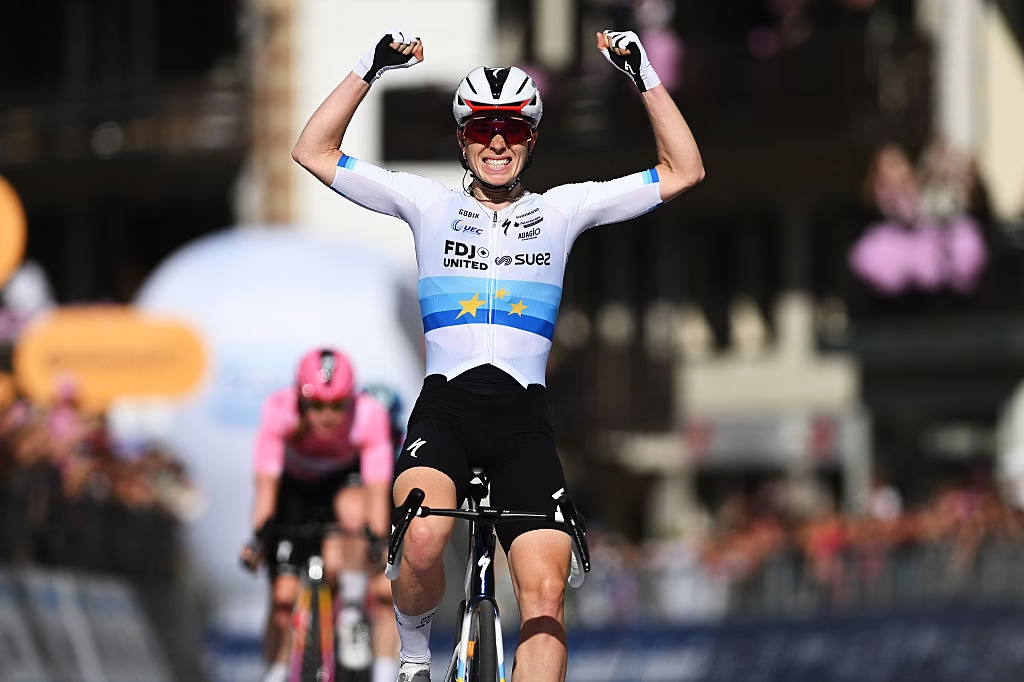
Marlen Reusser was the outstanding rider over the 21km course and took yellow, but Vollering’s performance was almost as important in the longer story of the Tour. She finished only 18 seconds behind Reusser and moved into second overall, putting herself exactly where she needed to be before the race reached the more selective terrain.
The gap to Niewiadoma-Phinney was particularly useful. Vollering gained 51 seconds on her on the stage itself, with Niewiadoma-Phinney finishing 1:09 behind Reusser. At that point, the Tour looked as though it might be moving towards a contest shaped by Reusser’s time trial strength and Vollering’s climbing, with Niewiadoma-Phinney forced to recover a significant deficit.
That interpretation did not survive the mountains, but the Dijon seconds still mattered. Vollering never had to chase the race from a position of complete desperation. Even when Niewiadoma-Phinney later turned Mont Ventoux into her own stage, Vollering had enough accumulated time and enough strength to keep the overall contest within reach.
Grand Tours are usually remembered through their mountain attacks, but Vollering’s 2026 victory was also built on an afternoon against the clock.
Stage 5 showed which riders were actually capable of winning
The race narrowed considerably on Stage 5 into Belleville-en-Beaujolais.
By the time the strongest riders emerged from a day containing eight categorised climbs, several pre-race contenders were already losing contact. Pauline Ferrand-Prévot was dropped. Elisa Longo Borghini lost ground. Cédrine Kerbaol was no longer part of the immediate stage fight.
At the front, Vollering, Reusser and Niewiadoma-Phinney remained.
Niewiadoma-Phinney tried to surprise them in the sprint, but Vollering came past in the final metres to take the stage. The GC reward was modest, with Reusser keeping yellow and Vollering reducing her deficit by only a couple of seconds through the bonuses, but the sporting meaning was much larger.
By then the Tour had begun to establish three different routes to victory. Reusser had the strongest time trial. Niewiadoma-Phinney had the tactical unpredictability to exploit hesitation. Vollering had the acceleration and climbing strength to finish difficult stages.
All three would shape the final weekend, but Stage 5 was the first clear indication that Vollering was not merely trying to limit losses before the high mountains. She could still beat the riders who would eventually matter most.
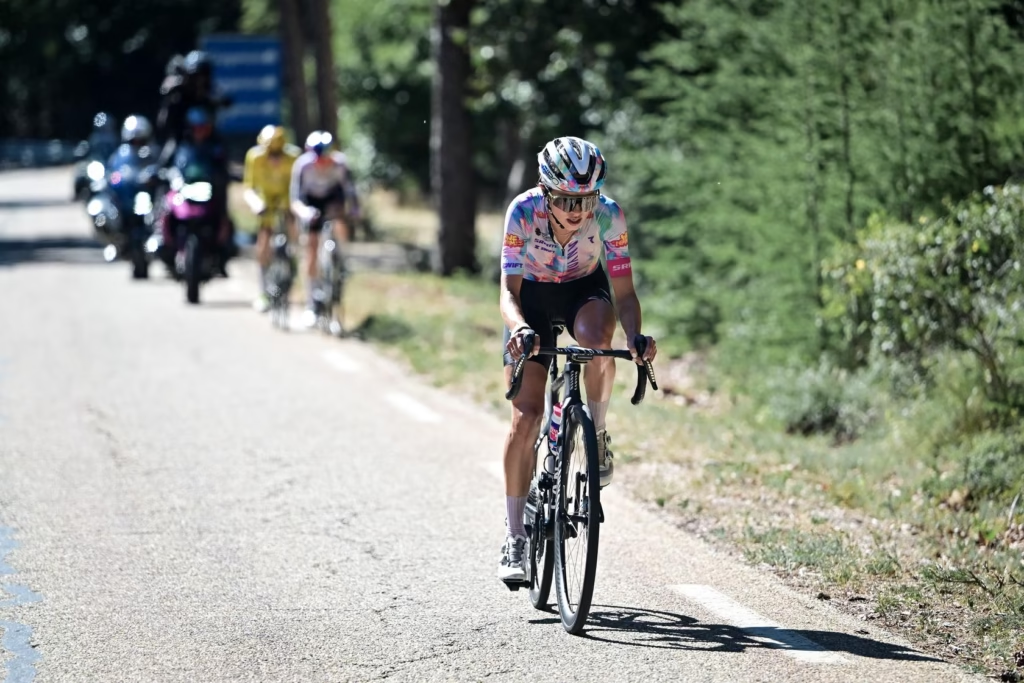 Photo Credit: A.S.O./Billy Ceusters
Mont Ventoux was Vollering’s biggest mistake
The most revealing part of Vollering’s Tour may be the stage she lost.
Niewiadoma-Phinney’s solo victory on Mont Ventoux was the outstanding tactical performance of the race. She attacked with more than nine kilometres remaining while Vollering and Reusser became trapped in a stand-off behind.
Neither wanted to provide the other with a free ride. Reusser had yellow to protect, while Vollering needed to take time from her. Both knew that towing a direct rival up Ventoux could be as damaging as allowing Niewiadoma-Phinney some freedom.
The problem was that the hesitation lasted too long.
Niewiadoma-Phinney kept riding while Vollering and Reusser watched one another, and the gap grew towards two minutes. By the time Vollering finally attacked in the final kilometre, the stage had already gone.
The acceleration itself was revealing. Vollering immediately dropped Reusser and took around half a minute out of her over a very short distance, suggesting that she had possessed the strength to act much earlier. That is why the obvious post-stage question became why Vollering waited so long to attack on Mont Ventoux.
It was the biggest tactical mistake of her Tour. Niewiadoma-Phinney won by 1:16 and took yellow, turning what had been a 1:05 deficit to Vollering before the stage into a 15-second advantage afterwards.
Yet the final kilometre still mattered enormously. Vollering’s late effort limited the damage sufficiently that the Tour remained salvageable.
The final kilometre of Ventoux kept the Tour alive
It is easy to focus only on the time Vollering lost on Ventoux, but the seconds she recovered late were just as important.
Once she finally committed, Reusser could not follow. Vollering took around half a minute out of the Swiss rider and substantially reduced Niewiadoma-Phinney’s advantage before the summit.
Without that effort, the gap heading into Stage 8 might have been large enough to make Sunday’s final circuit the only realistic place to recover yellow. Instead, Vollering started Saturday just 15 seconds away.
That changed the tactical possibilities completely.
She did not need a miraculous long-range mountain raid. A small late gap combined with bonuses could bring the race back to her.
Stage 8 provided exactly that opportunity.

Stage 8 was the correction to Ventoux
The Stage 8 route from Sisteron to Nice had been officially classified as flat and had been widely viewed as Lorena Wiebes’s final major sprint opportunity.
It should, on paper, have been the quieter of the final two days for the GC riders.
FDJ United-Suez refused to treat it that way.
The team increased the pressure on the late climbs and positioned Vollering aggressively for the decisive roads above Nice. Where she had waited too long on Ventoux, this time she recognised the opportunity before the race had fully settled.
Vollering attacked, Niewiadoma-Phinney and Longo Borghini initially tried to respond, and then the gap opened. Once clear, Vollering committed fully rather than looking behind or waiting for cooperation.
She won alone, 17 seconds ahead of Longo Borghini and Niewiadoma-Phinney. With the ten-second stage winner’s bonus against Niewiadoma-Phinney’s four seconds for third, the overall swing was 23 seconds.
A 15-second deficit became an eight-second lead.
The full reversal is covered in the Stage 8 race report, but its wider importance was tactical. Vollering had learned from Ventoux almost immediately. She stopped waiting for the obvious GC stage and stopped allowing the rival situation to dictate when she should move.
She simply attacked when the opportunity was there.
The Gery controversy made the final day even more charged
Stage 8 also produced the most contentious episode of the race.
Niewiadoma-Phinney accused Célia Gery of deliberately blocking her towards the barriers while FDJ United-Suez were positioning Vollering for the decisive move. Canyon SRAM raised the incident with the race jury, but no sanction followed.
The competing accounts and commissaires outcome are covered in our piece on Niewiadoma-Phinney’s accusation against Gery.
Whatever interpretation is placed on that incident, it ensured the final stage was never going to begin quietly. Niewiadoma-Phinney had lost yellow by eight seconds and believed the moment that helped cost her the jersey involved more than simply being out-ridden. Vollering had taken control of the Tour and knew Canyon SRAM had no reason to wait.
The sporting equation was already simple enough. Niewiadoma-Phinney needed time. Vollering only needed to stop her getting it.
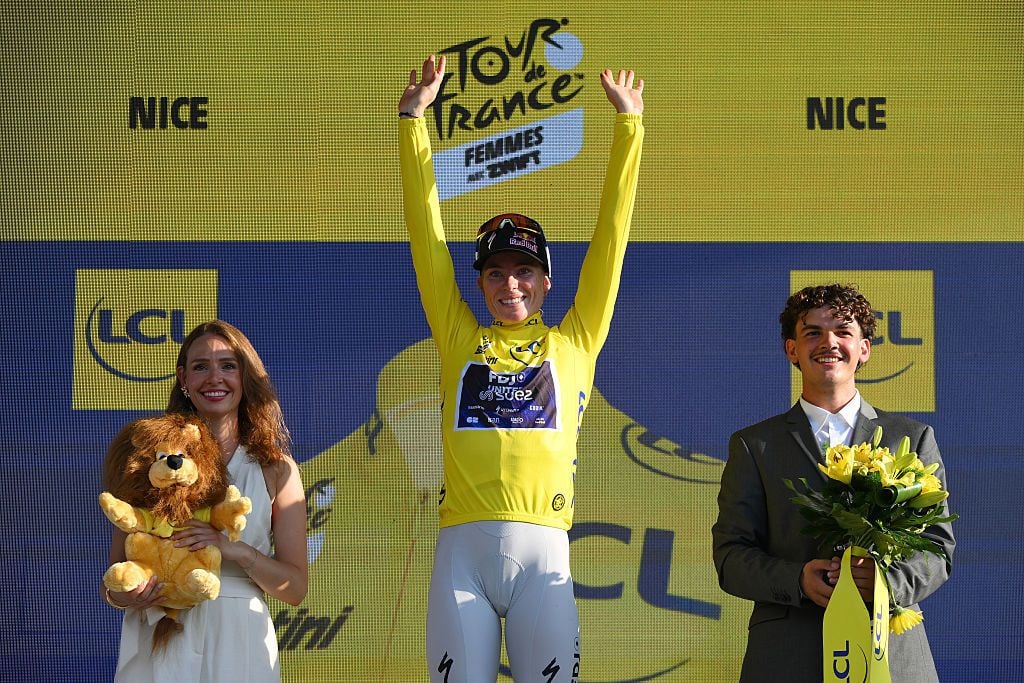 Photo Credit: Getty
Stage 9 began with history waiting
No modern Tour de France Femmes had entered its final stage with first and second separated by so little.
Vollering’s eight-second advantage was smaller than the previous record of 27 seconds going into the 2024 finale. The historical comparison was particularly sharp because the same two riders had already decided a Tour by four seconds.
Our look at how the 2026 rivalry echoed the 2024 Tour captured the symmetry. Two years earlier, Vollering had started the final stage 1:15 behind Niewiadoma-Phinney and attacked all the way to Alpe d’Huez, eventually coming four seconds short.
In 2026, their roles were reversed. Vollering had yellow, while Niewiadoma-Phinney had four ascents of the Col d’Èze and only eight seconds to recover.
The expectation was a stage decided by tiny gaps, bonus arithmetic and repeated tactical pressure.
What actually happened was far more emphatic.
Reusser’s challenge disappeared almost immediately
One of the reasons Stage 9 had looked so dangerous for Vollering was that the race still contained a third rider capable of affecting the GC fight.
Reusser started only 1:12 behind yellow. A long-range Movistar move could have recreated the sort of tactical confusion that had helped Niewiadoma-Phinney on Ventoux, forcing Vollering and Canyon SRAM to decide who should chase and how much responsibility each should accept.
Instead, Reusser’s challenge unravelled early.
She was dropped on the opening Col d’Èze and then crashed heavily on the descent. Although she remounted, her podium challenge was effectively over.
That changed the shape of the stage. The race increasingly became what it had always threatened to become: Vollering against Niewiadoma-Phinney.
The absence of Reusser also removed one of the main tactical complications. Vollering no longer had to worry about dragging another dangerous GC rider back into contention every time she responded to Canyon SRAM.
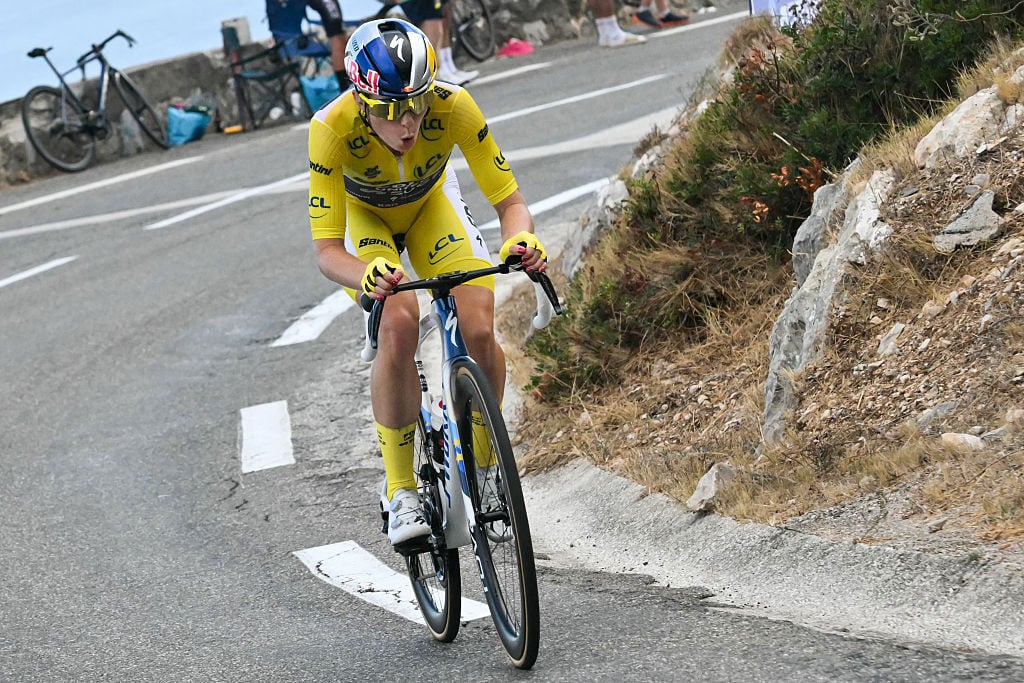 Photo Credit: Getty
Vollering did not defend eight seconds, she destroyed the argument
The obvious way for Vollering to approach Stage 9 was defensively. She had only eight seconds over Niewiadoma-Phinney, but that was still enough to make the tactical equation relatively simple: follow the Canyon SRAM leader, avoid being isolated at the wrong moment and make sure any road gap remained manageable once the final bonuses were taken into account.
With four ascents of the Col d’Èze packed into just 99.2 kilometres, Canyon SRAM had several opportunities to complicate that plan. Niedermaier could be used as a second card, Niewiadoma-Phinney could attack repeatedly and the short distance encouraged aggression because there was little need to conserve resources for later.
Vollering did not need to initiate anything herself.
What happened was much more emphatic.
By the final ascent, the Tour had already changed shape and Niewiadoma-Phinney still needed those eight seconds. Instead of sitting on her wheel and waiting for the attack, Vollering made the decisive move herself.
That decision effectively closed the argument about who was strongest on the final day.
The final Col d’Èze turned eight seconds into more than a minute
Vollering attacked around the final Col d’Èze with roughly 16 kilometres remaining and immediately created separation.
Niewiadoma-Phinney could not close it.
Paula Blasi emerged as the strongest rider in the chase and rode with Niewiadoma-Phinney, but neither could prevent Vollering’s advantage growing as the race headed towards Nice.
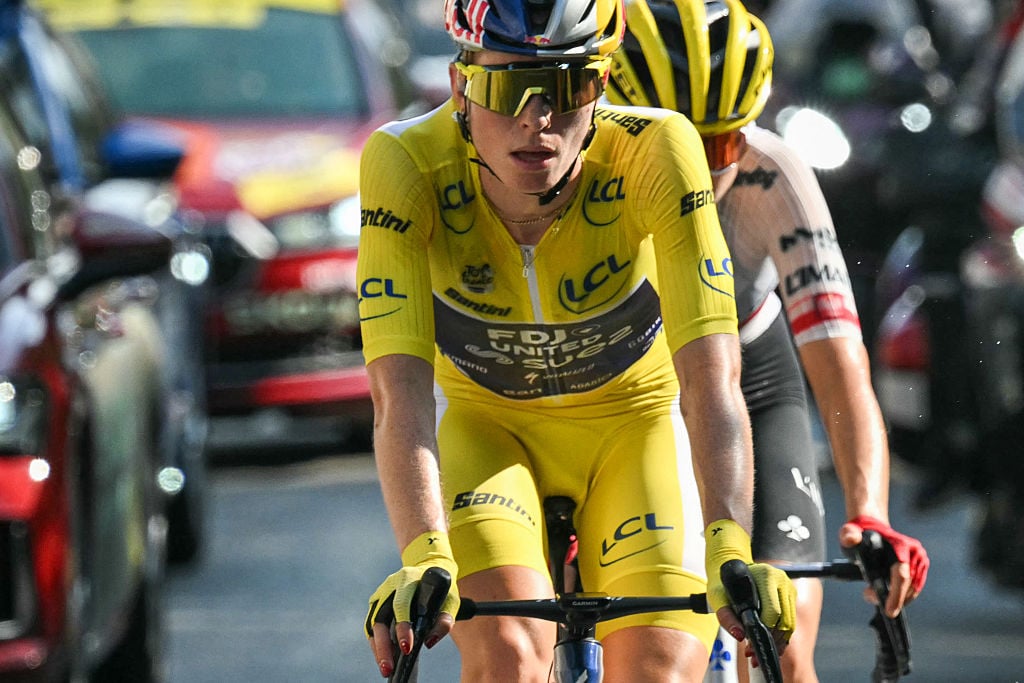
At the finish, Vollering had won Stage 9 by 1:04 from Blasi and Niewiadoma-Phinney. Niedermaier was fifth at 1:06, Isabella Holmgren sixth at 1:08 and Longo Borghini seventh at 1:14.
The final GC arithmetic was suddenly straightforward. Vollering received ten bonus seconds for the victory, while Niewiadoma-Phinney collected four for third. Add that six-second difference to the 1:04 road gap and the eight seconds Vollering already held at the start, and her final Tour-winning advantage became 1:18.
For most of the weekend, the Tour had been discussed in individual seconds.
Vollering finished it in minutes.
Winning Stage 9 changed the meaning of Stage 8
Had Vollering simply followed Niewiadoma-Phinney around Nice and protected yellow by a handful of seconds, Stage 8 would probably have remained the defining ride of her Tour.
Stage 9 changed that interpretation.
The late attack into Nice on Saturday was not merely a clever tactical raid that supplied the cushion required for Sunday. It was evidence that Vollering’s condition was still improving as the race entered its final weekend.
On Ventoux she had been strong enough to drop Reusser but tactically too hesitant to exploit it in time. On Stage 8 she was sharper tactically and attacked before the obvious moment. By Stage 9 she was able to remove tactics from the discussion almost completely by riding everyone else off her wheel.
That progression is probably the clearest explanation for how the Tour moved from Niewiadoma-Phinney apparently taking control on Friday to Vollering standing in Nice with a victory margin of more than a minute on Sunday.
Blasi’s second place showed how strong the final attack really was
Paula Blasi finishing second is an important detail because it helps put the scale of Vollering’s final performance into context.
The 23-year-old had already been one of the revelations of the Tour, climbing strongly on Ventoux and challenging Niedermaier in the young rider classification. On Stage 9 she was the closest rider to Vollering.
She still lost 1:04.
Niewiadoma-Phinney was not isolated, briefly distanced and then beaten by a handful of seconds. The entire leading group was comprehensively dropped.
That removed much of the ambiguity left by Mont Ventoux. There, Niewiadoma-Phinney had combined strength with an excellent tactical decision while Vollering and Reusser hesitated. In Nice, there was no equivalent explanation available.
Vollering attacked and nobody could follow.
Longo Borghini benefited from Reusser’s collapse
Reusser’s early problems also changed the final podium.
Longo Borghini had started Stage 9 fourth overall and 1:53 behind the Swiss rider. Once Reusser’s race unravelled, the Italian was able to move into third overall.
It was a reward for an increasingly strong final part of the Tour. Longo Borghini had finished third on Mont Ventoux, second on Stage 8 and remained among the strongest riders on the final day even as Vollering rode away.
Her consistency also reflected the wider strength of UAE Team L’IMAD, with Blasi second on the final stage and Dominika Włodarczyk producing another strong Tour.
The final podium therefore told its own story. Vollering had been the strongest rider when the race reached its decisive final weekend, Niewiadoma-Phinney had come closest to beating her through a mixture of strength and tactical instinct, and Longo Borghini had ridden herself back onto the podium through consistency as other contenders fell away.

Vollering won three very different stages
One useful way to understand Vollering’s Tour is through the stages she won.
Stage 5 required her to finish off a selective three-rider contest after a hard climbing day. Stage 8 required her to recognise an unexpected tactical opportunity and turn a supposed transition stage into a solo GC attack. Stage 9 required a completely different kind of authority, attacking while already in yellow and distancing every rival on the final mountain of the race.
Those victories required different qualities rather than one repeatable formula. Timing mattered. So did acceleration, sustained climbing, descending and the confidence to take responsibility rather than waiting for another rider to create the race.
That versatility is a better explanation for the final outcome than simply saying Vollering was the strongest climber.
At different points of the Tour, she needed to be more than that.
The Tour was won through adaptation as much as strength
Vollering was not unbeatable throughout the nine stages.
Reusser beat her in Dijon.
Niewiadoma-Phinney outmanoeuvred her spectacularly on Mont Ventoux.
Stage 8 was surrounded by controversy.
There were several points where another rider had a perfectly credible route to overall victory.
What Vollering did particularly well was prevent any setback becoming irreversible.
She limited her losses against Reusser in the time trial. She beat Niewiadoma-Phinney on Stage 5. When Ventoux exposed the biggest tactical weakness of her race, she corrected it within 24 hours. When Stage 8 put her back into yellow by only eight seconds, she refused to spend Sunday merely protecting them.
Dijon gave Vollering the time cushion that kept her close when the race later swung towards Niewiadoma-Phinney, while Mont Ventoux exposed the biggest tactical weakness of her Tour. She responded to that mistake within a day by attacking into Nice on Stage 8, and then removed any remaining ambiguity by winning the final stage by more than a minute.
Taken together, those performances tell a much more interesting story than a Tour won through one dominant climbing day.
-
 Photo Credit: Getty

This second Tour was nothing like the first
Vollering’s first Tour de France Femmes victory in 2023 was much cleaner.
She took control with an overwhelming ride on the Col du Tourmalet and carried a substantial advantage into the final time trial in Pau. The strongest climber became the obvious winner, and the last stage largely confirmed what the mountain had already established.
The 2026 race demanded something more complicated.
Vollering never controlled the GC continuously. She was not the strongest rider against the clock. She was not the smartest rider tactically on Ventoux. She did not even enter the final weekend in yellow.
What she did was keep placing herself close enough to strike again.
That is why the less glamorous moments matter just as much as the final attacks. Dijon mattered because she took time when Niewiadoma-Phinney could not. The final kilometre of Ventoux mattered because she prevented a tactical defeat becoming a decisive one. Stage 8 mattered because she attacked before Canyon SRAM expected the Tour to move. Stage 9 mattered because, once she had the advantage, she proved she did not actually need it.
Four seconds in 2024, 1:18 in 2026
The comparison with 2024 will inevitably follow this victory.
Niewiadoma-Phinney beat Vollering by four seconds then, the closest final margin the modern Tour de France Femmes has produced. Two years later, the same two riders arrived at another final stage separated by only eight seconds.
The expectation was another afternoon of calculations carried all the way into Nice.
Instead, Vollering refused to let the Tour remain that close.
She did not reclaim the race through a four-second bonus calculation or a desperate sprint to the line. She won Stage 9 by 1:04 and the Tour by 1:18.
That final margin does not mean the race itself was comfortable. Quite the opposite. On Friday evening, Niewiadoma-Phinney had ridden away on Mont Ventoux and looked capable of becoming the first two-time winner of the modern Tour. On Saturday, Vollering attacked back into yellow. On Sunday, with the race still theoretically balanced on eight seconds, she removed every remaining doubt.
The defining image of the 2026 Tour may ultimately come from that final day rather than the move which first put Vollering back into yellow. She began Stage 9 with the jersey on her shoulders and no requirement whatsoever to attack.
She attacked anyway, and this time nobody could come with her.

