
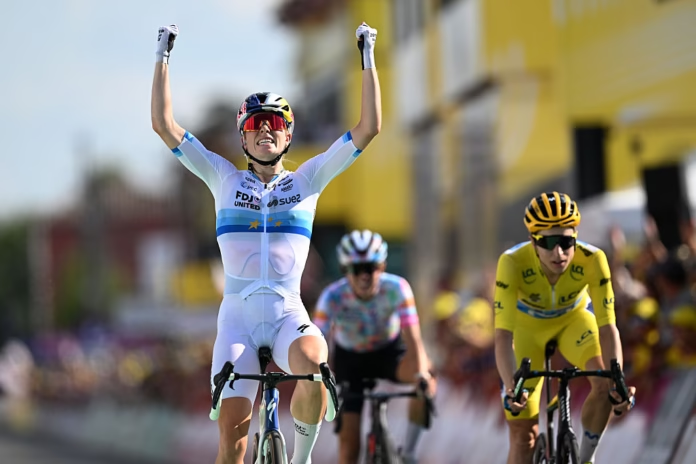
Demi Vollering won stage 5 of the 2026 Tour de France Femmes in Belleville-en-Beaujolais, beating Marlen Reusser and Kasia Niewiadoma-Phinney in a three-rider sprint after a brutal late selection on Mont Brouilly.
The FDJ United-Suez rider attacked on the final climb, reduced the yellow jersey group to three, then came past Niewiadoma-Phinney in the finishing straight to take the stage and bonus seconds. Reusser finished second in the same time, keeping the yellow jersey after another composed ride in a stage that could easily have exposed her.
Niewiadoma-Phinney finished third after cresting Mont Brouilly first and attacking again inside the final 300 metres. Dominika Włodarczyk, Isabella Holmgren and Antonia Niedermaier finished 45 seconds down, while Nienke Vinke, Femke de Vries and Thalita de Jong came in at 1:12. Niamh Fisher-Black completed the top 10 at 1:15.
The first real mountain trap after Dijon
Stage 5 looked like a transition stage only if judged by its finish town. In reality, the 140-kilometre route from Mâcon to Belleville-en-Beaujolais was a full day of attrition, with eight categorised climbs, little flat road and around 2,900 metres of elevation gain through the Beaujolais.
After the Dijon time trial had put Reusser into yellow, this was the first chance for the climbers and punchier GC riders to test how strong Movistar’s control really was. Reusser began the day only 14 seconds ahead of Vollering, with Cédrine Kerbaol third at 54 seconds, Elisa Longo Borghini fourth at 1:03 and Niewiadoma-Phinney fifth at 1:09.
The final pair of climbs made the stage dangerous. The Col de Durbize came inside the final 35 kilometres, before Mont Brouilly offered 3 kilometres at 7.7 per cent and a difficult descent and flat run-in to the finish.
It was a day built to create tactical chaos. It delivered exactly that.
Pieterse starts collecting again
Puck Pieterse began the day in the polka-dot jersey and wasted no time turning the stage into another mountains-classification exercise.
The first climb, the Côte de Cenves, arrived almost immediately after the start. Pieterse accelerated near the summit and took maximum points, ahead of Franziska Koch, Magdeleine Vallieres and Mischa Bredewold. That set the pattern for the next part of the stage.
The pace was already hurting riders. Charlotte Kool and Alison Jackson were among those struggling early, while the field quickly began to shed riders on the rolling roads and twisting descents. This was not a day where the peloton eased into the climbs.
Fisher-Black attacked after the Côte de Cenves and briefly opened a gap, but the move was brought back as more riders tried to go clear. The stage was still searching for its decisive breakaway, but the pressure was already real.
Crashes and constant attacks thin the bunch
The second categorised climb, the Col de la Croix de l’Orme, brought more attacks and the first major crash of the day. Chiara Consonni went down along with Usoa Ostolaza, with Consonni calling out in pain before eventually getting back on her bike.
Pieterse again took points at the summit, extending her hold on the mountains classification, before repeating the pattern on the Côte de Saint-Christophe. The Fenix-Premier Tech rider was now dominating the polka-dot fight rather than merely defending it.
Riejanne Markus, Justine Ghekiere, Juliette Labous, Zoe Bäckstedt and others tried to animate the race, while Marianne Vos was among the riders distanced as the climbs came one after another.
The stage was being raced like a one-day Classic. Teams were not waiting for Mont Brouilly. They were using every rise and descent to force selections.
Wiebes takes green points before being dropped
Lorena Wiebes, now in the green jersey after losing yellow on stage 3, fought hard to stay near the front until the intermediate sprint in Monsols.
Carlota Cipressi attacked before the sprint and crossed first, taking 25 points. Wiebes led the peloton across shortly afterwards for second and 20 points, with Lotte Kopecky third, Maëva Squiban fourth and Vallieres fifth.
That pushed Wiebes further clear in the points classification, moving her to 131 points. But the effort came at a cost. Soon after, on the Col de Fontmartin, Wiebes was dropped as the peloton began to split more seriously.
From that point, the green jersey was out of the stage fight. The day had shifted fully towards the climbers, the breakaway and the GC contenders.
A major 19-rider move goes clear
The decisive breakaway formed after the Col de Fontmartin and into the middle section of the stage. It eventually grew to 19 riders, and it was far too strong to be treated as a normal escape.
The move contained Femke de Vries and Sarah van Dam of Team Visma | Lease a Bike, Juliette Berthet and Koch of FDJ United-Suez, Niedermaier of Canyon SRAM, Włodarczyk and Squiban of UAE Team L’IMAD, Vinke of SD Worx-Protime, Liane Lippert of Movistar, Amanda Spratt, Markus and Fisher-Black of Lidl-Trek, Lore de Schepper and Ghekiere of AG Insurance-Soudal, Vallieres and Noemi Rüegg of EF Education-Oatly, Pieterse of Fenix-Premier Tech, De Jong of Human Powered Health and Célia Le Mouël of Ma Petite Entreprise.
It was a major tactical moment. Almost every serious team had representation. UAE Team L’IMAD had Włodarczyk and Squiban. Lidl-Trek had numbers. FDJ had Koch and Berthet up the road for Vollering. Movistar had Lippert, giving Reusser a satellite rider. Team Visma | Lease a Bike had De Vries and Van Dam, which could either serve the break or help Ferrand-Prévot later.
The move was also dangerous on GC. Niedermaier began the day at 1:43, De Vries at 1:47 and Włodarczyk at 1:59. If the break stayed clear, the overall standings could be turned inside out.
FDJ and Movistar take responsibility
For a while, Movistar appeared to play bluff, despite Reusser’s yellow jersey being under threat. FDJ United-Suez therefore took up much of the responsibility behind, with Amber Kraak and Évita Muzic working to control the gap for Vollering.
Eventually Movistar began to cooperate, with Paula Ostiz contributing to the chase. That partnership mattered. The break had around 1:40 over the peloton across the Côte de Pruzilly and into the valley roads, but it never fully disappeared.
The stage had reached a tactical balance. The breakaway had enough strength to force the GC teams to work, but the GC teams were unwilling to let riders such as Niedermaier, De Vries and Włodarczyk gain too much rope.
Pieterse kept taking mountains points in the break, topping the Col de Gerbet and Côte de Pruzilly. By that point, she had effectively secured another day in polka dots, while the GC fight behind became increasingly tense.
Durbize blows the race apart
The Col de Durbize was the first of the two decisive late climbs. Its official numbers, 3.6 kilometres at around 5.8 per cent, did not fully capture the difficulty. The final kilometre and a half stayed above 9 per cent and kicked towards 16 per cent.
Squiban attacked from the foot of the climb, but Fisher-Black closed her down, with Vallieres, Lippert, Niedermaier and others following. The breakaway began to fragment, while behind them FDJ hit the climb hard through Muzic.
The yellow jersey group was quickly reduced to around a dozen riders: Vollering, Niewiadoma-Phinney, Ferrand-Prévot, Kerbaol, Reusser, Blasi, Longo Borghini, Le Court-Pienaar, Holmgren, Van der Breggen and Mavi García were all in the key selection at first.
Then Vollering attacked.
Ferrand-Prévot cracked almost immediately. Van der Breggen and Kerbaol were also dropped, while Reusser, Niewiadoma-Phinney and Holmgren were able to follow the acceleration. Longo Borghini was just behind, trying to limit the damage.
It was the first major GC rupture of the day.
Ferrand-Prévot loses contact
Ferrand-Prévot had already lost significant time in Dijon, and stage 5 made the situation worse. Once Vollering accelerated on the Durbize, the defending Tour champion was unable to respond.
Van Dam dropped back to help her, but the gap grew rapidly. First it was 40 seconds, then more than a minute, then well over 2 minutes by the time the leaders were approaching Mont Brouilly.
This was the moment Ferrand-Prévot’s Tour defence began to look seriously compromised. The time trial had put her under pressure. Durbize exposed her on the road.
It was not just a small acceleration at the top of a climb. It was a sustained split caused by FDJ’s work, Vollering’s attack and the presence of satellite riders ahead. Ferrand-Prévot was now chasing from a position of weakness, with the strongest riders in the race moving away.
The yellow jersey group catches the break
The front of the race reshaped again after the Durbize. The remaining breakaway riders were still ahead, but the yellow jersey group was coming across, helped by riders who had been in the move.
Koch dropped back and pulled for Vollering, showing exactly why FDJ had placed riders in the break. Lippert also worked strongly for Movistar and Reusser before eventually sitting up with around 14.5 kilometres to go.
By 22 kilometres remaining, the yellow jersey group had joined the head of the race. It created a strong front group containing Reusser, Vollering, Niewiadoma-Phinney, Włodarczyk, Niedermaier, Holmgren, De Vries, Fisher-Black, Vinke, Pieterse, De Jong, Vallieres and others.
Behind, Longo Borghini, Blasi and Le Court-Pienaar were already chasing at around 35 to 40 seconds. Ferrand-Prévot, Kerbaol, Rüegg and Van der Breggen were more than a minute back.
The stage win and the GC battle were now in the same group.
Bonus seconds sharpen the fight
Before Mont Brouilly, the front group contested the bonus sprint in Saint-Lager. Reusser was first, taking 6 seconds, with Vollering second for 4 seconds and Włodarczyk third for 2.
That mattered because Reusser had started the day only 14 seconds ahead of Vollering. Every second was part of the yellow jersey battle, as the Tour de France Femmes time bonuses had already shown across the opening stages.
It was also a sign that Reusser was not just defending passively. She knew the stage was dangerous and understood that the sprint for seconds was part of the GC fight. Vollering took less than she would have wanted, but she was about to use Mont Brouilly to apply much more direct pressure.
By the foot of the final climb, the race was perfectly set: Reusser and Vollering together, Niewiadoma-Phinney looking strong, several young riders still present, and major names already behind.
Vollering tears open Mont Brouilly
Mont Brouilly was the final climb of the day: 3 kilometres at 7.7 per cent, with a far harder final half and ramps above 10 per cent. FDJ United-Suez used Berthet to set a fierce pace at the bottom, dropping several riders from the front group.
Then Vollering took over. Her acceleration immediately reduced the race to the strongest riders. Reusser was under pressure but stayed attached. Niewiadoma-Phinney followed, while Włodarczyk, De Vries, Holmgren, Fisher-Black and Niedermaier initially clung on.
Vollering kept pressing. With 1.7 kilometres to the summit, only a handful remained on her wheel. Near the top, she surged again, and the final selection was made.
Reusser suffered but did not crack. Niewiadoma-Phinney stayed with Vollering. Behind them, Włodarczyk and De Vries began to lose contact, while Holmgren fought to remain close.
By the summit, only three riders were clear: Vollering, Reusser and Niewiadoma-Phinney.
Niewiadoma-Phinney takes the climb, but Vollering has the sprint
Niewiadoma-Phinney crested Mont Brouilly first, ahead of Vollering and Reusser. The trio then dropped into the descent towards Belleville-en-Beaujolais with a significant gap over the chasers.
The descent was fast and the final 5 kilometres flattened out, giving the three leaders a chance to time trial together towards the finish. Behind them, the gaps were already meaningful. Włodarczyk, Holmgren and Niedermaier were chasing at around 30 to 45 seconds, while Longo Borghini, Blasi, Ferrand-Prévot, Kerbaol and Van der Breggen were further back.
The front trio worked well enough to stay clear. Reusser, wearing yellow, had every reason to keep the move alive. Vollering was riding for the stage and to close the GC gap. Niewiadoma-Phinney was moving towards third overall and still chasing her first Tour de France Femmes stage win despite having won the overall title in 2024.
Inside the final kilometre, it came down to the sprint. Reusser led under the final few hundred metres, with Vollering and Niewiadoma-Phinney on her wheel. Niewiadoma-Phinney attacked with 300 metres to go, but Vollering came past before the line.
Vollering wins, Reusser keeps yellow
Vollering’s victory was a major statement. After limiting her losses in the Dijon time trial, she used the first genuinely selective road stage to show that she can hurt the race when the gradients steepen.
Reusser’s second place was almost as important. She did not win the stage, but she stayed with Vollering on the final climb, took bonus seconds before Mont Brouilly and finished in the front trio. Against a rider as explosive as Vollering, that was a strong defence of yellow.
Niewiadoma-Phinney finished third and moved up the GC, confirming that she is again a serious contender in this race. Her attack near the finish did not bring the stage win, but her ride across the final 25 kilometres was one of the strongest of the day.
Behind them, Włodarczyk, Holmgren and Niedermaier finished 45 seconds down, all delivering important rides in the young rider and GC battles. Vinke, De Vries and De Jong came home at 1:12, while Fisher-Black finished at 1:15 after spending much of the day in the break.
Longo Borghini and Blasi lose ground
UAE Team L’IMAD began the day with several cards high on GC, but stage 5 was mixed. Włodarczyk was excellent, making the late selection and finishing fourth, but Longo Borghini and Blasi both lost time when the decisive moves came on the Durbize and Mont Brouilly sequence.
Longo Borghini had started the day fourth overall and close enough to Reusser to stay firmly in the podium fight. By the final kilometres, she was in a chasing group rather than with the front trio, losing more than 1 minute to the stage contenders.
Blasi also slipped backwards after a strong start to the race. She had been sixth overall after Dijon and leading the young rider fight, but the repeated accelerations and late climbs put her under pressure.
The team still has Włodarczyk moving well and multiple riders in the overall picture, but the final split was costly. On a stage where UAE had riders in the right places early, the race moved away from two of their main GC options late.
Kerbaol and Van der Breggen caught out
Kerbaol began the day third overall after an excellent Dijon time trial, but the Belleville-en-Beaujolais stage exposed the difficulty of defending that position on repeated steep climbs.
She was distanced on the Durbize and found herself in the group with Ferrand-Prévot, Rüegg and Van der Breggen. That group was already more than a minute behind the yellow jersey selection with around 25 kilometres remaining, and the situation did not improve on Mont Brouilly.
Van der Breggen also lost contact on the Durbize after initially being part of the reduced GC group. After already losing time in the time trial, the SD Worx-Protime rider now faces a much more difficult route back towards the podium.
Both riders remain important in the wider race, but stage 5 clarified the hierarchy. Reusser, Vollering and Niewiadoma-Phinney were on a different level when the race hit its hardest final climbs.
Ferrand-Prévot’s defence suffers another blow
Ferrand-Prévot was the biggest loser among the headline favourites. She had already dropped to 13th overall after the Dijon time trial, and the road to Belleville-en-Beaujolais brought another large loss.
The French rider was distanced when Vollering attacked on the Col de Durbize, then continued to lose time across the final 25 kilometres. By the summit of Mont Brouilly she was around 2:30 behind the leaders, and with 2 kilometres remaining she was still well adrift.
It is now difficult to frame Ferrand-Prévot as merely under pressure. She is chasing the race. The defending champion still has terrain to come, including Mont Ventoux and the major mountain stages, but she will need something much more dramatic than a conventional attack near a summit finish.
For Team Visma | Lease a Bike, the tactical picture is complicated. De Vries and Van Dam were both in the day’s major move, and De Vries finished strongly, but the defending champion has lost time on consecutive GC days.
-
 Photo Credit: Getty

Pieterse extends her polka-dot lead
While the GC fight dominated the finale, Pieterse’s mountains classification ride deserves its own weight. She took maximum points on six classified climbs, a record for a single stage in the Tour de France Femmes avec Zwift.
She also moved to 13 classified climbs topped across her Tour de France Femmes career, another all-time race record. It was a clean sweep of the early and mid-stage climbs, and it made her hold on the polka-dot jersey much firmer.
This was not a passive defence. Pieterse spent the day fighting for points from the front, making the break and still staying present deep into the race.
The mountains classification now feels like a genuine objective rather than a jersey she happened to inherit. If there are points available, Pieterse is racing for them, and the rest of the field has not yet found a way to challenge her consistently.
A stage that changes the Tour
Stage 5 did not change the yellow jersey, but it changed almost everything around it. Vollering proved she could attack Reusser on steep climbs and win the stage. Reusser proved she could absorb those attacks and defend her race lead. Niewiadoma-Phinney moved into a much stronger GC position.
Behind them, several riders lost ground. Longo Borghini and Blasi slipped from the front group. Kerbaol lost the podium place she had earned in Dijon. Van der Breggen and Ferrand-Prévot both conceded more time. The young riders, especially Włodarczyk, Holmgren and Niedermaier, moved more firmly into the race.
The Tour de France Femmes 2026 route still has bigger mountain days to come, but Belleville-en-Beaujolais has already sorted the contenders from the hopefuls. Reusser has yellow, Vollering is pressing, and Niewiadoma-Phinney is close enough and sharp enough to matter.
Belleville-en-Beaujolais was the stage where the GC race stopped being theoretical. The climbs were short, but the damage was real.
Tour de France Femmes 2026 stage 5 result
| Position | Rider | Team | Time/gap |
|---|---|---|---|
| 1 | Demi Vollering | FDJ United-SUEZ | 3:53:54 |
| 2 | Marlen Reusser | Movistar Team | same time |
| 3 | Kasia Niewiadoma-Phinney | Canyon SRAM | same time |
| 4 | Dominika Włodarczyk | UAE Team L’IMAD | +0:45 |
| 5 | Isabella Holmgren | Lidl-Trek | +0:45 |
| 6 | Antonia Niedermaier | Canyon SRAM | +0:45 |
| 7 | Nienke Vinke | Team SD Worx-Protime | +1:12 |
| 8 | Femke de Vries | Visma | Lease a Bike | +1:12 |
| 9 | Thalita de Jong | Human Powered Health | +1:12 |
| 10 | Niamh Fisher-Black | Lidl-Trek | +1:15 |
Main photo credit: Getty

