
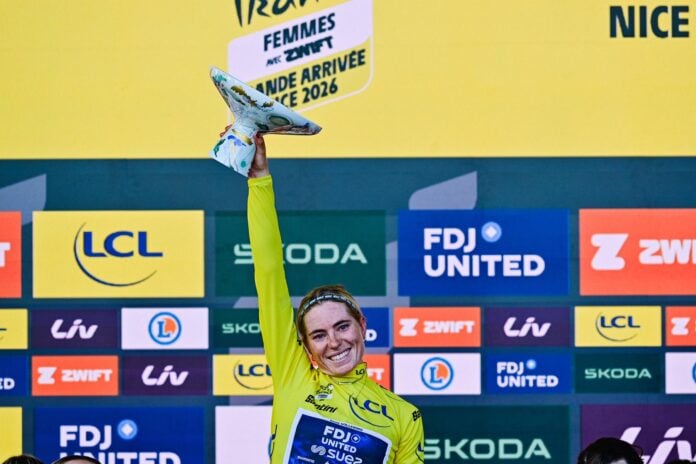
Demi Vollering left Nice with the yellow jersey, three stage victories and the largest share of the 2026 Tour de France Femmes prize fund.
The FDJ United-Suez rider earned €50,000 for winning the final general classification, then added considerably more through stage victories, stage placings, yellow jersey days and secondary classification results. Across the full nine stages, FDJ United-Suez finished comfortably at the top of the team prize-money ranking with €77,080.
Canyon SRAM were second with €51,500, largely through Kasia Niewiadoma-Phinney’s second place overall, Antonia Niedermaier’s white jersey and their repeated high stage placings. UAE Team L’IMAD earned €37,980 after placing Elisa Longo Borghini third overall, Paula Blasi fifth and Dominika Włodarczyk seventh, as well as winning the team classification.
At the other end of the scale, four teams earned less than €500 from official race prizes and Mayenne Monbana My Pie finished the Tour without collecting any prize money at all.
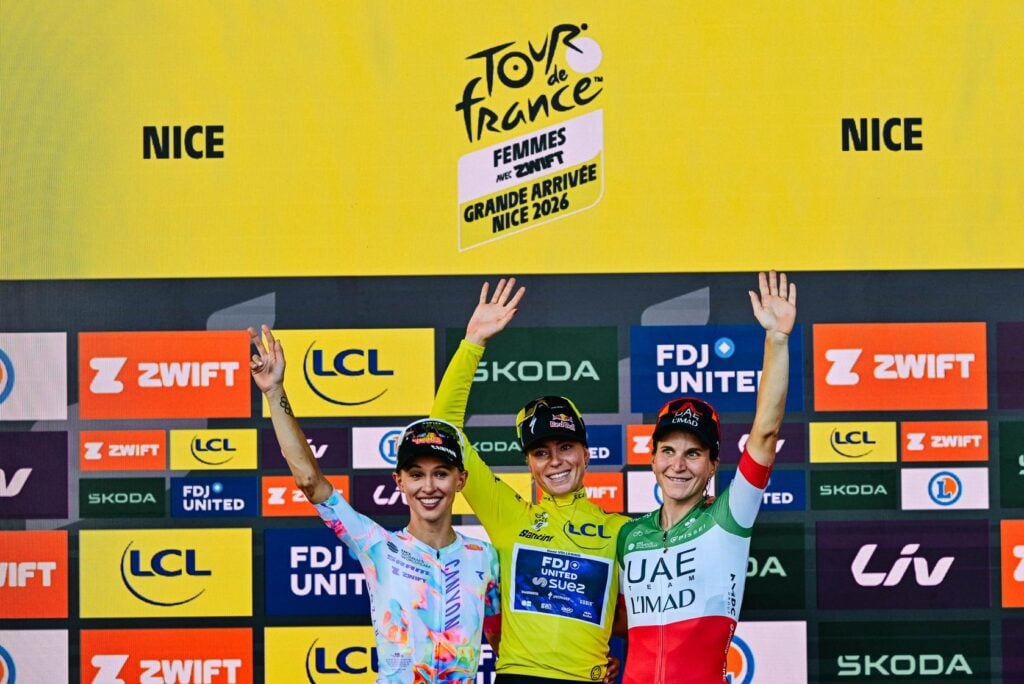 Photo Credit: A.S.O./Billy Ceusters
How much did Demi Vollering earn for winning the Tour de France Femmes?
The biggest single prize was the €50,000 awarded to Vollering for winning the final general classification.
Niewiadoma-Phinney received €25,000 for second place, while Longo Borghini earned €10,000 for third.
The full GC prize structure was:
| Final GC position | Prize money |
|---|---|
| 1st | €50,000 |
| 2nd | €25,000 |
| 3rd | €10,000 |
| 4th | €8,000 |
| 5th | €4,000 |
| 6th | €3,000 |
| 7th | €2,000 |
| 8th | €1,500 |
| 9th | €1,500 |
| 10th | €1,500 |
| 11th-15th | €1,200 each |
| 16th-20th | €1,000 each |
The full structure was set out before the race in our Tour de France Femmes 2026 prize money guide.
Vollering’s €50,000 GC payment was only part of what she generated. She also won Stages 5, 8 and 9, with each stage victory worth €4,000. That added another €12,000 from stage wins alone, before her other stage placings, days in yellow and second places in both the final points and mountains classifications were included.
The combination explains why FDJ United-Suez finished more than €25,000 clear of every other team in the final prize-money table.
How much is a Tour de France Femmes stage win worth?
Each stage winner received €4,000, with prize money paid down to 20th place on every stage.
| Stage position | Prize money |
|---|---|
| 1st | €4,000 |
| 2nd | €2,000 |
| 3rd | €1,000 |
| 4th | €500 |
| 5th | €400 |
| 6th | €300 |
| 7th | €240 |
| 8th-10th | €170 |
| 11th-15th | €110 |
| 16th-20th | €100 |
Vollering’s three wins therefore produced €12,000 from first-place stage prizes. Lorena Wiebes earned €8,000 from winning the opening two stages, while Sigrid Ytterhus Haugset, Marlen Reusser, Kim Le Court-Pienaar and Niewiadoma-Phinney each collected €4,000 for their victories.
Those nine winners can be followed through our permanent Tour de France Femmes 2026 results page, which includes the final GC, jersey winners and complete stage-win tally.
Tour de France Femmes 2026 team prize-money ranking
The final prize-money ranking was headed comfortably by FDJ United-Suez.
| Rank | Team | Prize money |
|---|---|---|
| 1 | FDJ United-Suez | €77,080 |
| 2 | Canyon SRAM | €51,500 |
| 3 | UAE Team L’IMAD | €37,980 |
| 4 | SD Worx-Protime | €18,940 |
| 5 | Lidl-Trek | €14,880 |
| 6 | EF Education-Oatly | €12,140 |
| 7 | AG Insurance-Soudal | €10,480 |
| 8 | Movistar | €8,860 |
| 9 | Team Visma | Lease a Bike | €7,370 |
| 10 | Fenix-Premier Tech | €6,740 |
| 11 | Uno-X Mobility | €5,140 |
| 12 | Human Powered Health | €3,180 |
| 13 | Cofidis | €1,490 |
| 14 | St Michel-Preference Home-Auber93 | €1,420 |
| 15 | Laboral Kutxa-Fundación Euskadi | €1,050 |
| 16 | Ma Petite Entreprise | €760 |
| 17 | Liv AlUla Jayco | €750 |
| 18 | Team Picnic PostNL | €400 |
| 19 | Lotto Intermarché Ladies | €340 |
| 20 | VolkerWessels Cycling Team | €250 |
| 21 | Mayenne Monbana My Pie | €0 |
These totals reflect all of the prize money accumulated across the race rather than simply adding up the final GC payments. Daily stage results, jersey prizes, intermediate competitions, combativity awards and team-classification money all contribute.
Why FDJ United-Suez earned the most
The answer is largely Vollering.
Her €50,000 overall victory immediately gave FDJ a prize twice as large as the payment for second place. Three stage victories added another €12,000, while Vollering’s other results increased the total further.
She finished second in both the points and mountains classifications, and also collected prize money from wearing yellow after Stage 8.
The sporting story behind those results is covered in how Demi Vollering won the 2026 Tour de France Femmes. Her first victory came on Stage 5, but the biggest financial and sporting swing arrived during the final weekend, when she attacked into yellow on Stage 8 before winning Stage 9 from the yellow jersey.
That final stage alone brought another €4,000 win payment alongside the far more valuable €50,000 overall prize.
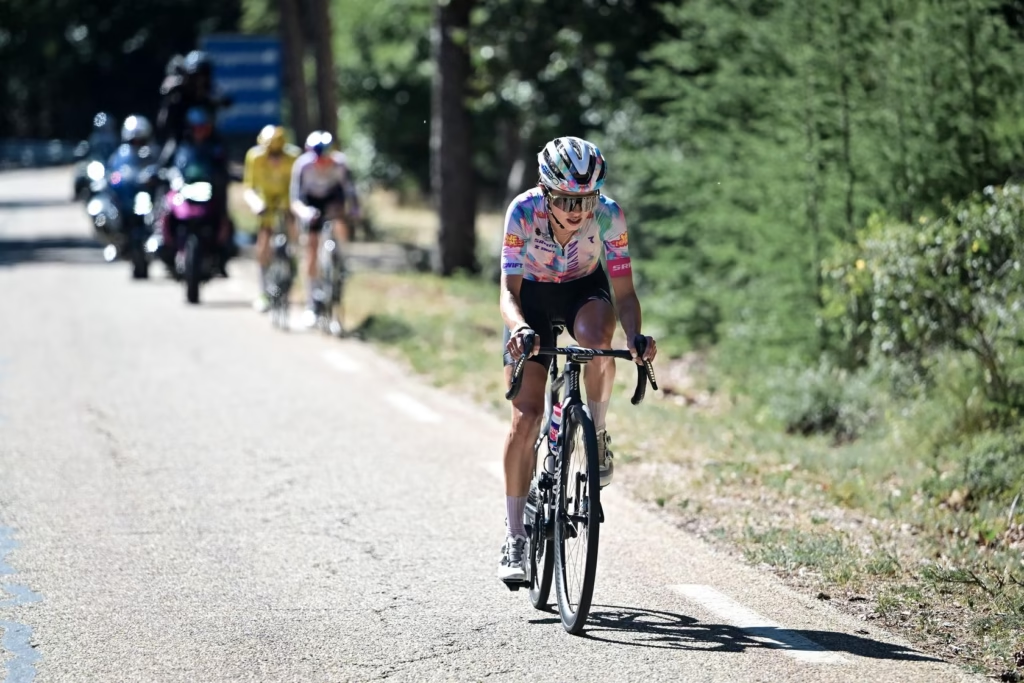 Photo Credit: A.S.O./Billy Ceusters
Canyon SRAM earned more than €50,000 without winning yellow
Canyon SRAM’s €51,500 total shows how quickly several major classification results can accumulate.
Niewiadoma-Phinney earned €25,000 for finishing second overall and another €4,000 for her Stage 7 victory on Mont Ventoux. She also collected money from stage placings and her position in the mountains classification.
Niedermaier added €3,000 for winning the white jersey as well as the €8,000 available for fourth place overall.
Those two riders alone accounted for a large share of Canyon SRAM’s total before the team’s other placings and daily prizes were considered.
They left Nice without yellow, but financially their combination of second and fourth overall plus the young rider classification made Canyon the clear second-highest earning team.
UAE Team L’IMAD earned almost €38,000 without a stage victory
UAE Team L’IMAD’s result came through depth rather than stage wins.
Longo Borghini earned €10,000 for third overall, Blasi received €4,000 for fifth and Włodarczyk another €2,000 for seventh. Blasi’s second place on Stage 9 was worth a further €2,000, while repeated top finishes across the race added smaller daily payments.
The team’s strength was reflected in the final Tour de France Femmes classifications, where UAE placed three riders inside the top seven.
They also won the final team classification, worth €6,000, after controlling that competition through much of the second half of the race.
It meant UAE could finish third in the overall prize-money table despite never winning an individual stage.
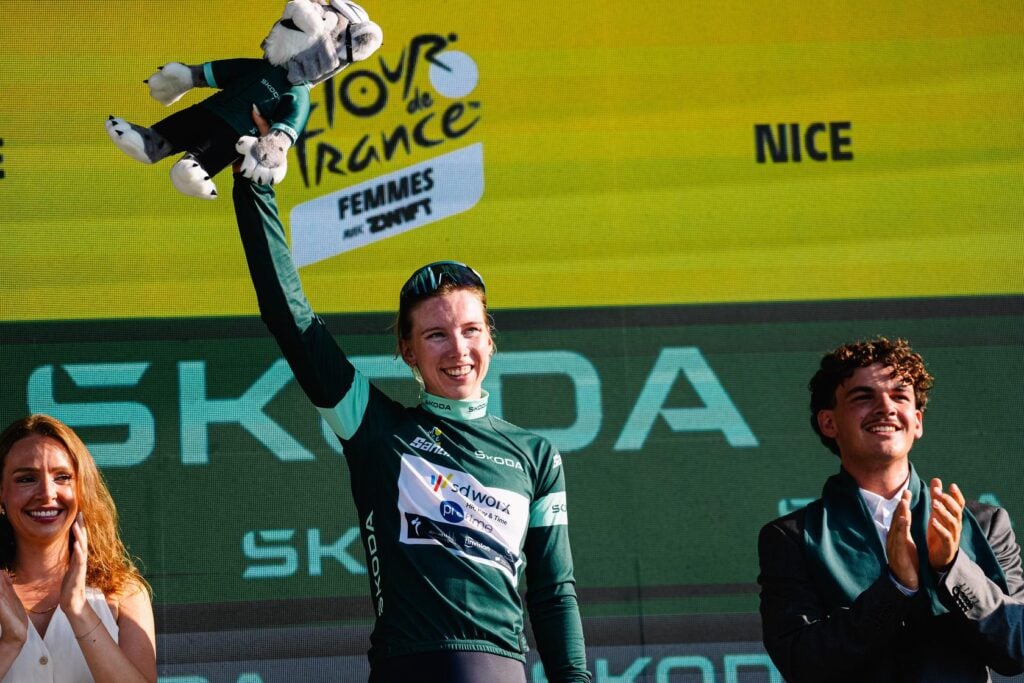 Photo Credit: A.S.O./Gaëtan Flamme
Wiebes helped SD Worx-Protime earn nearly €19,000
SD Worx-Protime finished fourth in the prize-money ranking at €18,940, with Wiebes responsible for much of that return.
Her victories on Stage 1 in Lausanne and Stage 2 in Geneva were worth €8,000 combined.
She then won the final green jersey, which carried another €3,000, while her days in yellow and green and repeated intermediate-sprint results generated additional payments.
Her Tour therefore demonstrated the financial value of dominating a secondary classification even without challenging for the GC.
How much did the green, polka-dot and white jersey winners receive?
Each of the three secondary classification winners received €3,000 for winning the final jersey.
| Classification | Winner | Final prize |
|---|---|---|
| Points, green | Lorena Wiebes | €3,000 |
| Mountains, polka dot | Puck Pieterse | €3,000 |
| Young rider, white | Antonia Niedermaier | €3,000 |
The green and mountains classifications also paid down to fifth place, while the young rider competition paid the top four.
There were additional daily payments for wearing each jersey. Intermediate sprints, categorised climbs and daily young rider results also carried smaller prizes, so the €3,000 final award represents only part of what each classification winner generated.
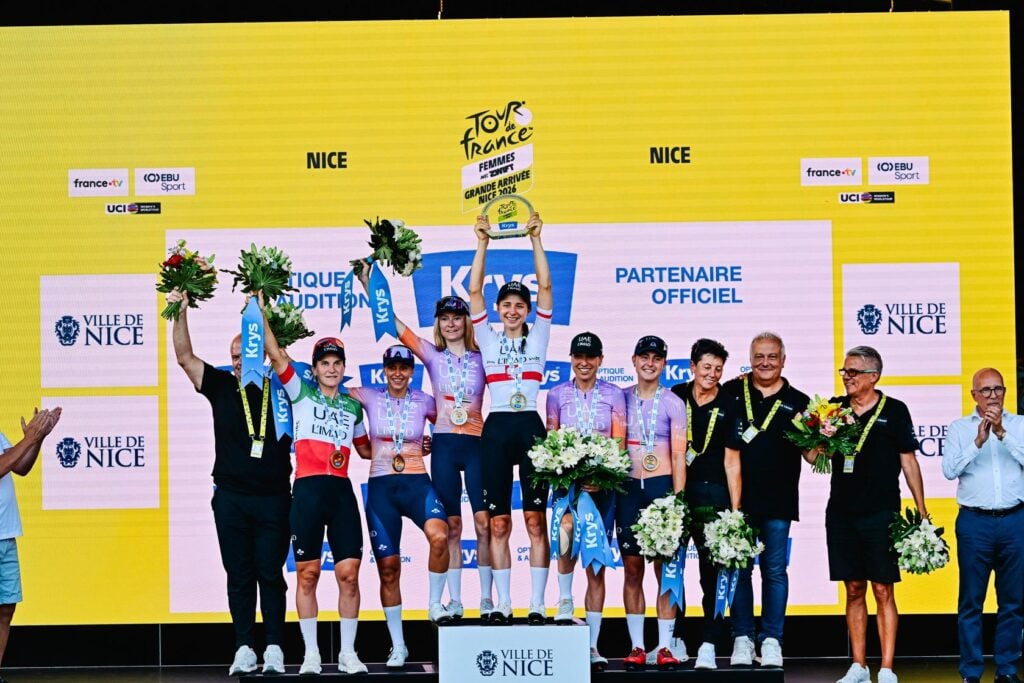 Photo Credit: A.S.O./Billy Ceusters
UAE Team L’IMAD earned €6,000 for the team classification
The final team classification was worth more to its winner than any of the three secondary individual jerseys.
UAE Team L’IMAD received €6,000 for first, with prize money paid to the top five teams:
| Final team classification | Prize money |
|---|---|
| 1st | €6,000 |
| 2nd | €4,000 |
| 3rd | €2,500 |
| 4th | €1,500 |
| 5th | €500 |
There was also a €200 prize for the best team on each individual stage.
The competition is calculated from the combined times of each team’s leading riders and particularly rewarded UAE’s depth, with Longo Borghini, Blasi and Włodarczyk all finishing high on GC.
One team left the Tour with no official prize money
The drop between the leading teams and those at the bottom of the table was substantial.
VolkerWessels collected only €250, Lotto Intermarché Ladies €340 and Team Picnic PostNL €400. Mayenne Monbana My Pie finished the Tour with €0 in official race prize money.
That does not mean those teams gained nothing from appearing at the Tour. Sponsor exposure, television visibility and simply having a place in the biggest stage race in women’s cycling can carry commercial value well beyond the official prize table.
The numbers nevertheless underline how concentrated the direct rewards are.
FDJ United-Suez earned €77,080.
The bottom four teams combined earned less than €1,000.
What was the total Tour de France Femmes 2026 prize fund?
The Tour promoted a prize fund of around €250,000 before the race, but the completed 2026 prize-money table adds up to €260,750 across the 21 teams once the full set of race prizes is included.
That covers the general classification, stages, jersey competitions, team classification, combativity and the smaller daily prizes available throughout the nine stages.
The pre-race Tour de France Femmes prize-money guide breaks down the individual categories in more detail.
How does Tour de France Femmes prize money compare with the men’s Tour?
The gap remains enormous.
Vollering earned €50,000 for winning the Tour de France Femmes overall. The winner of the men’s Tour received €500,000.
A men’s Tour stage win is worth €11,000 compared with €4,000 at the Tour Femmes, while the men’s green and polka-dot jersey winners receive €25,000 apiece compared with €3,000 for Wiebes and Pieterse.
The men’s Tour also distributes more than €2.3 million overall, compared with €260,750 across the completed women’s prize table.
There are obvious differences in scale. The men’s Tour contains 21 stages rather than nine, covers roughly three times the distance and operates within a much older commercial structure. The gap in prize money, however, remains substantially greater than the difference in race length.
For comparison, ProCyclingUK’s Tour de France prize-money guide explains how the men’s race distributes its much larger purse.
Does Vollering actually keep the €50,000?
Not necessarily.
Cycling prize money is commonly pooled within professional teams and divided between riders, with team-specific agreements sometimes also including staff. The €50,000 is therefore best understood as the official prize attached to Vollering’s overall victory rather than necessarily €50,000 of personal take-home income.
The same applies to FDJ United-Suez’s €77,080 total. It represents the money generated by the team’s performances across the Tour, not a single payment handed directly to Vollering.
The wider financial value of winning the Tour is also much greater than the official cheque. Salary bonuses, sponsorship exposure and the commercial value of becoming a two-time champion can all outweigh the published prize money.
For the official results table, though, the numbers are clear: €50,000 for Vollering’s yellow jersey, €77,080 for FDJ United-Suez across the race and €260,750 distributed across the 21 teams.

