Fabio Jakobsen has joined Team Visma | Lease a Bike with immediate effect, with the Dutch sprinter signing a contract through the end of 2028 as Visma begin a long-term attempt to rebuild him towards the level that once made him one of the fastest riders in the world.
The 29-year-old moves across from Team Picnic PostNL during the 2026 season rather than waiting until the winter transfer window. He will begin working within Visma’s performance structure immediately, with the coming months focused more on rebuilding condition and adapting to the team’s methods than rushing him back into a full racing programme.
“I’ve raced against the team for several years now, and seeing everything they’ve achieved throughout the years and how consistently they perform at the highest level, it’s a dream come true to wear these colours,” Jakobsen said.
The length of the deal is significant. Visma have committed to Jakobsen through 2028, giving both sides time to treat this as a genuine rebuilding project rather than expecting his former sprinting level to return within weeks.
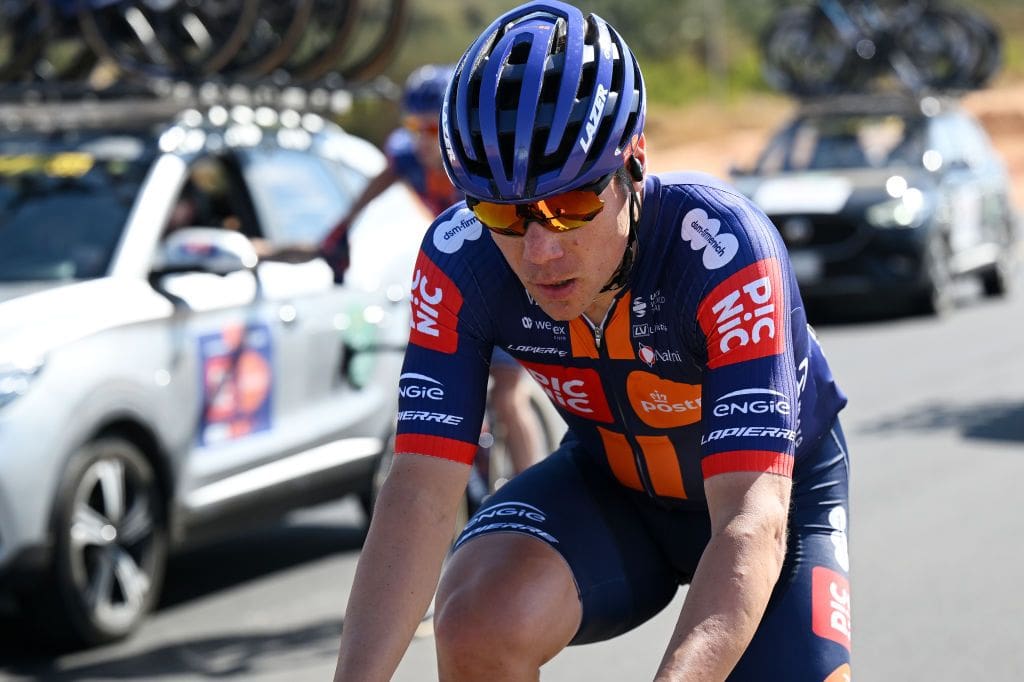
Visma were specifically looking for a pure sprinter
Perhaps the most revealing part of the move is how clearly Team Visma | Lease a Bike have defined Jakobsen’s role.
Head of Performance Mathieu Heijboer said the team had been looking for “a specialist for the pure flat sprints”, and the more Visma examined Jakobsen’s situation, the more convinced they became that there was still significant potential to recover.
That need has become particularly clear following Olav Kooij’s move to Decathlon CMA CGM for 2026. ProCyclingUK covered how Kooij left Visma to join Decathlon as the centre of a new sprint project, with Cees Bol and Robbe Ghys following him to form part of the new lead-out.
Matthew Brennan has developed rapidly and Wout van Aert can still win fast finishes, but neither is the same type of specialist as Jakobsen. At his best, the Dutchman is built around one very specific objective: surviving to the final kilometres of a flat race and producing elite speed.
“We had been looking for a specialist for the pure flat sprints,” Heijboer said. “The more we looked into Fabio’s situation, the more convinced we became that there is still a great deal of untapped potential.”
The immediate priority is rebuilding rather than racing
Visma have deliberately avoided presenting the move as an instant return to winning.
The coming months will be focused on Jakobsen’s physical condition, the team’s training philosophy, nutrition programme and wider performance structure. His return to competition is expected to be gradual, with Visma giving him time to become fully integrated before judging the project on results.
“My goal is to get back to the level where I can compete at the highest level again and sprint for victories,” Jakobsen said.
“As a sprinter, you never win on your own, so being part of a strong team is essential. I believe this is one of the best performance environments in the world.”
That cautious approach makes sense given the difficulties Jakobsen has faced over the past two seasons.

Iliac artery surgery interrupted Jakobsen’s 2025 season
The biggest setback came in 2025 when Jakobsen was diagnosed with restricted blood flow through the iliac arteries in both legs.
He underwent surgery in April and subsequently missed the Tour de France while rebuilding his condition. ProCyclingUK covered the situation when Team Picnic PostNL confirmed Jakobsen would miss the 2025 Tour while recovering from iliac artery surgery.
The problem helped explain why a rider renowned for producing enormous power in sprints had struggled to reproduce his previous level. Even after surgery, returning to competition was never going to be as simple as waiting for the wounds to heal. Jakobsen had to rebuild strength, race rhythm and confidence after an extended period in which his body had not been allowing him to perform normally.
That process was then complicated further when he fractured his collarbone following a crash at the Renewi Tour later in 2025.
By the start of 2026, the expectation was that the vascular issue itself was behind him. The challenge became rediscovering the physical level and sprint instincts required to compete consistently against the best fast men.
Jakobsen was back in major sprint fields during 2026
There have been signs during 2026 that Jakobsen was working his way back towards a more normal racing programme.
He returned to the Belgian and northern European one-day calendar and was part of Picnic PostNL’s sprint plans for races including Ronde Van Brugge and the Copenhagen Sprint.
Ahead of Ronde Van Brugge, ProCyclingUK still rated Jakobsen among the leading sprint contenders, with the flat course representing exactly the type of race where his specialist qualities should be most valuable.
He was also part of Picnic’s line-up for the 2026 Copenhagen Sprint team-by-team guide, alongside Pavel Bittner as the team tried to balance a proven pure sprinter with a younger, more versatile fast finisher.
Those appearances showed that Jakobsen had returned to regular competition. What has remained missing is the consistent stream of victories that defined the strongest years of his career.
Visma now believe a different environment can help close that gap.
 Photo Credit: Getty
His best years made Jakobsen one of the world’s benchmark sprinters
There is a reason Visma are willing to invest three seasons in the project.
Jakobsen has already won five stages of the Vuelta a España, the Vuelta points classification, a Tour de France stage and the European road race title. His career also includes major one-day victories at Scheldeprijs and Kuurne-Brussels-Kuurne.
His 2022 Tour de France stage victory came in Nyborg and confirmed his return to the very top level following the life-threatening crash he suffered at the 2020 Tour de Pologne.
That comeback remains one of the defining parts of Jakobsen’s career, but his latest challenge has been very different. The issue has not been rebuilding after one catastrophic accident, but understanding why his physical output had declined and then gradually recovering after vascular surgery and further injuries.
ProCyclingUK looked back at his standing within the sport in a 2025 piece on Jakobsen’s career and public profile, including his Tour stage win, five Vuelta victories and 2022 European title.
Those results are the level Visma are trying to move him back towards.
Visma believe there is still untapped potential
Jakobsen turns 30 at the end of August, but age is clearly not the reason Visma believe his best years are behind him.
Heijboer’s wording is important. Visma are not signing an experienced rider simply to add depth to the roster. They believe there is still “a great deal of untapped potential” and that the team’s performance structure can help access it.
“We believe we can create the right environment to help him unlock it,” Heijboer said.
“At the same time, having Fabio join us now allows us to start working with Fabio straight away instead of waiting until next season.”
That explains the importance of completing the move in August.
Even if Jakobsen races relatively little before the end of 2026, Visma gain several months to assess his training response, nutrition, biomechanics and sprint preparation before the start of 2027. Rather than arriving at training camp as a new signing who still needs to learn the system, he can enter next season having already spent months inside it.


Building a lead-out will be part of the challenge
Recovering Jakobsen’s physical level is only one part of the project.
Elite sprinting is highly dependent on structure. A rider can possess enormous peak power and still fail to win if he is consistently forced to move through traffic, launch too early or begin the sprint several wheels behind his rivals.
Jakobsen acknowledged that directly.
“As a sprinter, you never win on your own,” he said.
Visma will therefore need to work out which riders can form the most effective train around him. The team’s men’s roster has become increasingly built around versatility, stage-racing support and riders capable of fulfilling several roles rather than a large specialist sprint block.
Kooij’s departure removed the most obvious reason to maintain a dedicated flat-stage structure, but Jakobsen’s arrival changes that equation again.
The task over the next year will be to establish whether Visma can rebuild both the rider and the system around him.
A fresh start after the Picnic PostNL chapter
Jakobsen’s move also brings his time within the Picnic structure to a close.
He joined what was then dsm-firmenich PostNL ahead of 2024 after six successful years in the Quick-Step organisation. When the team became Picnic PostNL for 2025, Jakobsen remained one of the biggest names on the men’s roster, as covered in ProCyclingUK’s piece on the team’s change to the Picnic PostNL identity.
The move did not deliver the volume of victories either side had expected.
His first Tour with the team ended on Stage 12 in 2024 after a difficult opening half of the race, with ProCyclingUK reporting on Jakobsen’s withdrawal from that Tour. The vascular diagnosis the following year subsequently provided important context for why his performances had been so difficult to rebuild.
Visma now inherit a rider whose underlying ability has already been proved many times, but whose recent seasons have been dominated by trying to regain access to it.
“There’s a lot of work ahead,” Jakobsen said, “but I’m confident this is the right environment to make progress.”
The immediate transfer means that work starts now rather than in January. The contract through 2028 means Visma are prepared to give it time.