
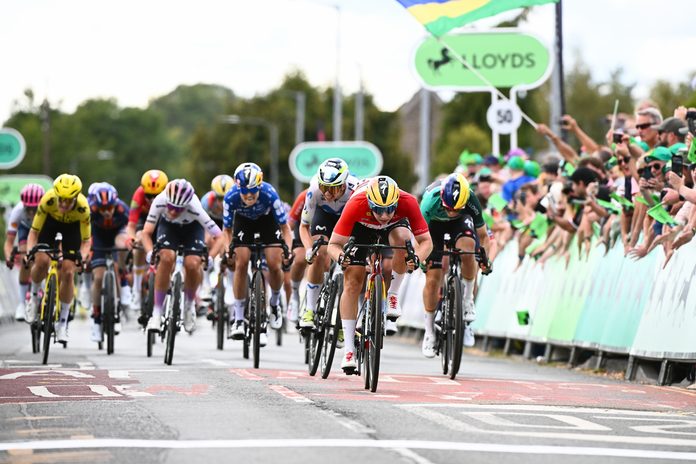
The Tour of Britain Women 2026 concludes on Sunday 23 August with a 123.8-kilometre stage starting and finishing in Royal Leamington Spa, where Kim Le Court-Pienaar will try to protect the overall lead and Lorena Wiebes will chase a fourth stage victory in five days.
Saturday’s demanding stage to Hay-on-Wye strengthened both storylines. Wiebes survived another climbing-heavy day before winning the reduced sprint, beating Liane Lippert and Le Court-Pienaar, while Le Court-Pienaar retained control of the general classification going into the final stage.
The Tour of Britain Women 2026 route guide always identified the Leamington finale as the race’s clearest sprint opportunity after the Welsh climbing block. The route is the flattest of the five stages, but 1,386 metres of climbing and late ascents of Sun Rising Hill and Burton Dassett Hills Country Park mean this will not necessarily be a routine procession towards a bunch finish.
That gives the stage a clear tactical tension. Wiebes is the obvious favourite if the sprinters survive, while Lippert and the other riders still chasing Le Court-Pienaar need to use the late Warwickshire climbs to prevent the final GC battle being reduced to bonus seconds.
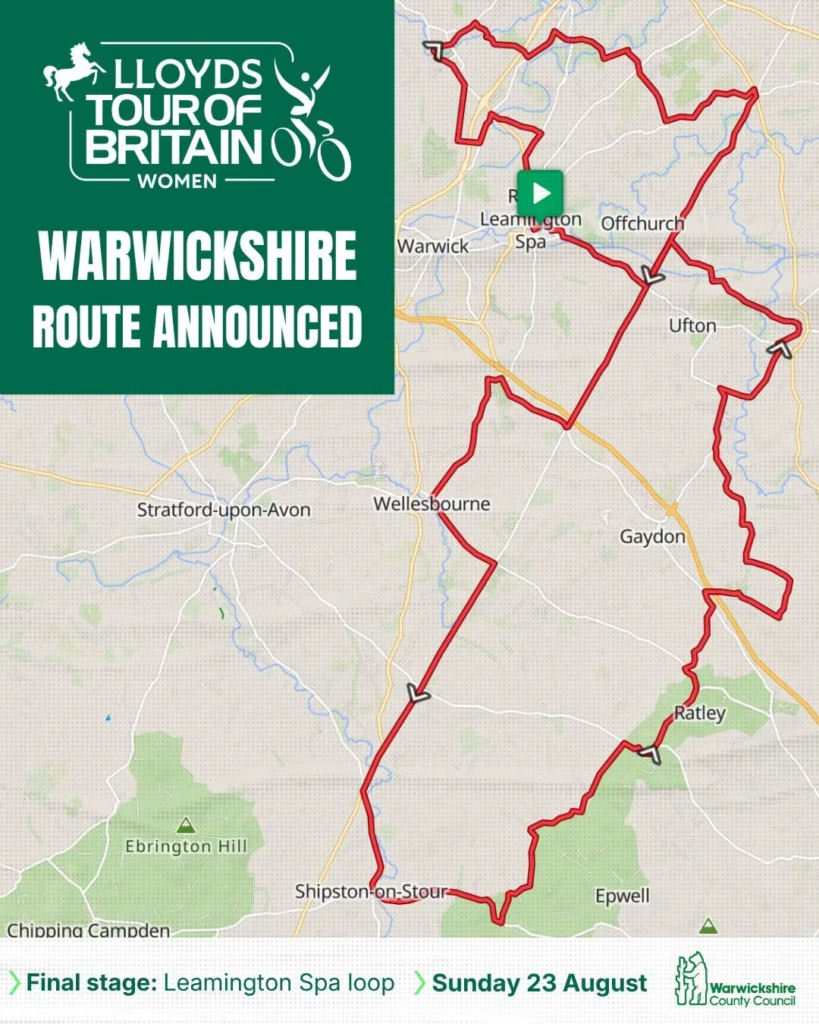
Tour of Britain Women Stage 5 route
Date: Sunday 23 August 2026
Start: Royal Leamington Spa
Finish: Royal Leamington Spa
Distance: 123.8km
Elevation: 1,386m
Stage type: Rolling / sprint
Start time: 11:00 BST
Expected finish: Around 14:30 BST
Key climbs: Sun Rising Hill and Burton Dassett Hills Country Park
Finish: Beside Jephson Gardens
The stage heads north from Royal Leamington Spa towards Kenilworth before looping south through the Warwickshire countryside and eventually turning back towards the finish.
The decisive terrain arrives relatively late. Sun Rising Hill measures around 900 metres at 10%, followed by Burton Dassett Hills Country Park at roughly 700 metres and 9%. Neither climb is long enough to create huge gaps on its own, but both are steep enough for riders to attack aggressively after more than 90 kilometres of racing.
Burton Dassett will also be familiar to followers of the men’s Tour of Britain after being used as a summit finish in 2025. This time, however, the climb comes well before the finish, giving riders dropped on the ascent time to organise a chase before the race returns to Leamington.
That distinction should be central to the stage.
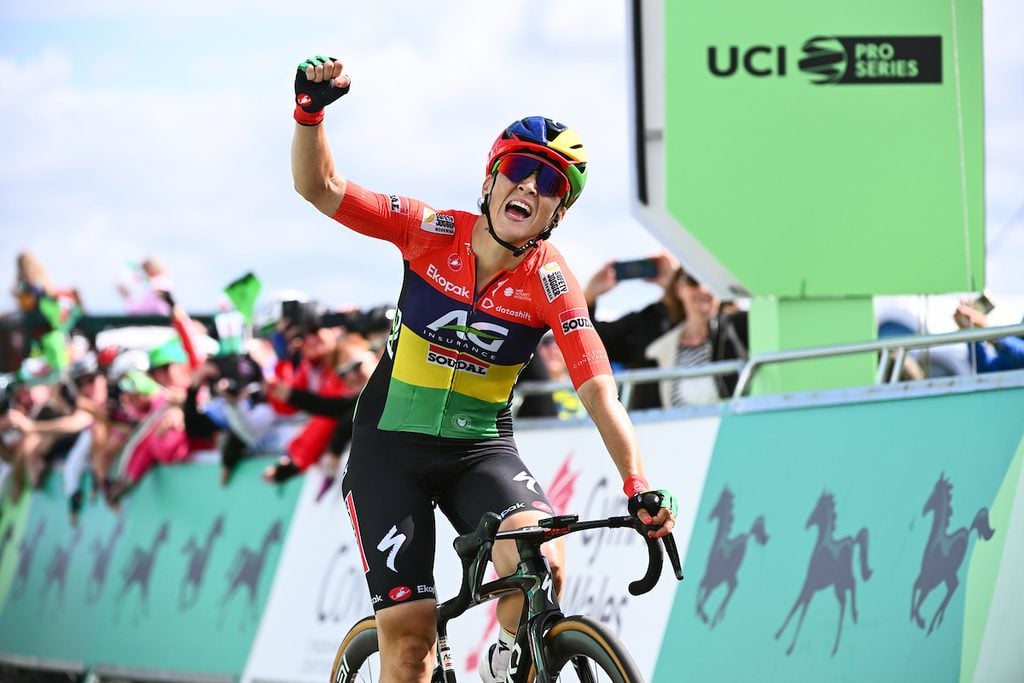
Le Court-Pienaar begins the final day in control
Kim Le Court-Pienaar starts Stage 5 with the race in her hands.
Her victory on the Great Orme established the first serious GC gaps, and she then backed that up by staying with the strongest riders on Stage 4 before finishing third behind Wiebes and Lippert in Hay-on-Wye.
That was arguably as important as the Great Orme win itself.
Stage 4 was longer, contained more total climbing and created several opportunities for the race to escape her control. Le Court-Pienaar still responded when Lippert attacked and retained enough speed to contest the finish afterwards.
The Tour of Britain Women 2026 contenders preview highlighted exactly that combination of climbing strength and finishing speed as one of her greatest advantages in this race.
On Sunday, she does not need to win.
Her priority is simply making sure none of the riders close enough to threaten the overall classification gain significant separation over Sun Rising Hill or Burton Dassett.
Lorena Wiebes is the clear Stage 5 favourite
Lorena Wiebes has now won three of the opening four stages, and Stage 4 in Hay-on-Wye was perhaps the most convincing demonstration yet of how difficult she has become to remove.
The stage contained sustained climbing and a selective final hour, but Wiebes survived with the main contenders and still had enough left to win the sprint.
That makes the Stage 5 profile far less intimidating.
There is less total climbing than on Saturday, and neither Sun Rising Hill nor Burton Dassett comes at the finish. Even if Wiebes loses contact briefly, SD Worx-Protime have plenty of road available afterwards to bring her back.
If she reaches Royal Leamington Spa with the front group, she will be extremely difficult to beat.
The route should also suit the way Wiebes has been racing this week. She no longer needs a completely flat stage with an intact sprint train. She has shown that she can survive harder terrain, respond to attacks and still produce her usual finishing speed.
A fourth victory from five stages is therefore entirely realistic.
Liane Lippert has to attack before Leamington
Liane Lippert cannot afford to wait for the sprint.
Her Stage 4 performance confirmed that she has the legs to challenge Le Court-Pienaar directly, but the final stage requires something more ambitious if she wants to overturn the GC.
The obvious opportunities are Sun Rising Hill and Burton Dassett.
Movistar need to make both climbs difficult, reduce the number of AG Insurance-Soudal domestiques around Le Court-Pienaar and then force the race leader to respond repeatedly.
Simply attacking once on Burton Dassett may not be enough.
The climb is too short and there is too much road remaining afterwards for a small gap to survive automatically.
Lippert therefore needs a race in which Le Court-Pienaar is already under pressure before the final ascent begins.
If the leading GC riders arrive together in Leamington, the opportunity to change the race will almost certainly have disappeared.
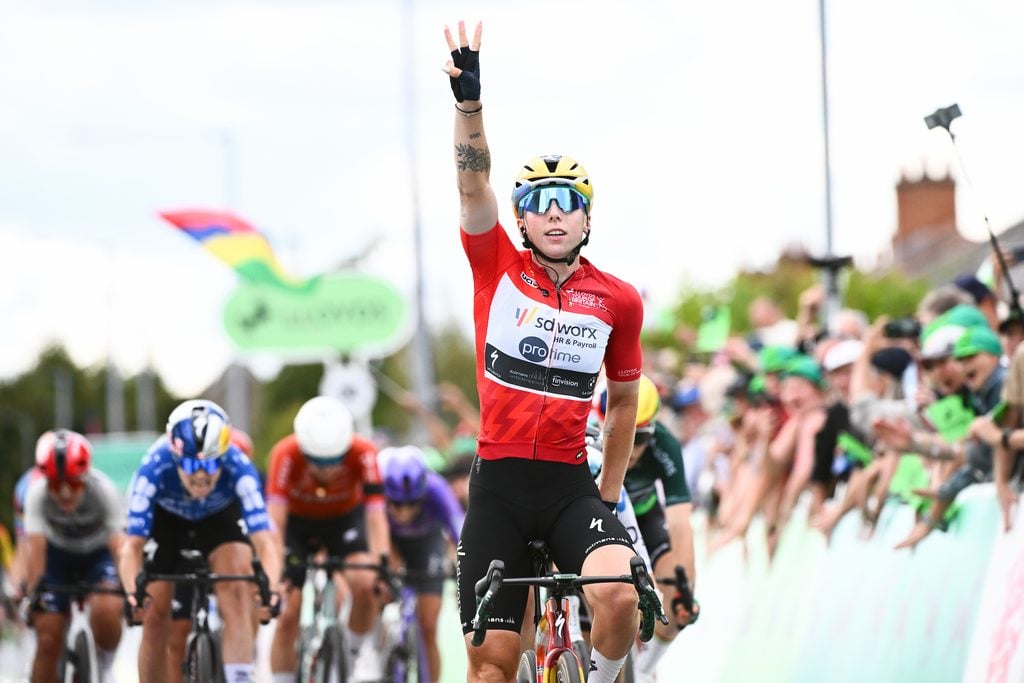 Photo Credit: Simon Wilkinson/SWpix.com
Wiebes can still improve her overall position
Wiebes’ sprint speed also creates an important secondary GC battle.
She remains close enough to Lippert that another stage victory and the associated bonus seconds could improve her final overall position even if Le Court-Pienaar remains safely in the lead.
That gives SD Worx-Protime every reason to chase a conventional finish.
Movistar need almost the opposite race.
Lippert needs the stage to become selective enough to take time from Le Court-Pienaar, while also avoiding bringing Wiebes towards another sprint where the Dutch rider can collect maximum bonuses.
That clash of objectives should make the final 40 kilometres far more interesting than a typical sprint finale.
Caroline Andersson can still attack the podium
Caroline Andersson remains one of the riders with the most to gain from an aggressive Stage 5.
Her Great Orme performance established her as one of the strongest climbing riders in the race, and she backed that up through the longer Stage 4 test.
The final day is less naturally suited to her because of the likely sprint, but that also clarifies the tactical objective.
Andersson needs to attack.
If Movistar begin applying pressure around Sun Rising Hill, she has every reason to follow rather than helping Le Court-Pienaar restore control.
She does not necessarily need to launch the first move herself. Using Lippert’s aggression could provide a much more efficient route towards improving her own final classification.
 Photo Credit: Cor Vos
Femke de Vries needs one last hard race
Femke de Vries should have similar ambitions.
Her Great Orme ride and strong Stage 4 confirmed that she has the climbing level to remain involved with the best riders on the harder terrain, but a straightforward Leamington sprint offers little opportunity to improve.
That means Visma | Lease a Bike should welcome an aggressive final stage.
De Vries can use the steep Warwickshire climbs to try to create separation from Wiebes and some of the faster all-rounders, while also putting pressure on the riders immediately ahead of her in the GC.
The stage is short enough that teams can afford to race aggressively.
There is little reason to conserve energy when the season’s final Tour of Britain kilometre is only a few hours away.
Karlijn Swinkels can still benefit from consistency
Karlijn Swinkels does not necessarily need to approach the stage with the same aggression.
Her strength throughout the race has been consistency rather than one decisive attack, and Stage 5 can reward that again if other contenders take risks.
A rider attacking on Burton Dassett and then being caught before Leamington can easily lose more than they gain.
Swinkels can therefore concentrate on staying close to the strongest riders and exploiting any mistakes made by those around her.
She also possesses enough finishing speed to contest a reduced sprint if Wiebes and the pure sprinters have been removed.
That means she has more tactical flexibility than many of the climbing specialists.
Mischa Bredewold gives SD Worx-Protime another attacking card
Mischa Bredewold could become especially important if the GC teams try to make the late climbs decisive.
SD Worx-Protime’s primary stage objective is clearly Wiebes, but Bredewold gives them a rider capable of attacking before the sprint.
That can force other teams to chase while Wiebes remains protected.
If Bredewold moves over Sun Rising Hill or Burton Dassett, AG Insurance-Soudal and Movistar cannot simply ignore her. Every rider they use in the chase is one less available to attack Wiebes or Le Court-Pienaar later.
It creates a simple two-card strategy.
Bredewold can attack. Wiebes can wait.
That is particularly dangerous on a stage where so many rival teams need an aggressive race.
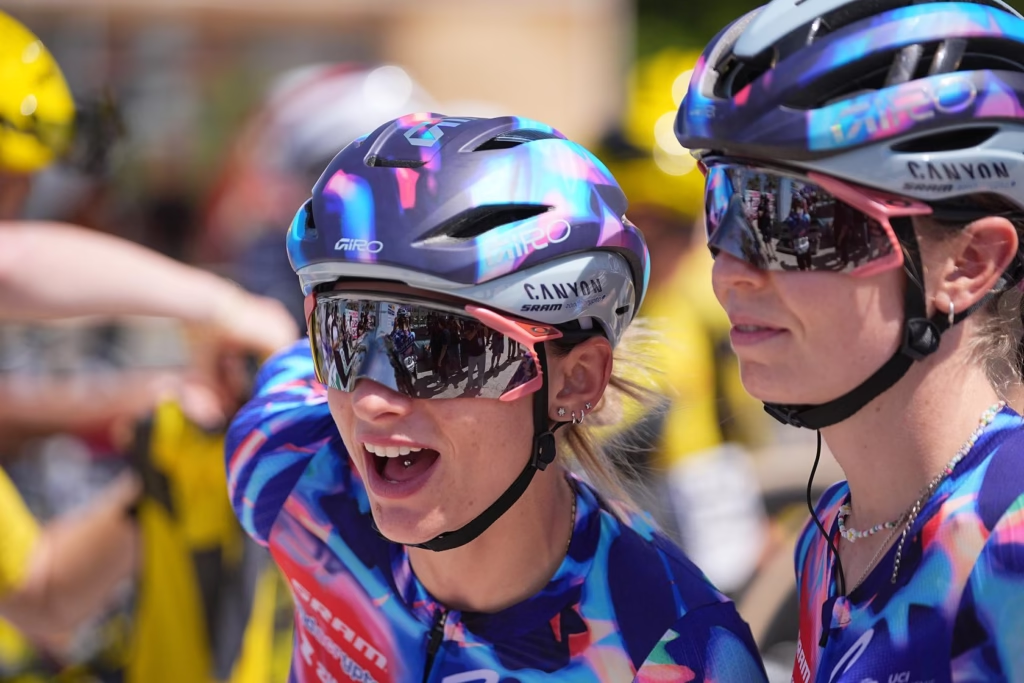 Photo Credit: RCS
Chiara Consonni is one of the strongest sprint alternatives
If the stage does end with a sizeable group, Chiara Consonni should again be one of the strongest alternatives to Wiebes.
She finished second on Stage 1 in Cockermouth and remains one of the few riders in the field with the pure finishing speed to challenge if Canyon SRAM can deliver her into the right position.
The late climbs are the main obstacle.
Wiebes has already shown that she can survive considerably harder terrain than most sprinters. Consonni has less margin for repeated attacks and therefore needs the GC battle to remain controlled enough for a larger group to reform.
If that happens, the sprint becomes much more interesting.
Wiebes remains the favourite, but Consonni is one of the riders capable of exploiting any mistake in the SD Worx lead-out.
The full Tour of Britain Women 2026 start list shows the depth of sprint talent that survived the harder Welsh stages.
Pfeiffer Georgi should look to attack before the sprint
Pfeiffer Georgi has little reason to wait for Leamington.
Her best opportunity comes from the late climbs and the tactical hesitation that can follow them.
Team Picnic PostNL can use Georgi around Burton Dassett or immediately afterwards, when the sprint teams may have lost domestiques and the GC leaders are more interested in watching one another than chasing a rider further down the classification.
The long run towards Leamington makes a solo move difficult, but a small group containing Georgi and several other powerful riders could be much harder to control.
Her Classics background makes her particularly dangerous if the finale becomes disorganised.
 Photo Credit: Alex Whitehead/SWpix.com
Fleur Moors can animate the final climbs
Fleur Moors is another rider who should welcome a more aggressive race.
She has repeatedly been visible during the Tour and has the punch required for short, steep climbs such as Sun Rising Hill and Burton Dassett.
Waiting for Wiebes in Leamington offers almost nothing.
Attacking before the sprint gives her a genuine route towards a result.
That makes Moors one of the riders most likely to become involved if Lidl-Trek decide to use the final stage proactively rather than simply protecting existing positions.
Lauren Dickson still has the mountains classification to think about
Lauren Dickson’s GC ambitions were hurt by her Stage 4 crash, but the final classified climbs still give her another objective.
She has been prominent throughout the Queen of the Mountains competition and can use Sun Rising Hill and Burton Dassett to target points rather than thinking purely about the final stage result.
That makes her tactically useful.
Dickson may have an incentive to attack earlier than many riders around her, and any QOM move involving a strong climber can quickly become relevant to the stage if the GC teams hesitate.
Her broader 2026 progression was one of the reasons she featured prominently in the Tour of Britain Women contenders preview, and the final day still gives her an opportunity to leave the race with a tangible result.
Sun Rising Hill can begin the final GC battle
Sun Rising Hill measures only around 900 metres but averages 10%, making it the first obvious place where the race can begin to fracture.
Nobody is likely to win the Tour there.
That is not necessarily the objective.
Movistar and the other teams chasing Le Court-Pienaar can use the climb to remove domestiques and discover which riders are already close to their limit.
If Le Court-Pienaar reaches Burton Dassett surrounded by teammates, defending the jersey becomes considerably easier.
If she arrives isolated after a series of attacks, the final climb becomes a much more serious problem.
Sun Rising Hill is therefore less about producing the decisive gap and more about setting up the conditions in which one can happen.
Burton Dassett is the final real opportunity to change the GC
The Burton Dassett Hills Country Park ascent is around 700 metres at 9% and provides the final obvious terrain where Lippert and the other GC challengers can attack Le Court-Pienaar.
The climb is short enough that the gaps themselves may remain small.
What happens immediately afterwards matters more.
A rider cresting with ten seconds cannot begin looking around and waiting for cooperation. They need to commit fully because the road back towards Leamington gives the chasing group plenty of time to reorganise.
That makes team composition crucial.
A small group containing several riders from different teams has a realistic chance of staying away.
One isolated attacker faces a much harder task.
The Tour of Britain Women 2026 route guide highlights exactly why the final stage is more complicated than its “flattest stage” label initially suggests.
-
 Photo Credit: quentinphotographiebe
 -
 Photo Credit: Getty

The run to Leamington strongly favours Wiebes
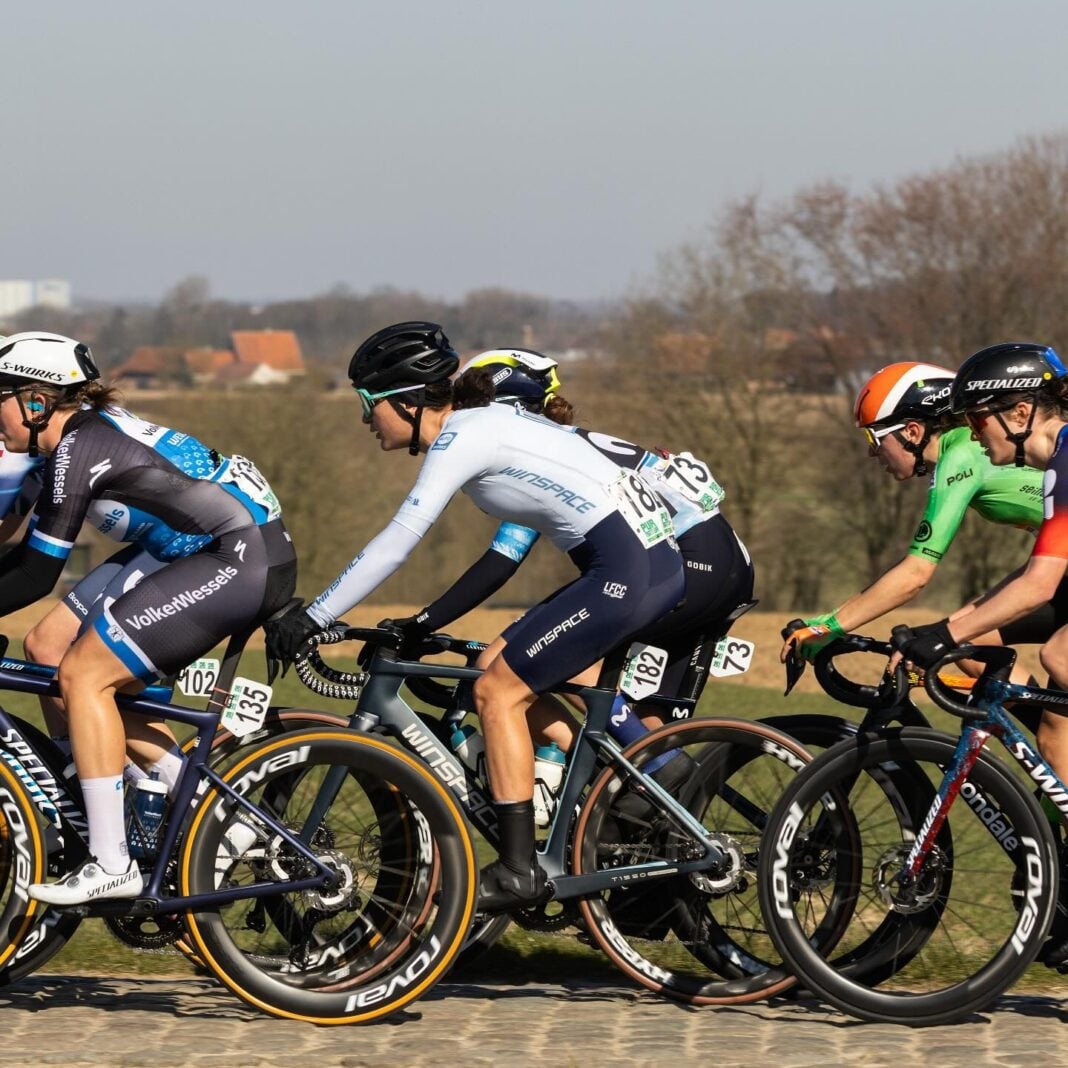
The biggest problem for anyone trying to remove Wiebes is the distance remaining after the climbing.
Dropping her for ten or fifteen seconds is not enough.
SD Worx-Protime have time to organise behind, and Wiebes has already demonstrated during this race that she can return after hard climbing and still produce an elite sprint.
That means rival teams need to create sustained separation.
If Wiebes returns before the final kilometres, the hierarchy becomes very simple.
Everyone else has to try to beat the fastest rider in the race in a sprint.
So far, nobody has managed it when she has arrived in position.
Who wins Tour of Britain Women 2026 Stage 5?
Lorena Wiebes is the clear favourite.
Three victories in four stages already establish that, but the manner of her Stage 4 victory makes the case even stronger. She survived the hardest sustained climbing stage of the race and still won the reduced sprint.
Stage 5 contains less climbing, while the steepest late ascents come far enough from the finish for her to return even if she is briefly distanced.
Chiara Consonni is one of the strongest direct alternatives if a sizeable group contests the finish, while Kim Le Court-Pienaar has enough speed to feature again if the finale is more selective.
Liane Lippert has the form to win but cannot race purely for the stage. Her priority has to be attacking Le Court-Pienaar and trying to overturn the overall classification, even if that reduces her chances of victory in Leamington.
Caroline Andersson and Femke de Vries should also be interested in an aggressive final stage, while Karlijn Swinkels can benefit if the riders around her take too many risks.
Pfeiffer Georgi, Mischa Bredewold and Fleur Moors are among the strongest attacking options before the sprint.
The most likely outcome remains a reduced peloton reforming after Burton Dassett before racing towards a sprint beside Jephson Gardens.
If that happens, Wiebes will be extremely difficult to stop.
For the overall race, however, the equation is different. Le Court-Pienaar has survived the Great Orme and the hardest day through Mid Wales. She now has one final set of Warwickshire climbs to negotiate before she can seal the biggest stage-race victory of her career.
For UK viewers planning to follow the finale, ProCyclingUK’s verified Tour of Britain Women 2026 viewing guide has the live TV, streaming and free YouTube options for the final stage.

