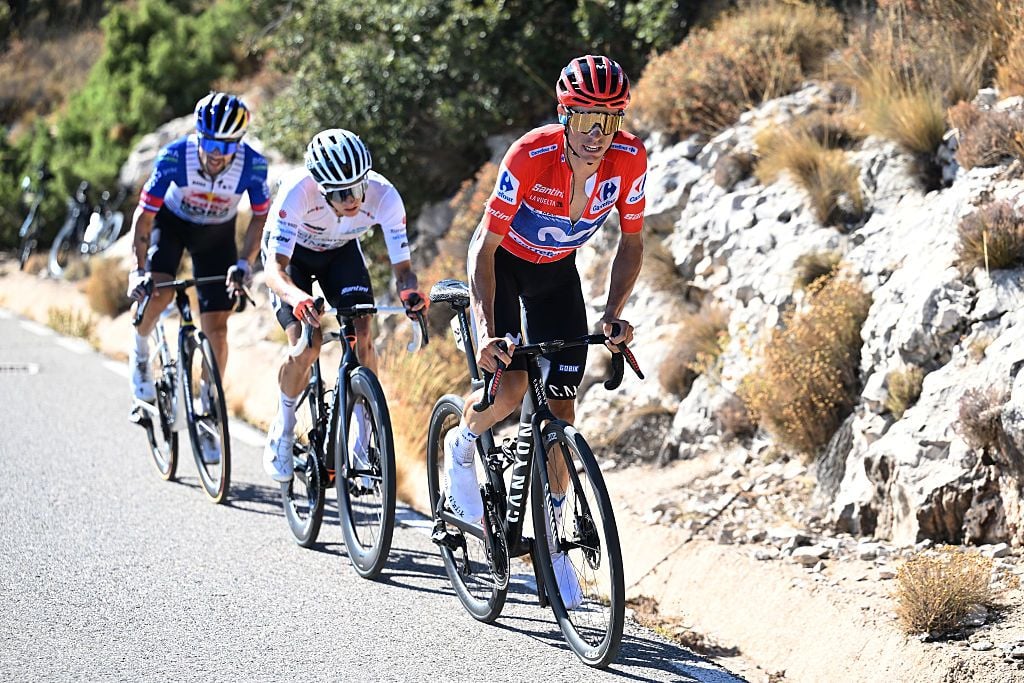
The Vuelta a España returns to the high mountains on Saturday with 154.5km from Jaén to Sierra de La Pandera, where Enric Mas faces another direct test from Primož Roglič and Felix Gall on one of the most important summit finishes of the second week.
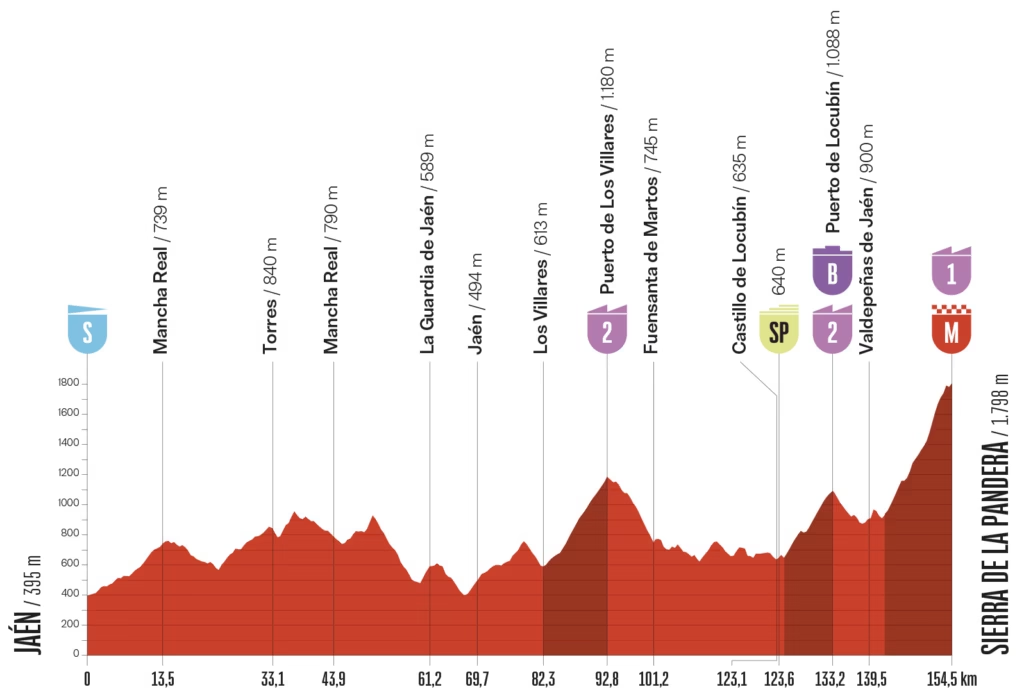
Stage 14 contains roughly 4,300 metres of climbing, much of it packed into the second half. Puerto de Los Villares begins with 72km remaining, Puerto de Locubín follows before the finale and the race then climbs all the way to La Pandera at 1,820 metres.
The official final climb measures 11.9km at 7.2%, but the average hides the real character of La Pandera. The gradients become much less consistent after the turn towards the summit with 8.4km remaining, and the final kilometres repeatedly move into double digits.
Mas arrives having strengthened his grip on red at Calar Alto on Stage 12. He attacked his main rivals with 13km remaining and finished 27 seconds ahead of Roglič, Gall and Richard Carapaz, taking his advantage over Roglič to 1:45 and over Gall to 2:06 before Friday’s transition through the Granada province.
La Pandera gives them another opportunity to change that direction. The problem is increasingly obvious: Mas is no longer simply defending the red jersey. He has been the rider taking time.
Vuelta a España Stage 14 at a glance
| Detail | Stage 14 |
|---|---|
| Date | Saturday 5 September 2026 |
| Start | Jaén |
| Finish | Sierra de La Pandera |
| Distance | 154.5km |
| Stage type | Mountain |
| Elevation gain | Around 4,300m |
| Puerto de Los Villares | 10.5km at 5.4%, Category 2 |
| Puerto de Locubín | 8.7km at 5.1%, Category 2 |
| Sierra de La Pandera | 11.9km at 7.2%, Category 1 |
| Finish altitude | 1,820m |
| Neutralised start | 12:15 BST |
| Official race start | 12:33 BST |
| Expected finish | Approximately 16:19-16:43 BST |
The full Vuelta a España 2026 route guide identifies La Pandera as one of the clearest GC stages of the second week, and the final 62km explain why.
Los Villares, Locubín and La Pandera arrive almost consecutively, with little opportunity for an isolated leader to recover once the serious climbing begins.
The profile is harder than the three classified climbs suggest
Only three climbs carry mountain points, but Stage 14 is not flat for 80km and then suddenly mountainous.
The race leaves Jaén towards Mancha Real before looping through the rolling roads around Torres, Pegalajar and La Guardia de Jaén. The profile repeatedly rises and falls, accumulating altitude before the first official climb starts.
That should make the opening part more demanding than its lack of categorised mountains suggests.
It also matters after two difficult days. Calar Alto contained more than 4,000 metres of climbing on Thursday, while Stage 13 from Almuñécar to Loja added another 192.8km across continually rolling terrain.
Saturday is shorter, but there is little chance to hide once the race reaches its second half.
Expect another serious fight for the breakaway
A strong breakaway should form early.
There are plenty of climbers far enough behind Mas to receive freedom from Movistar, and Stage 14 offers one of the best remaining opportunities for riders whose Vuelta is now about stage victories rather than the general classification.
Santiago Buitrago is an obvious candidate because he has already been active throughout the mountains competition. Lorenzo Fortunato has similar incentives, while riders such as Jørgen Nordhagen, Jarno Widar, Léo Bisiaux, Matthew Riccitello and Pavel Sivakov all have the climbing ability required if the break reaches La Pandera with enough time.
The composition matters more than the number of riders.
Movistar can afford to let ten or 15 riders several minutes down the classification build a large advantage. They have no need to chase purely for a stage victory when Mas’ priority is controlling Roglič and Gall.
A rider close enough to become a GC nuisance changes that calculation.
Puerto de Los Villares starts the real selection
The first categorised climb begins after 82.3km.
Puerto de Los Villares measures 10.5km at 5.4%, gaining 567 metres before topping out at 1,180 metres with 61.7km remaining.
The average is manageable enough that the main favourites should still have several teammates around them.
That does not make the climb unimportant.
Red Bull-BORA-hansgrohe and Decathlon CMA CGM can use Los Villares to begin stripping riders away from Movistar without asking Roglič or Gall to attack personally.
For Roglič in particular, that should be the objective.
Attacking Mas with more than 60km remaining makes little sense. Making sure Mas reaches the final climb with fewer teammates does.
Movistar have looked comfortable controlling this race, but they have already lost Cian Uijtdebroeks earlier in the Vuelta. Anything that reduces the support around Mas before La Pandera creates more opportunities for his rivals.
Movistar have not ridden like a team frightened of losing red
The way Mas raced Calar Alto matters almost as much as the time he gained.
Movistar did not spend the final climb trying to limit losses.
Mas attacked.
Raúl García Pierna had been placed in the breakaway and was later available to help his leader, giving Movistar an attacking option rather than simply setting tempo from the front.
Mas then continued alone and gained 27 seconds on Roglič, Gall and Carapaz.
It followed a similar pattern to Stage 9 on Alto de Aitana, where Mas waited until the final three kilometres before attacking and winning the stage.
Those performances have changed the dynamic of the Vuelta.
Roglič cannot assume the race leader will simply sit on his wheel and leave everything for the Stage 18 time trial.
If Mas feels stronger on La Pandera, he has already shown that he is willing to use it.
The road after Los Villares can keep the pressure on
Los Villares ends with 61.7km still to race, followed by a descent and rolling roads towards Fuensanta de Martos and Castillo de Locubín.
It is the sort of section where dropped domestiques can return if the race settles.
That gives the attacking teams another decision.
If Red Bull make Los Villares hard and then stop racing, Movistar can rebuild around Mas.
If they keep sending riders forward through the valley, anyone distanced on the climb has to work considerably harder to come back.
That can cost energy that matters later.
Grand Tour mountain stages are not always decided by the climb where the leader is dropped. Sometimes the decisive work is simply making sure the same domestique has to return to the front three times before the final ascent.
Puerto de Locubín begins the real finale
The second classified climb starts at 124.4km, leaving only 30.1km to the finish.
Puerto de Locubín is 8.7km at 5.1% and tops out with 21.3km remaining.
The gradient is again relatively moderate, but the timing makes it much more dangerous than the numbers imply.
Anyone dropped here has very little road left to reorganise before La Pandera.
This should therefore be where the strongest GC teams start using their remaining domestiques properly.
Red Bull can try to reduce Movistar.
Decathlon need to prepare Gall.
EF Education-EasyPost can create opportunities for Carapaz.
Bahrain Victorious have Jakob Omrzel sitting close enough overall that they no longer need to treat him purely as a stage hunter.
The riders do not necessarily need to attack the GC leader on Locubín. They need to arrive at the final climb having made his race as uncomfortable as possible.
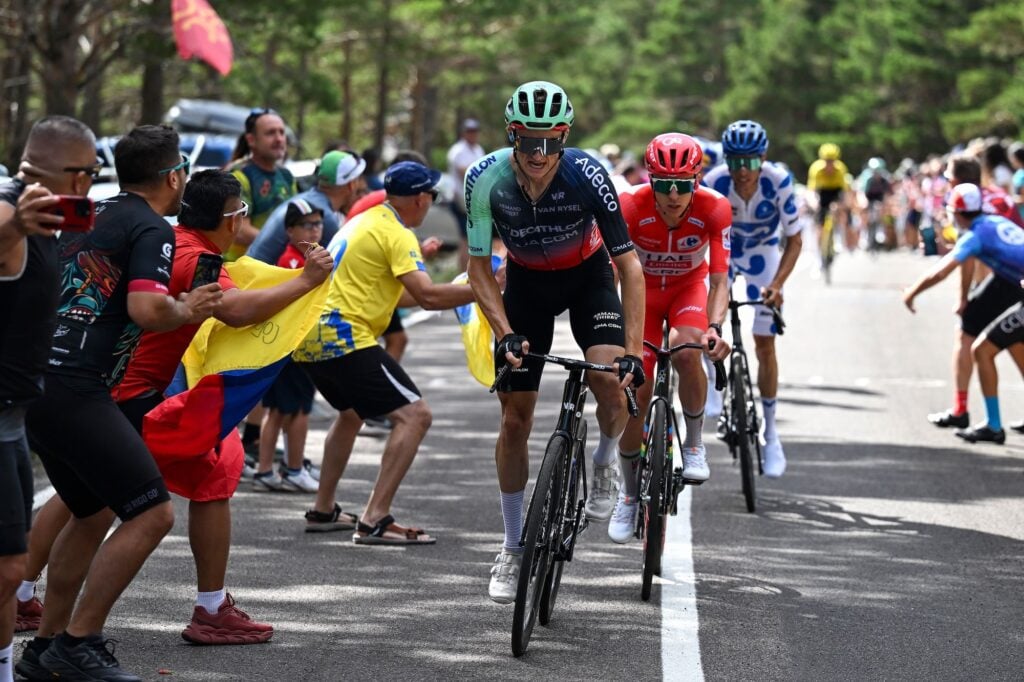 Photo Credit: Getty
Gregor Mühlberger’s Stage 13 crash is a significant loss for Gall
Gall will have to do that without one of his most valuable mountain domestiques.
Gregor Mühlberger crashed out during Stage 13, ending his Vuelta while sitting ninth overall.
His position in the GC was useful in its own right, but his value to Gall went further. Mühlberger had been one of Decathlon CMA CGM’s strongest riders deep into the mountain stages and provided exactly the sort of support Gall needs before a climb such as La Pandera.
The Vuelta withdrawal tracker has followed a race increasingly shaped by crashes and illness, with Mühlberger now another significant loss.
Decathlon still have Bisiaux and Riccitello, but the team have less climbing depth than they did when leaving Calar Alto.
That may force Gall to respond himself earlier than he would prefer.
The approach to La Pandera never properly settles
The riders descend from Puerto de Locubín towards Valdepeñas de Jaén.
There is then another difficult transition before the official La Pandera climb begins with 11.9km remaining.
This matters because the final ascent does not arrive after a long flat valley where every team can reorganise.
The race should already be reduced.
Some leaders may have only one teammate left.
Others may be isolated.
A breakaway can also begin losing time extremely quickly once the GC teams hit the approach at full speed.
That makes the advantage at the foot of La Pandera important. A break containing strong climbers may need several minutes rather than assuming two will be enough.
Sierra de La Pandera is much harder than 7.2% suggests
The official climb is 11.9km at 7.2%, with 860 metres of vertical gain between the foot and finish.
Those numbers make it look like a steady Category 1 ascent.
It is not.
The early kilometres are relatively manageable, but the character changes after the turn towards La Pandera with 8.4km remaining.
The road becomes narrower and more irregular. Gradients repeatedly move into double figures before easing again, making it difficult to find a consistent climbing rhythm.
That matters tactically.
Roglič’s explosive acceleration becomes useful on the steeper ramps.
Gall may prefer the longer sections where he can hold a high pace.
Mas has already shown that changing gradients do not concern him.
Carapaz generally thrives when a mountain becomes less predictable and the race turns into repeated attacks rather than a simple team-train climb.
The final kilometres should expose riders who have been surviving rather than riding comfortably.
The last five kilometres are where the real GC gaps should appear
There is little reason for Mas to expose himself on the lower slopes.
He has the advantage.
His rivals need the time.
That should allow Movistar to ride patiently while Roglič, Gall and Carapaz decide how much they are prepared to risk.
The steepest final section should eventually remove that stalemate.
La Pandera is difficult enough that waiting until the final 500 metres achieves very little for riders who need to take substantial time.
Roglič does not need to recover his entire Calar Alto deficit on Saturday. Taking 20 or 30 seconds would already change the tone of the race.
Another loss would be much more damaging.
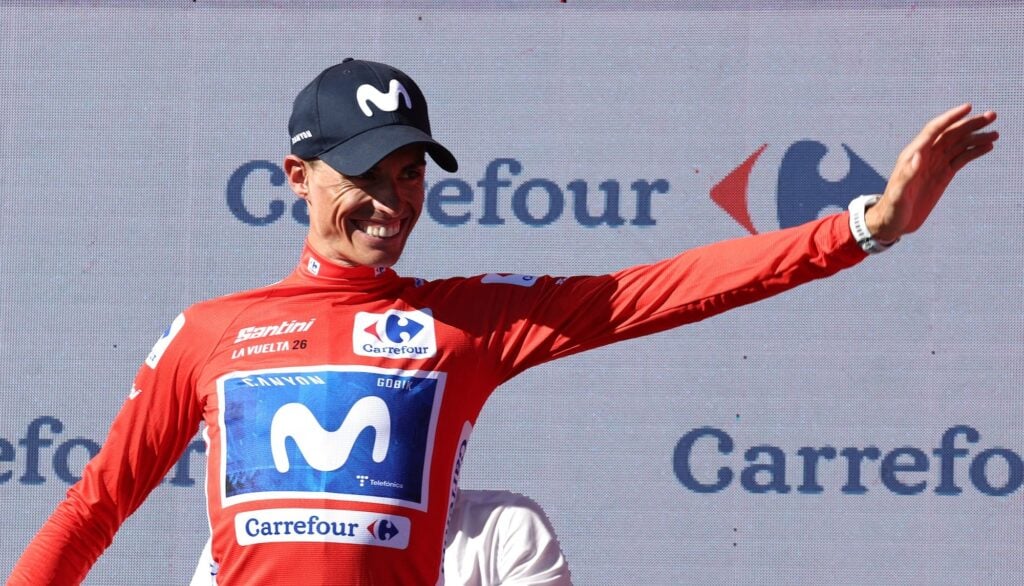 Photo Credit: Getty
Enric Mas has become the benchmark
Tadej Pogačar’s crash changed the Vuelta, but Mas has since done more than inherit his position.
The red jersey has won a mountain stage and gained time on his main rivals on another.
Aitana showed that he could attack late and finish.
Calar Alto showed that he could attack much earlier and sustain the effort.
That matters because Roglič, Gall and Carapaz now have fewer obvious weaknesses to target.
Mas is not waiting anxiously for the mountains to end.
He is using them.
His one major concern remains the 32.1km individual time trial on Stage 18, where Roglič should expect to gain time if the race reaches Jerez with the current hierarchy intact.
That gives Mas an incentive to take more time in the mountains if the opportunity appears.
La Pandera may therefore produce a more aggressive red jersey than the GC situation initially suggests.
Primož Roglič cannot wait for the time trial forever
Roglič’s Stage 18 advantage remains an important part of the Vuelta.
A 32.1km individual time trial from El Puerto de Santa María to Jerez de la Frontera should suit him considerably better than Mas.
The question is how much time he can reasonably expect to recover.
One minute is very different to two.
Mas continuing to add 20 or 30 seconds on every major mountain stage would eventually make even Roglič’s time-trial advantage insufficient.
La Pandera is therefore important even if Roglič does not win.
He needs to stop the direction of travel.
Matching Mas would stabilise the race.
Taking time would reopen it.
Getting dropped again would leave Red Bull increasingly dependent on one day against the clock.
Felix Gall has the mountain but fewer teammates
Few riders should welcome the La Pandera profile more than Gall.
He does not need a short explosive finish. His best chance comes when a climb lasts long enough for sustained climbing strength to matter and when repeated hard gradients gradually reduce the race.
Saturday gives him that.
The problem is what happens beforehand.
Without Mühlberger, Decathlon have fewer riders capable of staying with Gall deep into the finale.
If Movistar and Red Bull both retain numbers into Locubín, Gall may find himself having to respond personally before the final climb.
That makes the loss of one domestique much more important than a simple missing name from the start list.
Richard Carapaz knows exactly how to win on La Pandera
Carapaz is the only rider among the current GC contenders with a previous Vuelta stage victory on this summit.
He won here in 2022, attacking from the breakaway and staying clear as the favourites fought behind.
The context is different now.
Carapaz is racing for overall position rather than hunting the stage with freedom from the GC group.
His natural instincts should still suit the finale.
He rarely benefits from waiting for a controlled final kilometre. Carapaz is most dangerous when he can attack, force rivals to make decisions and turn a steady mountain into a tactical race.
That approach was also central to the two Tour de France mountain stages he won earlier this summer.
At nearly four minutes behind Mas after Calar Alto, simply following the red jersey achieves little.
Carapaz needs something more ambitious.
 Photo Credit: Getty
Jakob Omrzel has earned his place in the GC discussion
Omrzel’s Stage 12 win changed how everyone has to treat him.
The 20-year-old attacked from the breakaway on Calar Alto, dropped Urko Berrade and rode alone to his first professional victory.
More importantly for Saturday, the result moved him to sixth overall at 4:59 after Stage 12.
That removes much of the freedom he enjoyed on Thursday.
Movistar cannot allow him into another break and casually give him six minutes.
Neither can Onley or Carapaz if they are interested in defending their positions.
Omrzel may therefore have to race La Pandera alongside the established favourites rather than ahead of them.
That presents a different challenge, but another strong ride would make the podium conversation increasingly difficult to ignore.
Oscar Onley needs to show the Calar Alto losses were temporary
Onley had been one of the strongest challengers to Mas before Stage 12.
He was the only rider capable of following the Spaniard’s decisive attack on Aitana and had moved himself firmly into the podium picture.
Calar Alto changed that.
Onley crashed earlier in the day and then lost significant time on the final climb, slipping behind Carapaz in the overall standings.
La Pandera becomes an immediate test of recovery.
If the Calar Alto result was mainly a consequence of the crash, Onley has the climbing level to return to the front group.
If he loses ground again, the focus changes quickly from challenging for the podium to protecting fifth place from Omrzel and the riders behind.
Sepp Kuss needs something more than another controlled finish
Kuss has remained within the top 10 but has not yet produced the sort of mountain performance that once made him a Vuelta winner.
La Pandera suits him better than many stages.
The irregular gradients and long final ascent reward genuine climbing ability, while Visma | Lease a Bike have little reason to ask Kuss to defend a minor GC place conservatively.
Jørgen Nordhagen gives them another possible route to the stage through the breakaway.
If Kuss has the legs to stay with the main contenders, Saturday is a good day to show it.
Santiago Buitrago is one of the clearest breakaway favourites
Buitrago has two reasons to attack.
The stage suits him and there are substantial mountains points available.
Los Villares, Puerto de Locubín and La Pandera offer enough points for the mountains classification to shape the composition of the breakaway from the opening kilometres.
Bahrain also have Omrzel to protect behind.
That creates a useful split.
Buitrago can race aggressively for the stage without compromising the team’s GC position.
If the break succeeds, he can win on La Pandera.
If Movistar bring it back, Omrzel remains with the favourites.
Lorenzo Fortunato should also be looking towards the break
Fortunato is another rider who gains little from beginning La Pandera alongside Mas and Roglič.
His climbing is strong enough to win from the breakaway, but defeating the best GC riders after starting the final mountain together is a much harder proposition.
XDS Astana also have Harold Tejada close enough overall that the team can cover both scenarios.
Fortunato goes forward.
Tejada stays with the GC group.
That sort of two-level strategy should be common among teams with one rider still interested in the overall classification.
Jørgen Nordhagen and Jarno Widar have the freedom to attack
The younger climbers have been one of the stories of this Vuelta.
Omrzel has already converted his opportunity into a Grand Tour stage victory.
Nordhagen and Widar remain capable of doing something similar.
Both have enough climbing strength to survive a breakaway containing experienced mountain specialists and enough freedom in the overall classification to receive more road than the top-six riders.
Their challenge is choosing the correct move.
Stage 14 should produce several waves of attacks before the breakaway settles, and getting into the wrong group can mean spending huge amounts of energy before Los Villares even begins.
Will the breakaway win Stage 14?
There is a genuine chance.
Movistar’s interest is the red jersey rather than the stage.
If a harmless group gets five or six minutes, there is little reason for Mas’ team to spend the afternoon bringing it back purely so their leader can contest the win.
That leaves responsibility with Red Bull, Decathlon and EF.
Do they want the stage badly enough to chase?
Roglič has one incentive: bonus seconds.
Winning at La Pandera provides both a psychological result and time towards Mas.
Gall and Carapaz have similar reasons to prefer the break within reach.
The breakaway’s chances therefore depend on how quickly the GC challengers decide that the stage win matters.
A six-minute advantage approaching Los Villares should be enough to create two separate races.
Three minutes probably will not be.
La Pandera has a short but significant Vuelta history
This will be the seventh Vuelta finish on Sierra de La Pandera.
The previous winners are:
| Year | Winner |
|---|---|
| 2002 | Roberto Heras |
| 2003 | Alejandro Valverde |
| 2006 | Andrey Kashechkin |
| 2009 | Damiano Cunego |
| 2017 | Rafał Majka |
| 2022 | Richard Carapaz |
The climb has repeatedly produced meaningful GC racing even when the stage itself has gone to the breakaway.
Its irregular final kilometres make that almost inevitable.
There is very little room for a struggling rider to bluff once the road turns towards the summit.
How Stage 14 is likely to unfold
The opening race for the break should be aggressive but Movistar have no reason to make the first half unnecessarily difficult once the right riders are clear.
That changes on Los Villares.
Red Bull need to start reducing the race before La Pandera rather than asking Roglič to attack a fully supported Mas.
Puerto de Locubín should remove more domestiques and provide the first realistic opportunity for secondary leaders to move.
The final climb then becomes much simpler.
Roglič needs time.
Gall needs time.
Carapaz needs considerably more.
Mas can afford to watch them.
That does not necessarily mean he will.
The strongest indication from Calar Alto was not that Mas could defend the red jersey. It was that he did not appear interested in defending when attacking offered something better.
Main contenders for Vuelta Stage 14
Enric Mas is the reference after winning on Aitana and gaining more time on Calar Alto. His form allows him to wait, but his recent racing suggests he may attack anyway.
Primož Roglič remains the most important challenger. La Pandera suits his acceleration, but another mountain stage cannot pass without him beginning to reduce the deficit.
Felix Gall should appreciate the sustained climbing but enters Saturday without Mühlberger, weakening Decathlon’s ability to prepare the final ascent.
Richard Carapaz has already won on La Pandera and has little to gain from another conservative ride.
Jakob Omrzel has to be taken seriously after Calar Alto, even though his improved GC position means the freedom he enjoyed there has largely disappeared.
Oscar Onley can return to the front if he has recovered fully from his Stage 12 crash.
From the breakaway, Santiago Buitrago, Lorenzo Fortunato, Jørgen Nordhagen, Jarno Widar, Léo Bisiaux and Matthew Riccitello all have a route to victory.
Mas has made the question much harder for his rivals
La Pandera arrives at exactly the point where Roglič and Gall need another mountain stage.
The difficulty is that Mas appears to need it as well.
He won on Aitana.
He attacked again on Calar Alto.
Instead of waiting for the time trial to expose a weakness, Movistar have spent the second week trying to increase the amount of time Roglič will need to recover there.
Saturday offers the challengers enough terrain to change the race. Around 4,300 metres of climbing, three classified ascents in the final 72km and the irregular final slopes of La Pandera leave no shortage of opportunities.
The issue is not the route.
It is whether anybody can make Mas struggle on it.