
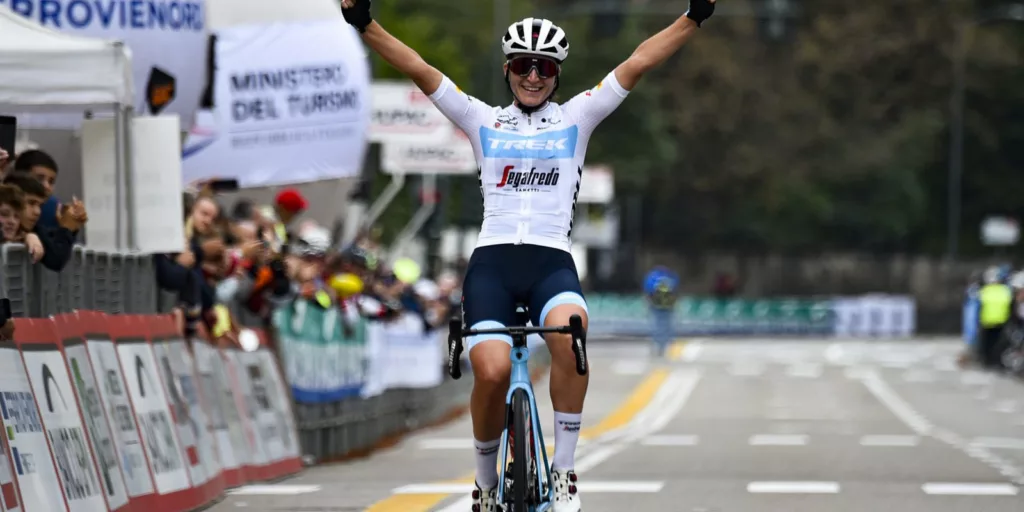
Tre Valli Varesine Women is still a young race, but it has already acquired a place in the Italian autumn that feels considerably older than its first edition in 2021. Organised by the Società Ciclistica Alfredo Binda, the women’s event uses the same Varese landscape that has shaped the long-established men’s Tre Valli Varesine: short climbs, technical roads and repeated circuits that reward riders who can climb hard without losing their sprint.
The race has grown quickly in both distance and status. Its first five editions produced winners including Arlenis Sierra, Elisa Longo Borghini, Liane Lippert, Cédrine Kerbaol and Longo Borghini again. That is an unusually strong early palmarès and reflects how the event sits in the calendar, close to the World Championships, European Championships and other Italian autumn races. Our beginner’s guide to Tre Valli Varesine Women 2026 covers the modern race. The history explains how it reached that point so quickly.
The women’s race arrives in Varese
The first Tre Valli Varesine Women was held in 2021. The men’s event had already existed for more than a century, giving the organisers an established race identity, local infrastructure and a landscape deeply associated with professional cycling. Adding an elite women’s race therefore did not require inventing a new concept. The challenge was to create a women’s event with enough sporting substance to stand alongside the historic men’s race rather than simply borrowing its name.
The Varese area was well suited to that aim. The roads around the city offer repeated short climbs rather than one decisive mountain, and the circuits make the race visible to spectators while steadily reducing the group. It is terrain that can suit climbers, puncheurs and strong Classics riders. Pure sprinters have difficulty surviving if the pace is high enough, while lightweight climbers still need the acceleration and positioning to handle a fast final.
Arlenis Sierra won the inaugural edition after a breakaway survived to the finish. Mavi García took second and Rachel Neylan third. That first podium immediately showed the range of riders the course could reward: Sierra brought speed and race craft, García climbing strength and Neylan the durability needed for difficult one-day racing.
Longo Borghini raises the level in 2022
The second edition in 2022 represented an early step forward. The race had moved up to UCI 1.1 level and Elisa Longo Borghini delivered the sort of victory that gives a young event credibility. The Italian attacked on the final circuit and rode alone to the finish in Varese, beating Veronica Ewers by 26 seconds, with Ane Santesteban third.
Longo Borghini was already one of the defining Italian riders of her generation, a winner of major Classics and a regular Grand Tour contender. Her presence on the winners list linked the new race to the highest level of women’s cycling. It also established a pattern that would return: Tre Valli Varesine Women could be won by attacking before the finish rather than waiting for a reduced sprint.
The course itself was beginning to become part of the race’s identity. The repeated Varese circuits and climbs such as Montello and Bobbiate reward accumulated effort. One ascent may not be decisive, but the fifth or sixth acceleration over the same terrain can expose riders who were comfortable earlier in the day.
Lippert and the development of the circuit race
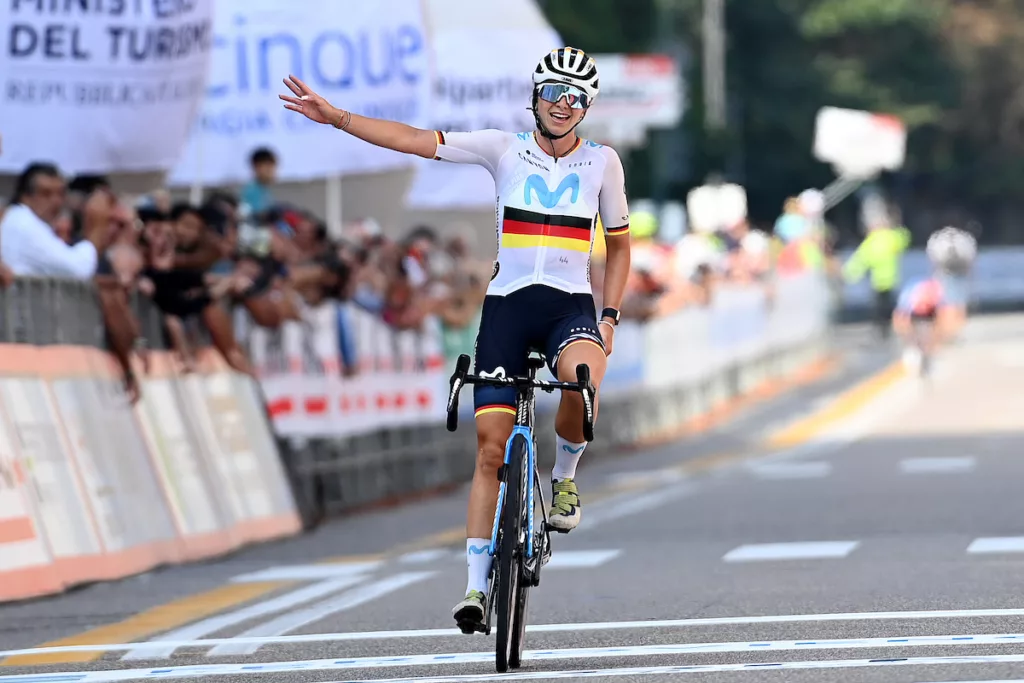
By 2023 the race had extended to 112 kilometres and used six laps of the Varese city circuit. Liane Lippert won for Movistar after a selective race in which the leading group was repeatedly reshaped by attacks. The German’s victory fitted the course perfectly. Lippert is at her best on short, repeated climbs where explosive power matters more than sustained mountain pacing.
The third edition also demonstrated that the women’s race was no longer dependent on one or two headline names to create a strong field. Elisa Balsamo, Cecilie Uttrup Ludwig, Arlenis Sierra and other established riders were involved in the contest. The growing depth made the race harder to control because several teams had credible winning options.
That tactical uncertainty is one reason Tre Valli has developed quickly. The circuit is difficult enough to remove many sprinters but rarely so hard that one rider can simply ride everyone off the wheel from a long distance. Teams have to decide whether to attack, protect a fast finisher or use numbers to force rivals to chase.
 Photo Credit: Getty
Kerbaol’s rain-soaked 2024 victory
The 2024 edition gave the women’s race one of its most memorable days. Severe rain hit the Varese area and conditions became so difficult that the men’s Tre Valli Varesine was stopped. The women had raced earlier and completed their event in the downpour, with Cédrine Kerbaol taking victory.
The weather changed the demands completely. Descending, visibility, braking and the willingness to commit on soaked roads became as important as climbing form. Kerbaol’s strength as a descender and aggressive racer gave her an advantage in conditions that punished hesitation. The result also gave the young race an edition that immediately entered its own folklore rather than relying on the history of the men’s event.
For organisers, the contrast between the completed women’s race and the abandoned men’s event also drew attention to the severity of the conditions. It was not a day that should be romanticised purely because riders finished, but it showed how exposed the Varese circuits can become when autumn weather arrives.
Longo Borghini versus Vollering in 2025
The fifth edition produced the strongest direct duel in the race’s short history. Italian champion Elisa Longo Borghini and newly crowned European champion Demi Vollering escaped together on the final ascent of Montello after an aggressive 136-kilometre race. Vollering tried to turn the finale into a climbing contest, but Longo Borghini stayed with her and refused to waste energy before the sprint.
Longo Borghini launched in the closing metres and beat Vollering to take her second Tre Valli Varesine Women victory. Noemi Rüegg won the sprint from the chasing group for third. The result was important for the race because it put two of the world’s strongest stage-race and Classics riders head-to-head in a finale that was decided by tactics as much as physical strength.
It also came during a strong late-season run for Longo Borghini. She followed the Varese win with victory at the Trofeo Tessile & Moda on the climb to Oropa, a result covered on ProCyclingUK in our report on Longo Borghini’s Oropa victory. Her 2025 Tre Valli success therefore sits within a wider autumn campaign rather than as an isolated result.

A race finding its permanent place
Five editions are not enough to give Tre Valli Varesine Women the historical weight of Italy’s oldest races, but they are enough to show a clear trajectory. The race has increased in distance, attracted stronger fields and produced winners whose careers already carry major international victories. Longo Borghini’s two successes give the palmarès an early reference point, while Sierra, Lippert and Kerbaol ensure it is not dominated by one rider type.
The timing also helps. Autumn Italian racing creates a cluster of opportunities for riders who remain in form after the World and European Championships. Varese is particularly effective because the roads demand a mix of skills rather than one narrow speciality. Riders have to cope with repeated climbing, descents, corners and changes of pace, and the finish remains close enough to the final difficulties for tactical hesitation to be punished. That has allowed the event to produce solo winners, small-group finishes and direct two-rider contests within only a handful of editions. The race also benefits from the cycling culture around Varese. The city and surrounding province have hosted major championships and professional races for decades, so the women’s event arrives on roads where spectators already understand the significance of the circuits and climbs.
That local continuity matters for a young race because it gives each edition a setting that already feels established. The timing also helps. Autumn Italian racing creates a cluster of opportunities for riders who remain in form after the World and European Championships. That can produce unusual combinations of motivation: some riders are chasing one final major result, some are racing in fresh championship jerseys and others are trying to rescue a season that has not gone as planned.
The relationship with the men’s race should remain an advantage rather than a ceiling. Sharing an organiser and a familiar finish gives the women’s event immediate recognition, but the strongest editions have been memorable for their own reasons: Sierra’s inaugural break, Longo Borghini’s attacks, Kerbaol’s survival in the rain and the Vollering duel. Those moments are building a separate archive for the women’s race, which is essential if it is to keep growing in stature. Tre Valli Varesine Women has therefore developed faster than many new races because the sporting ingredients were already present: an experienced organiser, a cycling city, selective roads and a useful place on the calendar. The first five editions did the rest. By 2026 it is no longer simply the women’s companion race to an old Italian Classic. It has enough history of its own for the Varese finale to carry expectations before the riders even reach the final circuit.

