
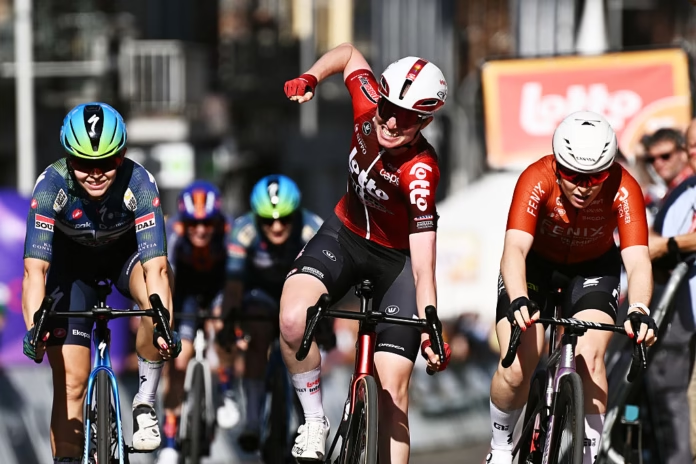
Linda Riedmann won Binche Chimay Binche pour Dames 2026 for Lotto Intermarché Ladies after a late break was caught with two kilometres remaining. Charlotte Kool finished second for Fenix-Premier Tech, while Nicole Steigenga took third for AG Insurance – Soudal Team.
The race was decided by a sequence of reshaping moves rather than one escape holding its advantage to the finish. Audrey De Keersmaeker and Steigenga triggered the main pressure, seven riders gained a small gap, and the front group was later reduced to four before the peloton closed it down.
That catch changed the contest, but it did not make the final kilometres uneventful. Team Picnic PostNL was still pulling with one kilometre remaining after featuring repeatedly in the attacks, and Riedmann emerged from that unsettled closing phase to take the win.
How it unfolded
The first clear acceleration came with 32 kilometres remaining, when Audrey De Keersmaeker attacked for Team Picnic PostNL. One kilometre later, riders were dropping from the back of the peloton. Those two events established the early shape of the decisive phase: pressure was narrowing the bunch while De Keersmaeker tried to force a separation ahead.
Nicole Steigenga attacked at 31 kilometres to go, immediately adding another direct challenge to the peloton’s cohesion. Within the next kilometre, seven riders had established a small gap. The composition of that group was not identified, but its formation marked the first meaningful split and placed Steigenga inside the race’s principal move.
The gap did not settle the result. It became the platform for a series of further attacks, while the peloton began to organise behind it. By 23 kilometres remaining, Fenix-Premier Tech was pulling in the bunch, bringing Kool’s team into the chase while the riders ahead were still trying to change the shape of the race.
De Keersmaeker and Steigenga force the first selection
De Keersmaeker’s attack was important not only because it opened the late sequence, but because it was followed by a second acceleration from Steigenga. The first move created pressure, the response helped produce the seven-rider gap, and the race moved away from an intact peloton before the closing kilometres had begun.
Riders dropping at the back of the peloton provided a clear consequence of that pressure. The bunch was not simply allowing the front group to gain ground while remaining unchanged behind it. Its rear was already being removed from contention as the attackers created a smaller and more selective race at the front.
Fenix-Premier Tech’s work at 23 kilometres gave the chase a more defined structure. The move ahead still held a small gap, but the peloton now had a team committed to reducing it. That made the seven-rider group vulnerable, even as the break remained active enough to produce another change in its composition.
At 20 kilometres to go, De Keersmaeker attacked again, this time from the late break. Her second move kept Team Picnic PostNL at the centre of the decisive phase and showed that the front group was still competing internally rather than waiting for the peloton to arrive.
The seven-rider move becomes four
Three kilometres after De Keersmaeker’s second acceleration, four riders attacked from the late break. The race therefore moved through two distinct stages in quick succession: seven riders first gained a small advantage, then the front was reduced to four as the attacks continued.
That reduction mattered because it left fewer riders between the chasing peloton and the finish. The four-rider move was more concentrated than the original group, but it was also being pursued by a bunch that had already begun to pull behind it. The break had quality and momentum, yet it had not secured the outcome.
Fenix-Premier Tech’s earlier work remained part of that pressure, while Team Picnic PostNL continued to influence the front through De Keersmaeker. The race was consequently being shaped by more than one team: one was helping organise the chase, another had repeatedly created moves, and the four riders ahead were still trying to stay clear.
At 10 kilometres remaining, a rider from VolkerWessels Cycling Team attacked from the peloton. That counter-move did not become a confirmed winning escape in the available evidence, but it underlined that the bunch was still unsettled even after the break had been reduced.
The chase refuses to let the break settle
The VolkerWessels attack added a new point of pressure behind the four riders ahead. Instead of a simple chase closing steadily on a stable break, the race contained an attack in the peloton while the late break continued to fight for its advantage.
The front group had already changed from seven riders to four. Behind it, the peloton was also producing fresh movement. That combination kept the result open: the break had not disappeared, but neither had the bunch accepted a single organised pursuit without further challenges.
Five kilometres from the finish, Karla Bell crashed for Révvi-EGS Group-Velopro. The incident occurred during this unsettled closing phase. It is recorded as a crash involving Bell, but the packet does not establish that it determined her result or changed the outcome at the front.
The crash was followed by the continuation of the same central contest, with the four-rider move still ahead and the peloton attempting to bring it back. There is no evidence here to connect the incident to the catch or to any rider’s final placing, so its significance remains limited to the fact that it occurred during the late chase.
The decisive catch comes with two kilometres left
The break was caught by the peloton at two kilometres to go. That was the decisive structural change of the race. The seven-rider gap had been reduced to four, but the smaller move still survived until the final two kilometres before being neutralised.
The timing of the catch left no evidence of another substantial breakaway forming before the finish. The attacks had shaped the race and narrowed the field, but none of the recorded moves remained clear when the result was finally decided.
Steigenga’s third place gave the earlier attacking phase a direct link to the podium. She had attacked at 31 kilometres, was involved in the phase that produced the seven-rider gap, and ultimately finished among the top three. The late break did not need to survive for her initial aggression to remain central to the result.
Kool’s second place followed a different route through the finale. Fenix-Premier Tech was recorded pulling in the peloton at 23 kilometres, when the break still held a small advantage. That chase involvement became part of the sequence that brought the front group back, and Kool finished closest to Riedmann in the final order.
Team Picnic PostNL remains visible in the final kilometre
After the break had been caught, Team Picnic PostNL was pulling in the peloton with one kilometre remaining. The team had therefore featured at several points in the race’s decisive development: De Keersmaeker opened the attack at 32 kilometres, accelerated again from the break at 20 kilometres, and the team was still present at the head of the bunch after the catch.
The closing kilometre was consequently not a passive run-in after the main move had disappeared. The peloton was being led by a team that had helped shape the break’s formation and later its internal pressure. The available evidence does not identify a specific lead-out or finishing tactic, but it does confirm that the bunch remained actively organised.
Riedmann was then recorded as the winner, with Kool second and Steigenga third. The result came after the principal escape had been brought back, making survival through the repeated selections and the post-catch finish more important than the escape itself lasting to the line.
Why Riedmann came through the late reshaping
Riedmann won a race in which control moved repeatedly between attackers and the chasing peloton. De Keersmaeker’s opening acceleration created the first pressure, Steigenga’s attack helped produce the seven-rider gap, and further moves reduced that group to four. The peloton then completed the final reversal at two kilometres.
The winner’s decisive advantage in the race story was her ability to convert the final post-catch phase into victory. The packet does not identify a separate attack by Riedmann, a finishing gap or a specific tactical action, so the conclusion is limited to the verified result: she reached the decisive finish ahead after the late break had been neutralised.
Kool reached second after Fenix-Premier Tech had helped pull the peloton towards the break. Steigenga reached third after taking part in the attacking sequence that created the first meaningful selection. Their final positions reflected two different contributions to the same late contest, while Riedmann was the rider who prevailed once that contest returned to the peloton.
The race’s final shape was therefore determined by several linked changes rather than one isolated move. The bunch was reduced at the rear, a seven-rider group gained a small gap, De Keersmaeker and four other riders kept the front active, and the break was finally caught with two kilometres remaining.
Behind the podium, Lonneke Uneken finished fourth, ahead of Letizia Borghesi in fifth and Pfeiffer Georgi in sixth. Mylène De Zoete was seventh, Loes Sels eighth, Meis Poland ninth and Manon De Boer tenth.
Binche Chimay Binche pour Dames 2026 Result
| Pos. | Rider | Team / nation |
|---|---|---|
| 1 | Linda Riedmann | Lotto Intermarché Ladies |
| 2 | Charlotte Kool | Fenix-Premier Tech |
| 3 | Nicole Steigenga | AG Insurance – Soudal Team |
| 4 | Lonneke Uneken | |
| 5 | Letizia Borghesi | |
| 6 | Pfeiffer Georgi | |
| 7 | Mylène de Zoete | |
| 8 | Loes Sels | |
| 9 | Meis Poland | |
| 10 | Manon de Boer |

