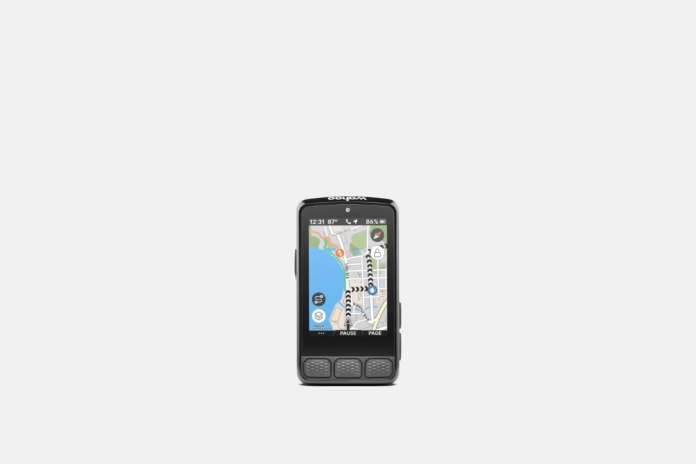
Wahoo’s ELEMNT BOLT 3 and ROAM 3 are closer relatives than their different shapes suggest. Both have colour screens, dual-band satellite positioning, offline mapping and Wahoo’s current navigation interface. Both connect to the same training sensors and use USB-C charging. The real buying decision is whether the ROAM’s larger touchscreen, spoken directions and extra battery capacity justify paying £100 more than the compact BOLT.
At UK retailers checked on 31 October 2026, the BOLT 3 was listed in stock for £249.99 and the ROAM 3 for £349.99, both £50 below their respective recommended prices. That makes the price gap unusually straightforward. You are not paying for a different mapping ecosystem or fundamentally better GPS accuracy. You are buying a more accommodating way to use essentially the same platform.
This comparison is based on official specifications, current UK product listings and independent road tests. ProCyclingUK has not conducted a direct hands-on test of the two units together. Where reviewers disagree about display performance or battery life, the differences matter more than an unqualified verdict.
Wahoo ELEMNT BOLT 3 vs ROAM 3 specifications
| Feature | ELEMNT BOLT 3 | ELEMNT ROAM 3 |
|---|---|---|
| UK price checked 31 October | £249.99 at The Bicycle Chain | £349.99 at The Bicycle Chain |
| Recommended UK price | £299.99 | £399.99 |
| Model reference | WFCC9 | WFCC8 |
| Screen | 2.3-inch colour TFT | 2.8-inch colour touchscreen |
| Controls | Physical buttons only | Touchscreen and physical buttons |
| Claimed battery life | Up to 20 hours | Up to 25 hours |
| Internal storage | 32GB | 64GB |
| Weight | About 84-85g | About 109g |
| Satellite reception | Dual-band GNSS | Dual-band GNSS |
| Audio | Alert beeper | Speaker with spoken directions and digital bell |
| Water resistance | IPX7 | IPX7 |
| Charging and connectivity | USB-C, ANT+, Bluetooth, Wi-Fi | USB-C, ANT+, Bluetooth, Wi-Fi |
The current UK offers are direct retailer listings: BOLT 3 at £249.99 and ROAM 3 at £349.99. Both were marked in stock when checked. They are non-affiliate links, and sale prices can change. Wahoo’s own UK product pages continue to show £299.99 and £399.99 respectively.
The ROAM’s screen is bigger, but size is only part of it
The BOLT’s 2.3-inch display is designed to put essential data and a usable route line in a compact space. It is much improved over earlier BOLT models, with sharper colours and more legible mapping. Road.cc considered the new screen a meaningful hardware upgrade, even though its reviewer was less convinced by the increase in price and reported some route-sync problems. For training rides where speed, power and intervals dominate the screen, the BOLT’s dimensions are a virtue.
The ROAM’s 2.8-inch screen offers more space for street names, route context and upcoming turns. That difference becomes useful when navigating unfamiliar lanes, especially where several roads meet close together. It is also touch-sensitive, so you can interact with maps more directly rather than relying exclusively on button presses. Wahoo retains physical controls, which is sensible because wet gloves and touchscreens are not always an easy combination.
A larger display is not automatically a brighter or faster one. Cycling Weekly praised the ROAM’s substantial improvements while reporting that its screen was not as impressive as some competing computers. Other independent reviews have noted occasional slow startup or touch response. The BOLT is not necessarily harder to read in sunlight simply because it is smaller; the decision is about the amount of map you want visible at once and how you prefer to interact with it.
 Photo Credit: Wahoo
Navigation is similar until you need to interact with the map
Both computers support route following, turn-by-turn instructions, rerouting and integration with popular planning services. Both use dual-band GNSS to improve positioning in difficult environments, although that is a technical capability rather than a guarantee of flawless tracking. A rider following a prepared GPX route through open countryside should not expect the ROAM to find the route more accurately merely because it costs more.
The difference appears at junctions and when plans change. On the BOLT, the map is constrained by the smaller display and you use buttons to change views. On the ROAM, the additional space and touch gestures make it easier to examine what is coming up, particularly when stopped at a crossroads. The ROAM also has a speaker for spoken turn prompts, while the BOLT relies on beeps and on-screen instructions.
Spoken navigation is useful if you ride unfamiliar routes often and want fewer reasons to look down. It is less compelling on a familiar training loop, where the computer spends most of its time displaying power, heart rate and lap information. Neither unit turns a poor route into a good one; choosing and checking a sensible course still matters.
Buttons, gloves and wet-weather use
The BOLT 3 is a buttons-only computer. Its six physical controls have clear roles, and there is no touchscreen layer to operate accidentally. That is attractive for racing, cyclocross, winter training and riders who prefer tactile feedback. The trade-off is that moving around maps and changing screens can take more button presses than it would on a touchscreen.
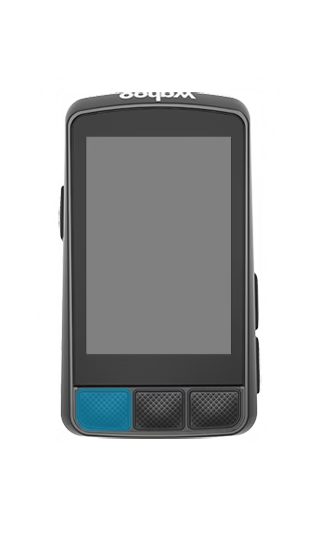 Photo Credit: Wahoo
The ROAM combines touch and buttons rather than forcing a choice between them. It is easier to pan around a map when stationary, while the physical controls remain available with gloves or in rain. Both carry an IPX7 rating, so normal British wet-weather riding should not be a reason to favour one over the other. IPX7 is a water-resistance specification, not a promise that ports, mounts or seals never need care.
Both models have also lost the LED strips that characterised earlier Wahoo computers. Information previously presented through those lights now sits on the screen. That is not necessarily a downgrade, but riders who used LEDs for power-zone cues or turn alerts should consider how much they relied on that separate visual signal.
Battery claims are not the same as real-world endurance
Wahoo’s current comparison lists up to 20 hours for the BOLT 3 and up to 25 hours for the ROAM 3. The extra five hours sounds useful for audax, bikepacking and long events, but the figures are manufacturer estimates under specified conditions. Navigation, screen brightness, connected sensors and the frequency of alerts can change actual endurance substantially.
Independent results are mixed rather than neatly confirming a five-hour advantage. Cycling Weekly reported around 18 hours from the ROAM 3 with a connected phone and multiple sensors. Other reviewers of the new Wahoo generation have seen significantly lower endurance with demanding screen and navigation settings, while some BOLT tests have exceeded the manufacturer’s estimate. Different firmware, brightness settings and test methods make those figures unsuitable for a direct laboratory-style comparison.
For a three-hour club ride, either battery is more than adequate if charged beforehand. For a very long day, a small power bank and a sensible charging plan are more reliable than treating the headline 25 hours as guaranteed. The ROAM offers a larger theoretical margin, but that is not the same as a measured five-hour advantage in identical conditions.
Weight, mounts and cockpit space
At roughly 84-85g, the BOLT is around 24-25g lighter than the 109g ROAM. That difference will not transform a rider’s climbing speed, but the smaller shape sits neatly on a racing bike and leaves more room around the stem. It is also less intrusive on a cyclocross or gravel cockpit where cables, lights and other accessories compete for space.
The ROAM’s larger body is hardly excessive, and the benefit is immediate if you spend hours looking at a map. Both use Wahoo’s mounting system, but it is worth checking the supplied out-front mount and clearance around integrated handlebars before buying. A computer that is comfortable to read and easy to reach is more useful than saving a few grams.
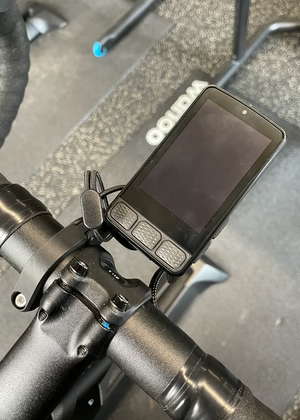 Photo Credit: Wahoo
Training features and software are not the reason to spend more
The core Wahoo experience is shared. Both computers support ANT+ and Bluetooth sensors, structured workouts, power and heart-rate recording, climb information and syncing with established training platforms. Neither becomes a better power meter simply because it has a touchscreen. The ROAM’s additional storage, 64GB against 32GB, provides more room for maps and data, but 32GB is already generous for most UK riders.
The BOLT is therefore the rational choice if you mainly want reliable ride data, planned routes and an interface you can operate without looking down for long. The ROAM earns its premium through the experience of navigating and exploring, not through a hidden set of training metrics unavailable on the smaller unit. Both still depend on Wahoo’s app and firmware ecosystem, which independent reviewers have sometimes criticised for setup and syncing frustrations.
Is the ROAM 3 worth another £100?
Choose the BOLT 3 if you race, train on familiar roads or value a compact cockpit. At the £249.99 UK listing checked, it provides the essential mapping, dual-band GPS, sensor support and colour display for substantially less money. The lack of a touchscreen is a deliberate trade-off rather than an omission that makes the unit unsuitable for navigation.
Choose the ROAM 3 if you regularly follow unfamiliar routes, tour or ride long distances. The larger map, touch interaction, spoken prompts and greater claimed battery reserve are features you can use on every exploratory ride. For a cyclist who routinely pauses to work out a junction, the £100 difference is easier to justify than it is for someone who mostly watches a power field.
Do not upgrade automatically if you already own a functioning recent Wahoo. Both models improve their predecessors, but a better screen alone may not justify replacing a computer that still records rides and navigates reliably. Look first at the limitations you encounter on actual rides, then decide whether a touchscreen, speaker or extra screen space would fix them.
For more detailed context, our separate ELEMNT BOLT 3 review and ELEMNT ROAM 3 review examine the hardware individually. The £250 to £500 GPS computer buying guide places them alongside alternatives, while the Garmin Edge 550 versus BOLT 3 comparison covers a different decision.