
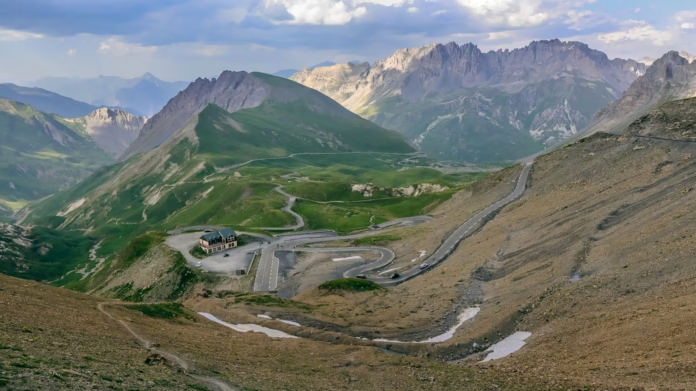
The Col du Galibier is one of those climbs that feels bigger than the numbers.
At 2,642 metres, it is the highest point of the 2026 Tour de France and the centrepiece of Stage 20, where the peloton tackles it after the Col du Télégraphe before descending towards the Col de Sarenne and Alpe d’Huez.
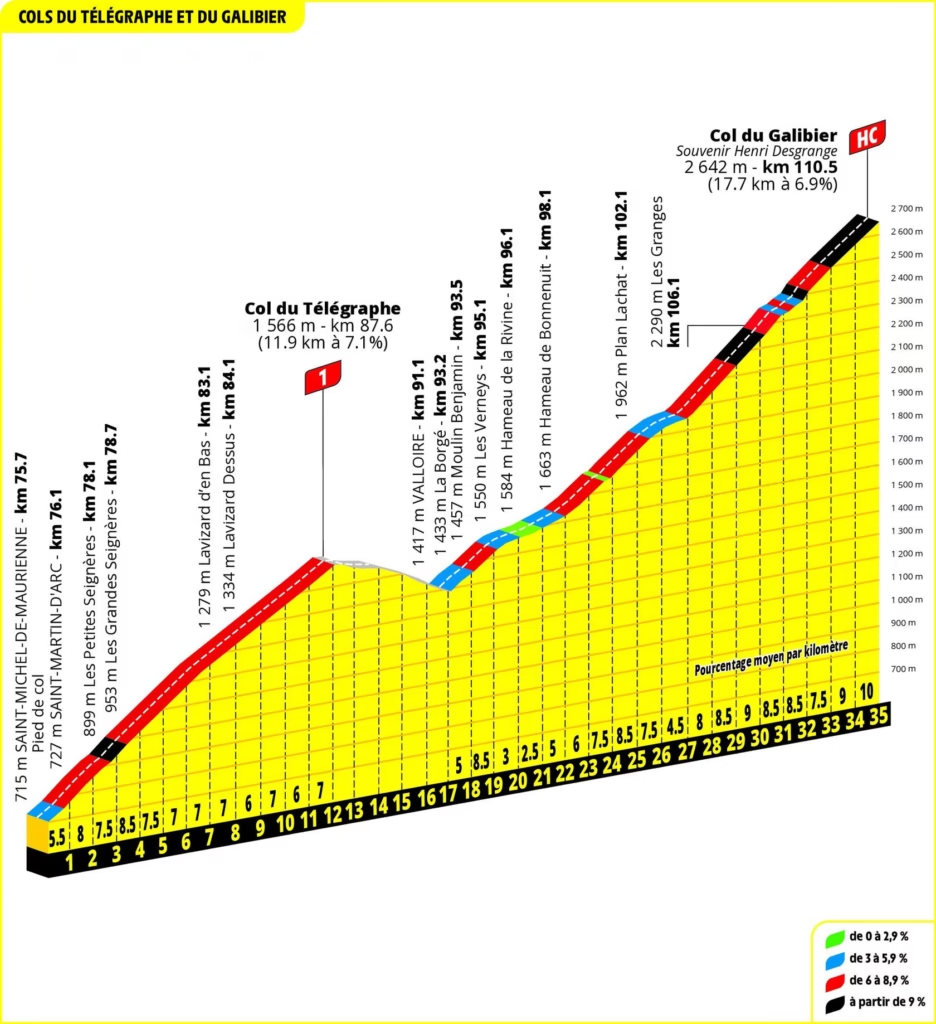
The official Stage 20 profile lists the Galibier as 17.7 kilometres at an average gradient of 6.9%, rated hors catégorie.
But the Galibier matters because of far more than altitude.
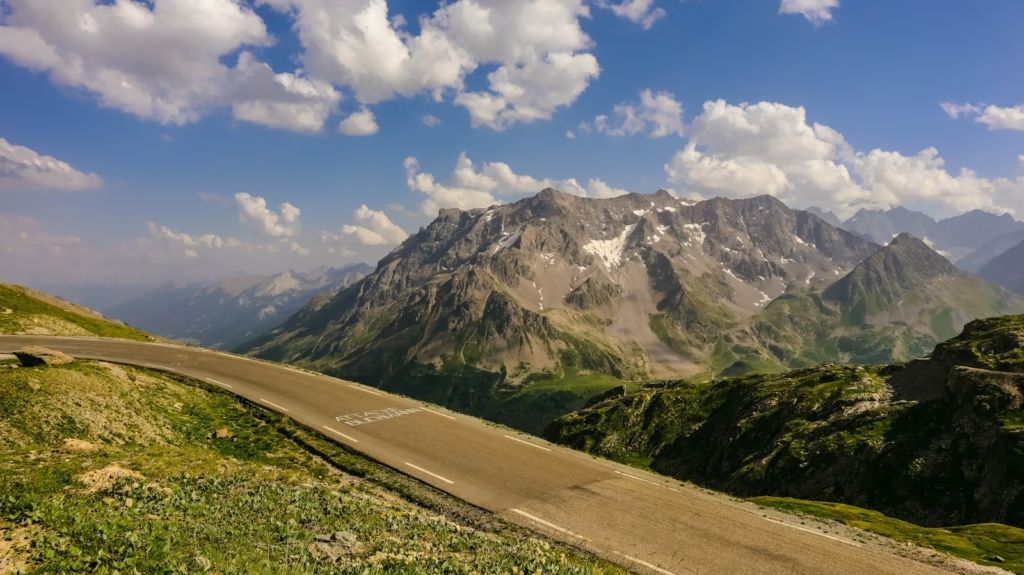
This is one of the climbs that helped create the mythology of the Tour de France. It belongs alongside the Tourmalet and Alpe d’Huez among the race’s defining mountains, yet it has a character entirely of its own: long, exposed, high enough for the landscape to become almost barren, and difficult enough that a rider can begin falling apart several kilometres before the summit.
In 2026, it returns as the roof of the Tour and one of the key features of the hardest mountain stage of the race.
 Photo Credit: ASO-Charly Lopez
Where is the Col du Galibier?
The Galibier sits in the French Alps between Savoie and the Hautes-Alpes.
It links the Maurienne valley around Saint-Michel-de-Maurienne and Valloire with the Col du Lautaret to the south.
There are effectively two ways to ride it.
From the north, cyclists usually approach via the Col du Télégraphe, descend briefly into Valloire and then begin the Galibier itself.
From the south, the road rises from the Lautaret. That side is shorter, but the altitude and exposed final kilometres still make it a serious climb.
For Tour history, the northern side is the classic approach.
It is also one of several major high-mountain roads accessible from the Briançon area. ProCyclingUK’s guide to cycling in Briançon and Serre-Chevalier covers the Galibier and Lautaret alongside climbs including the Izoard and Granon.
How hard is the Galibier on Stage 20?
The official Stage 20 ascent from Valloire is:
17.7km at 6.9%
The summit reaches 2,642 metres, making it the highest point of the 2026 Tour.
Those numbers still understate the real challenge.
The Galibier comes immediately after the Télégraphe, itself 11.9km at 7.1%. There is a descent into Valloire between the two, but in practical terms the riders face a huge Alpine sequence.
Earlier in Stage 20 they will already have climbed the 24km Croix de Fer.
That sequencing is why the Galibier is so important in the 2026 Tour’s biggest climbs.
It does not have to be the final climb to decide the race.
By the time the favourites reach Valloire, weakness may already have been exposed.
Why the final kilometres are so difficult
The lower part of the Galibier out of Valloire can feel deceptively manageable.
The road initially rises steadily through the valley, but the climb becomes increasingly exposed as the altitude increases.
Above Plan Lachat, the character changes.
The road begins twisting through a much barer landscape, the gradients become more persistent and there is increasingly little shelter from wind or changing weather.
The final kilometres regularly sit around 8% and 9%.
Then comes the altitude.
Above 2,000 metres, reduced oxygen availability adds another layer to an effort that is already being made after hours of climbing.
The final kilometre is especially severe, kicking upwards through the bends towards the summit after the road for motor traffic turns towards the tunnel.
For an amateur rider, this is where pacing errors made much lower down tend to become obvious.
For a Tour contender, it is where a small weakness can turn into a major gap.
The Télégraphe and Galibier are really one huge climb
Looking at the Galibier profile in isolation misses half the story.
From Saint-Michel-de-Maurienne, riders first climb the Col du Télégraphe.
After reaching the summit at 1,566 metres, the road descends only briefly towards Valloire before beginning to rise again.
The complete northern approach therefore feels much more like one enormous mountain broken by a short interruption.
That accumulated effort is one reason the Galibier has been so effective throughout Tour history.
Riders do not begin it fresh.
On Stage 20 in 2026, that effect becomes even more extreme because Croix de Fer comes beforehand.
The Tour de France 2026 Alps guide identifies this Télégraphe-Galibier sequence as the middle section where teams can be stripped away before the race even reaches Sarenne.
The Galibier helped create the mythology of the Tour
The Tour first crossed the Galibier in 1911.
That alone gives it a place in the foundations of Tour de France history.
The Pyrenees had been introduced a year earlier, but the Galibier pushed the race into another level of high-mountain absurdity.
Roads were rough. Bikes were heavy. Gearing bore little resemblance to modern equipment.
Émile Georget was the first rider over the summit, with only a tiny number of riders reportedly managing the climb without walking.
Henri Desgrange loved what the mountain represented.
The Tour was not supposed to be merely difficult. Climbs such as the Galibier were supposed to make it appear almost unreasonable.
More than a century later, that identity has survived.
Why the Souvenir Henri Desgrange matters
The Galibier has a particularly strong connection with Tour founder Henri Desgrange.
A monument to Desgrange stands near the southern side of the pass, and when the Tour crosses the Galibier the prestigious Souvenir Henri Desgrange is normally awarded there.
In 2026, the honour is once again attached to the summit.
That gives the first rider across more than mountain classification points.
Crossing the Galibier first connects a rider with one of the oldest pieces of Tour mythology.
It is a prize built around history rather than simply mathematics.
Coppi, Bartali and the age when the mountains defined riders
Few rivalries are more closely associated with post-war cycling than Fausto Coppi and Gino Bartali.
Their battles became inseparable from the great Alpine and Pyrenean roads on which the Tour was decided.
Bartali represented the established generation. Coppi became the elegant modern challenger, devastating when a race became long and mountainous.
The Galibier formed part of that world.
It was the sort of climb on which their rivalry made sense: long enough for tactics to become secondary, high enough to expose weakness and remote enough to make the riders themselves appear tiny against the mountains.
Cycling has changed enormously since then.
The landscape has not.
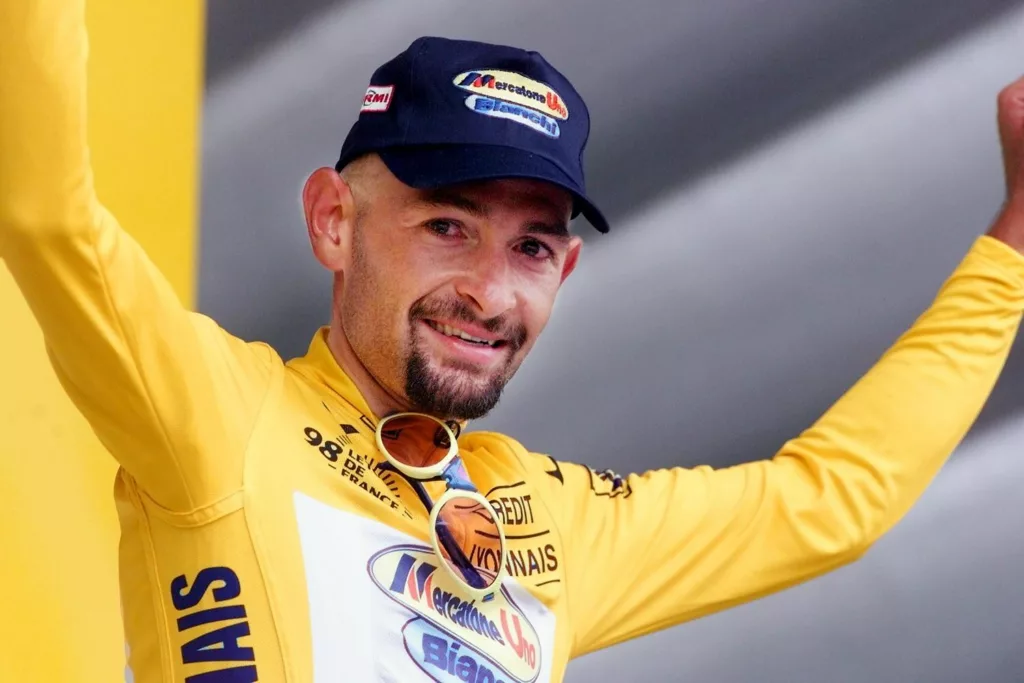
Pantani turned the 1998 Tour on the Galibier
One of the most famous modern performances involving the Galibier came from Marco Pantani in 1998.
Jan Ullrich began the stage to Les Deux Alpes in yellow.
Pantani attacked near the summit of the Galibier in terrible weather and committed completely.
What followed became one of the defining mountain raids of the era.
Ullrich unravelled.
By Les Deux Alpes, Pantani had gained almost nine minutes and taken control of the Tour.
He would go on to win in Paris.
It remains one of the clearest examples of why the Galibier does not need to host the finish to decide the Tour.
It can create the damage.
The kilometres afterwards can turn that damage into disaster.
Andy Schleck’s extraordinary 2011 attack
The Galibier produced another modern classic in 2011.
Andy Schleck attacked on the Col d’Izoard with roughly 60 kilometres remaining on Stage 18 and committed to a long-range offensive.
He stayed away across the remaining mountains and won at the Galibier summit.
The stage was historic for another reason: it was the first Tour de France summit finish on the Galibier and, at the time, the highest stage finish in Tour history.
Schleck’s attack remains one of the benchmark long-distance GC moves of the modern era.
It also demonstrated something that remains relevant in 2026.
The Galibier rewards riders who are prepared to act before the obvious moment.
 Photo Credit: A.S.O./Aurélien Vialatte
The Galibier still shapes modern Tours
The mountain has continued to matter in the Pogačar era.
Nairo Quintana crossed it alone before winning in Valloire in 2019.
It featured twice during the 2022 Tour, while Tadej Pogačar used the descent after cresting it first in 2024 as part of a decisive attack towards Valloire.
That versatility is part of the Galibier’s appeal.
It can be a launchpad.
It can be a summit finish.
It can be a place where teams disappear.
It can also be the point where a rider cracks before the stage has reached its supposedly decisive climb.
That is why its position on Stage 20 of the 2026 Tour is so interesting.
Alpe d’Huez gets the finish.
The Galibier may create the conditions that decide what happens there.
Why altitude matters so much on the Galibier
At 2,642 metres, altitude becomes a genuine performance factor.
There is less oxygen available than at sea level.
Professional cyclists prepare for altitude extensively, but preparation does not remove the physiological effect.
A rider climbing close to their limit may find the final kilometres disproportionately difficult.
Recovery between accelerations becomes harder.
Repeated changes of pace become increasingly expensive.
The effect becomes more relevant late in a stage because altitude is being layered onto existing fatigue, reduced glycogen stores and several hours of previous climbing.
That combination is what makes a high pass like the Galibier so effective.
The gradient does not need to reach 15%.
A rider already near their limit can simply stop being able to follow.
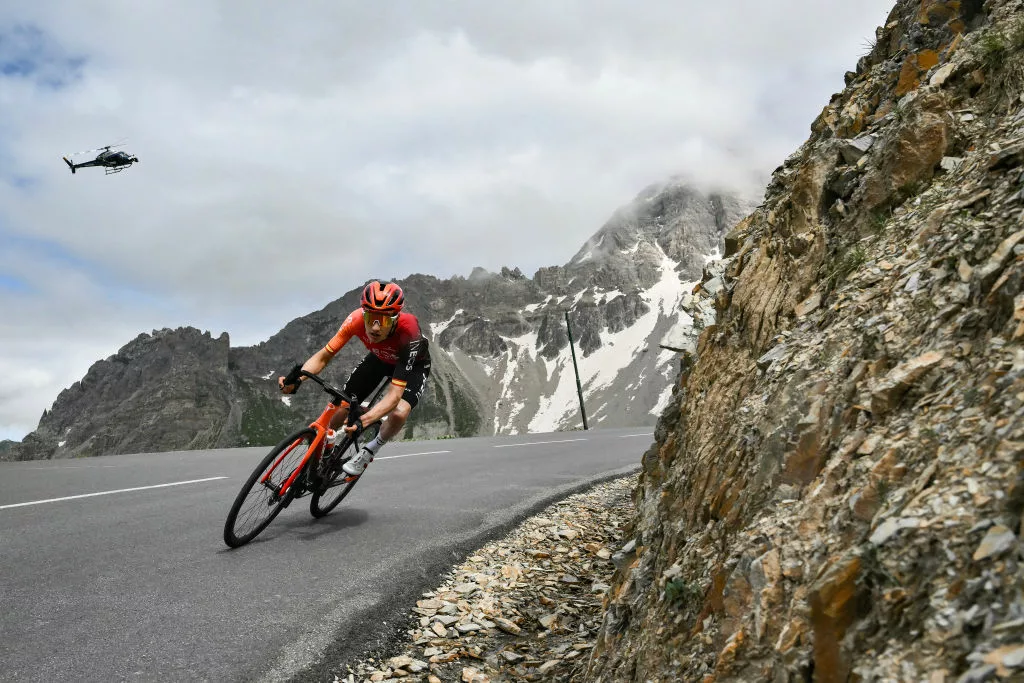
The descent can matter as much as the climb
Crossing the summit is only half the problem.
From the Galibier, the road drops towards the Col du Lautaret before continuing downhill.
Speeds can become extremely high.
In dry conditions, technically confident riders can use the descent aggressively.
In rain, the calculation changes completely.
Braking distances increase, grip becomes less predictable and painted road markings become more dangerous.
That is particularly relevant to Stage 20 in 2026 because the Galibier comes with a huge amount of racing still remaining.
A rider who gains ten seconds over the summit may be able to turn it into considerably more on the descent.
A rider defending a podium or yellow jersey has to decide how much risk that time is worth.
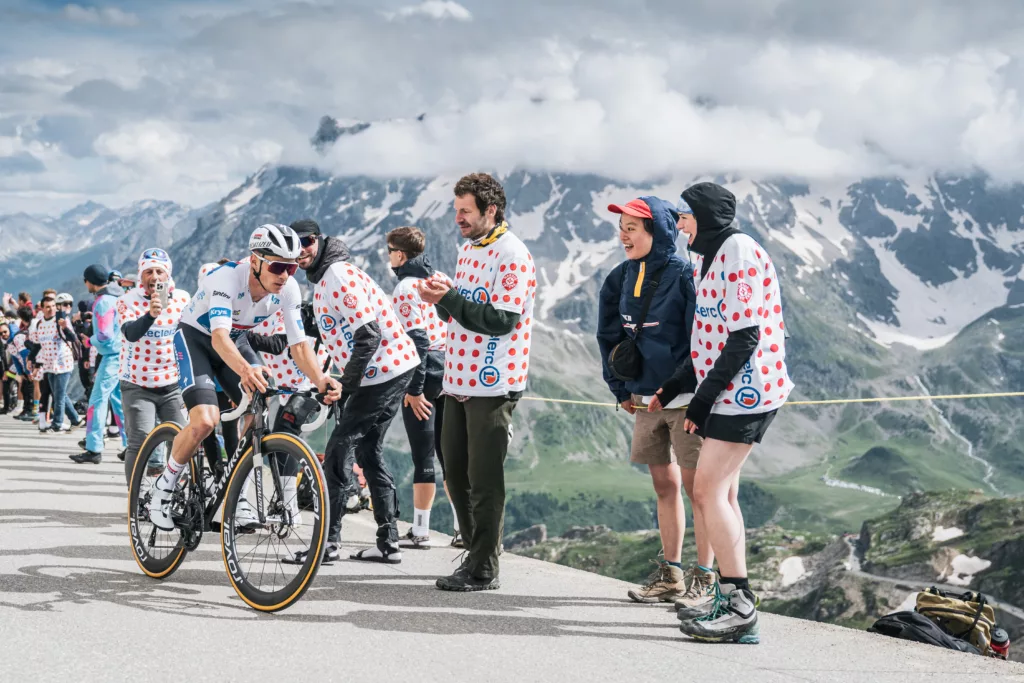 Photo Credit: A.S.O./Charly López
How to cycle the Galibier yourself
The Galibier is one of the great destinations for anyone planning a cycling trip to the French Alps.
For most riders, the northern approach via the Télégraphe provides the complete experience.
Starting around Saint-Michel-de-Maurienne means climbing the Télégraphe first, descending into Valloire and then tackling the Galibier.
It is a huge ride.
The most important advice is to treat the Télégraphe conservatively.
Riding hard there can feel manageable because the gradient is steady and the altitude is relatively low.
The cost arrives later.
Once beyond Valloire, the Galibier becomes progressively more difficult and the upper kilometres demand considerably more than the average gradient suggests.
Riders planning a broader Alpine trip can find more ideas in ProCyclingUK’s France cycling hub and guide to cycling in the Alps.
What gearing do you need for the Galibier?
There is little benefit in overgearing the Galibier.
Strong amateur climbers may be perfectly comfortable with relatively traditional ratios, but most riders will enjoy the climb far more with a compact or semi-compact setup and a cassette that leaves a genuine bailout gear.
The issue is not one exceptionally steep ramp.
It is duration.
Grinding a gear that feels acceptable for ten minutes becomes much less attractive after the Télégraphe and another hour of climbing towards 2,600 metres.
A 34-tooth inner chainring paired with a 30, 32 or 34-tooth largest sprocket gives most recreational riders far more flexibility.
The aim is to preserve cadence before the upper mountain starts biting.
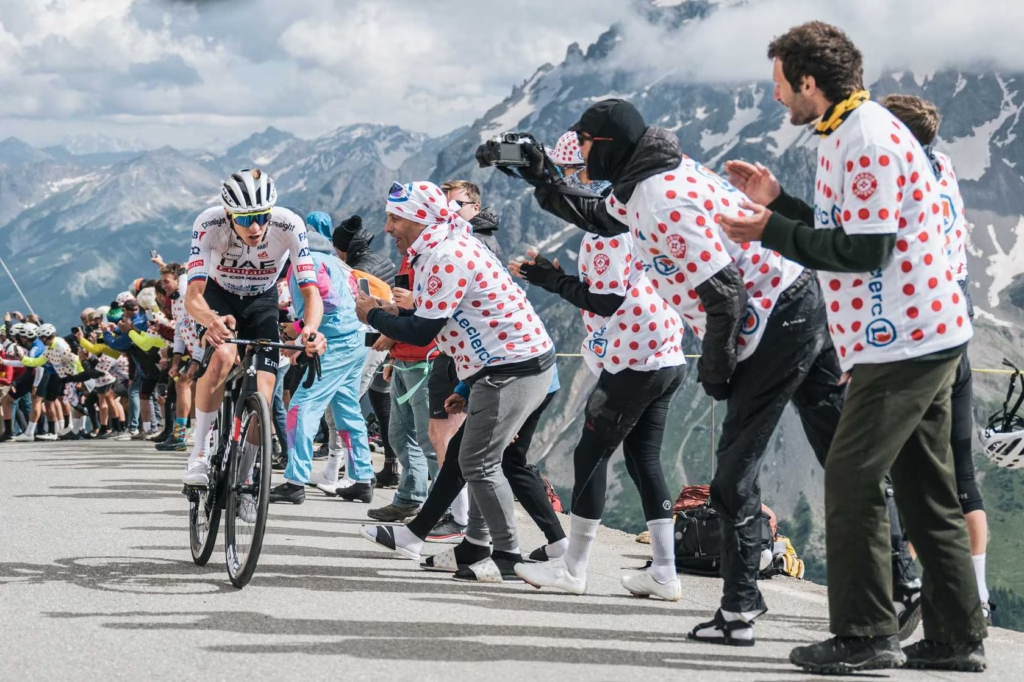
Do not underestimate the weather
Weather is arguably the biggest practical consideration when riding the Galibier.
Conditions in the valley can tell you surprisingly little about what is happening near the summit.
A warm morning lower down can become cold, wet and windy above 2,500 metres.
Carrying a lightweight waterproof or windproof layer is sensible even when the forecast looks good.
For the descent, another layer can make an enormous difference.
After climbing for more than an hour, body temperature can fall quickly once pedalling effort drops and speed rises.
Gloves are also worth carrying on all but the most settled midsummer days.
The wider ProCyclingUK France travel section has guides to several Alpine bases and major French cycling regions for riders building a trip around climbs such as the Galibier.
When is the Galibier open?
The Galibier is a high Alpine pass and closes through winter because of snow.
The exact opening date varies each year depending on snowfall, avalanche risk and clearance work.
Anyone planning to ride in May or early June should never assume the pass is open simply because conditions in the valleys are warm.
Summer is the most reliable period.
July and August offer the best chance of full access, although weather can still change rapidly at summit level.
Checking road status and the mountain forecast before setting out is essential.
Which side of the Galibier is harder?
For Tour history and sheer scale, the northern approach via the Télégraphe is the more imposing ride.
The Galibier itself is difficult from either direction.
From the north, however, riders effectively have to earn the right to begin it by climbing another major mountain first.
That accumulated effort is what gives the route its reputation.
The southern approach from the Lautaret begins much higher and is considerably shorter.
It is still demanding, particularly towards the summit, but it does not have the huge build-up provided by the Télégraphe.
For a first visit, the northern route is the classic choice.
For anyone wanting to understand why the Galibier has shaped so many Tours, it is the one to ride.
-
 Photo Credit: A.S.O./Gaëtan Flamme
Why the Galibier remains one of the Tour’s greatest climbs
The Galibier does not need gimmicks.
It does not have the tightly packed hairpins of Alpe d’Huez or the brutal gradients of some newer summit finishes.
Its appeal is scale.
The road keeps climbing until the trees disappear, the landscape turns to rock and mountain, and riders are exposed more than 2,600 metres above sea level.
The Tour first crossed it in 1911.
Coppi and Bartali raced across it.
Pantani used it to turn the 1998 Tour upside down.
Andy Schleck won at its summit after attacking from 60 kilometres out.
More than a century after Émile Georget first crossed it, the Galibier remains the most frequently used major Alpine pass in Tour history.
And in 2026, it returns as the highest point of a Tour whose final Alpine showdown has been built around exactly this sort of terrain.
Alpe d’Huez may provide the final image.
The Galibier is where the race can be broken long before the finish comes into view.

