
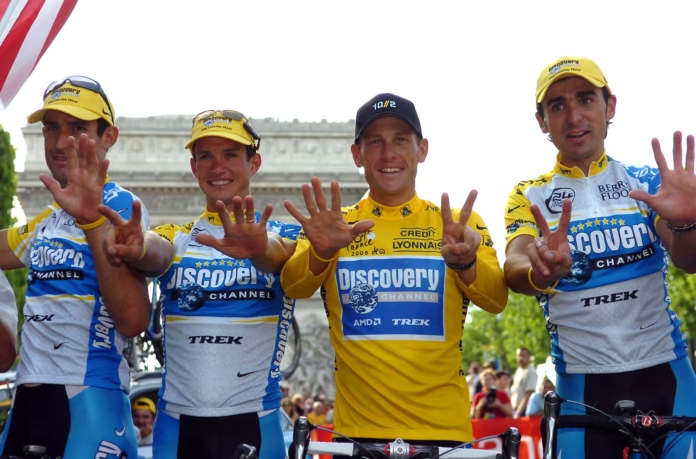
Discovery Channel arrived in professional cycling as a new title sponsor, but almost nothing about the team itself was new.
The blue and black kit replaced the familiar US Postal colours for 2005. Johan Bruyneel remained in charge, Lance Armstrong remained the Tour de France leader and Tailwind Sports continued operating the organisation behind them. Trek bikes, American ownership and a core of long-serving riders completed the sense of continuity.
Discovery inherited the most successful Tour structure of its era. It also inherited the dependencies, suspicions and internal culture that had formed around Armstrong, a story explored in full in our US Postal team history.
Its three seasons produced remarkable results. Paolo Savoldelli won the 2005 Giro d’Italia, Armstrong finished his first career with another victory on the road at the Tour and Alberto Contador emerged as a Grand Tour leader by winning the 2007 Tour.
Yet Discovery never became the clean second chapter its new identity appeared to promise.
Armstrong’s retirement left it without the rider around whom the entire system had been constructed. The attempt to replace him with Ivan Basso created an immediate ethical crisis, while Contador’s breakthrough arrived during one of the most chaotic Tours in modern history.
Discovery Channel won the Tour on the road in its first season and officially in its final one.
Between them came the uncomfortable evidence that changing the jersey had not changed the team.
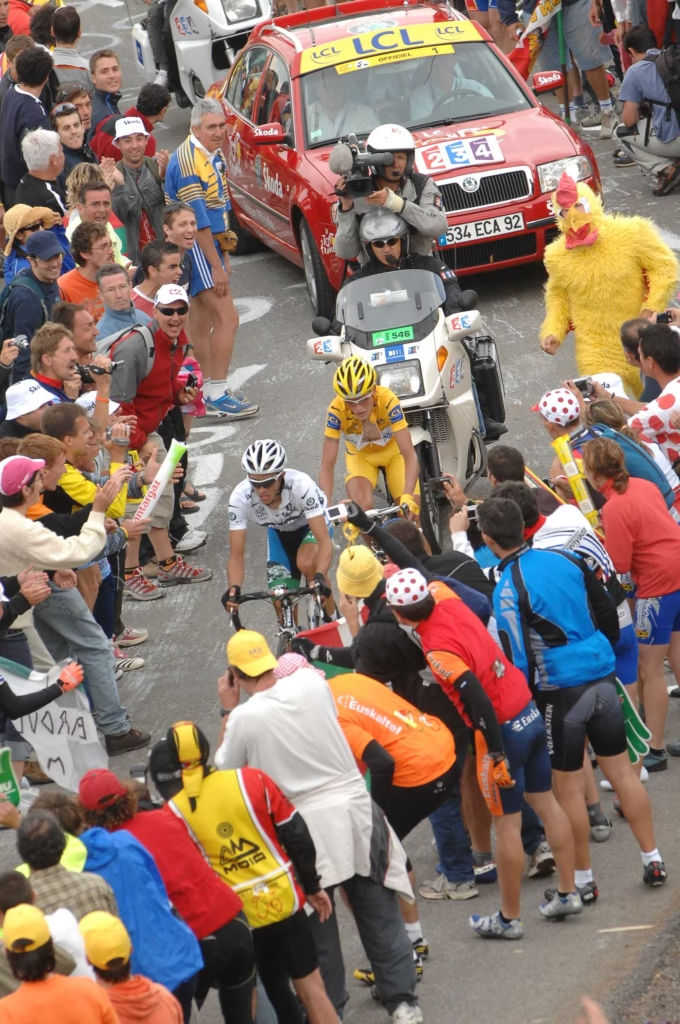
Discovery Channel cycling team at a glance
| Detail | Information |
|---|---|
| Active seasons | 2005-2007 |
| Previous identity | US Postal Service |
| Operating company | Tailwind Sports |
| Team director | Johan Bruyneel |
| Bicycle supplier | Trek |
| Official Grand Tour wins | 2005 Giro d’Italia and 2007 Tour de France |
| Major leaders | Lance Armstrong, Paolo Savoldelli, George Hincapie, Ivan Basso, Levi Leipheimer and Alberto Contador |
| Final season | 2007 |
| Reason for closure | Discovery ended its sponsorship and no replacement was secured |
Discovery Channel agreed to replace US Postal as title sponsor during 2004. The team then became one of the original UCI ProTour squads when the new top-level series began in 2005.
A new sponsor rather than a new team
The change from US Postal to Discovery Channel looked substantial from outside the sport.
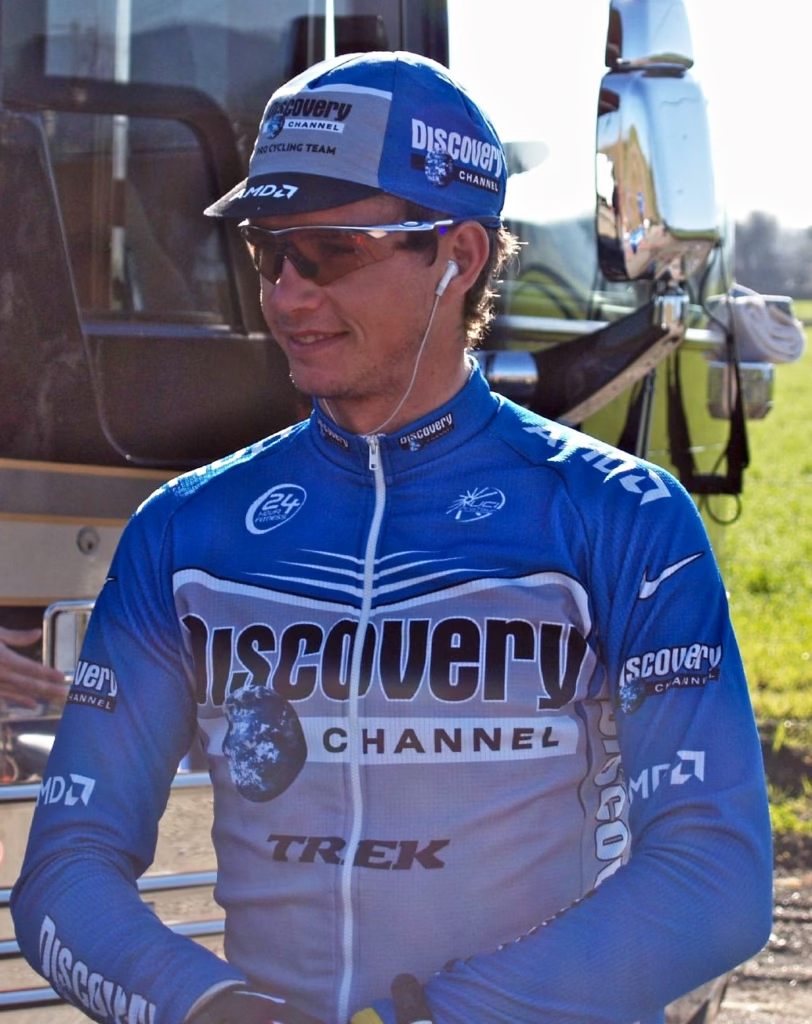
A government-backed postal service had been replaced by a global television brand. The red, white and blue kit gave way to a cleaner blue and grey design, while the Discovery name connected cycling with travel, science and adventure programming.
Operationally, it was a continuation.
Bruyneel remained the central sporting figure. Bill Stapleton and Tailwind Sports continued running the business, while Armstrong’s commercial influence remained fundamental to the sponsorship.
The agreement extended beyond race exposure. Discovery was buying into Armstrong’s global profile as much as the cycling team itself, using the sport as part of a wider relationship with one of the most marketable athletes in the world.
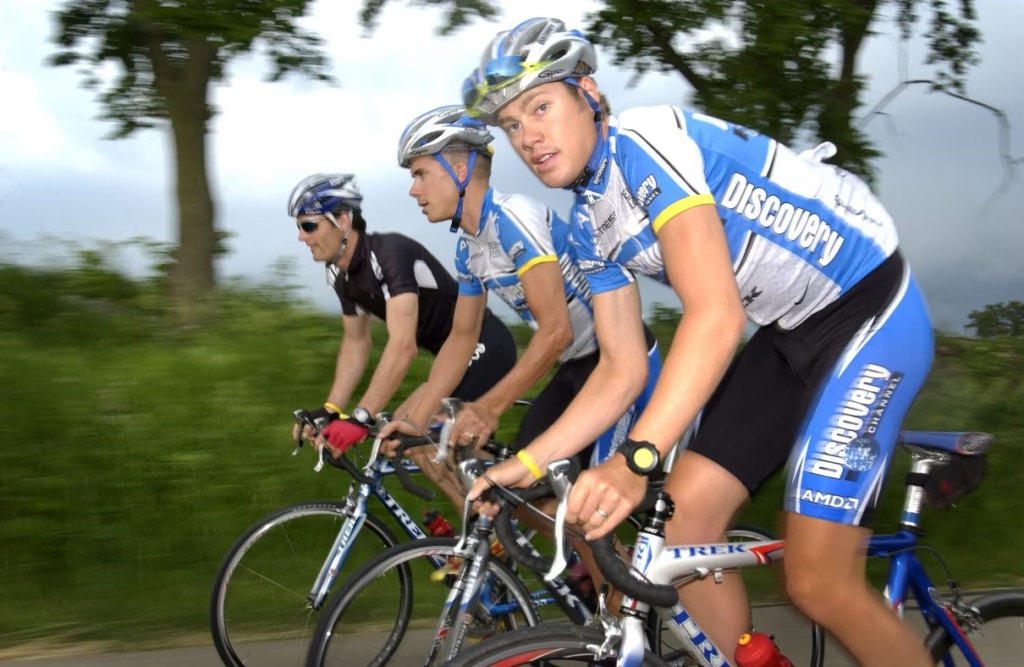
The roster retained much of the US Postal structure. George Hincapie, Viatcheslav Ekimov, José Azevedo, Yaroslav Popovych and Manuel Beltrán were among the riders expected to support Armstrong or fill established roles around him.
This was sensible from a performance perspective. US Postal had developed a repeatable method for controlling the Tour, built around a dominant leader, powerful mountain domestiques, equipment preparation and Bruyneel’s deliberately conservative tactics.
The problem was that Discovery did not receive only the useful parts of that inheritance.
It also took over a team whose identity was almost inseparable from one rider and whose later history would be rewritten by the investigation into Armstrong and the US Postal programme.
Discovery was not beginning again. It was extending a project that had already been built, refined and compromised.
American cycling had taken a long road to reach Discovery
Discovery sat within a longer history of American attempts to establish professional teams in Europe.
The 7-Eleven team had forced open the door during the 1980s, bringing US riders, commercial thinking and a visibly different culture into the Tour and Giro. Motorola continued that development during the 1990s and gave Armstrong his first major trade-team platform.
US Postal took the model much further.
It was not merely an American team competing successfully in Europe. It became a Tour-winning machine, commercially organised around Armstrong’s story and sporting ambitions.
Discovery therefore inherited decades of progress in American professional cycling, but it also inherited a much narrower purpose than 7-Eleven or Motorola had possessed.
Those earlier teams had contained different leaders, race programmes and identities.
US Postal had increasingly existed to win the Tour with one man.
2005 began with dominance at the Giro
The first major victory of the Discovery era did not come through Armstrong.
Paolo Savoldelli won the 2005 Giro d’Italia, beating Gilberto Simoni and José Rujano after taking control of the race during its second half. It was Savoldelli’s second Giro victory and gave Discovery a Grand Tour title before Armstrong had begun his final Tour campaign.
Savoldelli was an unusual leader for a Bruyneel team.
He was not the strongest pure climber in the race, but he was tactically intelligent, an excellent descender and capable against the clock. Discovery protected his advantage rather than attempting to dominate every mountain stage.
The victory showed that the organisation could win without Armstrong.
It did not yet prove that it could replace him at the Tour.
The team’s identity remained split. Savoldelli led in Italy, while almost every other significant decision was still shaped around July.
Armstrong’s farewell Tour prolonged the old era
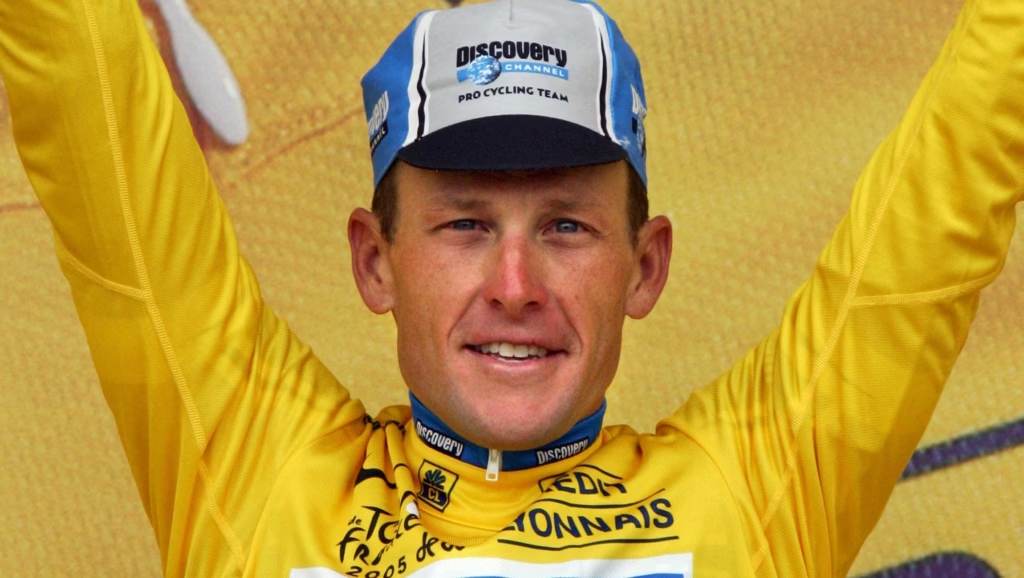
The 2005 Tour de France was presented as Armstrong’s farewell.
Discovery controlled the race in much the same way US Postal had controlled the previous editions. Armstrong took yellow, his domestiques set the tempo in the mountains and rivals were repeatedly forced to attack a complete team rather than an isolated leader.
The squad also won beyond the general classification battle. Hincapie took the mountain stage to Pla d’Adet, while Savoldelli won in Revel during the final week.
Armstrong reached Paris first and stood on the top step for what was then described as a record seventh consecutive Tour victory.
The result was later disqualified alongside his previous six Tour wins. The official list of every Tour de France winner now contains no winner for the editions from 1999 to 2005.
That retrospective change matters to the Discovery story.
At the time, 2005 appeared to be a perfect transition season. The sponsor received maximum exposure, Savoldelli won the Giro and Armstrong ended his career on top.
In reality, it delayed the difficult work.
Discovery had continued using the structure built for Armstrong because Armstrong was still there. Only after he retired did the team have to discover whether it possessed a broader identity.
The sense of renewal surrounding Armstrong’s first Tour victory had already been misleading in 1999. Our look back at the 1999 Tour de France shows how a race presented as a fresh start after Festina instead became the beginning of another damaged era.
Replacing Armstrong was not a normal succession problem
Most successful teams replace a leader by promoting a younger rider, signing an established contender or changing their objectives.
Discovery had to replace more than a Tour favourite.
Armstrong had shaped the roster, calendar, sponsorship and public image of the organisation. Domestiques joined knowing their principal job was to support him in July. Bruyneel’s tactics were built around defending a rider who rarely displayed a clear weakness once the Tour reached the mountains.
There was no single candidate ready to inherit that position.
Popovych had won the 2005 Tour’s young rider classification and looked capable of developing into a Grand Tour contender. Savoldelli was a Giro winner but less suited to the Tour’s longer climbs.
Hincapie had become one of Armstrong’s most trusted domestiques and had shown greater stage-race potential, but he was already 33 during the 2006 Tour.
José Azevedo, Tom Danielson and Manuel Beltrán offered further options without resembling a clear replacement.
Bruyneel responded by refusing to choose one.
Discovery entered the 2006 Tour with several possible leaders and the idea that the road would decide the hierarchy. It was the opposite of the Armstrong model, where every role had been settled before the race began.
Hincapie’s yellow jersey disguised the 2006 problem
The post-Armstrong era initially appeared to begin smoothly.
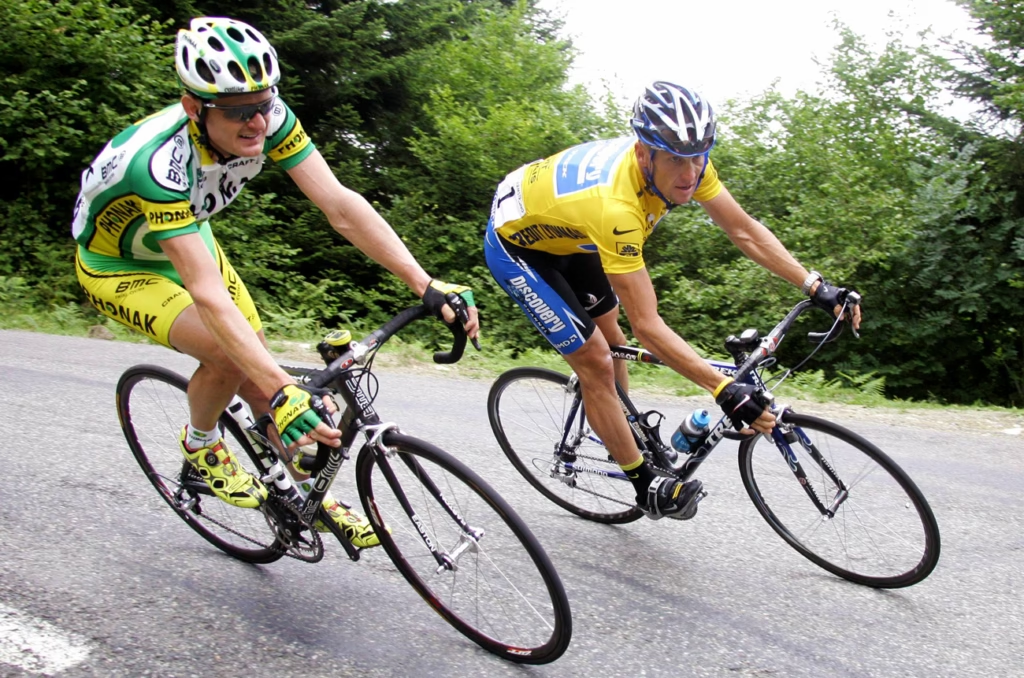
Hincapie finished second in the Strasbourg prologue by a fraction of a second and moved into yellow after collecting a time bonus on stage 1. For one day, Armstrong’s longest-serving team-mate became the visible successor.
It did not last.
Once the race reached the Pyrenees, Discovery’s collection of possible leaders collapsed as a collective GC challenge. Hincapie faded, Popovych lost time and Savoldelli never became a realistic contender.
José Azevedo eventually became the team’s best finisher in 18th place. Hincapie fell to 32nd, while no Discovery rider reached the final top ten.
The team did salvage a stage victory through Popovych. The Ukrainian attacked his breakaway companions on the road to Carcassonne and finished alone, giving Discovery its first Tour stage win since Armstrong’s retirement.
It was an important victory, but it also clarified the team’s position.
Discovery remained strong enough to win stages and place riders in decisive moves. It no longer had the central figure required to control the Tour.
The system remained.
Its organising principle had disappeared.
The 2006 Tour exposed how narrow the old model had been
Discovery’s struggles were not caused by a weak roster.
The team contained experienced Grand Tour riders, strong domestiques and several cyclists who would enjoy significant success elsewhere. What it lacked was flexibility.
US Postal had spent years perfecting one task: delivering Armstrong to the Tour in peak condition and protecting him through three weeks.
Discovery discovered that those methods were less decisive when the strongest rider was unknown.
Multiple leadership can work when riders have complementary ambitions or when the race settles the order quickly. At Discovery, it became a sign of uncertainty.
Hincapie was asked to transform from domestique and Classics rider into Tour contender. Popovych carried expectations based partly on potential rather than proven three-week consistency. Savoldelli’s Giro qualities did not automatically transfer to July.
The team could still organise a chase, control a breakaway and support a leader.
It first needed to know who that leader was.
Ivan Basso appeared to provide the obvious answer
Ivan Basso looked like the most convincing replacement available.
He had finished second to Armstrong at the 2005 Tour before dominating the 2006 Giro d’Italia. At 29, he was entering the years in which many Grand Tour riders reach their strongest level.
He also came with an obvious problem.
Basso had been removed from the 2006 Tour after his name appeared in the Operación Puerto investigation. Although the Italian case was initially shelved through a lack of usable evidence, the suspicion had not disappeared.
Discovery signed him in November 2006.
The move made sporting sense and damaged almost every claim that the team was beginning a different era. Basso had been excluded under the ethical framework followed by the leading teams, yet Discovery moved quickly once his immediate legal obstacle was removed.
Other teams reacted angrily and attempted to exclude Discovery from their professional association for signing a rider implicated in the investigation.
Discovery had found its post-Armstrong leader.
It had also shown that sporting opportunity remained more persuasive than the appearance of a clean break.
Operación Puerto destabilised several of the most powerful teams of the period. The collapse of Liberty Seguros and Astana-Würth is part of the final chapter in our ONCE team history, while Jan Ullrich’s removal from the 2006 Tour forms a decisive part of the Telekom team story.
Discovery was operating inside that same damaged environment.
Its response was to sign one of the central riders under suspicion.
The Basso gamble collapsed before the Giro
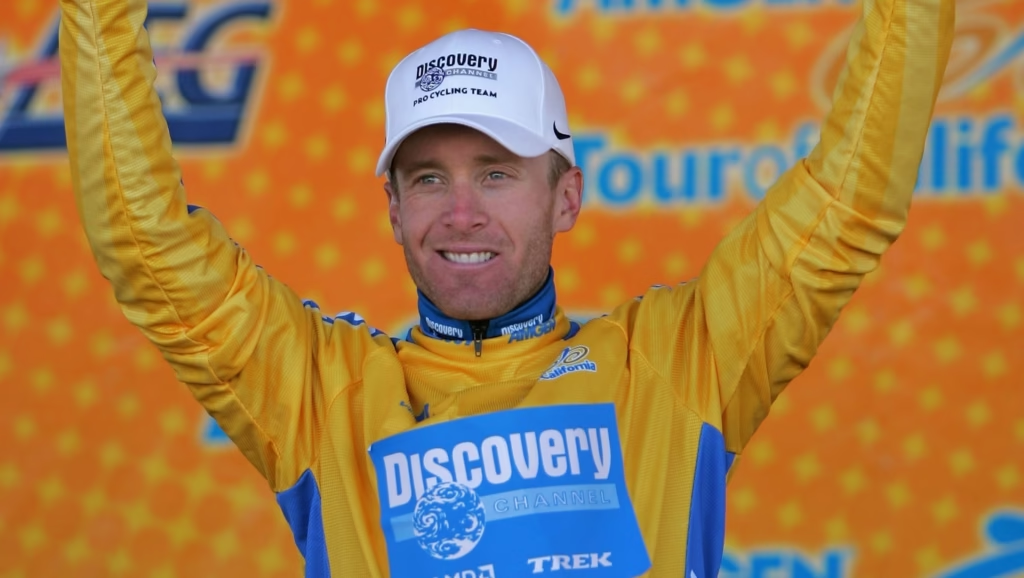
Basso began 2007 in Discovery colours and worked for Levi Leipheimer at the Tour of California.
He was expected to target the Giro and potentially return to the Tour. The partnership promised to give Bruyneel the proven Grand Tour favourite he had lacked in 2006.
It unravelled in April.
Discovery suspended Basso when the Italian Olympic Committee reopened its investigation. He was released from his contract days later at his own request, citing the renewed proceedings.
Basso subsequently admitted involvement with the Puerto network, describing it as attempted doping, and received a two-year ban.
The episode left Discovery without its planned leader only weeks before the Giro.
More importantly, it demonstrated the uncomfortable continuity between the US Postal and Discovery periods. The organisation had not been caught by a hidden development. It had deliberately accepted a highly visible risk because Basso offered the best chance of restoring Tour dominance.
The second act was beginning to resemble the first, only without Armstrong’s control over the story.
Contador emerged almost by accident
Alberto Contador joined Discovery in January 2007 after his Liberty Seguros-Würth team had collapsed in the fallout from Operación Puerto.
He was talented but not yet a Tour favourite.
Contador had returned from the life-threatening cerebral cavernoma that interrupted his career in 2004 and had shown flashes of climbing ability. Discovery initially appeared to view him as a developing stage racer rather than the immediate centre of the team.
That changed at Paris-Nice.
Contador attacked on the final stage around Nice, overturned Davide Rebellin’s lead and won the general classification. It was his first major stage-race victory and the clearest indication that Discovery had found a rider capable of succeeding Armstrong without simply copying him.
Contador climbed differently from Armstrong.
He attacked more instinctively, accelerated repeatedly and appeared comfortable creating disorder. Where Armstrong’s Discovery predecessor had been constructed around control, Contador was at his most dangerous when the race became unstable.
That distinction shaped the 2007 Tour.
Discovery entered the 2007 Tour with a hierarchy, but not the expected one
Leipheimer started the Tour as Discovery’s established leader.
He had won the Tour of California and had already finished on the Vuelta a España podium. Contador was a protected young rider, while Popovych offered another high-level climbing option.
The team’s depth quickly became apparent.
Contador won at Plateau de Beille after matching Michael Rasmussen in the Pyrenees. Leipheimer remained close through consistency and time-trial strength, while Popovych worked for both and stayed high in the general classification.
Discovery did not control the race as comprehensively as it had during the Armstrong years.
It did not need to.
The 2007 Tour was collapsing around its leading teams.
Alexandre Vinokourov tested positive for a homologous blood transfusion, forcing Astana to leave. Cofidis withdrew after Cristian Moreni tested positive.
Rasmussen was removed by Rabobank while wearing yellow after the team concluded he had misled it about his whereabouts before the Tour.
Contador inherited the race lead after Rasmussen’s removal before stage 17. He then had to defend it against Cadel Evans and his own team-mate Leipheimer.
The final time trial showed Discovery at its strongest and strangest
The stage 19 time trial from Cognac to Angoulême produced the defining image of Discovery’s final Tour.
Leipheimer won the stage, beating Evans by 51 seconds. Contador finished fifth and retained yellow, but his advantage over Evans was reduced to only 23 seconds. Leipheimer moved to within 31 seconds of his team-mate.
Discovery entered the final road stage with three riders inside the top eight overall.
Contador led. Leipheimer was third at the time, while Popovych sat eighth after spending much of the race supporting the two riders ahead of him.
The team had finally found a successor to Armstrong, but it had done so in circumstances that made celebration difficult.
Contador had taken yellow because Rasmussen was expelled. The Tour had already lost Vinokourov and Moreni to positive tests. Basso, Discovery’s intended leader, was serving a ban.
Even the apparent Contador-Leipheimer podium pairing would later be revised. Leipheimer admitted using prohibited methods during parts of his career and had his 2007 Tour results disqualified.
Contador’s victory remains in the official record, with Discovery Channel listed beside his name in the Tour de France winners list.
The surrounding triumph became progressively less stable.
The 2007 Tour win could not save the team
Discovery Channel had already announced in February 2007 that it would not renew its sponsorship beyond the end of the season.
The company said the decision was linked to changes within its own leadership rather than cycling’s doping crisis. Discovery representatives publicly stated that the sport’s scandals were not the reason for withdrawing.
That distinction became less meaningful once Tailwind attempted to find a replacement.
Cycling’s commercial environment was toxic. Operación Puerto had destabilised the sport, the 2006 Tour winner had tested positive and the 2007 race lost leading riders and entire teams to further scandals.
Prospective sponsors were being asked to associate themselves with a sport producing almost daily reputational damage.
Tailwind announced in August, less than two weeks after Contador won the Tour, that the team would cease operations at the end of the season.
It was one of the clearest demonstrations of professional cycling’s fragile business model.
Discovery had just won the sport’s biggest race.
It still could not sell its future.
Telekom faced a comparable commercial collapse during the same period, while the attempt to rebuild that structure under a different philosophy eventually produced High Road and HTC-Columbia. That reinvention is explored in our HTC-Columbia team history.
Discovery never attempted the same kind of public reset.
It simply ended.
Discovery’s riders did not disappear
The closure did not dismantle Bruyneel’s sporting network.
Bruyneel moved to Astana, taking several important Discovery riders and staff with him. Contador and Leipheimer followed, while other members of the old structure found places across the peloton.
At Astana, Contador won the 2008 Giro d’Italia and Vuelta a España before winning the Tour again in 2009.
Bruyneel also reunited with Armstrong when the American returned to racing. The lineage later continued through RadioShack, another American-sponsored team involving Armstrong, Bruyneel, Trek and several familiar riders and staff.
Discovery therefore ended as a sponsor identity rather than as a cycling influence.
Its people, methods and relationships continued shaping the sport for years.
This was one reason the US Postal story proved so difficult to contain. The team did not disappear cleanly when its sponsors changed. Its network moved between organisations, carrying experience, loyalties and habits into new projects.
Discovery belonged to cycling’s wider crisis of trust
Discovery cannot be understood as an isolated team making a few questionable decisions.
It raced during a period in which cycling repeatedly claimed to be starting again while failing to address the structures behind its scandals.
The 1998 Festina affair had already exposed organised doping as something larger than individual riders making private choices. Our Festina team history examines why that scandal should have forced a deeper reckoning.
Instead, the sport moved into the Armstrong era, Operación Puerto and the chaos of the 2007 Tour.
Sponsors changed. Teams changed names. Managers promised improvement. Riders were suspended, returned and moved between organisations.
The deeper incentives remained.
Discovery’s Basso signing captured the contradiction perfectly. The team wanted to present itself as modern, professional and commercially credible, but it was still prepared to gamble on a rider closely associated with the biggest active investigation in the sport.
The decision was not unusual within that era.
That was the problem.
How should Discovery Channel’s results be remembered?
The sporting record requires several distinctions.
Savoldelli remains the official winner of the 2005 Giro d’Italia. Contador remains the official winner of the 2007 Tour de France and its young rider classification.
Armstrong’s 2005 Tour result was disqualified along with his other results from August 1998 onwards. Leipheimer’s 2007 Tour results, including his third place at the time and stage 19 victory, were also disqualified following his later admission and sanction.
That leaves Discovery with two official Grand Tour victories across three seasons rather than the three celebrated on the road.
The team also won major stage races, Tour stages, national championships and Classics results. Leif Hoste finished second at the 2006 Tour of Flanders, while riders including Popovych, Hincapie and Contador gave the squad a broader programme than the old image of an Armstrong-only operation suggested.
Yet results alone cannot explain its place in cycling history.
Discovery was supposed to prove that the organisation could outlive Armstrong. It did so competitively, winning another Tour with a 24-year-old successor.
It failed to establish a convincing identity independent of the culture and compromises that had defined US Postal.
Contador’s place among the greatest Tour de France winners remains complicated by his own later sanction, but his 2007 victory was still the clearest proof that Bruyneel’s team could win the race without Armstrong.
That made Discovery successful.
It did not make it renewed.
Was Discovery Channel simply US Postal under another name?
Legally and operationally, it was a continuation.
The sponsor changed, but Tailwind Sports, Bruyneel, Trek and much of the team structure remained. Discovery did not buy an unrelated squad or build a new organisation around a fresh management group.
Sportingly, the three years contained two distinct phases.
The 2005 season was effectively the final US Postal campaign in different colours. Armstrong remained the leader and the Tour team performed its familiar task.
The 2006 and 2007 seasons were the genuine attempt to move beyond him. That period produced uncertainty, the Basso mistake and eventually the discovery of Contador.
The answer is therefore more complicated than the jersey.
Discovery was not merely a rebrand, because Armstrong’s retirement forced the team to change. It was not a genuine fresh start, because the same people and incentives continued to determine how that change happened.
-
 Photo Credit: Canyon SRAM (supplied media release)
 -
 Photo Credit: Park Tool
Discovery’s place among cycling’s great teams
Discovery belongs within cycling history because it won major races and because it reveals how difficult team identities can be to separate from the structures beneath them.
Some squads are remembered primarily through style, nationality or a particular part of the calendar. Euskaltel-Euskadi represented Basque identity. Saeco became associated with Mario Cipollini and sprinting spectacle. ONCE brought tactical control and Spanish Grand Tour ambition.
Discovery is remembered through inheritance.
It inherited Armstrong, Bruyneel, Tailwind, Trek and the US Postal system. It inherited an elite roster and a method for winning Grand Tours. It inherited commercial visibility that most teams could only imagine.
It also inherited a story that would eventually collapse.
The wider men’s cycling history hub brings Discovery’s three seasons into context alongside the other teams that shaped the Grand Tours, Classics and professional peloton.
Few were as successful over such a short period.
Few were so unable to define themselves independently of what came before.
The uneasy second act
Discovery Channel’s history is compressed into only three seasons, but it contains an entire cycle of dominance, uncertainty, renewal and collapse.
The team began by winning the Giro and Tour on the road. It spent its second season discovering that Armstrong could not be replaced by committee. It entered its third with Basso, lost him to the Puerto investigation and then found a new Tour winner in Contador.
That would normally be remembered as successful rebuilding.
Instead, Discovery sits awkwardly between two eras. It was the afterlife of US Postal and the foundation for Bruyneel’s Astana project, while never lasting long enough to develop a stable identity of its own.
The organisation proved that its Tour-winning expertise extended beyond Armstrong.
It also showed that the deeper problems extended beyond him.
Discovery changed the colours, found a new champion and won the Tour once more.
It never escaped the team it had been.

