Nicole Cooke’s 2008 season belongs among the defining achievements in British road cycling. On 10 August she won the Olympic women’s road race in Beijing, then on 27 September she won the world road race championship in Varese. No rider had previously won both road race titles in the same calendar year. It was a double built on two different finales, two carefully judged sprints and a long recovery from injuries that had almost persuaded Cooke to stop racing.
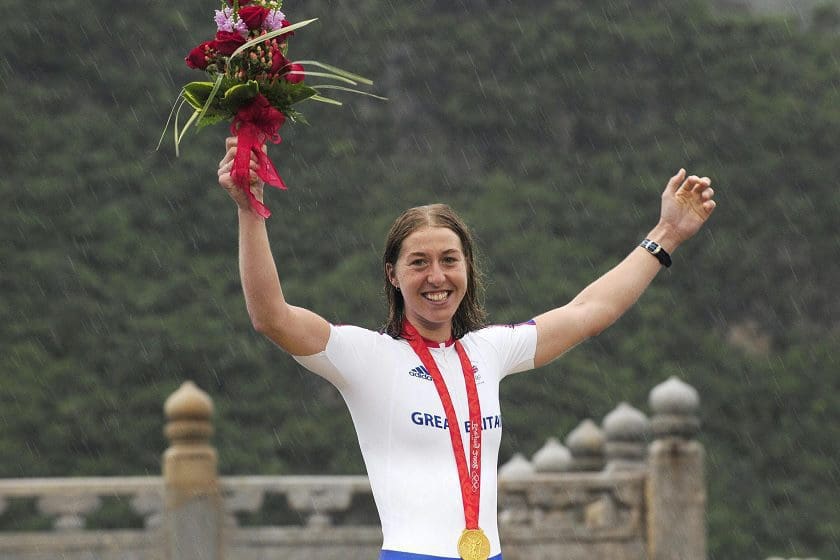
The Olympic victory came in torrential rain near the Great Wall of China. The world title came seven weeks later in northern Italy, after attacks on the final lap had reduced the race to five riders. Both wins required Cooke to make the correct decision in the closing metres, but neither was simply a sprinting result. Her positioning, tactical patience and willingness to commit at the right moment mattered just as much.
The road to Beijing was not straightforward
Cooke was already one of the outstanding road riders of her generation. She had won the women’s Tour de France, reached the top of the world rankings and taken a series of major one-day victories. At Athens in 2004 she had finished fifth in the Olympic road race, a result that disappointed her given the form she had shown in the years around it.
Her route towards Beijing was complicated by recurring knee problems. In an interview looking back on the Olympics, Cooke described seriously considering retirement in November 2007 because she could not see how she would reach the required level. The eventual Olympic champion was therefore not arriving after an uninterrupted run of success. She had spent the winter questioning whether she could compete at all.
She reduced her racing programme during 2008 rather than trying to collect victories every weekend. There were encouraging results, including a stage win at the Tour de l’Aude and another British road race title, but the emphasis was on arriving at the Olympics with enough fitness to challenge for gold. Her eighth consecutive national road race championship showed that the domestic standard remained firmly within her reach.
The British selection was small: Cooke, Emma Pooley and Sharon Laws. The three riders could not control a major international road race by numbers alone. Their opportunity lay in making the race difficult for rival nations and ensuring Cooke was in the right position when the decisive move formed.
Beijing’s rain-soaked Olympic road race
The women’s road race on Sunday, 10 August was 126 kilometres long, beginning in Beijing and finishing near the Badaling section of the Great Wall. Heavy rain changed the character of the contest. Visibility, braking and grip became part of the challenge, while the climbing on the finishing circuit made it harder for teams to maintain a conventional sprint train.
Cooke had experience from cyclocross and mountain biking as well as road racing, a background that helped her deal with poor conditions. Yet her win was not the result of a daring solo attack. She spent much of the race managing her effort and avoiding unnecessary work. The final selection developed with approximately six kilometres remaining, leaving five riders to contest the medal positions.
Pooley and Laws contributed to the British effort earlier in the race. Pooley was active in making the contest hard and preventing rivals from simply conserving energy until the final climb. With only three British starters, that work was especially important. Cooke still had to deliver the result herself, but it is misleading to present the Olympic gold as an entirely isolated performance.
The steep approach to the finish favoured a rider who could produce a sustained uphill acceleration rather than merely jump from a sheltered position on a flat road. Cooke knew that kind of finish suited her. The question was whether she could time her effort against opponents who were equally aware of the stakes.
How Cooke won the Olympic sprint
Sweden’s Emma Johansson and Italy’s Tatiana Guderzo were among the riders still in contention in the final kilometre. Cooke initially appeared slightly behind the decisive acceleration. Rather than panic, she built speed on the climb and used the inside line through a bend to gain ground.
She later recalled realising that she was travelling faster than the riders ahead and that the same effort could carry her all the way to the line. It was an unusually long uphill sprint, requiring commitment before the final few metres. Cooke passed her rivals and crossed the line with her fists clenched, the emotion visible immediately.
Her winning time was 3 hours 32 minutes 24 seconds. Johansson took silver and Guderzo bronze. The result delivered Great Britain’s first gold medal of the Beijing Games and its 200th Olympic gold since the beginning of the modern Games. It was also the first Olympic cycling gold for a British woman and the first individual Olympic gold for a Welsh woman.
Those distinctions mattered well beyond one cycling race. British track cycling was about to enjoy a remarkable Olympics, but Cooke’s road victory had already given the team its breakthrough. The win also demonstrated that the country’s elite women’s road programme could produce an Olympic champion without the resources or depth available to the largest national squads.
Seven weeks later, a different test in Varese
Cooke’s Olympic success could have been the end of her major objectives for the year. Instead she arrived at the Road World Championships in Varese, Italy, with an opportunity to add the rainbow jersey. The women’s road race took place on Saturday, 27 September, over 138.8 kilometres and eight laps of a demanding circuit.
The course contained repeated climbs, including the Montello and Ronchi ascents. It offered opportunities for aggressive riders to split the field but also allowed regrouping when attacks were not sustained. Marianne Vos, Judith Arndt, Emma Johansson and several other established contenders made the race tactically difficult.
Cooke later said she felt more relaxed at the Worlds because she had already achieved her principal goal in Beijing. That did not mean she lacked ambition. The distinction was psychological: she no longer carried the same pressure to make her entire season worthwhile. She could respond to the race as it unfolded rather than trying to force a prearranged outcome.
The British team again had to make its presence felt without dominating through numbers. The world championship field was strong, and a series of attacks meant Cooke could not simply wait for a large bunch sprint. The key was recognising which moves threatened the race and which could be allowed to spend themselves.
The five-rider finale and Vos’s late move
An earlier group of around a dozen riders gained an advantage before the Dutch and British teams helped bring it back. On the final lap, attacks on the Montello climb reshaped the contest. Cooke, Vos, Arndt, Trixi Worrack and Emma Johansson formed the decisive group after Swedish rider Susanne Ljungskog lost contact following a puncture.
The five riders were not content to ride together to the line. Vos and Worrack tried to force a separation, while Cooke responded to the moves that mattered. A series of accelerations reduced the opportunity for anyone to recover fully. It also created the possibility that the strongest sprinter would be caught out of position after covering too many attacks.
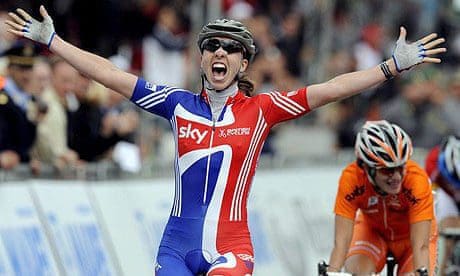
Vos launched her finishing effort before the line. Cooke reacted immediately, accelerated past the Dutch rider and took the rainbow jersey. Arndt finished third, with Johansson fourth and Worrack fifth. The result was decided in the final metres, but Cooke’s restraint through the preceding attacks was a central part of the victory.
Her winning time was 3 hours 42 minutes 11 seconds. Vos and Arndt were credited with the same time. Cooke had now won the two most prestigious one-day road races available to a woman in 2008, and had done so against many of the same leading rivals.
Why the Olympic and world double was unprecedented
The Olympic road race is held every four years, while the world championship takes place annually. Winning either requires peaking for a particular day. Winning both in one season demands the ability to recover from one major target and then rebuild for another, often on a very different course.
Cooke was the first rider, male or female, to take the Olympic and world road race titles in the same year. The claim is specific to the road races, not to every cycling discipline or every Olympic and world championship combination. That distinction matters because the achievement is extraordinary without expanding it into something it was not.
The two victories also show different aspects of her racing intelligence. In Beijing she understood the uphill sprint and used the bend to carry her speed past the leaders. In Varese she survived repeated attacks, stayed attentive to Vos and finished with the strongest acceleration. In neither race did she have the luxury of a large team controlling the final kilometres.
Her 2008 season included an eighth successive British road race championship. That title may look modest beside Olympic and world gold, but it reflects the consistency that preceded the double. She had been the benchmark in British women’s road racing for years before becoming an Olympic champion.
Cooke’s place in British cycling history
The double arrived at a time when British cycling was beginning to attract a much wider audience. The Olympic track team’s medal haul soon dominated headlines, yet Cooke’s victory had come first and on the road. Her achievement helped establish that British women could win the sport’s biggest international one-day races.
Cooke’s career also included victories in the Grande Boucle Féminine and Giro d’Italia Femminile, major Classics and World Cup competitions. Those successes give the 2008 double its proper context: it was the culmination of a long record at the top of the sport, not a sudden breakthrough by a previously unknown rider.
Her later comments about the treatment of women in cycling and the need for equal development opportunities are part of that legacy. She argued for girls to have access to the same national championship pathways as boys and challenged a system in which women’s racing received less attention and support. The achievements of later British generations did not erase those earlier battles.
For a broader view of British world champions, see our history of Great Britain at the Road World Championships. Our World Championships winners and records guide places Cooke’s Varese victory alongside the other rainbow jersey winners.
-
 Photo Credit: David Pintens / BELGA MAG/AFP via Getty Images
-
 Photo Credit: Getty Images