
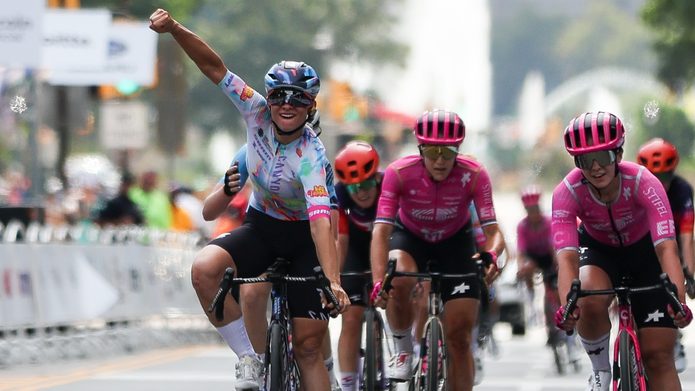
Chiara Consonni won the 2026 Philadelphia Cycling Classic, taking victory for Canyon SRAM in the first women’s edition of the race since 2016.
The Italian sprinter edged Alexandra Volstad of EF Education-Oatly with a bike throw after a chaotic final sprint, with Ella Sabo finishing third for Virginia’s Blue Ridge TWENTY28. Kristen Faulkner was fourth for EF Education-Oatly, ahead of Marit Raaijmakers of Human Powered Health and Agnieszka Skalniak-Sójka of Canyon SRAM.
The 101.9-kilometre race was shaped by repeated attacks on the Manayunk Wall and Lemon Hill, an early breakaway that survived deep into the race, a late five-rider move containing both Consonni and Faulkner, and a crash in the final few hundred metres that disrupted the sprint.
For Consonni, it was a first victory on US soil and a well-timed return to the top step after a race that never fully settled until the line.
A historic race returns to Philadelphia
The Philadelphia Cycling Classic returned in 2026 after a decade away, bringing elite road racing back to one of the sport’s most recognisable American circuits.
The women’s race used the city’s familiar terrain: the Benjamin Franklin Parkway, the roads along the Schuylkill River, the run through Fairmount Park, the climb into Manayunk and the repeated test of Lemon Hill. The Manayunk Wall remained the defining feature, with its steep gradients forcing selections and giving attackers a platform every time the race hit the climb.
That made the race more than a simple sprint opportunity. The distance was manageable, but the course was not. A rider needed positioning, climbing legs, recovery and enough speed left for the finish.
Consonni had all of it.
Early attacks test the bunch
The race began with the kind of nervousness expected from a revived event with a selective circuit.
Mairen Lawson of Aegis and Farah-Dale Morris of Automatic Racing were among the first to create separation, opening a small gap of around 20 seconds before the peloton brought them back on the Manayunk Wall.
EF Education-Oatly were already active in the early phases. Babette van der Wolf led over the Wall, while Elizabeth Dicon of HigherDose | Renova took points on Lemon Hill before the race’s more established breakaway began to form.
That opening phase was important because it set the tone. Teams were not waiting for the finish. The WorldTour squads wanted to make the race harder, the domestic teams wanted visibility, and the course gave every small move a chance to create pressure.
Valtulini launches the main breakaway
Elisa Valtulini then started the longest breakaway of the day for Vini Fantini-BePink.
She was joined by Haixin Dong of XDS China, Rachel Galler of 1K Flips-FTP Racing Jakroo, Philadelphia local Kim Stoveld of Automatic Racing, Marlen Lawson of Aegis x Leaders of Enchantment, Galen Bolard of Competitive Edge and Rebecca Lang of Winston Salem-Flow.
The move built a lead of around 40 seconds before the Manayunk Wall, where Bolard used the steepest section to ride away from the rest of the break. She took the points there, then continued to animate the race by winning the Lemon Hill sprint as the group behind began to fracture.
Lawson was distanced, then Galler also lost contact, but the breakaway still forced the peloton to chase. It gave the race a proper shape and prevented the favourites’ teams from simply riding a controlled procession into the final circuits.
EF Education-Oatly force the decisive split
The breakaway’s day ended on the final long lap, when EF Education-Oatly lifted the pace at the base of the Manayunk Wall.
That move did more than bring the escape back. It immediately created a new selection. Faulkner and Van der Wolf went clear for EF Education-Oatly, with Consonni and Skalniak-Sójka there for Canyon SRAM. Megan Guarnier, the last winner of the race back in 2016, also made the move for CCB p/b Levine Law Group.
It was a dangerous group. EF had two riders, Canyon SRAM had two riders, and Guarnier gave the move both experience and symbolic weight given her connection to the race’s previous edition.
They began the descent with around 10 seconds on a reduced chase group of roughly 20 riders. With 21.5 kilometres remaining and three further ascents of Lemon Hill still to come, the move had enough quality to survive if the cooperation held.
But behind, Human Powered Health were forced to chase.
Human Powered Health bring it back
Human Powered Health had missed the front split and took on much of the responsibility behind.
That was understandable. Raaijmakers, Giada Borghesi and Maggie Coles-Lyster all gave the team reasons to want the race back together. Letting EF Education-Oatly and Canyon SRAM ride away with numbers would have been too dangerous.
The chase gradually reduced the gap, and the five-rider move was caught with around 10 kilometres remaining. That brought the race back into a reduced group, but it did not calm the finale.
Instead, the short laps produced repeated attacks. Aegis and Vini Fantini-BePink were among the teams trying to disrupt the sprint scenario, while EF Education-Oatly and Canyon SRAM kept applying pressure in the final kilometres.
The favourites were still there, but nobody was being given an easy lead-out.
Canyon SRAM stay patient
Canyon SRAM had already shown strength by placing Consonni and Skalniak-Sójka in the late five-rider move.
Once that was brought back, their task changed. They had to keep Consonni in position, manage the counter-attacks and avoid being forced into chasing every move alone. That was easier because they still had numbers and because EF Education-Oatly were also racing aggressively rather than simply waiting.
Consonni later said the team knew the climb could make a difference and that they tried to split the group late before it came back together. That reflected how Canyon SRAM raced: they were not only defending a sprint option, they were actively trying to shape the final.
That mattered in the final kilometres. The race had been hard enough to remove many riders, but not hard enough to stop a sprint. Canyon SRAM had to make sure Consonni reached it with enough support and enough calm.
They did.
-
 Photo Credit: UAE Team L’IMAD
Final crash disrupts the sprint
The final sprint was chaotic.
A crash in the final few hundred metres disrupted the group just before the line, reducing the number of riders able to contest the win properly and adding another layer of confusion to an already nervous finish.
Consonni still found her way through. Volstad launched strongly for EF Education-Oatly and came close to taking the biggest win of her career, but Consonni timed her throw better at the line.
The margin was extremely tight. Volstad was close enough to force a proper finish-line decision, but the Italian had done enough. Sabo followed in third for Virginia’s Blue Ridge TWENTY28, giving the American team a major podium in one of the most prominent one-day races in the United States.
For Consonni, it was not a dominant long sprint. It was a finish decided by positioning, timing and nerve after a race that had repeatedly threatened to split apart.
Consonni takes first US victory
Consonni’s win carried extra meaning because it was her first victory on US soil.
The travel, time difference and unusual course all made the challenge different from a European one-day race. Yet she handled the demands well: she survived the Wall, followed the key late selection, stayed patient when that move was caught and then finished the job in a crash-affected sprint.
She also credited her team after the finish, pointing to the work done around her in the final laps and the lead-out that positioned her for the sprint. That was fair. This was not only a sprinter appearing at the end after an easy day. Canyon SRAM had been present in the decisive moves and still had enough organisation left for the finish.
Consonni only had to do her sprint, but the reason she could do it was the work that came before.
Volstad and Sabo make their mark
Volstad’s second place was a strong result for EF Education-Oatly.
The Canadian came within a tyre’s width of a major professional win and backed up her team’s aggressive approach. EF had been visible from the early climbs, helped create the late five-rider move through Faulkner and Van der Wolf, and still placed Volstad in position for the final sprint.
It was a near miss, but not a hollow one. Volstad spoke afterwards about the team continuing to learn its sprint process and getting closer through a run of podiums. Philadelphia was another sign that the group is becoming more coordinated in fast finishes.
Sabo’s third place was also significant. Against WorldTour opposition and on a course loaded with history, a podium for Virginia’s Blue Ridge TWENTY28 was a major return. The race rewarded riders who could survive the repeated climbs and still sprint after a messy final kilometre. Sabo did both.
Faulkner finishes fourth after aggressive EF race
Faulkner finished fourth, capping an active race from EF Education-Oatly.
Her presence in the five-rider move after the Manayunk Wall showed how seriously EF approached the final phase. Rather than simply waiting for Volstad, they used their strength to try to split the race, first through Van der Wolf and Faulkner, then later by keeping the pressure on in the reduced group.
Faulkner did not win, but her result showed the depth of EF’s performance. The team placed second and fourth, and had helped shape the race at several key points.
In a race where the WorldTour teams were expected to carry much of the tactical weight, EF Education-Oatly were one of the central forces.
Human Powered Health salvage top-five finish
Human Powered Health were another major team in the finale.
They had to chase after missing the decisive five-rider move, and their work helped bring the race back together before the final 10 kilometres. That effort could have left them exposed, but Raaijmakers still finished fifth and Borghesi took seventh.
That gave the team a strong result from a difficult tactical position. Missing the EF and Canyon SRAM split could have been costly, especially given the quality of the riders ahead, but Human Powered Health reacted quickly enough to keep the race alive.
Once the sprint came back together, they still had riders in position to contest the top 10. It was not a winning day, but it was a resilient one.
Guarnier returns to the race’s story
Guarnier’s presence in the decisive late move added a neat historical thread.
She had been the last winner of the women’s race in 2016, before the Philadelphia Cycling Classic disappeared from the calendar. Ten years later, she was back in the front selection on the Manayunk Wall, riding with the WorldTour favourites and helping make the return edition feel connected to the race’s past.
She eventually finished 10th, but her role was more than a result line. The race’s revival was always going to invite comparisons with its previous era, and Guarnier gave that link a human face inside the racing itself.
The win went to Consonni, part of the current WorldTour sprint generation. But the race also carried a reminder of what Philadelphia had been before its hiatus.
The Wall still decides the race
The 2026 edition confirmed that the Manayunk Wall remains the race’s defining feature.
It did not directly produce the winner, but it shaped almost everything that mattered. Early attacks were caught there. Bolard used it to split the breakaway. EF Education-Oatly used it to bring the race back and launch the key five-rider move. The repeated climbs narrowed the field enough to make the final sprint a reduced and chaotic one rather than a full peloton finish.
Lemon Hill also played its part, offering points and repeated late pressure, but the Wall remained the climb that forced the race to react.
That is why the Philadelphia Cycling Classic still feels distinct. The race is urban, fast and spectator-friendly, but it is not a flat city sprint. Riders have to earn the right to contest the finish.
Consonni earned it, then sprinted like the fastest rider left.
A revived race gets a proper winner
The return of the Philadelphia Cycling Classic needed a race that felt worthy of the setting.
It got one. The early breakaway put local and domestic teams into the story. EF Education-Oatly and Canyon SRAM animated the decisive climb. Human Powered Health had to chase. Guarnier connected the new edition to the old one. The final sprint was dramatic, messy and close enough to require a bike throw.
Consonni was the right kind of winner for that race. She was the fastest finisher, but she was not simply protected all day and delivered to a flat finish. She had to climb, follow moves, survive the final chaos and time the sprint perfectly.
Philadelphia returned with a race that was tactical, selective and tense. Consonni made sure it ended with a WorldTour-quality winner.
Philadelphia Cycling Classic 2026 women’s result
| Position | Rider | Team | Time/gap |
|---|---|---|---|
| 1 | Chiara Consonni | Canyon SRAM zondacrypto | 2:34:55 |
| 2 | Alexandra Volstad | EF Education-Oatly | same time |
| 3 | Ella Sabo | Virginia’s Blue Ridge TWENTY28 | same time |
| 4 | Kristen Faulkner | EF Education-Oatly | same time |
| 5 | Marit Raaijmakers | Human Powered Health | same time |
| 6 | Agnieszka Skalniak-Sójka | Canyon SRAM zondacrypto | same time |
| 7 | Giada Borghesi | Human Powered Health | same time |
| 8 | Gaia Segato | Vini-Fantini-BePink | +0:04 |
| 9 | Jamie Chapman | Aegis x Leaders of Enchantment | +0:04 |
| 10 | Megan Guarnier | CCB Kenetik p/b Levine Law Group | +0:04 |
Main photo credit: Getty

