
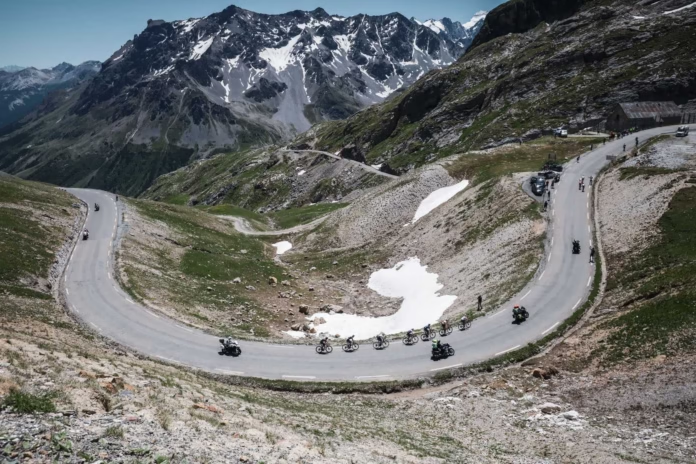
The hardest mountain stage of the 2026 Tour de France may now have another complication.
Rain is possible across the Alps during Stage 20, with clouds expected to build through the afternoon and a good chance of showers as the race crosses the Col du Galibier and heads towards the Col de Sarenne and Alpe d’Huez.
The forecast is not completely settled. Conditions around Alpe d’Huez itself could remain relatively bright, while the higher mountains are more exposed to rapidly changing weather.
That uncertainty matters because Stage 20 is already the queen stage of the 2026 Tour de France.
The riders face 170.9 kilometres and around 5,450 metres of climbing across the Croix de Fer, Télégraphe, Galibier and Col de Sarenne before eventually reaching Alpe d’Huez.
Wet roads would add another layer of risk, particularly on the long descent after the Galibier and the roads around Sarenne.
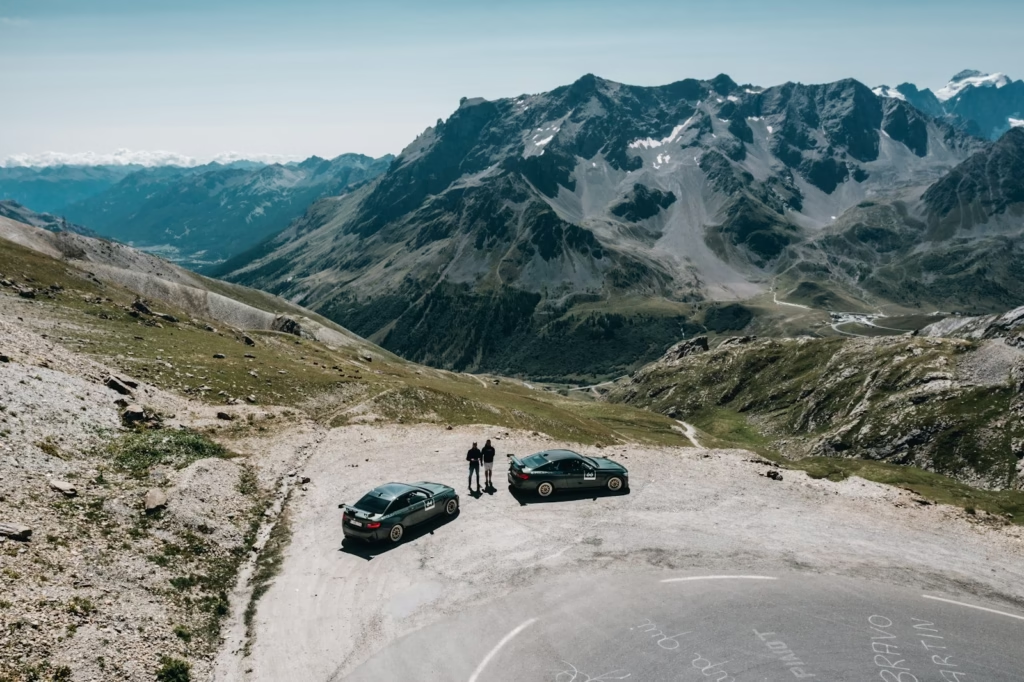
When could the rain hit Stage 20?
The critical weather window comes in the second half of the stage.
Conditions are expected to be warm in the valleys, but cloud should build as the afternoon progresses with showers possible across the mountains.
That overlaps directly with the most important section of the race.
The riders are expected to reach the summit of the Galibier during the afternoon before descending towards the Lautaret and continuing towards the start of the Sarenne section.
Mountain forecasts can change quickly and there is no guarantee that the peloton will actually ride through sustained rain.
The important point is that teams cannot assume the roads will remain dry.
Even a short shower can be enough to change grip substantially, particularly if the road has previously been dry and water mixes with dust and residue on the surface.
For a stage containing some of the fastest descending of the final week, that is enough to alter the tactical picture.
The Galibier descent becomes much more important
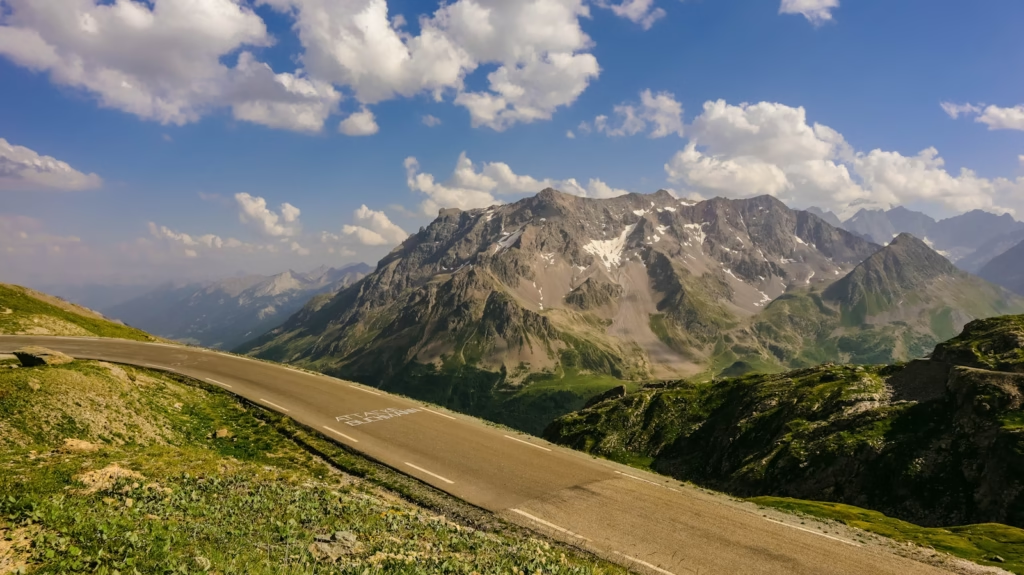
The Galibier is not simply another climb today.
What happens after the summit could be just as significant.
The descent towards the Col du Lautaret is generally more open than the northern approach the riders will climb from Valloire, but speeds can still be enormous. From the Lautaret, the road continues downhill for a prolonged period before the route eventually turns towards Sarenne.
In dry conditions, a GC group may remain relatively stable there.
Rain makes that less certain.
Braking distances increase. Painted markings become more slippery. Riders become more cautious about carrying speed into bends, particularly when visibility is reduced.
That creates a tactical problem.
A rider willing to descend aggressively can potentially turn a small advantage at the summit into a much larger one.
Anyone following has to decide whether matching that risk is worthwhile on the penultimate day of the Tour.
Tom Pidcock could have an opportunity away from the climbs
Tom Pidcock is the obvious rider to watch if the roads become wet.
His descending ability has been one of the defining strengths of his career, and his famous 2022 victory on Alpe d’Huez was partly built by the time he gained descending from the Galibier towards the breakaway.
That does not mean rain automatically helps him.
Pidcock suffered badly on Stage 19, eventually admitting he had gone too deep before Alpe d’Huez and had nothing left on the final climb.
The question today is therefore whether he can remain close enough to the relevant groups before the road starts descending.
If he does, difficult conditions could give him another way to influence the race.
After nearly three weeks of racing, riders do not necessarily need to be stronger uphill to gain time. They can also exploit moments when others are unwilling to take the same risks.
Richard Carapaz is another rider who could benefit if the race becomes less controlled.
His willingness to attack early and create disorder makes him a natural threat on a stage where rain could disrupt the normal GC pattern.
Sarenne could become dangerous for a different reason
The Col de Sarenne was already one of the most interesting parts of Stage 20 before rain entered the discussion.
The climb itself comes deep into a brutally difficult day, but the roads around Sarenne are narrower and less conventional than the main approach to Alpe d’Huez.
Earlier this month, storms caused mudslides around sections of the Stage 20 route, increasing scrutiny of the roads before the Tour arrived.
The route has remained in place, but fresh rain would inevitably make teams more cautious about surface conditions.
The real danger is not necessarily the climb.
It is what happens around the summit and afterwards.
If a rider reaches the top with a small advantage, wet roads could make the following kilometres strategically important. A technically confident rider may be able to expand the gap without attacking again.
Equally, a rider defending a podium position may decide that trying to recover five seconds is not worth risking the entire Tour.
That matters particularly in the white jersey battle between Isaac del Toro and Paul Seixas, where the gap is only 24 seconds.
UAE’s reduced team makes wet conditions more awkward
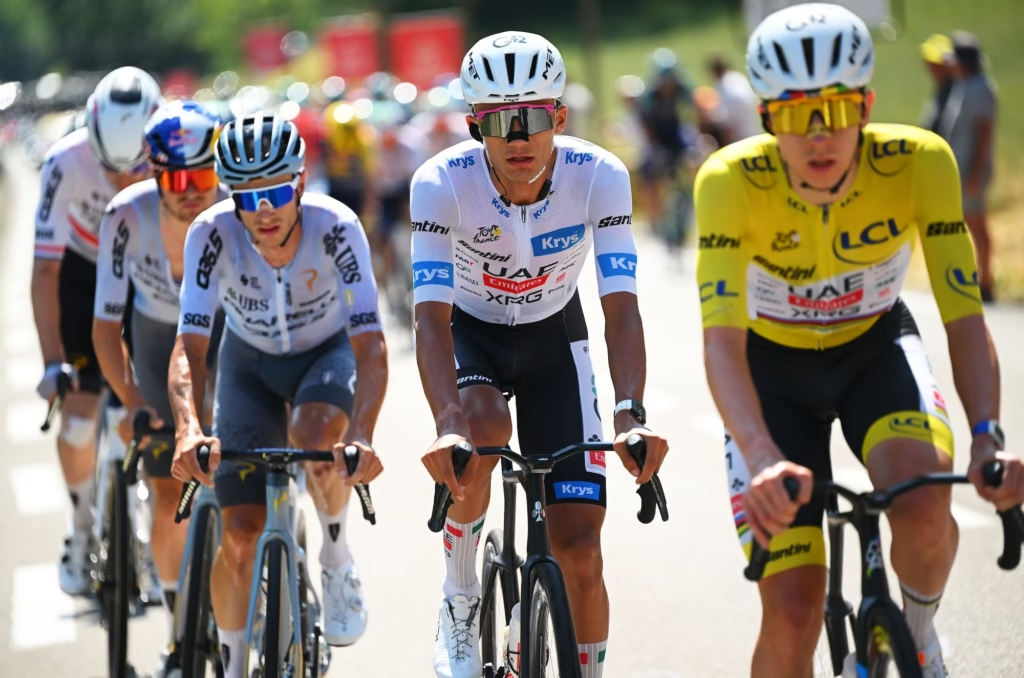
The weather also complicates the job facing UAE Team Emirates-XRG.
The team remains in control of the Tour, but it reaches Stage 20 without the same depth it had earlier in the race.
Brandon McNulty abandoned on Stage 18 through illness, while Adam Yates and Tim Wellens have also been managing illness during the final week.
Pogačar himself has shown no clear indication that he is struggling, but the support structure around him is weaker.
That distinction matters.
On a straightforward dry mountain stage, UAE can use numbers and pace to control much of what happens.
Wet roads introduce situations that cannot be solved simply by riding harder.
Pogačar needs teammates around him approaching important descents. He needs someone available after a mechanical problem. He needs riders positioned ahead if the group fragments unexpectedly.
McNulty was particularly useful because he could fill several of those roles.
His absence was already significant before Stage 20.
Rain would make it more so.
Rivals have a reason to test Pogačar before Alpe d’Huez
The biggest tactical consequence is that attacks could come earlier.
Without rain, the straightforward approach for Pogačar’s rivals would be to make the race hard across the Galibier and then concentrate on Sarenne and the final kilometres.
Wet roads create another opportunity.
A rider going over the Galibier with even a small advantage can force Pogačar into a decision.
Does he descend aggressively enough to close immediately?
Or does he accept a temporary gap rather than take unnecessary risks when his yellow jersey advantage is already substantial?
That is particularly interesting because Pogačar does not need to win Stage 20.
His rivals do.
The incentives are therefore different.
A rider targeting the stage, podium or classification may be prepared to take a level of risk that makes little sense for someone already in control of the Tour.
Del Toro and Seixas cannot afford to ignore each other
The rain could have an even greater effect on the battle for third overall and the white jersey.
Del Toro leads Seixas by only 24 seconds.
At that margin, descending is no longer simply a way of reaching the next climb.
It can decide the classification.
If Seixas reaches the Galibier summit five or ten seconds ahead of Del Toro and finds wet roads on the descent, the Mexican suddenly faces a difficult choice.
He can chase aggressively and risk losing everything through a crash, or ride within himself and potentially surrender enough time to put the jersey under serious pressure.
The same applies in reverse.
After three weeks of climbing, time trialling and attacking, one cautious corner could ultimately make the difference between third and fourth in Paris.
-
 Photo Credit: A.S.O./Gaëtan Flamme

The breakaway may be the biggest beneficiary
The weather could also improve the breakaway’s chances of winning the stage.
UAE already have little reason to chase riders who pose no threat to Pogačar’s yellow jersey.
Their reduced team gives them another reason to conserve energy.
Rain adds another.
Why ask Yates, Wellens or Felix Großschartner to take risks on a wet descent simply to bring a stage hunter back within reach?
That calculation could benefit riders such as Sepp Kuss, who came close from the breakaway on Stage 19 and has another opportunity on a route that should suit his endurance climbing better.
The ideal scenario for the escapees is a large move establishing several minutes before the Télégraphe and UAE deciding that the stage victory is not worth controlling.
If the roads then become wet, the incentive to close the gap becomes smaller still.
Stage 20 could become a contest of risk as well as strength
There is no guarantee that Stage 20 will become a wet-weather epic.
The forecast remains changeable, with sunshine possible at times and showers more likely as cloud builds across the mountains.
But teams cannot ignore the possibility.
That alone changes how riders approach the Galibier and Sarenne.
Stage 20 was already the hardest mountain stage of the 2026 Tour.
Rain would make raw climbing strength only part of the equation.
Descending confidence, positioning, team support and the willingness to take risk could all become decisive.
For Pogačar, the sensible race may simply be to stay upright.
For everyone still trying to take something from this Tour, wet roads might offer one final opportunity to make the race unpredictable.

