

Sepp Kuss came close to giving Visma | Lease a Bike the stage win they badly needed on Alpe d’Huez yesterday.
Today, he gets another chance.
Kuss finished fourth on Stage 19 after spending much of the day in the breakaway and surviving deep into the final climb. He eventually finished 1:14 behind Tadej Pogačar, who swept past the remnants of the move and claimed another dominant victory.
For Kuss, though, the opportunity was real.
“I’m already looking forward to tomorrow. It’s a day that suits me better, so hopefully I still have some energy left,” Kuss said afterwards. He expects Stage 20 to be “a bit more of an endurance test”, a description that should suit him far better than the short, explosive racing of Friday.
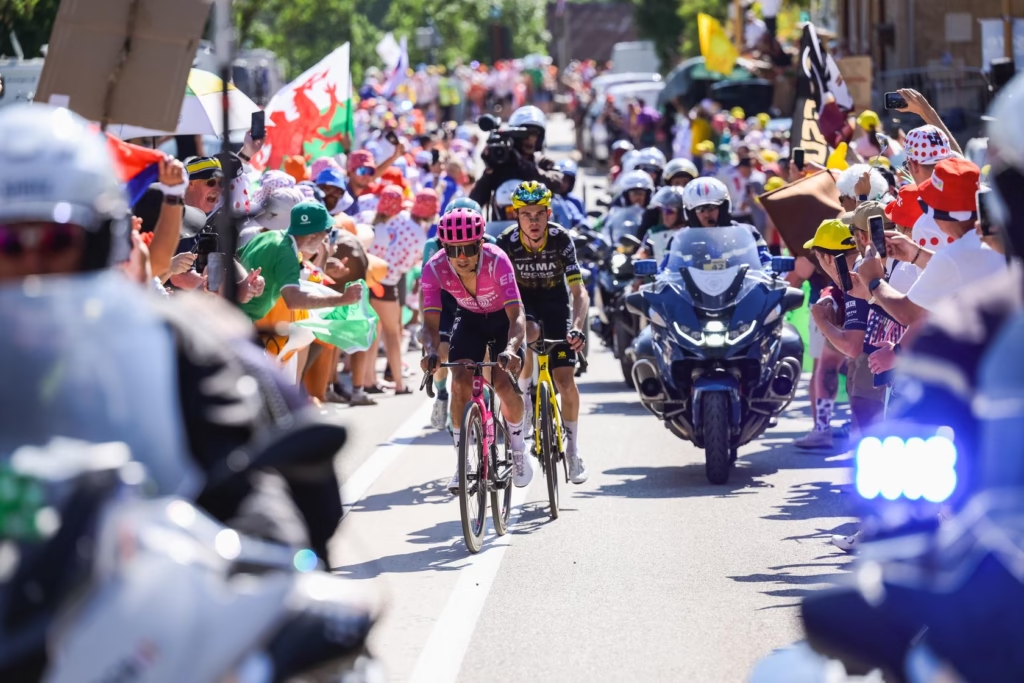
Kuss was close, but the break never had enough time
Stage 19 gave Kuss exactly the type of freedom Visma were looking for following Jonas Vingegaard’s withdrawal from the Tour.
He made the break and remained in contention deep into the final climb, but the move never built the sort of advantage required to survive against Pogačar.
That mattered because Stage 19 was deliberately short and aggressive. At 127.9km, with Alpe d’Huez waiting at the end, there was little room for a break to build a huge buffer before the GC favourites began racing behind.
Kuss was still there when the front group began fragmenting, but the repeated attacks did not play to his strengths.
His best climbing tends to come from a sustained, controlled effort rather than a sequence of short accelerations. Once the break started attacking one another and Pogačar was closing rapidly from behind, Kuss’s chance of turning the move into a stage win was disappearing.
Fourth place was still a strong ride.
It also looked like an opportunity missed.
Why Stage 20 may suit Kuss much better
The encouraging part for Kuss is that today’s stage is fundamentally different.
Stage 20 is the queen stage of the 2026 Tour de France, taking the riders over the Col de la Croix de Fer, Col du Télégraphe, Col du Galibier and Col de Sarenne before the final run into Alpe d’Huez.
At 170.9km and with well over 5,000 metres of climbing, it is not simply another summit finish.
It is an endurance contest.
That is why Kuss immediately identified it as a better opportunity.
The Croix de Fer comes early enough to make the breakaway fight difficult from almost the start. The Télégraphe and Galibier then create a prolonged period of climbing at altitude, before Sarenne provides another major test late in the stage.
ProCyclingUK ranked it as the hardest mountain stage of the 2026 Tour, and that extra difficulty could help Kuss rather than hurt him.
The longer the climbing lasts, the more the race moves towards the kind of sustained effort where he has traditionally been strongest.

Can Kuss make the break again?
Visma have every reason to try.
Vingegaard’s withdrawal changed the entire meaning of their Tour.
The Dane crashed out on Stage 15 while sitting second overall, leaving the team without the rider around whom its entire yellow jersey campaign had been built. The wider impact of that crash is covered in why Vingegaard abandoned the Tour de France.
For Kuss, it also changed his role.
Instead of spending the final week preserving energy for Vingegaard and staying close to his leader in the mountains, he can race much more freely.
Stage 19 showed that Visma are willing to use that freedom.
Stage 20 should encourage exactly the same approach.
The problem is that almost every strong climber outside the podium battle can look at the route and see the same opportunity.
A stage containing Croix de Fer, Télégraphe, Galibier, Sarenne and Alpe d’Huez is an obvious target for riders who have no GC position left to defend.
That should make the opening hour extremely aggressive.
For Kuss, simply making the right move could require a substantial effort.
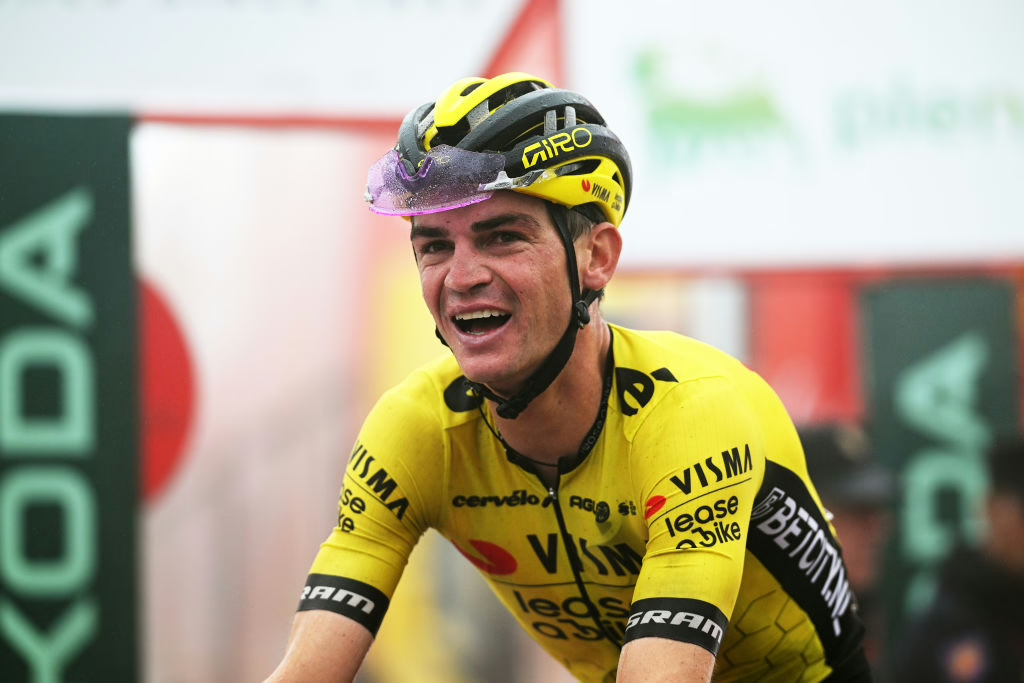
The harder route could finally favour the break
The shape of Stage 20 may give Kuss a better chance of staying away than he had yesterday.
Stage 19 was difficult, but the route still allowed UAE Team Emirates-XRG to keep the break within manageable range before Pogačar attacked.
Stage 20 gives UAE a different calculation.
The team already controls yellow, while Isaac del Toro has a podium position and white jersey to defend. Their priority is therefore likely to be controlling the GC race rather than chasing every stage hunter up the road.
That is where Kuss needs the race to split.
If a large break containing no threat to the overall classification gains several minutes early, UAE have little reason to spend heavily closing it down before the decisive climbs.
The 2026 Alps guide identified Stage 20 as a day where the breakaway’s chances depend heavily on the GC situation.
That situation now looks favourable.
Pogačar does not need another stage victory.
Kuss desperately wants one.
Pogačar remains the biggest problem
That does not mean the break is safe.
Stage 19 demonstrated what happens if Pogačar reaches the final climb with the attackers still within range.
He simply catches them.
For Kuss, the key is therefore not whether he can climb Alpe d’Huez quickly enough to beat Pogačar from the same group. He almost certainly cannot.
His chance depends on creating enough separation before the GC race really begins.
That makes the Galibier and Sarenne particularly important.
By the time the riders reach the second half of the stage, the break needs a gap measured in minutes rather than seconds.
If Kuss reaches Sarenne with that advantage and still has riders around him, the stage can become a genuine contest among the escapees.
If Pogačar is already visible behind, the outcome begins to look familiar.
-
 Photo Credit: A.S.O./Gaëtan Flamme

A stage win would transform Visma’s final week
The significance for Visma goes beyond Kuss himself.
This Tour was built around challenging Pogačar with Vingegaard.
That ended on Stage 15.
A victory on the queen stage cannot replace a yellow jersey campaign, but it would give Visma something substantial to take from a final week that suddenly became about salvaging opportunities rather than winning the Tour.
Kuss would also be an appropriate rider to deliver it.
For years, his Tour role has been defined primarily by supporting Vingegaard. He has spent some of the hardest mountain stages in cycling sacrificing his own chances for the team leader.
Now he has the freedom to race for himself.
That freedom almost produced a victory yesterday.
Today’s route gives him one more chance.
Kuss knows he is unlikely to beat Pogačar in a straight fight on Alpe d’Huez. His route to victory is to get ahead early, survive the huge climbing load and reach Sarenne with enough time that the yellow jersey battle no longer matters.
After fourth place on Friday, the form appears to be there.
Stage 20 now has to give the break enough room to use it.

