
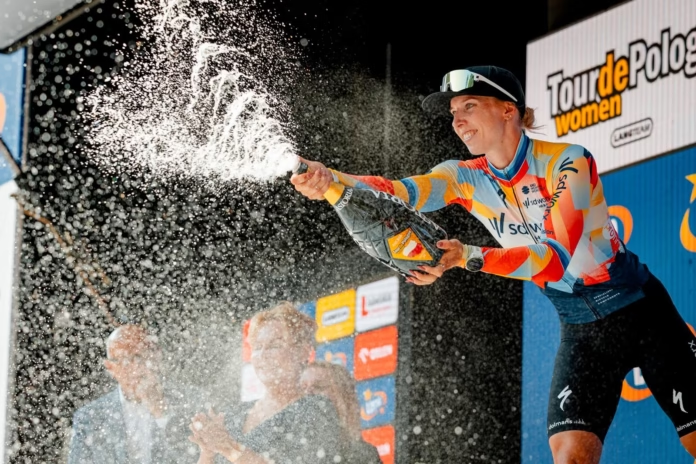
The Tour of Britain Women 2026 continues on Thursday 20 August with a 110.5-kilometre second stage from Clitheroe to Blackpool, and this is the day the sprinters will have been waiting for.
There are still 1,392 metres of climbing, including Waddington Fell and the steep Nick o’ Pendle early in the stage, but almost all of the difficult terrain is packed into the opening third. Once the race leaves the Ribble Valley and heads west towards the Fylde coast, the profile becomes progressively easier before a fast finish on Blackpool’s promenade.
That makes Lorena Wiebes the clear favourite. The climbs provide rival teams with an opportunity to make her work, but they come far enough from the finish that dropping her temporarily is unlikely to be enough. There is plenty of road for SD Worx-Protime to bring the race back together, and if Wiebes reaches Blackpool with the front group she should be extremely difficult to beat.
The more realistic challengers are riders with enough outright speed to compete in a conventional sprint: Chiara Consonni, Lara Gillespie, Nienke Veenhoven and Ally Wollaston. The Tour of Britain Women 2026 route guide makes Stage 2 the clearest pure sprint opportunity of the five-day race.
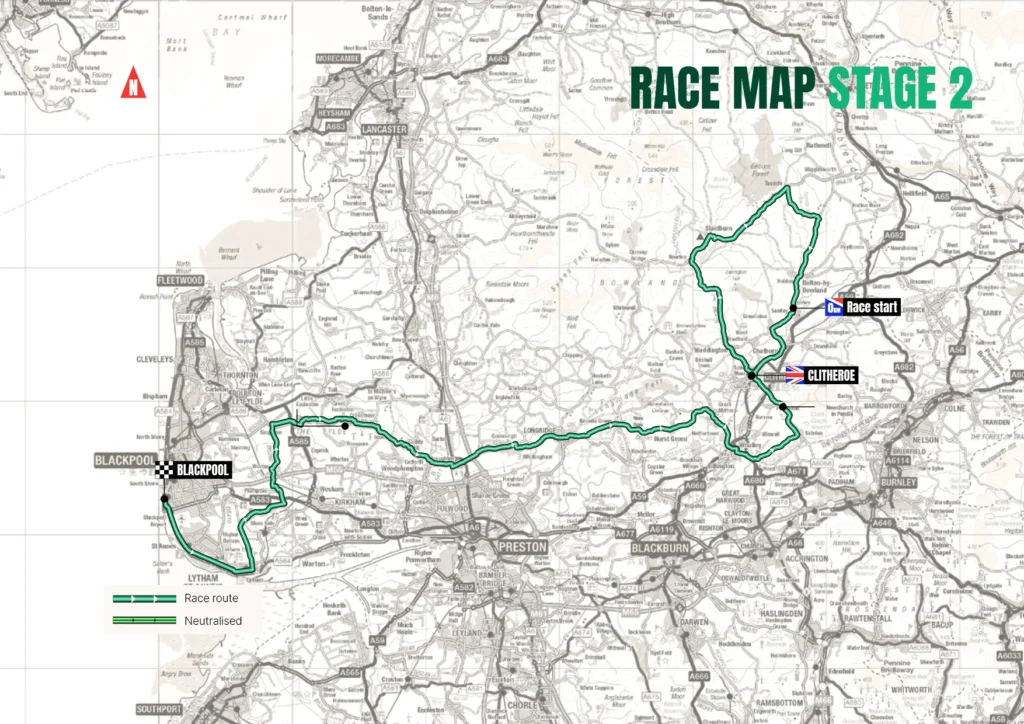
Tour of Britain Women 2026 stage 2 route
Date: Thursday 20 August 2026
Start: Clitheroe
Finish: Blackpool
Distance: 110.5km
Elevation: 1,392m
Stage type: Early climbing followed by a likely bunch sprint
Stage 2 begins in Clitheroe in the Ribble Valley, with the hardest terrain arriving almost immediately rather than being saved for the finale.
The route initially heads into the Forest of Bowland, where Waddington Fell takes the riders to the highest point of the stage. The peloton then drops back towards Clitheroe before tackling Nick o’ Pendle, the most significant named climb of the day at 1.9 kilometres averaging 7.6%.
That gradient is hard enough to hurt a sprinter if the pace is aggressive, but its position is the crucial detail. Once Nick o’ Pendle is finished, the major climbing is effectively over with roughly 70 kilometres still remaining.
The route then heads west through flatter terrain towards Whalley, Longridge and Broughton before turning towards the Fylde coast. Once the race reaches Lytham St Annes, the final approach towards Blackpool becomes increasingly suited to the sprint teams.
The finish comes on the promenade, providing a very different challenge from the exposed and rolling opening stage around Cockermouth.
The early climbs are difficult, but probably too far from Blackpool
Stage 2 is clearly designed with the sprinters in mind, but Waddington Fell and Nick o’ Pendle still give teams without an elite fast finisher one obvious tactical option.
They can make the opening hour as hard as possible.
Nick o’ Pendle is steep enough to create genuine separation if a strong team commits to the climb, particularly if the peloton has already been stretched on the roads beforehand. Riders who begin the ascent badly positioned could quickly find themselves chasing.
The problem is what happens afterwards.
There are more than 70 kilometres available for regrouping, much of it significantly easier than the opening terrain. Even if Wiebes, Consonni or another sprinter loses contact briefly, their teams have ample time to organise a chase.
Dropping Wiebes on Nick o’ Pendle therefore achieves very little unless the front group continues driving afterwards.
That is difficult when so many teams have an interest in bringing the race back together.
 Photo Credit: Getty
Lorena Wiebes is the clear favourite
There is less need for qualification around Lorena Wiebes on Stage 2 than there was on the opening day.
This is much closer to the sort of stage on which she should begin as the overwhelming benchmark.
Wiebes can survive significantly harder terrain than most pure sprinters, so expecting Nick o’ Pendle alone to remove her permanently is unrealistic. Rival teams instead need to make the entire opening section expensive enough that she reaches Blackpool with less energy and less support.
Even that may not be enough.
SD Worx-Protime have one of the strongest teams in the race and can use Lotte Kopecky and Mischa Bredewold to cover dangerous moves while allowing Wiebes to ride more conservatively. That dramatically reduces the value of simply attacking whenever the road rises.
If the peloton enters the final five kilometres together and SD Worx-Protime still have their sprint structure intact, the stage becomes extremely difficult for anyone else to win.
Verdict: The clear favourite. The opposition needs to disrupt her race before Blackpool rather than expecting to beat her from equal positions in the final 200 metres.
Chiara Consonni has the speed to challenge
Chiara Consonni is one of the strongest direct alternatives if Stage 2 produces the expected bunch sprint.
The Blackpool route suits her considerably better than the opening stage around Cockermouth. The difficult climbing comes early enough that Canyon SRAM have time to bring her back if she is briefly distanced, while the long flatter run towards the coast gives the team an opportunity to organise properly.
That should also change how Canyon use Zoe Bäckstedt.
Rather than treating Bäckstedt primarily as an attacking option, the team can use her power to protect Consonni, control moves and help establish position before the sprint.
Consonni’s problem is not route suitability. It is Wiebes.
She has the acceleration to win at this level, but beating Wiebes usually requires excellent positioning and timing rather than simply producing a faster final sprint.
Verdict: The most convincing conventional sprint challenger to Wiebes.
 Photo Credit: Getty
Lara Gillespie belongs among the main alternatives
Lara Gillespie deserves another prominent place in the Stage 2 discussion.
The route gives her fewer problems than Stage 1 because the main climbing is so far from the finish. If the peloton regroups as expected, Blackpool becomes primarily about positioning, timing and top speed.
That is a much better scenario for Gillespie.
She is particularly dangerous if the sprint becomes less organised than SD Worx-Protime would like. A disrupted lead-out, a late surge from another team or a fight for Wiebes’ wheel could create exactly the sort of opening that allows a rider slightly outside the dominant sprint train to win.
Gillespie’s presence also matters tactically because her team has another reason to help control any dangerous move after Nick o’ Pendle.
The more teams that want a sprint, the harder it becomes for attackers to keep the race broken.
Verdict: A genuine podium contender and one of the strongest options if the finale becomes chaotic.
Nienke Veenhoven has one of her best opportunities
Nienke Veenhoven should have Stage 2 marked as one of her clearest opportunities of the week.
The flatter second half removes many of the complications that can limit pure sprint ambitions elsewhere in the race. Once the peloton has crossed the early climbs, Team Visma | Lease a Bike can turn their attention almost entirely towards positioning her for Blackpool.
The challenge is the depth of the sprint field.
Wiebes will command the most attention, while Consonni, Gillespie and Wollaston all need to be near the front. On a fast approach where there are few opportunities to regain position late, entering the final kilometre several wheels too far back could be decisive.
Veenhoven therefore needs a cleaner lead-out than simply hoping her speed carries her through.
Verdict: Strong podium outsider and a realistic winner if the main sprint trains lose control.

Ally Wollaston has stage and GC reasons to sprint
Defending champion Ally Wollaston has more reason than most to treat Blackpool seriously.
She is not the fastest rider in the field in an outright sprint, but she has enough speed to contest a top finish and potentially collect valuable bonus seconds.
That matters in a race whose recent history has been defined by tiny GC margins. Wollaston won the 2025 Tour of Britain Women by only four seconds, a result covered in ProCyclingUK’s history of the Tour of Britain Women.
Stage 2 is therefore not simply about surviving safely before the Great Orme.
If Wollaston can take seconds in Blackpool, she arrives at the first major GC finish with a slightly larger margin to work with.
Her ideal stage is probably one where the opening climbs are raced hard enough to put fatigue into the pure sprinters without causing lasting splits.
Verdict: Strong top-five and podium possibility, with GC bonuses giving her extra incentive.
Mischa Bredewold and Lotte Kopecky should work for Wiebes
Stage 2 should produce one of SD Worx-Protime’s simpler tactical plans.
Mischa Bredewold and Lotte Kopecky are both capable of winning far more difficult stages, but there is little reason to complicate the race if Wiebes remains comfortable.
Their value is in making sure she does.
Kopecky can follow dangerous moves over the early climbs, while Bredewold gives the team another powerful rider capable of controlling the road once the race begins flattening out.
That structure makes eliminating Wiebes particularly difficult. Teams cannot simply attack on Nick o’ Pendle and expect SD Worx-Protime to panic, because one of the strongest all-rounders in the peloton may simply follow the move.
Only if Wiebes genuinely loses contact and fails to return should Kopecky or Bredewold become primary stage options.
Verdict: Tactical insurance and support for Wiebes unless the expected sprint plan collapses.
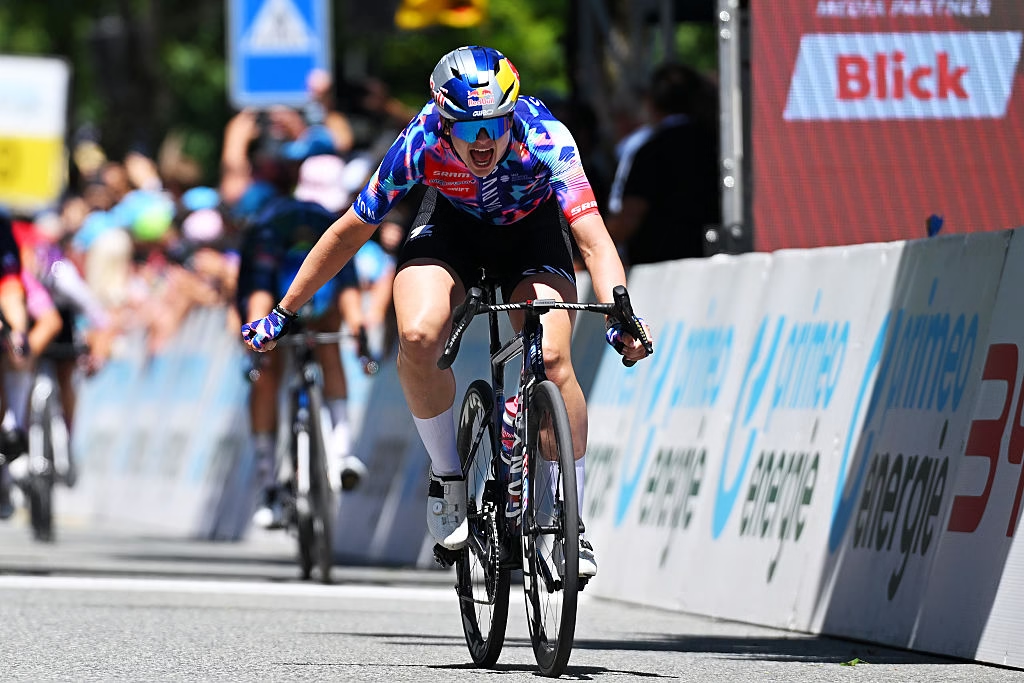
Zoe Bäckstedt can be crucial without attacking
Stage 2 suits Zoe Bäckstedt, but Canyon SRAM’s most effective use of her may be very different from Stage 1.
With Consonni holding a legitimate chance of winning in Blackpool, there is little reason to attack simply because the opening terrain allows it.
Bäckstedt’s power is more valuable protecting Consonni, helping close dangerous moves and driving the team into position on the approach to the coast.
That does not remove her own opportunity completely.
If the race splits on Nick o’ Pendle and Bäckstedt finds herself in a strong front group while Consonni is behind, Canyon SRAM can immediately change plans. Few riders are better equipped to help a small group maintain speed across flatter roads.
But that should be the contingency rather than the starting strategy.
Verdict: More valuable as part of Canyon SRAM’s sprint structure unless the early climbs produce an unexpected split.
Could anyone attack and stay away?
The route encourages teams to try, but the odds are heavily against them.
Nick o’ Pendle is the obvious place to force the issue. It is steep enough for strong Classics riders and GC contenders to create a meaningful selection.
What it lacks is proximity to the finish.
More than 70 kilometres of relatively favourable terrain separates the climb from Blackpool. Any group that gets away needs sustained cooperation and enough representation from teams with sprint interests to prevent an organised chase.
That is a difficult combination to find.
SD Worx-Protime want Wiebes. Canyon SRAM have Consonni. Visma have Veenhoven. Wollaston and Gillespie also give their teams reasons not to let a manageable move disappear.
A late attack is more plausible, particularly if the sprint teams hesitate during the final approach, but the overall shape of the stage strongly rewards control.
Blackpool should produce one of the fastest finishes of the week
Once the race reaches the Fylde coast, the character of Stage 2 changes almost completely.
The climbing is finished, the roads become much faster and the sprint teams have time to build their lead-outs before Blackpool.
That should make positioning increasingly expensive.
A fast, relatively open finale often looks simple on a route map but can actually make moving forward harder. When every train can accelerate at the same time, riders who lose the right wheel several kilometres from the line may never get it back.
That particularly favours Wiebes because SD Worx-Protime are so effective at controlling high-speed finishes.
For Consonni, Gillespie, Veenhoven and Wollaston, the fight to enter the final kilometre in the first six or seven wheels may matter almost as much as the sprint itself.
-
 Photo Credit: A.S.O./Billy Ceusters
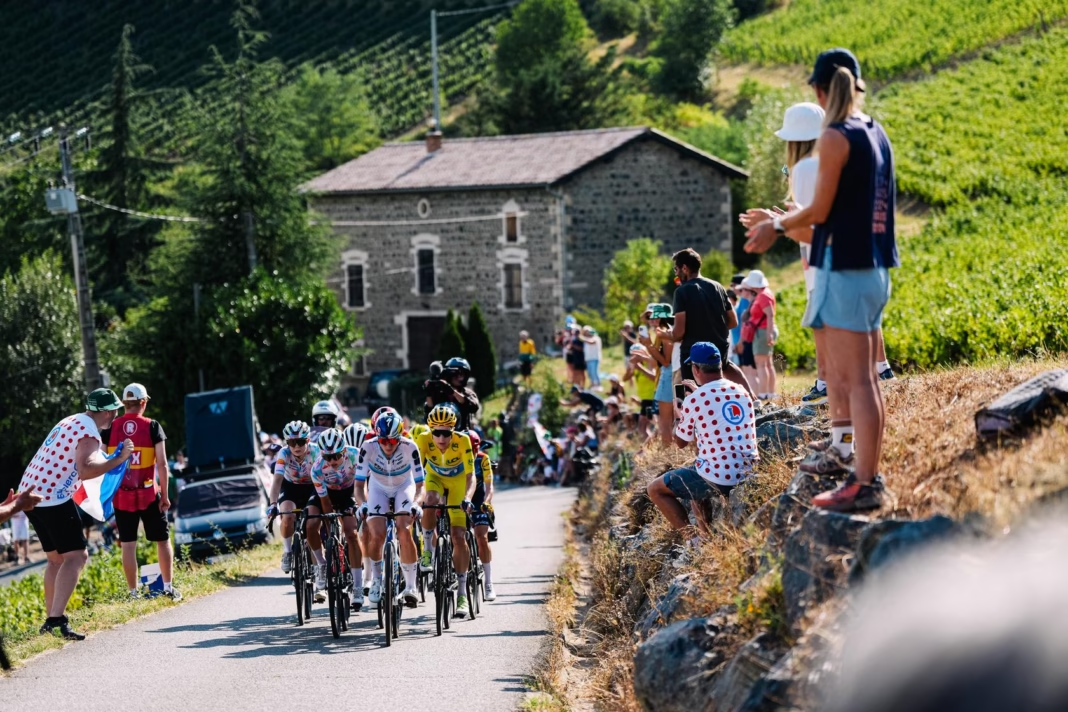
Stage 2 still matters to the general classification
This is primarily a sprint stage, but the GC riders cannot switch off.
The opening climbs create at least some risk of splits, while bonus seconds at the finish remain important in a five-stage race where the overall margins could be small.
The bigger issue is what comes next.
Stage 3 finishes on the Great Orme above Llandudno, providing the clearest early opportunity for the strongest overall contenders to create meaningful gaps. The Tour of Britain Women 2026 contenders preview explains why riders such as Kopecky, Kim Le Court-Pienaar and Wollaston will view that stage very differently from Blackpool.
For Wollaston in particular, taking bonus seconds on Stage 2 could reduce the amount of time she needs to gain or defend when the race goes uphill.
For Wiebes and the other pure sprinters, Blackpool may be the best opportunity before the race turns decisively towards the GC battle.
Who wins Tour of Britain Women 2026 Stage 2?
Lorena Wiebes should win Stage 2 if the race follows its most likely pattern.
The opening climbs make the profile look more complicated than a pure flat stage, but their distance from Blackpool is the decisive factor. Even if Wiebes is put under pressure on Waddington Fell or Nick o’ Pendle, there should be enough road for SD Worx-Protime and the other sprint teams to bring the race back together.
The strength of the sprint interest also matters. Canyon SRAM, Visma and several other teams have little reason to allow an attack to disappear when they have realistic podium or stage-win opportunities in Blackpool.
Chiara Consonni looks the strongest direct challenger, with Lara Gillespie, Nienke Veenhoven and Ally Wollaston forming the next group most capable of exploiting any mistake from Wiebes or her lead-out.
The full Tour of Britain Women 2026 start list underlines the depth of that sprint field, but the hierarchy remains clear.
If nobody can significantly disrupt SD Worx-Protime before the promenade, Wiebes is the rider to beat by a considerable margin.

