

The Tour of Britain Women 2026 stays in Wales on Saturday 22 August for the penultimate stage of the race, with 138 kilometres from Llanidloes to Hay-on-Wye and a route containing close to 2,500 metres of climbing.
Stage 3 on the Great Orme finally produced the first meaningful GC separation of the week, with Kim Le Court-Pienaar emerging as the strongest rider on the summit finish. Lorena Wiebes also limited her losses well enough to remain relevant before a stage that may actually suit her better tactically, while Karlijn Swinkels, Caroline Andersson, Femke de Vries and Lauren Dickson all have reasons to view Saturday as an opportunity rather than simply a day to defend.
The Tour of Britain Women 2026 route guide identified the two Welsh stages as the decisive block of the race, but Stage 4 is very different from the Great Orme. There is no summit finish and no single climb where everyone can wait for the decisive attack. Instead, the repeated ascents through Mid Wales should create a more attritional and tactical contest before a fast run towards Hay-on-Wye.
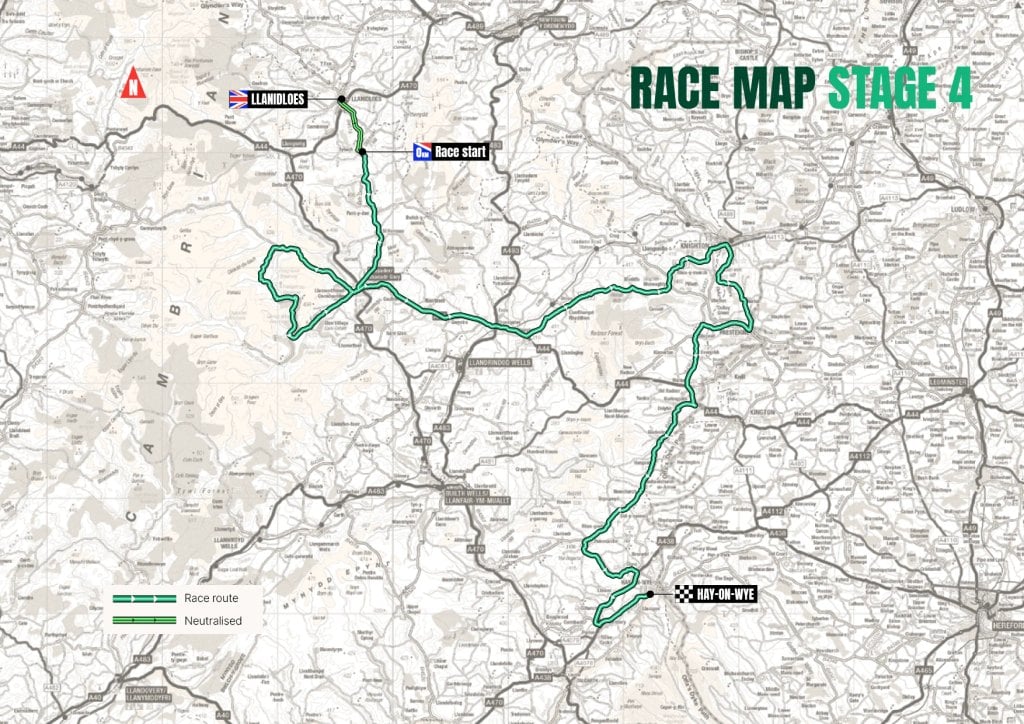
Tour of Britain Women Stage 4 route
Date: Saturday 22 August 2026
Start: Llanidloes
Finish: Hay-on-Wye
Distance: 138km
Stage type: Hilly / medium mountain
Total climbing: Around 2,400 metres
Key terrain: Elan Valley and repeated Mid Wales climbs
Final major climb: Around 16km from the finish
GC importance: Very high
The riders head south from Llanidloes towards Rhayader before entering the Elan Valley, where the first substantial climbing of the stage begins. From there, the route continues through an almost constant succession of rises and descents before eventually turning towards Hay-on-Wye.
There are three classified climbs across the stage, but the numbers alone do not explain why Saturday should be difficult. The route rarely gives the peloton a long period of genuinely flat road, and that creates repeated opportunities for teams to increase the pressure rather than waiting for one obvious decisive point.
The final significant climb comes with around 16 kilometres remaining. That makes it the most natural launch point for a late GC attack, but there is still enough road afterwards for dropped riders to return if the front group begins hesitating.
That distinction is important. On the Great Orme, losing contact meant losing time immediately. On Stage 4, a rider can be distanced briefly and still find a route back into the race.
Stage 3 has established the hierarchy
Friday provided the first proper climbing test of the Tour and confirmed Kim Le Court-Pienaar as the rider everyone now has to measure themselves against.
She had already shown strong form during the opening stages and then delivered on the Great Orme, where the short, steep climb suited her combination of climbing ability and finishing speed.
That result changes the nature of Stage 4.
Le Court-Pienaar no longer needs to attack simply to prove that she is the strongest. The riders behind her need to find a way to take time back, while she can concentrate on responding to the moves that genuinely threaten her position.
At the same time, the Great Orme did not create gaps large enough to make Saturday purely defensive. The route to Hay-on-Wye is difficult enough that one aggressive day can still overturn the classification.
The Tour of Britain Women 2026 contenders preview looked at Le Court-Pienaar as one of the riders best suited to the overall balance of the race, and Stage 3 has strengthened that case considerably.
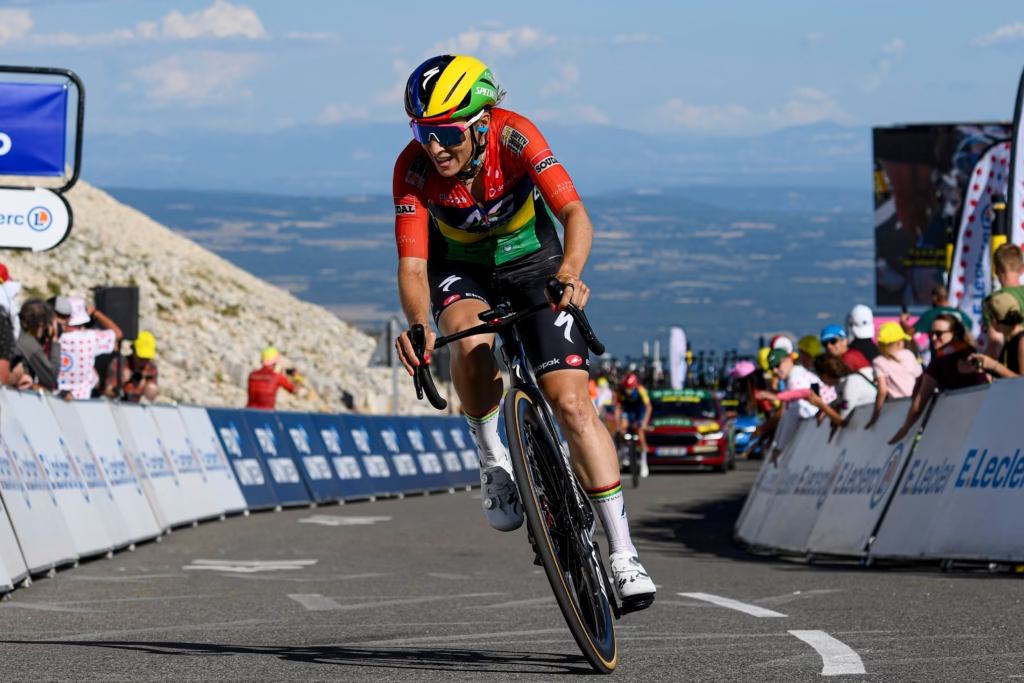
Kim Le Court-Pienaar now has the race to control
Kim Le Court-Pienaar starts Stage 4 as the central reference point.
Her Great Orme victory showed that she has the climbing form required to deal with the strongest riders on the hardest finishing terrain of the race. Stage 4 asks a different question, but one that should still suit her extremely well.
Le Court-Pienaar can climb strongly enough to survive the repeated ascents, but she also has the finishing speed to make a reduced sprint advantageous. That means she does not need to force the race from a long way out.
If the main contenders remain together over the final climb, she should still be one of the fastest riders in the group approaching Hay-on-Wye.
The challenge is deciding which attacks need to be chased.
A rider sitting several minutes down can be given freedom. A rider close enough to threaten the GC cannot.
That makes team management particularly important. AG Insurance-Soudal need to avoid spending too much energy on harmless moves while ensuring none of the genuine overall contenders gain enough time to change the race.
Lorena Wiebes can absolutely contest Stage 4
Lorena Wiebes remains one of the most important riders in the Stage 4 equation.
Her Great Orme ride was important because it demonstrated that the Welsh climbing has not removed her from the overall conversation. Stage 4 contains more total climbing, but the shape of the route may actually give Wiebes a better opportunity to remain involved.
There is no summit finish.
If Wiebes loses a small amount of ground on the final climb, there is still time for SD Worx-Protime to organise a chase on the descent and flatter run towards Hay-on-Wye.
That changes what the climbers need to achieve.
Putting ten seconds into Wiebes over the top may not be enough. They need to create a gap large enough that she cannot return, because bringing her back into the group transforms the finish completely.
If Wiebes reaches Hay-on-Wye with the leading contenders, she immediately becomes one of the strongest stage-winning options in the race.
The obvious concern is accumulated fatigue. Almost 140 kilometres of climbing and repeated attacks provide rivals with far more opportunities to test her than Friday’s short summit finish did.
But treating Wiebes simply as a rider trying to survive would now underestimate how well she has been climbing.
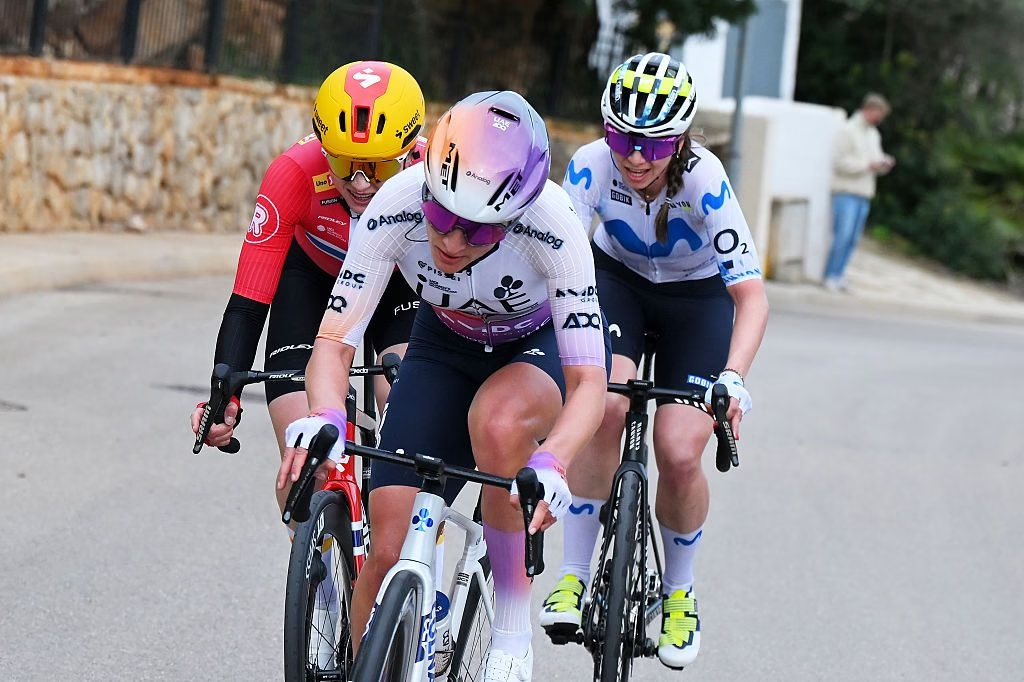
Karlijn Swinkels has the ideal consistency for this kind of stage
Karlijn Swinkels should be one of the riders most comfortable with Saturday’s more attritional profile.
She does not need one enormous acceleration to produce a strong stage race. Her value comes from surviving repeated difficult moments, positioning herself well and avoiding the single bad spell that costs significant time.
That approach should work well between Llanidloes and Hay-on-Wye.
The route is hard enough to expose weaknesses but does not contain one climb where every rider has to commit to an all-or-nothing attack.
Swinkels can therefore concentrate on remaining close to Le Court-Pienaar and allowing the riders further behind to take more of the risks.
She also has enough finishing speed to make a reduced group useful, particularly if Wiebes has been removed.
After finishing third overall in the 2025 Tour of Britain Women, Swinkels already knows how valuable consistency can be in this race. Stage 4 is exactly the type of day where that approach can move her closer to another major overall result.
Caroline Andersson could be better suited to Stage 4 than the Great Orme
Caroline Andersson deserves to be treated as one of the strongest contenders for Saturday.
The Swedish rider’s profile is better suited to a long, rolling and selective stage than to a short uphill sprint.
Stage 4 places more emphasis on endurance and repeated climbing, which should play towards her strengths.
Andersson had already been active through the opening stages and collected mountains points before the race reached Wales, showing that she has both the form and willingness to race aggressively.
Her best scenario is one where the stage becomes progressively harder and the faster riders are forced to spend energy repeatedly.
If the race is still largely together approaching the final climb, Wiebes and Le Court-Pienaar retain a significant finishing advantage.
Andersson therefore has more reason to support an aggressive race from further out.
She should be considered a genuine GC and stage threat rather than simply a wider outsider.
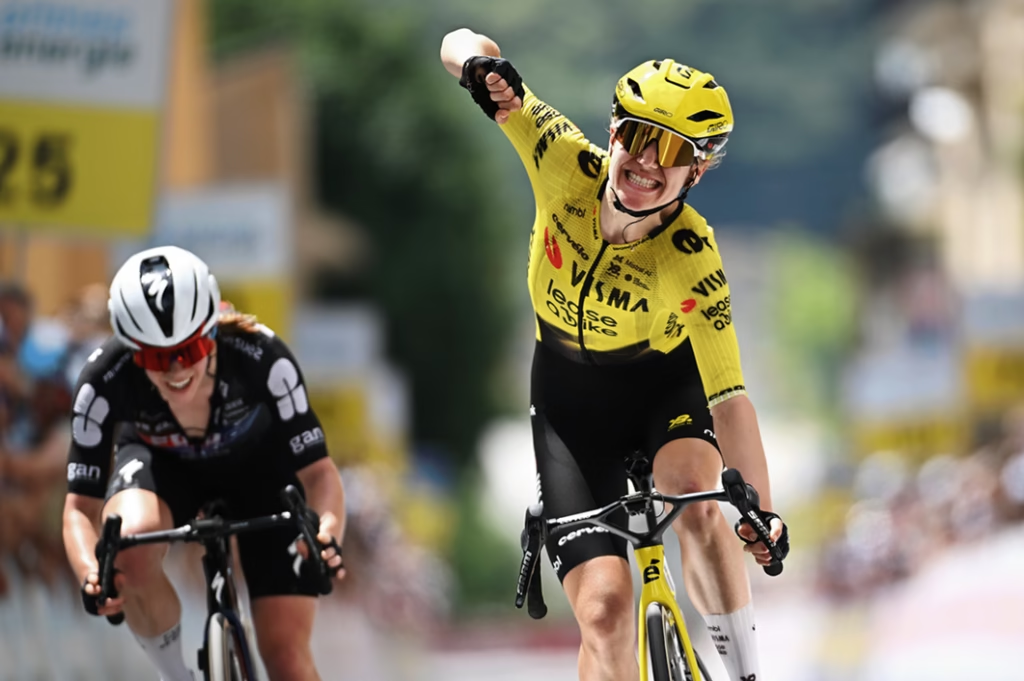
Femke de Vries should benefit if the race becomes attritional
Femke de Vries is another rider whose chances should improve as the duration of the climbing increases.
The Great Orme rewarded acceleration and punch over a relatively short effort. Saturday is more about sustaining a high level across several hours.
That distinction should suit de Vries.
Visma | Lease a Bike have little reason to make the stage conservative if de Vries remains close enough to improve her overall position. Her best route is likely to involve increasing the pressure before the final climb rather than simply waiting for a short finishing effort.
The more selective the stage becomes, the less important sprint speed will be.
That works in her favour.
If de Vries can reach the final 30 kilometres in a small group containing only the strongest climbers and all-rounders, she becomes much more dangerous than she would be in a larger finish.
Lauren Dickson is a genuine contender, not just a comeback story
Lauren Dickson should also be included among the serious Stage 4 contenders.
Her presence at the race comes after the collarbone fracture that interrupted a breakthrough 2026 season, but the performances she produced before the injury make her impossible to dismiss on terrain like this.
Dickson had already established herself as one of Britain’s strongest emerging stage racers before the crash, with results on difficult climbing terrain showing that she can compete well beyond domestic level.
The Tour of Britain is her return to racing, which means the biggest question is not whether she has the underlying climbing ability but how much race sharpness she has been able to recover.
Stage 4 should provide a better test of that than the Great Orme.
The longer distance and repeated climbing reward sustained condition rather than one short burst, while the lack of a summit finish means Dickson can race more creatively rather than simply measuring herself against the strongest riders on one final ascent.
She has already been active in the mountains classification during the opening stages, another indication that she is not here simply to ride herself back into fitness.
If her legs hold across the full 138 kilometres, she has a realistic route towards a very strong stage result.
The Elan Valley could begin the damage early
The first major climbing comes relatively early through the Elan Valley, and that could matter more than the stage profile initially suggests.
Nobody needs to attack for the overall race there.
Simply making the pace difficult can be enough.
If teams begin losing domestiques with more than 70 kilometres remaining, their leaders become much easier to isolate later.
That is particularly important for riders trying to put pressure on Wiebes or Le Court-Pienaar.
Waiting until the final climb allows the strongest teams to preserve their structure.
Racing hard earlier forces them to work.
For Andersson, de Vries and Dickson, the objective should therefore be to make the stage progressively more difficult rather than expecting one explosive move to solve the GC.
The final climb is the obvious attack point
The last significant ascent comes with roughly 16 kilometres remaining, giving the GC riders a clear opportunity to make one final selection.
By that stage, the riders will already have completed most of the day’s climbing.
That means even a relatively modest gradient can become much more damaging than it would be earlier.
A rider who attacks with tired legs around her can quickly create ten or twenty seconds.
The problem comes afterwards.
The road descends towards Hay-on-Wye and then becomes faster, giving a chasing group the opportunity to reorganise.
That makes commitment essential.
Anyone attacking over the climb needs to keep riding rather than looking behind and waiting for cooperation.
That could create one of the most interesting tactical situations of the entire race.
Wiebes changes how everyone has to approach the final climb
The presence of Wiebes near the GC battle makes the final climb particularly important.
If she is still in the group at the bottom, the climbers cannot simply hope to gain a few seconds and then relax.
They need to keep her away.
Le Court-Pienaar is also quick enough that several riders will not want to bring her to Hay-on-Wye either.
That means the likes of Andersson, de Vries and Dickson have strong incentives to attack before the finish.
Their problem is that the faster riders can afford to wait.
This tactical imbalance should drive much of Stage 4.
The riders with the best sprint want fewer attacks. The riders without that finishing speed need more.
A reduced sprint remains one of the most likely outcomes
Despite all the climbing, Stage 4 could still end with a reduced group.
The final climb is far enough from Hay-on-Wye for a small peloton to reform if the gaps are limited.
If that happens, the stage immediately swings towards Wiebes and Le Court-Pienaar.
Swinkels can also finish quickly enough to challenge, but the riders who rely primarily on climbing will have missed their main opportunity.
That is why the stage cannot simply be treated as a conventional mountain day.
The terrain is difficult enough to break the race, but the finale rewards riders who can survive and still sprint.
-
 Photo Credit: quentinphotographiebe
 -
 Photo Credit: Getty

Stage 4 is the last major opportunity to change the GC
Sunday’s final stage around Royal Leamington Spa remains demanding enough to create tactical racing, but it does not offer the same sustained climbing as Saturday.
That makes Stage 4 the final obvious chance for riders behind Le Court-Pienaar to take substantial time through terrain alone.
Anyone leaving Hay-on-Wye significantly behind will face a difficult task on the final day, particularly if Wiebes remains close enough to collect more bonus seconds.
The Tour of Britain Women 2026 route guide explains why Stage 4 was always expected to be the tactical counterpart to the Great Orme.
Friday created the hierarchy.
Saturday is the day to attack it.
Who wins Tour of Britain Women 2026 Stage 4?
Kim Le Court-Pienaar starts as the obvious reference after her Great Orme performance. She has the climbing strength to survive the hardest parts of the stage and enough speed that she does not need to manufacture a solo finish.
Lorena Wiebes should also be treated as a genuine stage-winning contender. Stage 3 showed that she can survive harder terrain than many expected, and the descent and run-in after the final climb give her a route back even if she briefly loses contact.
Karlijn Swinkels remains one of the safest all-round options and should be difficult to remove through attrition alone.
Behind them, Caroline Andersson, Femke de Vries and Lauren Dickson are particularly interesting because all three should benefit if the race becomes a sustained climbing contest rather than a controlled run towards the final 20 kilometres.
That is the central tactical battle.
Le Court-Pienaar has the GC position and the finish. Wiebes has the fastest sprint. Swinkels has consistency. Andersson, de Vries and Dickson have every reason to make the stage harder before Hay-on-Wye.
If those attacks fail to create enough separation, Wiebes could end a day containing nearly 2,500 metres of climbing as one of the favourites for the stage win. If they succeed, Stage 4 could overturn much of what the Great Orme established only 24 hours earlier.

