
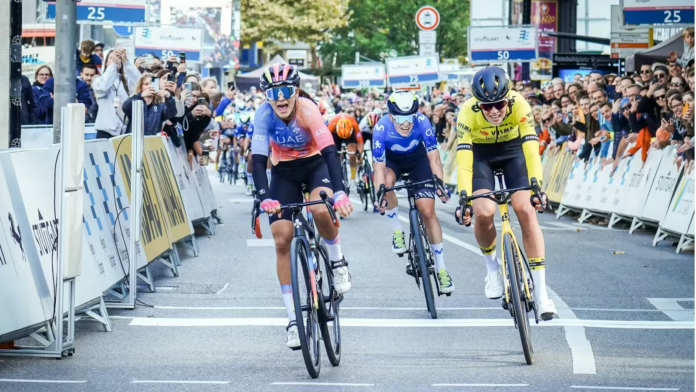
The Women’s Cycling Grand Prix Region Stuttgart has a completely new look for 2026, with Tamm hosting both the start and finish of a 134.7km route built around repeated rolling circuits through the Ludwigsburg district.
Sunday 13 September marks the fourth edition of the German Women’s ProSeries race, but the first under its revised regional format. Previous editions travelled from a different host town towards Stuttgart. This time, the race leaves Tamm, heads west through the countryside around Eberdingen and Markgröningen twice, then returns for three short finishing laps around Tamm, Asperg and Möglingen.
There is no major climb. Instead, the route contains four mountain-prize passages, constant changes of gradient and enough repetition for teams to make the second half considerably harder than the first.
The final 35.4km consists of three laps of an 11.8km circuit, giving faster riders a realistic path to victory if they survive the longer outer loops. Attackers, meanwhile, have their clearest opportunity on the second passage of the climbs before the race returns to Tamm.
For more background on the event and its change of format, our beginner’s guide to the Women’s Cycling Grand Prix Region Stuttgart 2026 covers how the race has developed since its launch in 2023.
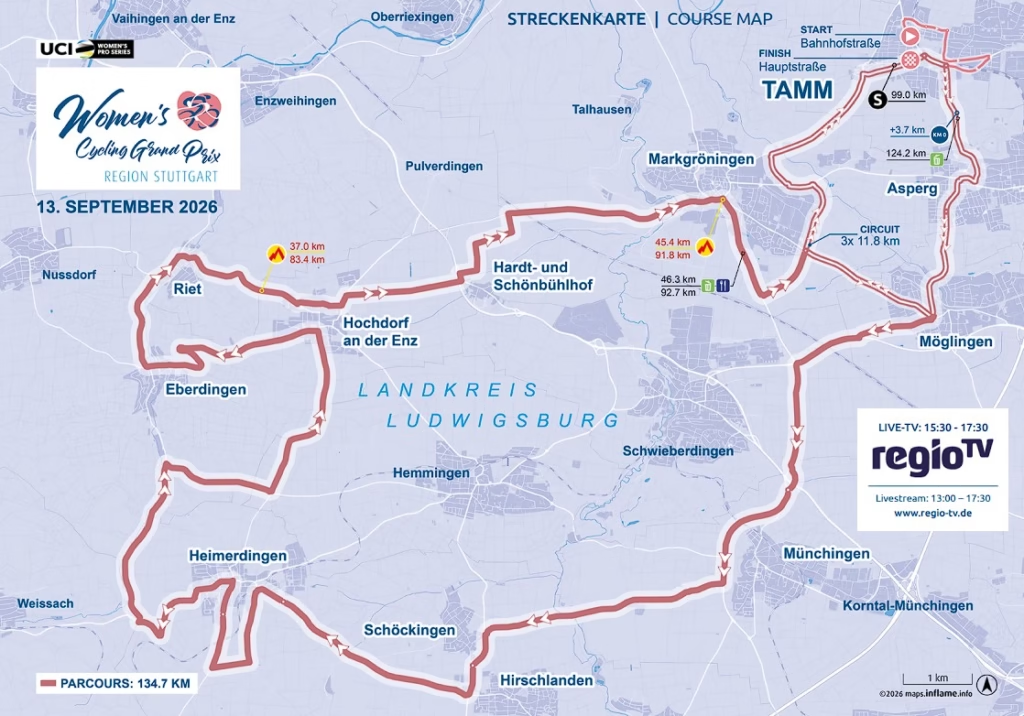
Women’s Cycling Grand Prix Region Stuttgart 2026 route at a glance
| Detail | 2026 race |
|---|---|
| Date | Sunday 13 September 2026 |
| Start | Tamm |
| Finish | Tamm |
| Distance | 134.7km |
| UCI classification | 1.Pro |
| Series | UCI Women’s ProSeries |
| Mountain prizes | Km 37.0, 45.4, 83.4 and 91.8 |
| Intermediate sprint | Km 99.0 |
| First passage of finish | Around km 99.3 |
| Final circuit | 3 x 11.8km |
| Final circuit distance | 35.4km |
| 2025 winner | Eleonora Gasparrini |
The central feature is repetition. The riders tackle almost the same major loop twice before crossing the finish line in Tamm for the first time and beginning the shorter local circuits.
That gives the route two distinct halves. The opening 99km provides the climbing and most obvious attacking terrain. Once the race reaches Tamm, the balance shifts towards riders capable of surviving those efforts and still producing speed late in the day.
Tamm becomes the centre of the race for the first time
Tamm already has a place in the short history of the event.
The inaugural Women’s Cycling Grand Prix began there in 2023, when Elena Pirrone eventually won after the race travelled into Stuttgart. Böblingen hosted the start in 2024 and Filderstadt followed in 2025.
For 2026, the old point-to-point concept has disappeared.
Tamm now hosts both ends of the professional race, with the ceremonial start on Bahnhofstraße before the riders reach the official kilometre zero outside the town. The finish is on Hauptstraße.
The change follows the restructuring that also removed Stuttgart from the race name. The event is now the Women’s Cycling Grand Prix Region Stuttgart, reflecting a model centred more clearly on the municipalities surrounding the city.
Our history of the Women’s Cycling Grand Prix Stuttgart & Region looks at that transition in more detail, including the rapid move from UCI 1.2 status in 2023 to the Women’s ProSeries a year later.
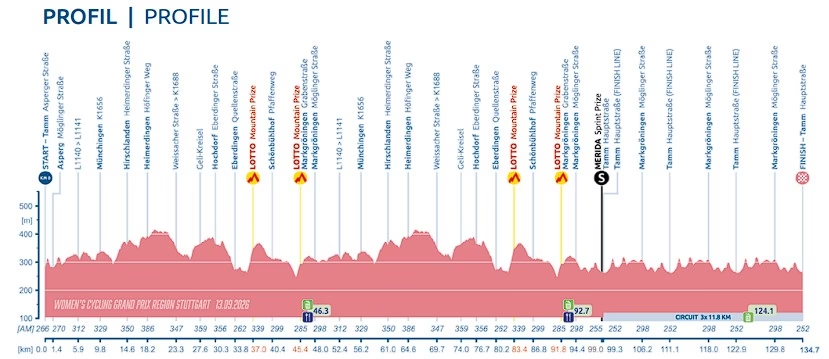
The opening kilometres favour the early break
Once the race leaves Tamm, the opening roads take the peloton through Asperg and Möglingen before turning towards Münchingen, Hirschlanden and Schöckingen.
The profile begins rolling almost immediately, but there is nothing severe enough to create an early climbing selection.
Altitude stays largely around 280 to 330 metres through the opening section, with short rises rather than sustained climbs.
That should give smaller teams an opportunity to establish an early break before the route becomes harder around Heimerdingen and Eberdingen.
For the larger teams, there is little reason to force matters immediately. With the same harder roads appearing twice and more than 130km to cover, controlling the composition of the escape should be more useful than spending riders trying to prevent one forming altogether.
The route gets harder approaching Eberdingen
The first meaningful change comes after roughly 25km.
From Heimerdingen, the race heads towards Eberdingen and onto the highest section of the outer circuit. The profile rises from below 300 metres towards approximately 400 metres as the riders move through the countryside towards Riet.
Again, there is no single long climb.
The difficulty comes from a sequence of rises with very little chance to establish a completely steady rhythm.
That distinction is important for the sprinters.
A rider who can comfortably survive one three-kilometre climb may find repeated accelerations much more expensive, particularly when teams continue pushing over the crest instead of allowing the peloton to regroup immediately.
The first mountain prize arrives at 37.0km.
It should provide an early indication of which teams intend to make the race selective, but the first passage is unlikely to be the decisive one.
Everybody knows they will return later.
Two mountain prizes complete the first major loop
After the first classified point, the road continues through the rolling section around Riet and Hochdorf an der Enz before dropping and climbing again towards Markgröningen.
The second mountain prize comes at 45.4km.
The riders then pass the feed zone at approximately kilometre 46.3 before beginning the journey back towards the roads used earlier in the race.
At this stage, the tactical value of the first loop may be greater than the physical damage.
Teams get a complete look at the important roads.
They know where the peloton stretches.
They see which corners require good positioning.
They discover whether a climb that appeared modest on the profile feels more demanding at racing speed.
Most importantly, they see which rivals are already using teammates to hold position.
All of that information becomes useful when the same section returns with around 50km remaining.
The same climbs return at 83.4km and 91.8km
The second passage is where the race should become much more serious.
The first mountain prize returns at 83.4km, exactly 46.4km after its opening appearance.
The second follows at 91.8km.
The gaps between those points are almost identical to the first lap, but the circumstances have changed completely.
There are fewer than 52km left when the riders reach the first climb and fewer than 43km remaining at the second.
Teams can afford to commit.
A rider dropped here no longer has another large regional loop in which to recover. The race is about to turn back towards Tamm and move onto the shorter finishing circuit, where organising a chase may become more difficult.
That makes the second passage through Eberdingen one of the obvious places to increase the pace.
A team with several strong all-rounders could begin applying pressure before the mountain prize, continue through the following roads and then attack again approaching Markgröningen.
It would not necessarily create a solo leader.
Reducing a peloton of 80 riders to 30 or 40 would already change the final circuits significantly.
The second Markgröningen passage is the best long-range attacking point
The mountain prize at 91.8km is probably the most interesting point on the route.
There are roughly 43km remaining, but most of the harder outer circuit is almost complete.
For riders without a strong sprint, this is the moment when the calculation changes.
Attacking much earlier requires spending a long time exposed on the larger loop. Waiting until Tamm means allowing the faster riders to reach terrain that suits them better.
A move around Markgröningen splits the difference.
There is enough remaining distance to establish a meaningful gap, but the attackers are already heading towards the finishing circuits rather than deeper into the countryside.
Teams protecting the likes of Eleonora Gasparrini or Cat Ferguson will need to be particularly alert here.
A six or eight-rider group containing several WorldTour teams can quickly become difficult to chase if everyone represented behind decides somebody else should do the work.
The race returns to Tamm after 99km
The large-loop phase effectively ends just before kilometre 100.
An intermediate sprint is positioned at 99.0km, shortly before the first passage through the finish area in Tamm at approximately 99.3km.
There are still 35.4km to race.
From here the nature of the course changes sharply.
The riders leave the wider regional roads behind and begin three laps of an 11.8km circuit through Tamm, Asperg and Möglingen.
That transition could become one of the key moments of the race.
If a strong break arrives in Tamm with 30 seconds, the peloton has enough distance to catch it but cannot afford much hesitation.
If everything is together, teams with fast finishers will suddenly find themselves in a much stronger position than they were ten kilometres earlier.
 Photo Credit: Getty
Three 11.8km circuits provide a different final test
The finishing circuit is rolling rather than genuinely hilly.
It repeatedly moves between roughly 270 and 310 metres, without anything comparable to the higher roads around Eberdingen.
That naturally brings the faster riders back into the equation.
A sprinter who survives the second outer loop no longer faces another major climbing obstacle. The remaining task becomes one of positioning, repeated acceleration and avoiding the late attacks.
That does not mean the final 35km will automatically be controlled.
The absence of one obvious climb can actually make attacks more difficult to manage. Riders can move on a short rise, through a corner or immediately after a chase has been completed.
There is no single point where a sprint team can say the danger has passed.
The first finishing lap should reveal who still has numbers
The first 11.8km circuit takes the race from roughly 35km to 23km remaining.
Teams are unlikely to commit their strongest attacks immediately unless an opportunity appears, but this lap should expose how much support the main leaders still have.
That could matter more than the attacks themselves.
If UAE Team L’IMAD reach Tamm with four riders around Gasparrini, controlling the final laps becomes realistic.
If repeated attacks on the second outer loop have left her isolated, every move becomes more dangerous.
The same calculation applies to Movistar around Ferguson and the other teams protecting riders with a fast finish.
The opening circuit is therefore likely to be about positioning and numbers as much as outright aggression.
The second finishing circuit is the danger zone
The penultimate lap should be considerably harder to control.
Anyone who does not want to sprint needs to attack before the final 11.8km becomes dominated by lead-outs.
That makes the period between roughly 23km and 12km remaining a natural attacking window.
A move here also has the advantage of uncertainty behind.
Sprint teams cannot immediately empty their entire lead-out chasing an attack with another lap still to cover. They have to decide how much energy to spend and which riders can be sacrificed.
That creates opportunities for strong Classics riders who can sustain a hard effort rather than relying on one explosive move.
An attacker does not necessarily need to reach the finish alone. Establishing a small selection can be enough to remove some of the fastest riders or leave them without teammates.
The final lap should become increasingly difficult for attackers
If a sizeable peloton begins the last 11.8km together, the balance swings towards the faster finishers.
There are still opportunities to move, but every kilometre makes the chase easier to organise.
The final approach towards Tamm is not a summit finish or a prolonged uphill drag where a climber can simply ride away. Riders attacking late need either hesitation behind or enough raw power to hold a small gap across fast roads.
That places extra importance on timing.
Going with 10km remaining could be too far.
Waiting until two kilometres to go may leave no space before the sprint trains take over.
The winner may need to recognise the brief moment when the front of the race reorganises after one attack has been caught and before the next team assumes control.
Gasparrini did exactly that in 2025.

Eleonora Gasparrini can win this race in more than one way
The defending champion has already shown why this style of race suits her.
Gasparrini won the 2024 edition from a three-rider sprint, then returned a year later and used a completely different method.
In 2025 she attacked in the closing kilometre and narrowly stayed ahead of a fast-finishing Ferguson to secure consecutive victories.
You can read the full account in our 2025 Women’s Cycling Grand Prix Stuttgart race report.
That tactical flexibility is particularly valuable on the new route.
Gasparrini can afford an aggressive second outer loop because she climbs well enough to remain with the strongest group. If a reduced bunch reaches Tamm, she still possesses enough speed to win there.
Her Eleonora Gasparrini rider profile also shows how much of her best racing has come on courses sitting between a pure sprint and a genuinely hilly Classic.
Trying for a third consecutive Stuttgart-region victory will make her an obvious reference point for everyone else.
Cat Ferguson should also prefer the new finale
Ferguson came within metres of catching Gasparrini in Stuttgart last year and returns to a route that should suit her particularly well.
The second passage through the longer circuit is hard enough to reduce the field without containing a climb that should put her under serious pressure.
If she reaches Tamm in the main selection, the final 35km gives her several options.
Movistar can ride for a sprint.
Ferguson can respond to attacks herself.
Or she can use her speed if a smaller group emerges on the penultimate circuit.
Her presence also changes the tactical problem for Gasparrini. Neither rider necessarily wants to arrive at the finish having done all of the chasing for the other.
That can open the door for attacks from riders willing to move earlier.
-
 Photo Credit: Getty

What type of rider suits the 2026 Stuttgart route?
The final course is best suited to a fast all-rounder rather than either extreme.
Pure climbers have no long ascent on which to make their biggest advantage count.
Pure sprinters need to survive four classified climbing passages and a second outer loop that can be raced very aggressively.
The ideal rider sits between those groups: strong enough to stay near the front through repeated short climbs, quick enough to win from a reduced bunch and comfortable responding to attacks rather than relying on a completely controlled lead-out.
That rider profile has already defined the race’s short history.
Elena Pirrone won the inaugural edition after an attacking race. Gasparrini has followed with victories from both a small-group sprint and a late attack.
The 2026 route gives similar riders several ways to win again.
Where will the Women’s Cycling GP Stuttgart & Region 2026 be decided?
The most important section should begin with the second mountain-prize passage at 83.4km.
That is where teams trying to distance the faster riders can start making the race genuinely selective.
The following mountain prize at 91.8km is the clearest point for a longer-range attack. From there, the riders are heading back towards Tamm and the harder part of the regional loop is effectively behind them.
If the race is together after the first local circuit, attention shifts to the penultimate 11.8km lap. Riders without a strong sprint need to use it rather than allowing the major teams to organise themselves for the final passage.
If a reduced peloton is still intact when the bell rings, Gasparrini, Ferguson and the other faster finishers should have the advantage.
The route does not contain one landmark climb that tells everyone when to attack. Its difficulty comes from asking that question repeatedly.
The first outer loop gives teams information.
The second gives them the opportunity to use it.
The final three laps decide whether the damage was enough.

