
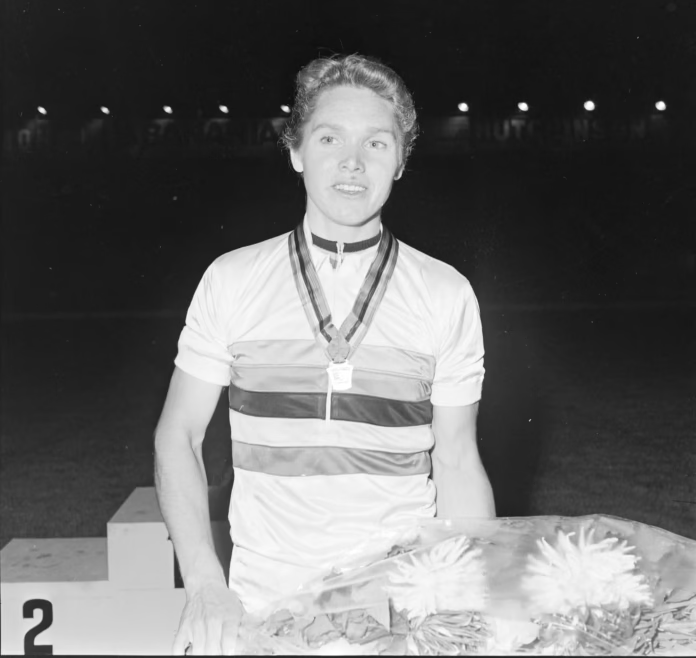
Yvonne Reynders did not build a modern, media-friendly legend. She built a hard one, forged in an era when women’s cycling asked for far more resilience than recognition. Seven world titles across road and track, a stack of major championship medals and a career that stretched across the rough, underwritten years of post-war racing should place her much higher in the sport’s memory than she usually sits.
She was not a footnote to somebody else’s story. She was one of the riders defining the shape of women’s competition across the late 1950s and 1960s, winning on roads and tracks that were often indifferent, exposed and brutally honest about form.
Belgium gave her the kind of racing culture that strips cycling down to essentials. Wind off open fields, narrow lanes, hard roads, and a national instinct for toughness before presentation. Reynders thrived in that world. She was elegant on a bike, but not decorative. Her victories came from reading races quickly, staying composed in the churn of positioning and then riding with enough authority to make the final answer blunt.
In the wider women’s cycling history, she deserves to stand among the essential names rather than the optional ones. Her record is exceptional. Her influence is larger than the trophy cabinet suggests.
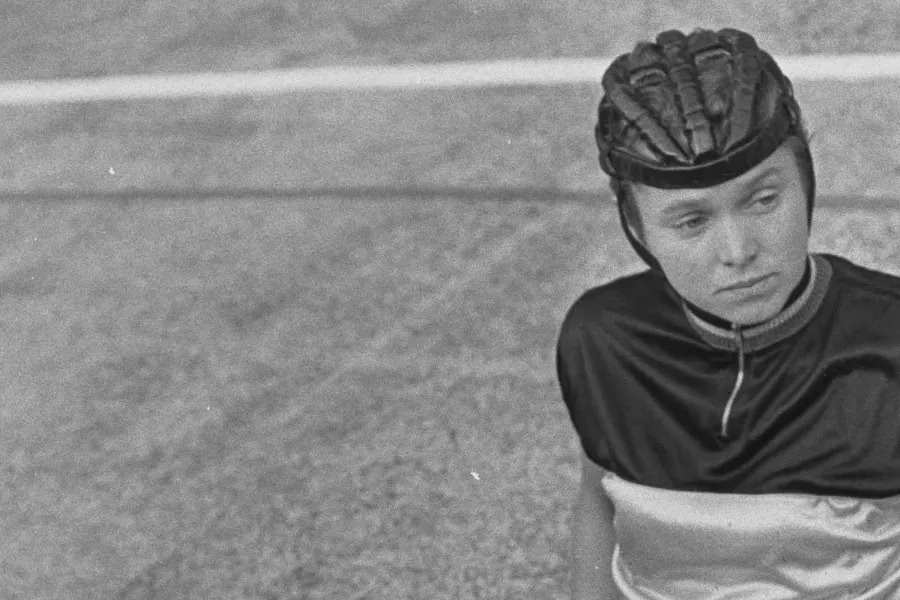
A champion from the heart of Belgian racing
Yvonne Reynders was born in Schaerbeek, Belgium, on the 4th August 1937, but her story quickly became tied to the kind of working, practical cycling life that shaped so many riders before modern development pathways existed. Before she became a world champion, she had been an athlete, a worker, and someone whose strength was built in the ordinary demands of daily effort rather than in a polished sporting system.
That background matters. Women’s racing in her era was still fighting for structure, calendar consistency and public attention. The best riders had to create their own momentum within a limited system. Reynders did exactly that, becoming one of the most successful figures in the sport at a time when the margins were thin and the opportunities narrower still.
Belgium’s racing landscape was not confined to a few celebrated climbs or headline monuments. It lived in parish roads, industrial outskirts, and long stretches of exposed tarmac where a rider had to make the most of every small advantage. That environment shaped her style. She was alert, efficient and hard to dislodge once she had found a rhythm.
The later Belgian tradition, from Reynders through to modern names such as Jolien d’Hoore and Lotte Kopecky, has often been built around the same basic qualities: positioning, timing, toughness and an instinct for races that do not unfold politely.
How she raced
Reynders was not a rider who seemed to need drama to win. The race was enough. Her strength lay in judgement, in knowing when to follow and when to force the issue.
On flat roads she had the steadiness to absorb speed and stay present when others were stretched. In attritional championship races, where repeated surges could wear down the field, she was often the one still looking settled when the final laps arrived. On the track, she had the discipline and controlled force needed to turn pursuit racing into something precise rather than frantic.
Her career belonged to an age before live coverage could frame a personality every week, but the results tell you about the rider well enough: composed, durable, difficult to shake, and capable of delivering on the biggest days.
That is why she belongs naturally alongside the riders gathered in ProCyclingUK’s women’s cycling rider history archive. The modern sport is easier to understand when its earlier champions are treated as central figures rather than historical decoration.
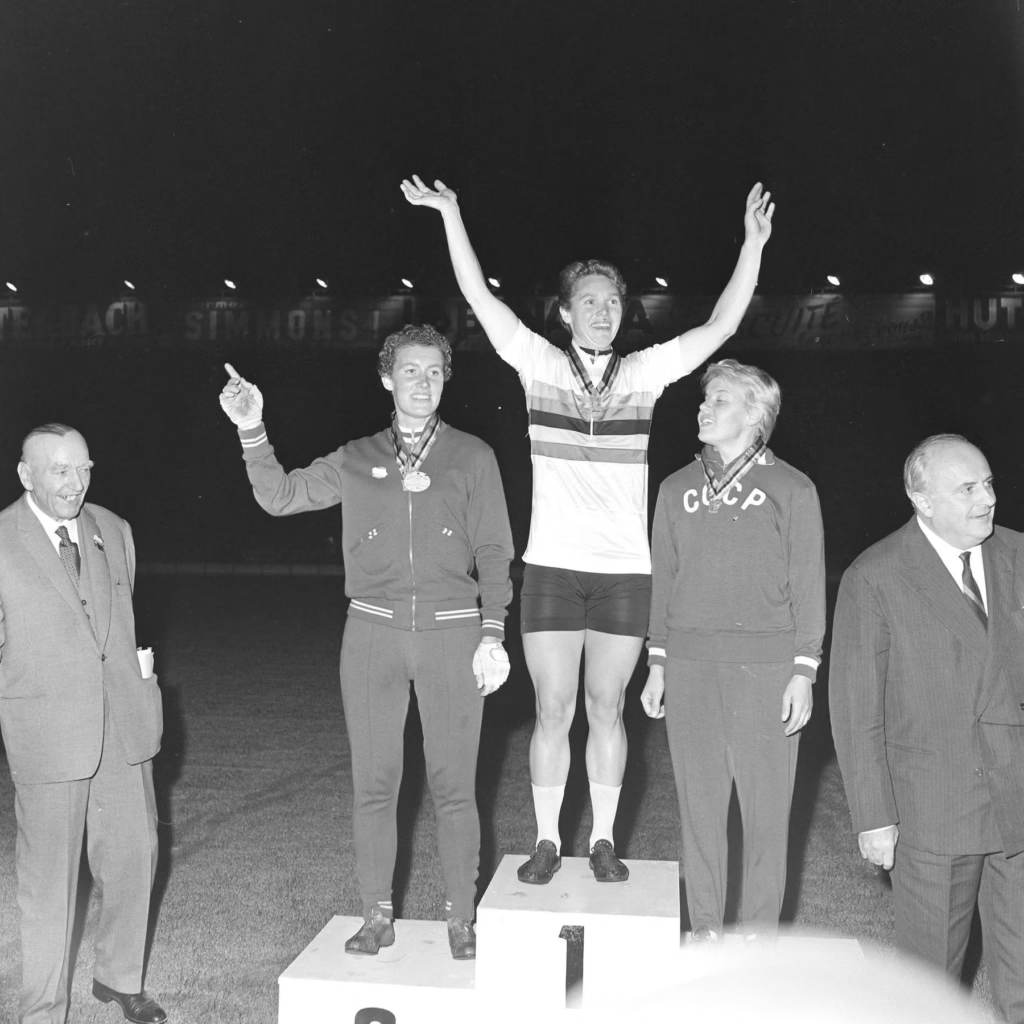
The results that built the reputation of Yvonne Reynders
Reynders’ reputation was built on a record that still stands out across women’s cycling history. Her biggest victories came on both road and track, giving her a breadth that few riders of any era can match.
- World road race champion: 1959, 1961, 1963, 1966
- World individual pursuit champion: 1961, 1964, 1965
Seven world titles across road and track
Reynders won seven world titles, a figure that should immediately place her in the higher echelons of the sport’s all-time champions. Four came on the road, in 1959, 1961, 1963 and 1966. Three came on the track in the individual pursuit, in 1961, 1964 and 1965.
These were not accidental successes or isolated bursts. They came across several years, signalling a rider who could return to peak condition again and again, and who understood how to target championship formats on very different terrain.
That breadth matters. Some champions are road specialists. Others are built for the track. Reynders bridged both. The same competitive intelligence that made her such a threat in a road world championship also translated to the track, where rhythm, discipline and mental control could be just as decisive as a finishing kick.
Her road titles place her firmly inside the deeper story of the road cycling world championships. The women’s road race only began in 1958, and Reynders became one of the event’s first great repeat winners. That gives her a foundational status that should not be overlooked.
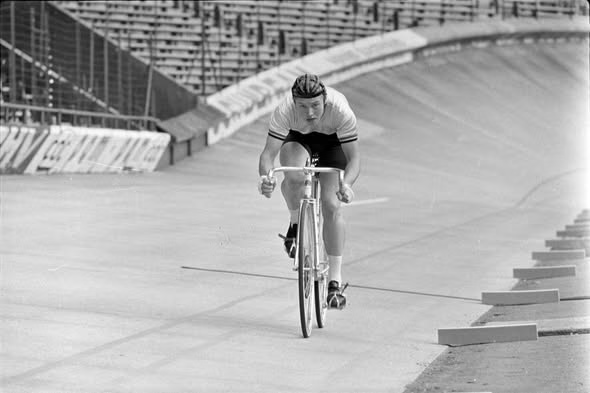
Belgian championships and domestic dominance
Belgium’s national scene was fiercely competitive, and Reynders won multiple Belgian titles on top of her world victories. Domestic wins mattered because they were often contested on familiar, searching roads where there was nowhere to hide. The same fields, the same winds, the same hard little rises would come back race after race. To keep winning there required more than a single peak season.
She also won across a long stretch of the 1950s and 1960s, which is a clue to her standing beyond any one championship day. Longevity in cycling is often underappreciated when the sport’s memory narrows to a handful of famous images. Reynders had real staying power.
Her name still carries enough meaning in Belgian cycling that the modern Grote Prijs Yvonne Reynders keeps her legacy visible on the calendar. Recent editions, including Scarlett Souren’s 2024 victory and Eline van Rooijen’s earlier win, show how her name still sits within the living fabric of women’s racing.
A career of more than headline numbers
Not every important rider can be captured neatly by one iconic victory. Reynders’ significance is broader. She was a persistent presence in the results, part of the racing fabric inseparable from the era’s strongest women. Her career helped normalise the idea that women’s road and track racing could have depth, regularity and stars capable of sustained excellence.
The comparison with Beryl Burton is unavoidable, and useful. Burton and Reynders were different riders from different racing cultures, but both belonged to a generation that had to make greatness visible through results rather than through a professional structure built to elevate them. Burton’s British dominance and Reynders’ Belgian championship presence both show how much women’s cycling relied on self-made champions before the sport properly caught up with them.
That is also why Reynders should be discussed alongside later figures such as Jeannie Longo and Marianne Vos. The eras are different, but the connection is clear: riders who won across formats, across years, and across changing versions of women’s cycling.
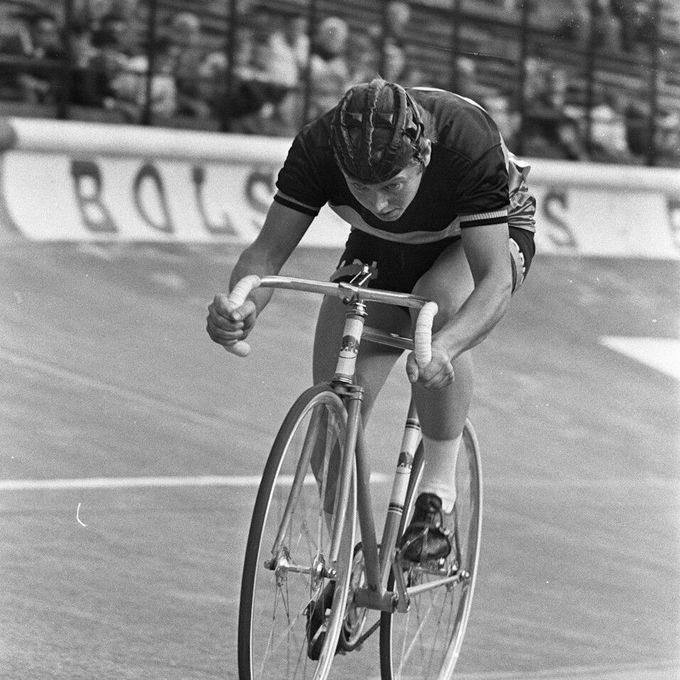 Photo Credit: Ron Kroon/Anefo
Why Yvonne Reynders sits too low in cycling history
There is a tendency in sports memory to privilege the recent, the televised and the easy to package. Riders from the pre-modern era often get flattened into statistics, if they are remembered at all. Yvonne Reynders suffers from that. The number of her world titles is known among specialists, but she is rarely treated as the towering figure that tally implies.
She belongs in the company of the foundational names of women’s cycling because she was one of the few who repeatedly converted opportunity into result at the very top level. When a rider wins seven world titles across road and track, there is no need to dilute the achievement with qualifiers. That is a record of real consequence. It suggests authority over an era, not just occasional superiority.
There is also the quiet difficulty of measuring her against race conditions that were unlike those of today. Equipment, support, race calendars and broader professional structures were all developing unevenly. To keep winning under those circumstances required self-reliance. Yvonne Reynders’ achievements were built without the institutional backup modern champions take for granted.
That is a theme that runs throughout women’s cycling’s history, from early world championship racing to the struggles that later shaped the modern calendar, including the long road towards races such as the Tour de France Femmes gaining the visibility they deserved.
The roads and races that shaped Yvonne Reynders
Reynders’ racing world was one of changing surfaces, modest logistics and intense local loyalties. Belgian roads in particular produced the sort of racing that asks for patience as much as power. A rider could spend half a day near the front without ever feeling safe. The road might seem straight, but a breeze across open land or a sudden bend through a village could change the entire mood of the race.
That kind of environment rewards riders who are mentally tidy. Reynders appears to have been exactly that sort of racer. She knew how to stay in the race before trying to win it. In championship events especially, that quality matters. The first attack is not always the one that counts. The winning move is often simply the one made by the rider most prepared to keep rolling uncertainty under control.
Her track success adds another layer. The individual pursuit demands a different kind of certainty, a controlled private argument with the clock and the opponent. In that sense, Reynders also fits into the broader history of women’s endurance racing against time, the same tradition that makes the women’s hour record such an important reference point in understanding the sport’s development.
Character, presence and racing temperament
Accounts of Reynders tend to emphasise results, which is understandable, but there is a sense of a rider with a very clear inward discipline. She did not need a theatrical style to command respect. The repeated success suggests focus, and perhaps a certain economy of emotion. In an era when women were too often framed through novelty rather than performance, that directness was its own kind of statement.
She raced with the authority of someone who expected to be at the centre of things. Not loudly. Just steadily, repeatedly, and with the confidence that if the race became selective enough, she would still be there when it mattered.
That matters when placing her in cycling history. The easiest legends are often the loudest or the most photographed. Reynders’ greatness is quieter, but not smaller. It sits in the relentlessness of the record and in the way she kept returning to the highest level.
-
 Photo Credit: quentinphotographiebe
 -
 Photo Credit: Getty
Life after racing
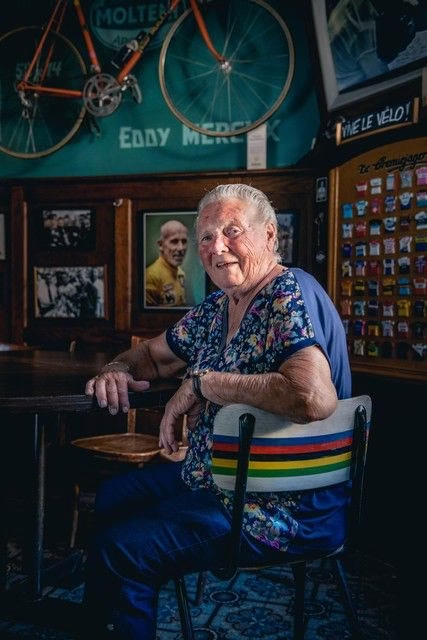
After her racing career, Yvonne Reynders stepped away from the elite road scene and has lived largely outside the modern glare that surrounds contemporary cycling figures. Like many champions of her generation, she did not move into a prolonged public role in the sport. Her legacy therefore comes mainly through the results themselves and through the gradual work of historians, race organisers and fans rebuilding women’s racing’s early archive.
That relative quiet is part of why she deserves renewed attention now. Riders like Reynders should not have to rely on memory alone. Their careers ought to sit visibly in the sport’s history, where they can be read alongside later generations rather than hidden behind them.
The presence of a modern race bearing her name helps, but it should not be the only way her story is encountered. Reynders deserves to be remembered as one of the major champions who helped establish what elite women’s cycling could look like.
Why Yvonne Reynders is worth your attention now
Yvonne Reynders is worth noting because her career contains a rare combination of longevity, breadth and repeated championship victory. Seven world titles is not a peripheral achievement. It is the kind of record that should force a reordering of any serious list of women’s road and track racing greats.
She was dominant in an era when that word carried real weight, because the sport asked riders to earn everything the hard way. Her road wins helped shape the early years of the women’s world championship. Yvonne Reynders’ track titles showed that her ability was not confined to one discipline. Her Belgian success placed her within one of cycling’s hardest racing cultures.
Her story also has a valuable simplicity. A Belgian rider, shaped by serious roads and serious racing, who kept winning at the very highest level. No need to inflate it. The achievement stands on its own.
Reynders should be remembered not as an early curiosity, but as a major champion whose place in cycling history ought to be much higher.
And it is the more striking for being so understated. The roads do not flatter anyone for long. Reynders kept making them answer to her.

