
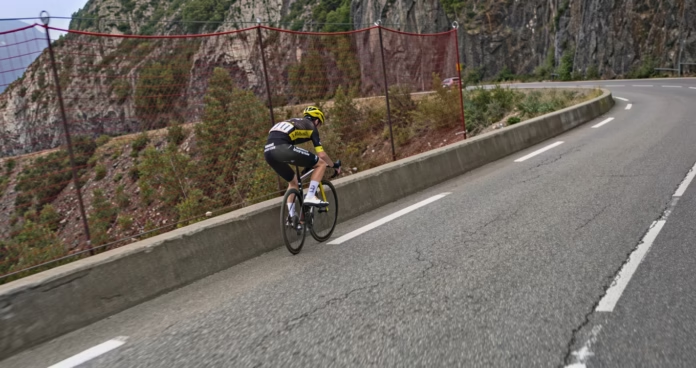
Sepp Kuss somehow escaped a frightening second crash on the descent from the Col de Sarenne, but the two incidents in quick succession effectively ended his chance of winning Stage 20 of the 2026 Tour de France.
The American had ridden away from Richard Carapaz and was alone at the front of the race on the descent towards Alpe d’Huez when his advantage began to unravel.
Kuss crashed once, recovered and continued.
Then, with around 5.8km remaining, he ran wide on another bend, struck the roadside barrier and was thrown towards the outside of the mountain road.
The safety protection prevented the incident from becoming considerably worse.
Kuss was able to remount, but the crashes allowed Carapaz back ahead and turned what had looked like a genuine stage-winning opportunity into a chase.
Kuss had dropped Carapaz before the crashes
What makes the sequence particularly frustrating is that Kuss had already done the difficult part.
He had spent much of the day in the decisive breakaway with Carapaz on the hardest mountain stage of the 2026 Tour.
The route contained 170.9km and 5,450 metres of climbing across the Croix de Fer, Télégraphe, Galibier and Sarenne before the finish at Alpe d’Huez.
Kuss survived all of it.
More importantly, he eventually managed to create separation from Carapaz.
The American moved ahead before the decisive descent and briefly found himself alone in the position every breakaway rider wants to occupy late in a mountain stage.
There was nobody left to follow.
Carapaz was behind.
The stage was there to be won.
Two crashes changed the race
Instead, the descent from Sarenne became decisive.
Kuss came down for the first time but was able to recover quickly enough to remain in contention.
The second incident was much more dramatic.
With approximately 5.8km remaining, Kuss carried too much speed into a bend and ran towards the outside of the road.
His bike hit the roadside protection and lifted beneath him, while Kuss was thrown towards the barrier.
For a moment, the television pictures made the crash look potentially much more serious than a lost stage win.
The protection caught him.
Kuss got himself upright and was quickly trying to continue.
Sportingly, though, the damage had already been done.
Carapaz went from chasing Kuss to leading the race
Before the crashes, Carapaz had been behind.
After them, the entire situation reversed.
Kuss lost momentum twice while Carapaz continued at racing speed.
At this level, even a relatively minor interruption on a descent can cost enough time to completely change a stage.
Two crashes made recovering much harder.
Carapaz had spent the day riding aggressively for the mountains classification and had already mathematically secured the polka dot jersey after taking maximum points on the Croix de Fer, Télégraphe and Galibier.
That story is covered in full in our Richard Carapaz polka dot jersey update.
Once Kuss hit the ground, Carapaz suddenly had another target.
A stage victory.
Kuss had been building towards this opportunity
There was nothing accidental about Kuss being at the front.
With Jonas Vingegaard gone, Visma | Lease a Bike had changed its entire approach to the final week.
Vingegaard abandoned the Tour after crashing on Stage 15, removing the team’s yellow jersey objective and freeing riders such as Kuss to target stages rather than spend their energy protecting a GC leader.
The tactical consequences were immediate.
Our analysis of Vingegaard’s withdrawal highlighted Kuss as one of the Visma riders likely to receive greater freedom in the mountains.
That is exactly what happened.
He was already prominent on Stage 19 at Alpe d’Huez and returned to the breakaway on Stage 20, a route much better suited to his ability to sustain long climbing efforts.
It would have been Visma’s first individual stage win
A Kuss victory would not have been Visma | Lease a Bike’s first stage win of the 2026 Tour.
That distinction belongs to Stage 1 in Barcelona, when Visma won the team time trial and Jonas Vingegaard took the first yellow jersey of the race. The official Tour result confirms that the team collectively won the stage.
Kuss would, however, have delivered Visma’s first individual stage victory of the 2026 Tour.
That would have carried particular significance after Vingegaard’s withdrawal.
The team arrived at the Tour with overall victory as its central objective and opened the race perfectly in Barcelona.
By the final week, the entire project had changed.
A Kuss win on the queen stage would have given Visma a major individual victory to take from a Tour that had otherwise unravelled around its GC leader.
Why Stage 20 suited Kuss better
The route was almost tailor-made for the type of effort Kuss prefers.
The Stage 20 live guide laid out just how extreme the day was: 5,450 metres of climbing, three hors catégorie ascents, the Category 1 Télégraphe and the technical descent after Sarenne.
Unlike the shorter Stage 19, there was less emphasis on repeated explosive accelerations and more on surviving hours of climbing.
That suits Kuss.
He has built much of his career around long mountain efforts and sustained tempo rather than short, violent changes of pace.
Stage 20 gave him the terrain to use that strength.
His legs put him in position to win.
The descent took that opportunity away.

The save mattered more than the lost time
The immediate sporting story is that Kuss lost a potential Stage 20 victory.
The more important point is how much worse the second crash could have been.
The Sarenne descent was always one of the most technically important parts of the 2026 Tour’s final Alpine showdown.
Kuss’s second fall demonstrated why. He reached the outside of the road with enough force for the bike to strike the barrier and his body to be thrown sideways.
Without the roadside protection, the consequences could have been far more serious.
Instead, he got up.
He remounted.
And he continued towards Alpe d’Huez.
A brutal end to Kuss’s stage-winning chance
Kuss had crossed the biggest mountains of the stage, dropped Carapaz and reached the final descent alone at the front.
For a few kilometres, Visma’s first individual stage win of the Tour looked genuinely possible.
Then came two crashes in rapid succession.
The second, with 5.8km remaining, was the one that provided the most frightening images and effectively ended his advantage.
For Kuss, there will inevitably be frustration at what might have been.
But given how close the second incident came to becoming something much more serious, reaching Alpe d’Huez safely may ultimately matter more than the stage result.

