
The GP Lucien Van Impe is one of the youngest races on the international women’s calendar, but the cycling history behind its name stretches back much further.
Held around Erpe-Mere in East Flanders, the race honours Lucien Van Impe, Belgium’s 1976 Tour de France winner and one of the greatest climbers in the history of the race. The current women’s event only joined the UCI calendar in 2024, but it developed out of a much older local racing tradition and has progressed rapidly, moving from national level to UCI 1.Pro status for 2026.
That rapid promotion has turned what was recently a relatively small Belgian summer race into an increasingly important part of the late-season women’s calendar. Our beginner’s guide to GP Lucien Van Impe 2026 covers the current route, race format and contenders, but its short modern history is already developing quickly.

The race is named after Belgium’s last male Tour de France winner
Lucien Van Impe was born in Mere in 1946 and remains one of the region’s most important cycling figures.
His career was built around climbing. Van Impe won the 1976 Tour de France, defeating Joop Zoetemelk, and claimed the Tour’s mountains classification six times between 1971 and 1983. That combination of an overall Tour victory and repeated success in the high mountains made him one of the defining climbers of his generation.
His place among the Tour’s best climbers is explored in our ranking of the greatest Tour de France climbers, where Van Impe’s longevity in the mountains places him alongside Federico Bahamontes among the race’s most enduring climbing specialists.
For Belgium, his 1976 victory carries another historical distinction. No Belgian man has won the Tour de France since, a run now stretching across half a century. Van Impe therefore remains the country’s most recent Tour winner, something clearly visible in our complete Tour de France winners list.
That gives his name particular resonance around Erpe-Mere.
The women’s race has much older local roots
The current women’s GP Lucien Van Impe is a relatively recent addition to the international calendar, but bike racing around Erpe-Mere predates it by decades.
A men’s race was held in the area for much of the 20th century and eventually became associated with Van Impe, maintaining the local connection between professional cycling and one of the municipality’s most famous riders.
The modern women’s event developed from that tradition rather than appearing as an entirely new race. An early women’s precursor was held in 2022 under the GP Kevin Van Impe name before the event adopted Lucien Van Impe’s name from 2023.
The first edition under that identity was still a Belgian national-level race rather than a UCI event.
Katrijn De Clercq wins the first women’s GP Lucien Van Impe
Katrijn De Clercq won the first women’s edition under the GP Lucien Van Impe name in 2023.
That race sits slightly outside the event’s international record because it was not yet part of the UCI calendar, but it remains the natural starting point for the modern women’s history.
The following season brought the change which established the race internationally.
GP Lucien Van Impe was upgraded to UCI 1.2 level for 2024, opening the event to a broader professional field and giving it a formal place on the international road calendar.

Evy Kuijpers takes the first UCI victory in 2024
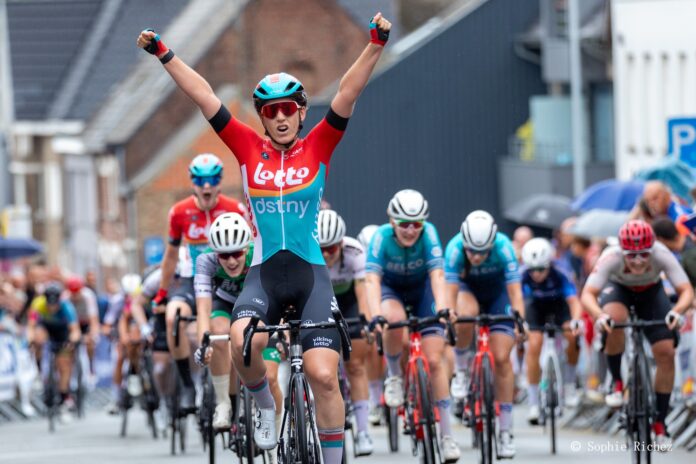
The first UCI edition produced a significant breakthrough for Evy Kuijpers.
After 140.7km of racing around Erpe-Mere, Kuijpers reached the finish with Anastasiya Kolesava and won the two-rider sprint to take the biggest victory of her career at that point.
ProCyclingUK’s 2024 GP Lucien Van Impe race report covered a win which was important both for Kuijpers and for the event itself. It gave the new international race an immediate storyline and provided proof that the jump to UCI level could attract a stronger professional field.
Kuijpers’ victory also established the type of racing the event could produce. Despite carrying the name of one of cycling’s great climbers, this was not a race decided by anything resembling an Alpine ascent. The rolling Flemish roads instead created a selective tactical contest where positioning, repeated short climbs and the ability to finish quickly after a hard race all mattered.
Lorena Wiebes gives the race its first superstar winner
The next step came almost immediately.
For 2025, the GP Lucien Van Impe was upgraded again, this time from 1.2 to UCI 1.1 status.
The stronger classification was matched by a much bigger-name winner.
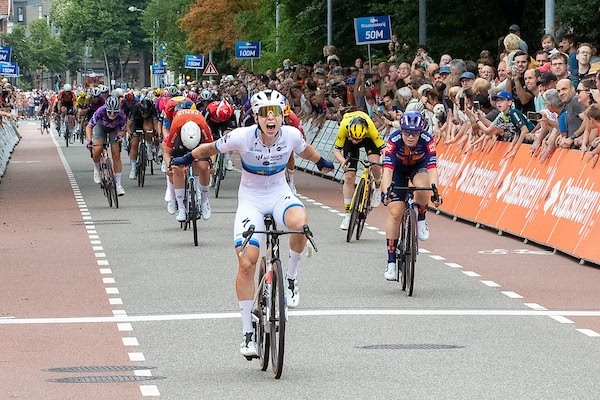
Lorena Wiebes arrived as the obvious sprint favourite and delivered in Erpe-Mere, beating Susanne Andersen and Shari Bossuyt. It was already her 17th victory of the 2025 season and gave the GP Lucien Van Impe its first winner from the very top level of the women’s peloton.
Our 2025 GP Lucien Van Impe race report covered how Wiebes survived the harder sections before using her speed in the finish.
That result was another important step for the race. Kuijpers had used the 2024 edition for a career breakthrough, while Wiebes arrived a year later as one of the most successful riders in the world and treated the event as another meaningful target.
A race named after a climber that does not necessarily suit climbers
There is a useful contradiction at the heart of the GP Lucien Van Impe.
Van Impe’s reputation was built on the high mountains of the Tour de France, yet his namesake race takes place on the short, rolling roads of East Flanders.
The parcours around Erpe-Mere typically mixes flatter roads with repeated short climbs rather than sustained mountain passes. That makes the race much more Flemish in character than the name might initially suggest.
A pure climber does not necessarily have an advantage. Instead, the race rewards riders who can handle repeated changes of pace, positioning battles and short ascents before still having enough speed for the finish.
The first two UCI editions demonstrated that range particularly well. Kuijpers won from a two-rider move in 2024, while Wiebes showed in 2025 that the world’s fastest sprinter could still survive the selective sections and contest victory.
That unpredictability is becoming part of the event’s identity.

2026 brings promotion to the Women’s ProSeries
The biggest step in the GP Lucien Van Impe’s development arrives in 2026.
After one year at 1.2 level and one at 1.1, the race has been promoted again to 1.Pro status, placing it in the Women’s ProSeries immediately below the Women’s WorldTour.
The rise has been remarkably fast:
| Year | Status | Winner |
|---|---|---|
| 2023 | National race | Katrijn De Clercq |
| 2024 | UCI 1.2 | Evy Kuijpers |
| 2025 | UCI 1.1 | Lorena Wiebes |
| 2026 | UCI 1.Pro | To be decided |
Within only a few seasons, the women’s event has moved from a regional Belgian race to one of the higher-ranked one-day events outside the WorldTour.
That progression is one of the main reasons the 2026 edition is worth watching. The stronger classification should improve the depth of the field again and gives teams another valuable late-summer opportunity for UCI points and a high-level result.



The race has grown quickly without losing its local identity
One of the strengths of GP Lucien Van Impe is that its international growth has not required it to abandon what made the race distinctive in the first place.
Erpe-Mere remains central to the event. Van Impe’s connection to the area gives the race an obvious historical identity, while the rolling roads ensure it still feels recognisably Belgian rather than becoming a generic one-day event simply because its UCI classification has increased.
That combination is valuable for a young women’s race.
New events often need several years to establish why they matter and what sort of racing people should expect. GP Lucien Van Impe has been able to borrow part of that identity from the cycling history already attached to its name and location.
The winners have helped as well. De Clercq supplied the national beginning, Kuijpers produced the first international breakthrough and Wiebes gave the event a genuinely high-profile champion.
Why GP Lucien Van Impe matters
The race does not yet have the history or prestige of Belgium’s established spring Classics, and there is little value in pretending otherwise.
What it does have is momentum.
The women’s event has progressed from national status to the ProSeries in only three years, while retaining a clear link to one of Belgium’s most celebrated Tour de France riders. That makes it a good example of how quickly the depth of the women’s calendar has developed.
It also occupies a useful place in the season. By August, many of the biggest stage races are complete and teams have more freedom to give opportunities to riders who spent the summer working for others or who are chasing late-season results and UCI points.
For 2026, the main historical question is therefore no longer whether GP Lucien Van Impe can establish itself as an international race. It has already done that.
The next stage is whether its new ProSeries status can turn a rapidly growing Belgian event into a permanent fixture immediately below the Women’s WorldTour.

