

The 2026 Tour de France Femmes had barely finished in Nice before attention could begin shifting towards something completely different.
In 2027, the world’s biggest women’s stage race comes to Britain.
The Tour de France Femmes 2027 begins in Leeds on Friday 30 July, before crossing the Pennines to Manchester, returning through the Peak District to Sheffield and then moving south for a historic team time trial through London.
It will be the first time the modern Tour de France Femmes has raced in Britain and the third foreign Grand Départ after the Netherlands in 2024 and Switzerland in 2026. Britain will also become the first country outside France to host the men’s and women’s Grand Départs in the same year.
More importantly, this is not simply a ceremonial opening weekend.
Stage 1 is unusually short and contains several climbs. Stage 2 has almost 3,000 metres of ascent through the Peak District. Stage 3 then introduces the first team time trial in the history of the modern Tour de France Femmes.
After a 2026 Tour that changed shape repeatedly, the message for 2027 is already obvious: the GC favourites cannot afford to wait until France before taking the race seriously.
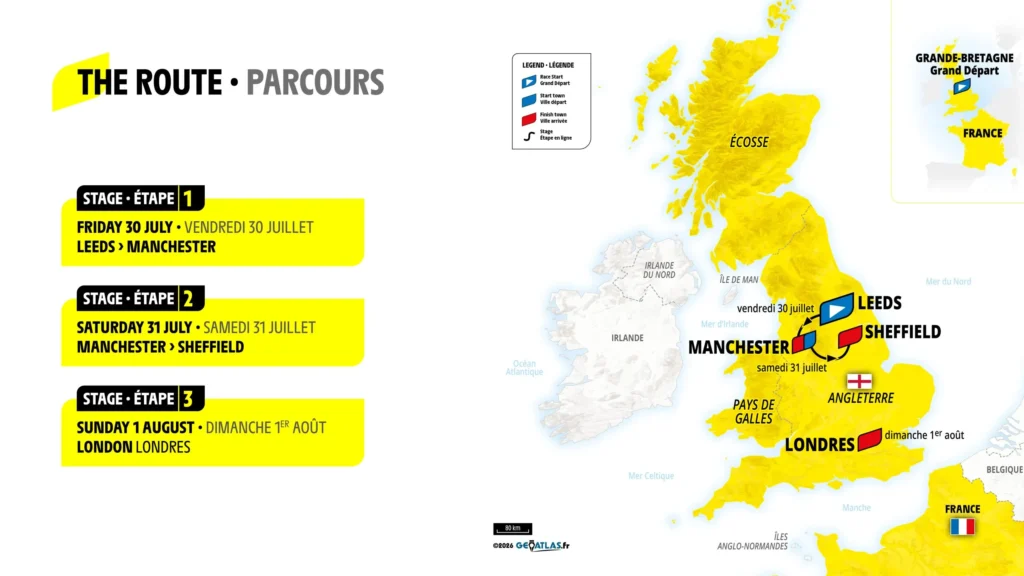
Tour de France Femmes 2027 UK stages at a glance
| Date | Stage | Route | Key detail |
|---|---|---|---|
| 30 July | Stage 1 | Leeds to Manchester | 85.7km, short and hilly |
| 31 July | Stage 2 | Manchester to Sheffield | 154.4km, almost 3,000m climbing |
| 1 August | Stage 3 | London | Approx. 18km team time trial |
| 2-7 August | Remaining Tour | TBC | Full route to be announced |
The complete 2027 Tour route has not yet been revealed. The British stages are confirmed, while the remainder of the race is due to be presented later in 2026.
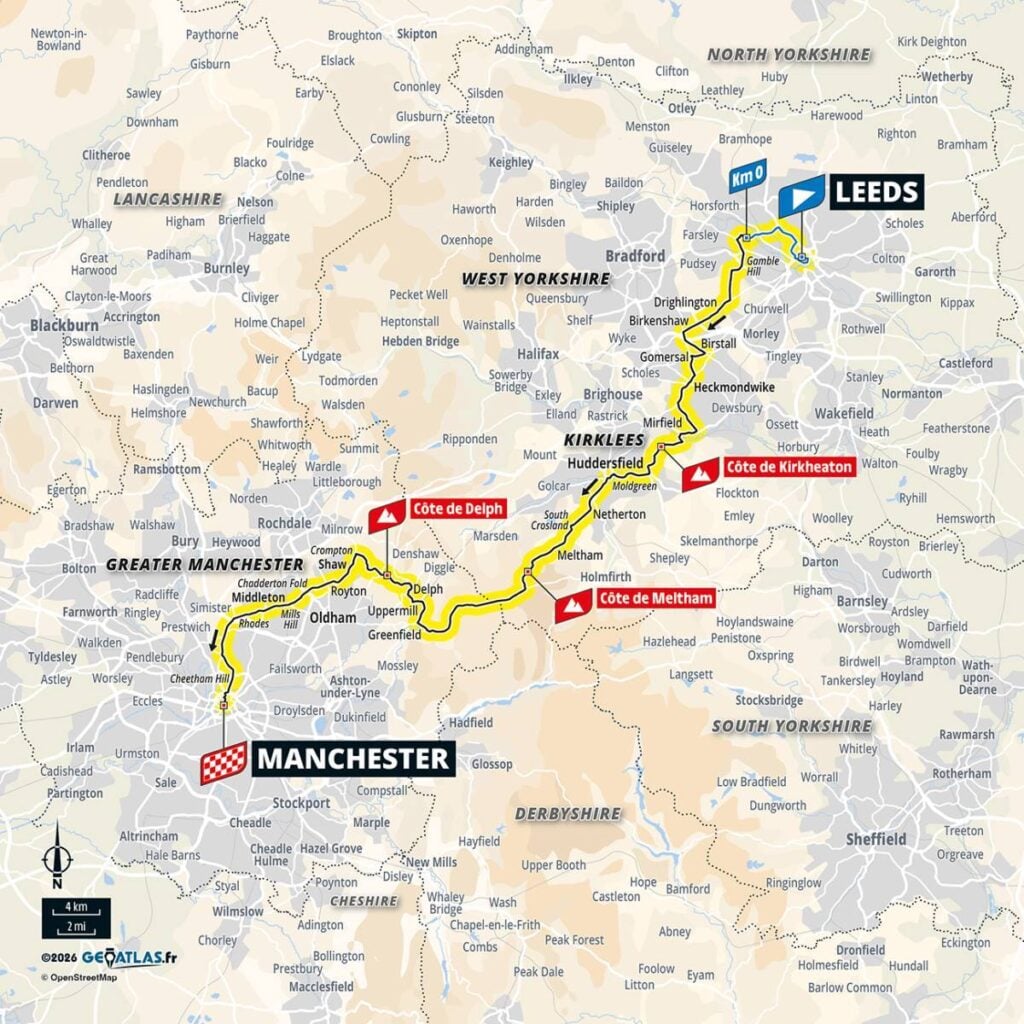
Stage 1: Leeds to Manchester could be more than a sprint
The first Tour de France Femmes stage ever held in Britain starts on The Headrow in Leeds, the same road from which the men’s Tour began its 2014 Grand Départ.
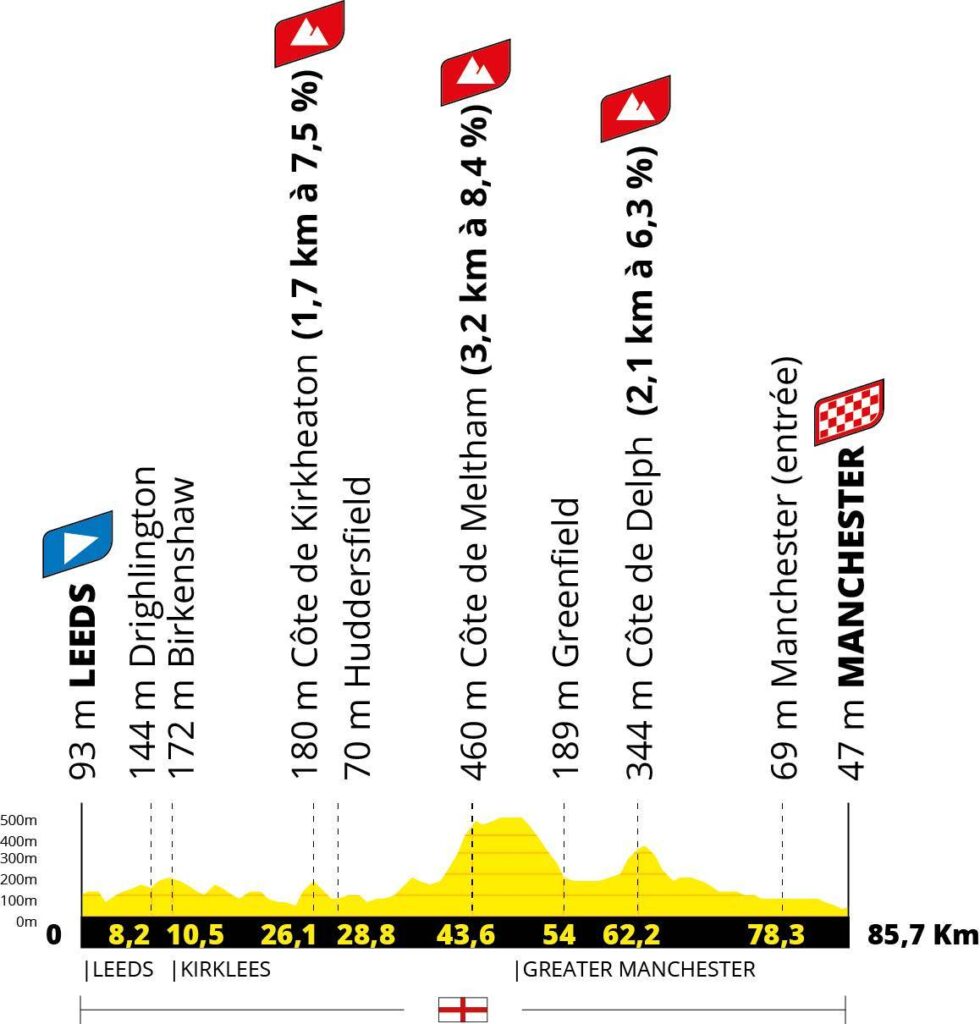
Stage 1 covers 85.7km to Manchester, making it exceptionally short by Tour standards.
The race travels through Huddersfield and crosses the Pennines before descending towards Greater Manchester and finishing on Deansgate.
Despite the short distance, the route contains enough climbing to make a straightforward bunch sprint far from guaranteed.
Among the main ascents are:
- Côte de Kirkheaton: 1.7km at 7.5%
- Meltham Hill: around 3.2km at 8.4%
- Delph: around 2.1km at 6.3%
That creates an interesting opening-day problem.
The fastest sprinters will see an opportunity to take the first yellow jersey, but teams with stronger puncheurs have little reason to allow them an easy ride. With fewer than 90km to race, there is also much less incentive to conserve energy than on a conventional 140km opening stage.
The 2026 Tour began with Lorena Wiebes taking control of the opening weekend. Leeds to Manchester gives the sprinters another route into yellow, but this time they will have to survive considerably more climbing to get there.
Yorkshire’s women’s cycling history gives the start extra weight
The Leeds start also carries obvious historical significance.
Beryl Burton was born in Leeds. Lizzie Deignan grew up in nearby Otley, while Cat Ferguson represents a new generation of British riders with connections to the region.
There is also the memory of 2014.
That men’s Grand Départ transformed Yorkshire into one of the most memorable British Tour settings, and the women’s race now gets an opportunity to create its own version rather than simply borrowing the history.
For British women’s cycling, that feels particularly significant. The modern Tour de France Femmes did not exist when the men’s Tour last started in Yorkshire.
Thirteen years later, the women’s peloton gets the same roads and the same scale of event.
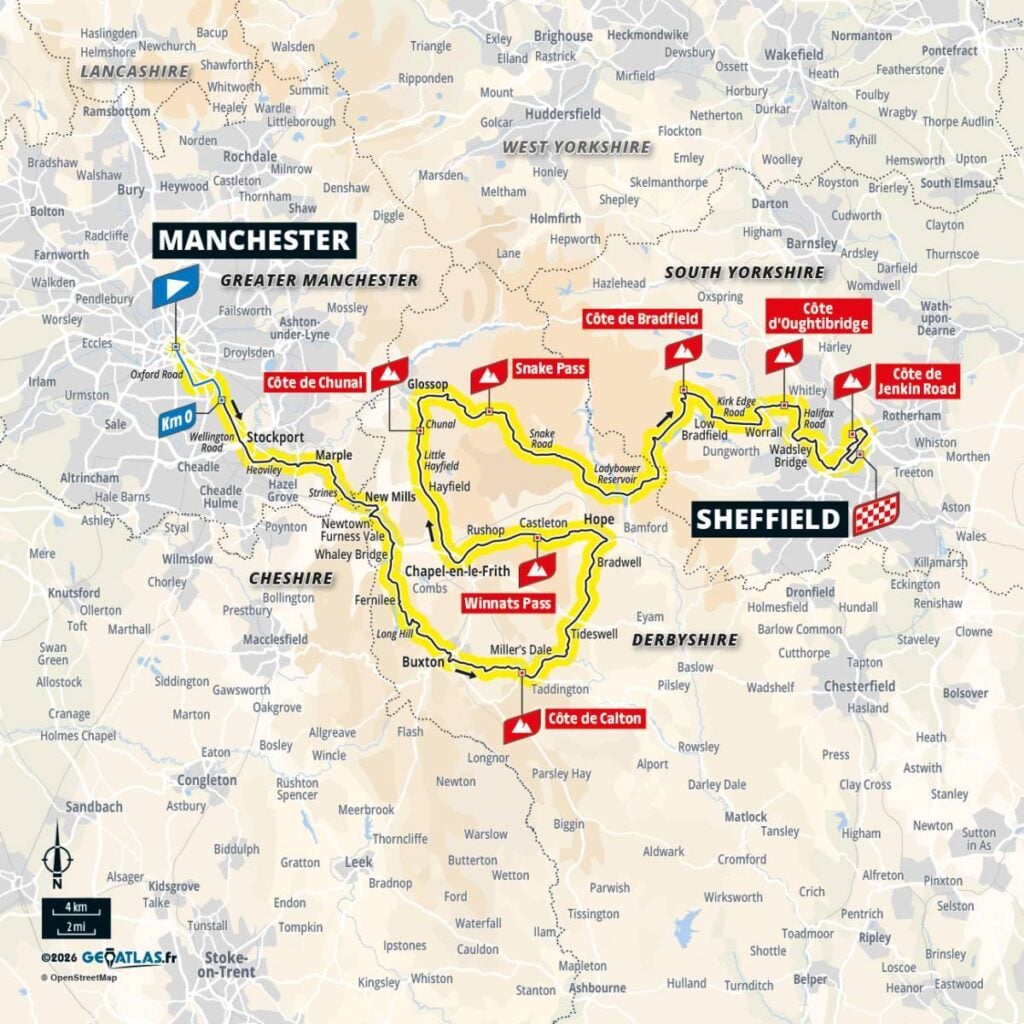
Stage 2: Manchester to Sheffield is the first obvious GC test
If Stage 1 introduces the Tour, Stage 2 could start shaping the general classification.
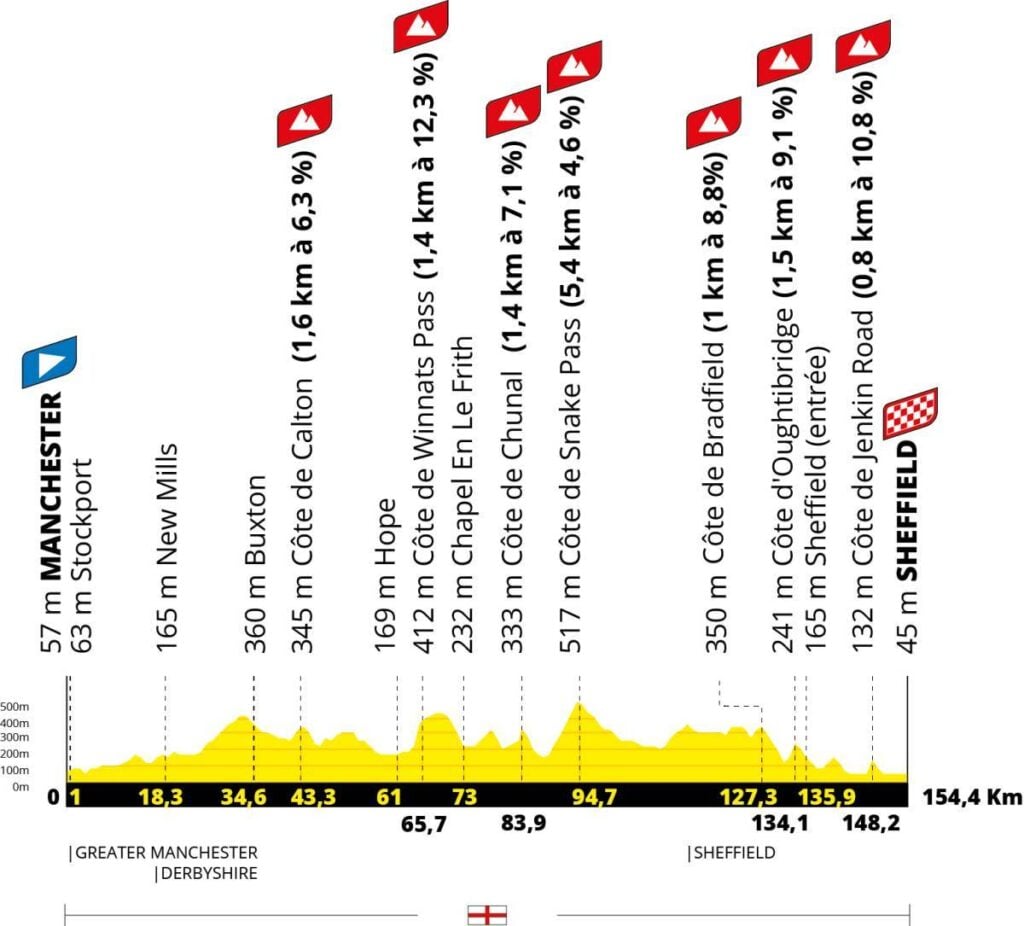
The riders leave Manchester on Saturday 31 July for a 154.4km stage to Sheffield containing almost 3,000 metres of climbing.
The route passes through Stockport, Marple and New Mills before heading into the Peak District.
Two climbs immediately stand out:
- Winnats Pass: 1.4km at 12.3%
- Snake Pass: 5.4km at 4.6%
Winnats Pass is particularly important.
At only 1.4km it is not a mountain climb, but an average gradient above 12% is enough to create meaningful gaps when raced aggressively. Its narrow road also puts a premium on positioning before the climb begins.
Snake Pass then provides a longer, steadier effort before the race reaches Sheffield.
By this point, the Tour will be barely 48 hours old.
That does not mean the GC teams can treat it as an introductory weekend.
Jenkin Road brings the Tour back to 2014
The final part of Stage 2 deliberately revisits roads made famous by the men’s Tour in 2014.
The women face:
- Côte d’Oughtibridge: 1.5km at 9.1%
- Côte de Jenkin Road: 800 metres at 10.8%
The stage finishes on Attercliffe Common, using the same finish location where Vincenzo Nibali won in 2014, although approached from the opposite direction.
Nibali’s attack that day gave him yellow on the way to winning the Tour.
It would be premature to assume the women’s race produces anything quite so decisive, particularly without knowing what awaits later in France.
But a stage containing nearly 3,000 metres of climbing, Winnats Pass and several steep Sheffield ramps is clearly capable of creating the first significant GC differences.
Climbers who expect to lose time in London have an obvious incentive to attack.
The London team time trial changes everything
The third British stage introduces something completely new.
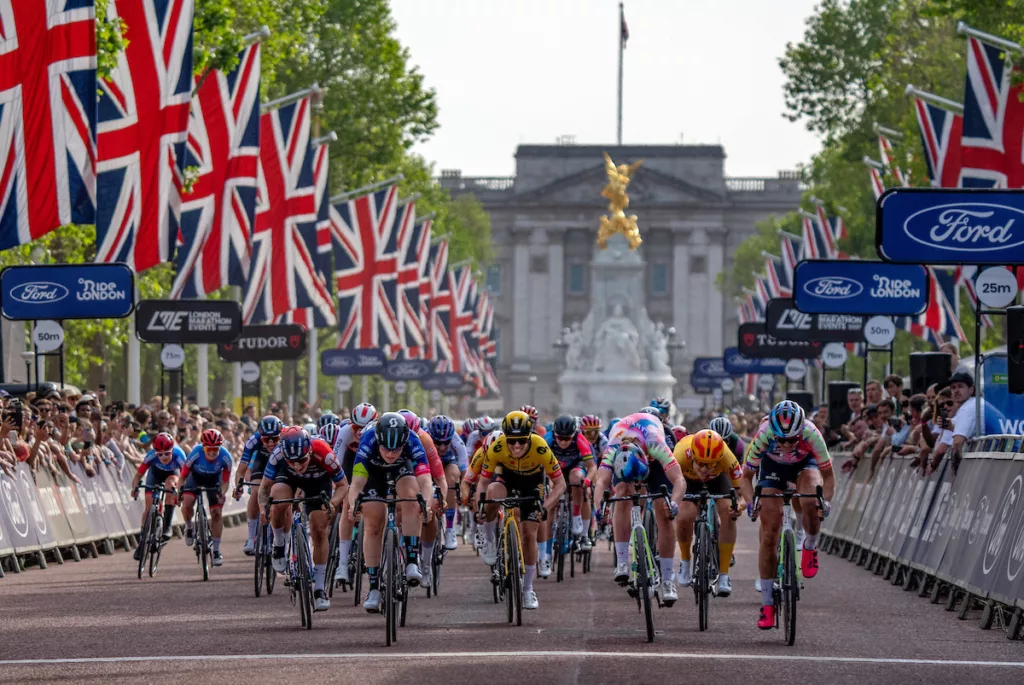
On Sunday 1 August, London hosts the first team time trial in modern Tour de France Femmes history.
The course is expected to cover approximately 18km through central London, passing close to landmarks including Tower Bridge, the Houses of Parliament and the London Eye before finishing on The Mall. The detailed road-by-road course will be confirmed when the complete 2027 Tour route is unveiled.
This matters far beyond the spectacle.
A normal individual time trial asks a GC contender to minimise their own losses.
A team time trial makes their result dependent on the entire squad.
That immediately makes team selection more complicated.
A GC leader surrounded by powerful rouleurs could gain significant time. A team built heavily around lightweight climbers may find itself defending before the race has even reached France.
What exactly is a team time trial?
Instead of riders starting individually, each team races the course together.
The objective is to maintain a fast, organised line, with riders taking turns on the front before moving back into the shelter of the group.
The strongest team is not necessarily the one containing the strongest individual rider.
Coordination matters enormously.
Teams need to judge:
- how long each rider should contribute
- how quickly to accelerate from corners
- whether weaker riders should be dropped
- how much risk to take through technical sections
- how to prevent gaps opening within the line
The precise 2027 timing regulations have not yet been published, so it is too early to say exactly how individual GC times will be calculated.
Those rules will matter almost as much as the London route itself.
The 2026 Dijon time trial showed why London matters
The Stage 4 time trial in Dijon provided one of the defining shifts of the 2026 Tour.
Marlen Reusser won the 21km stage and moved into yellow, forcing the climbers behind her to change the way they approached the rest of the race.
She ultimately did not win the Tour, but the time gained against the clock shaped everything that followed.
London could have the same effect in 2027, except this time the GC leaders cannot control the result entirely themselves.
That may influence team selection months before the Grand Départ.
For teams with serious yellow jersey ambitions, selecting seven riders who can climb in Sheffield and then perform cohesively in London becomes a significant balancing act.
Why the first three days already look unusually important
The sequencing is what makes the British Grand Départ particularly interesting.
Stage 1: short, fast and hilly.
Stage 2: almost 3,000 metres of climbing.
Stage 3: team time trial.
Those stages reward three different sets of skills.
A sprinter could take yellow in Manchester.
A climber or puncheur could take it in Sheffield.
A powerful GC team could take it in London.
The Tour could therefore arrive in France with its third race leader in three days, something that would feel entirely consistent with what happened in 2026.
Five different riders wore yellow during the 2026 Tour de France Femmes.
The 2027 opening stages appear deliberately designed to create similar instability.

What the 2026 Tour tells us about early time gaps
Demi Vollering eventually won the 2026 Tour by 1:18 over Kasia Niewiadoma-Phinney, but that final margin disguises how close the race remained.
Vollering entered the final stage only eight seconds ahead, the smallest advantage ever carried into the final day of the modern race. The significance of that margin is explored in our piece on whether eight seconds was the closest final-stage GC in Tour de France Femmes history.
She then attacked Niewiadoma-Phinney on the final Col d’Èze and won Stage 9 in yellow to seal her second Tour title.
That is relevant to London.
Twenty seconds lost in a team time trial might appear insignificant with almost an entire Tour remaining.
The recent history of this race says otherwise.
Kasia Niewiadoma won the 2024 Tour by four seconds.
The 2026 race reached its final morning with eight seconds between first and second.
There simply are not enough stages in the Tour de France Femmes to assume that small losses can comfortably be recovered later.
What happens after London?
This remains the biggest unanswered question.
The British Grand Départ is only the opening chapter.
The Tour is scheduled to continue until Saturday 7 August, but ASO has not yet revealed where the race resumes after London, which mountain ranges it will visit or where the yellow jersey will finally be decided.
That means we still do not know whether there will be:
- another time trial
- a major Alpine or Pyrenean summit finish
- several medium-mountain stages
- another decisive final-day route
- a route favouring climbers or more complete all-rounders
The 2026 Tour de France Femmes route contained Dijon, Mont Ventoux and a difficult final weekend around Nice.
The French portion of the 2027 route will eventually tell us just how valuable the seconds available in Sheffield and London really are.

Watching the 2027 Tour de France Femmes in Britain
All three British stages will be free to watch at the roadside.
Television arrangements are also unusually favourable for a home Grand Départ. 5 will show the British Tour stages live and free-to-air, while TNT Sports will also provide coverage.
That gives the first British Tour de France Femmes a substantially larger domestic platform than women’s cycling usually receives outside the biggest events.
Detailed stage timings, road closures, spectator zones and access arrangements will be published closer to July 2027.
Winnats Pass and the other narrow Peak District climbs are likely to require particularly careful planning for anyone hoping to watch roadside.
What we still do not know about the 2027 Tour
Several major details remain outstanding:
- the complete route after London
- the exact London team time trial course
- the team time trial timing regulations
- stage start and finish times
- participating teams and rider start lists
- detailed spectator and road closure information
Those gaps will begin disappearing when ASO presents the complete 2027 route later in 2026.
What is already clear is that Britain will not simply provide three photogenic opening stages.
The Manchester finish offers the first yellow jersey. Sheffield can expose GC weaknesses immediately. London then places each contender’s entire team against the clock.
The Tour will almost certainly be won later in France.
After the unpredictability of 2026, however, the British Grand Départ already looks difficult enough for someone to begin losing it before the race crosses the Channel.

