

Oscar Onley did not win Stage 9 of the 2026 Vuelta a España.
For the bigger picture, that hardly mattered.
On the hardest mountain stage of the race so far, after 187.4km and almost 5,000 metres of climbing, the 23-year-old British rider was the only man capable of following Enric Mas when the red jersey made the decisive attack on Alto de Aitana.
Onley reached the summit on the same time as Mas. Primož Roglič finished 12 seconds behind them. Felix Gall lost 18 seconds. Richard Carapaz conceded 54. Sepp Kuss had already been distanced further down the mountain.
The result moved Onley into fourth overall at 2:20, only 41 seconds from Gall’s third place, while also strengthening his hold on the white jersey.
ProCyclingUK’s Stage 9 report rightly records the day as a major Mas victory. For Onley, though, second place deserves to stand as a story in its own right.
This was not simply another good British result at a Vuelta already full of them.
It was a statement that Onley has a genuine Grand Tour podium to chase.
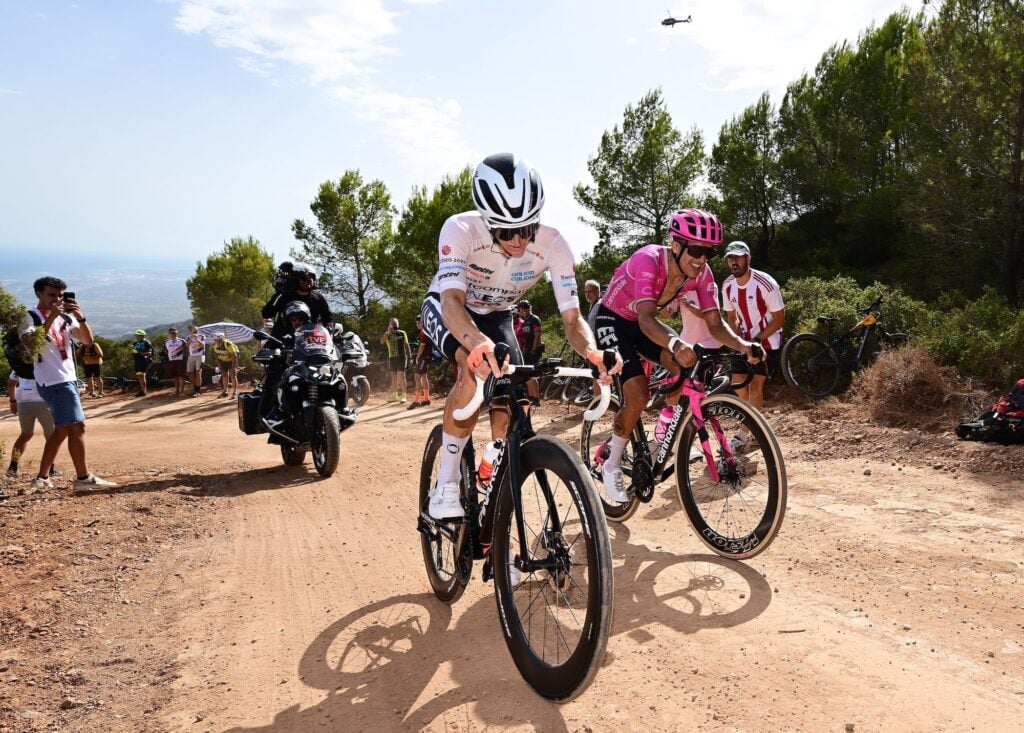 Photo Credit: Getty
Aitana was the test Onley needed to pass
There had been encouraging signs throughout the opening week, but Aitana was different.
Before Stage 9, it was still possible to question whether Onley’s position near the top of the GC would survive the Vuelta’s biggest mountain stages.
He had ridden well in Andorra and remained close through Valdelinares, but he had also paid heavily for trying to respond to Tadej Pogačar on Puerto El Bartolo during Stage 6.
That day, Onley briefly attempted to follow Pogačar’s acceleration on the gravel before fading and eventually conceding 1:38. ProCyclingUK’s Stage 6 report showed how that effort dropped him from the immediate podium group even though his wider GC challenge remained intact.
Aitana asked a much bigger question.
Stage 9 contained six categorised climbs and almost 5,000 metres of ascent. The final climb alone measured 22km at 5.8%, arriving after more than five hours of racing.
It was not a climb where a rider could bluff through five minutes of discomfort and limit the damage.
It tested sustained Grand Tour climbing.
Onley passed that test emphatically.
Following Mas mattered more than finishing second
Decathlon CMA CGM spent much of Aitana trying to create the hardest possible race for Gall.
The pace steadily stripped riders from the GC group.
Kuss disappeared.
Carapaz attacked and was eventually brought back.
Gall repeatedly tested the favourites.
Then Mas went with around three kilometres remaining.
Onley went with him.
Nobody else did.
Mas accelerated again inside the final two kilometres, but Onley remained attached while Roglič, Gall and the rest slipped backwards. The two reached the finish together before Mas used his faster kick to win the stage.
That distinction matters.
Onley did not survive by pacing himself behind and clawing back seconds near the summit. He was not given freedom because he was irrelevant to the classification.
He followed the strongest rider in the Vuelta when Mas attacked every remaining GC contender.
For a rider trying to establish himself as one of the peloton’s genuine Grand Tour leaders, it was a major step.
The Vuelta podium is only 41 seconds away
The numbers heading into the first rest day make the scale of the opportunity clear.
| Position | Rider | Team | Gap |
|---|---|---|---|
| 1 | Enric Mas | Movistar Team | Leader |
| 2 | Primož Roglič | Red Bull-BORA-hansgrohe | +1:18 |
| 3 | Felix Gall | Decathlon CMA CGM Team | +1:39 |
| 4 | Oscar Onley | Netcompany INEOS | +2:20 |
| 5 | Richard Carapaz | EF Education-EasyPost | +3:26 |
| 6 | Mattias Skjelmose | Lidl-Trek | +3:55 |
Onley is 41 seconds from the podium.
He is 1:06 ahead of Carapaz and 1:35 ahead of Skjelmose.
That changes the objective.
A top-five finish is no longer the ambitious outcome it appeared to be when the Vuelta began in Monaco. Onley is already fourth and has just put time into several riders who started the race with stronger expectations.
The wider Vuelta GC reset after Stage 9 now has Onley firmly within the leading group rather than as a promising outsider hanging onto it.
The immediate target is Gall.
Forty-one seconds can disappear on one mountain finish.
With Calar Alto, Sierra de La Pandera, Peñas Blancas and Collado del Alguacil still ahead, Onley has enough terrain to take them.

This is not Onley appearing from nowhere
The scale of his Aitana performance should not obscure what came before it.
Onley already finished fourth overall at the 2025 Tour de France, one of the biggest British Grand Tour breakthroughs of recent seasons.
He spent much of that Tour emerging as the best rider immediately behind Tadej Pogačar, Jonas Vingegaard and Florian Lipowitz, eventually finishing just short of the podium.
ProCyclingUK covered that breakthrough in Oscar Onley’s fourth place at the 2025 Tour de France.
That result established the ceiling.
What has changed is the expectation.
Onley joined Netcompany INEOS with the pressure of becoming one of the team’s principal Grand Tour leaders. His planned 2026 Tour de France challenge then disappeared after the shoulder injury he suffered at the Tour Auvergne-Rhône-Alpes.
The Vuelta became the major opportunity to show that fourth at the Tour was the beginning of something rather than one exceptional three-week run.
Nine stages in, that argument is becoming much stronger.
Burgos gave the first clue before the Vuelta
The clearest sign that Onley had rebuilt successfully came at the Vuelta a Burgos.
He won the uphill Stage 2 and finished second overall, only five seconds behind Gall.
That comparison looks increasingly relevant now.
Gall came into the Vuelta as one of the strongest pure climbers outside the original Pogačar-led hierarchy and reaches the rest day third overall.
Onley is 41 seconds behind him.
The question before Spain’s Grand Tour was whether the level Onley showed in a shorter stage race would survive once the racing became longer, the accumulated fatigue grew and the biggest mountains arrived deep into the opening week.
Aitana provided the best answer yet.
ProCyclingUK’s British riders guide before the Vuelta had a top five as a realistic Onley target, with the podium representing the major upside.
The upside has now become the obvious goal.
Onley learned from the Stage 6 mistake
The progression within this Vuelta has been just as interesting as the result itself.
On Stage 6, Onley tried to follow Pogačar when the race exploded on the gravel section of Puerto El Bartolo.
For a few moments, he looked capable of responding.
Then the effort caught up with him.
Onley eventually finished in the group containing Kuss and Skjelmose, 1:38 behind Pogačar and Mas.
On Aitana, his decision-making was noticeably different.
He did not react unnecessarily when Carapaz attacked.
He allowed Gall’s moves to be controlled without spending everything himself.
He stayed in the front group while Decathlon steadily removed riders around him.
Then, when Mas made the acceleration that actually mattered, Onley responded immediately.
That is the sort of judgement required to turn climbing ability into a three-week result.
The physical performance was exceptional.
The way he used it was almost as encouraging.
Britain’s Vuelta story has moved from stages to the GC
British riders had already shaped the first week long before Aitana.
Ethan Hayter came within 0.09 seconds of winning the opening time trial and taking the first red jersey in Monaco. Josh Tarling briefly held the fastest time, finished third and came away with the white jersey.
ProCyclingUK’s Stage 1 report captured just how close Britain came to starting the race with a victory.
Then Matthew Brennan turned his first Grand Tour into an immediate breakthrough.
He won Stage 2 in Manosque on his first road stage of a Grand Tour before winning again on Stage 5 in Roquetes.
Those were immediate, tangible successes.
Onley’s story is different.
There is no single stage on which his Vuelta can ultimately be judged.
He has another two weeks of protecting position, recovering between mountain stages, staying safe on apparently straightforward days and making decisions while Mas, Roglič, Gall and Carapaz race directly around him.
That is what makes his position potentially bigger.
Britain is no longer simply following riders capable of winning individual stages or jerseys.
It has a rider sitting fourth overall, 41 seconds from a Grand Tour podium, after matching the race leader on the hardest climb of the opening week.
Netcompany INEOS have the GC project they wanted
Onley’s performance also matters beyond the British angle.
Netcompany INEOS signed him because the team needed a rider capable of developing into a long-term Grand Tour leader.
That is an increasingly difficult rider to find.
Teams can sign excellent climbers, stage hunters and time triallists without finding someone capable of remaining near the front of a Grand Tour for three weeks.
Onley’s fourth place at the 2025 Tour provided compelling evidence.
Aitana strengthens it.
The Vuelta also presents a different leadership test from that breakthrough Tour.
Onley is not racing as an unexpected GC rider who can treat every high position as a bonus. He arrived as the team’s designated overall leader.
ProCyclingUK’s British Vuelta preview identified him as Britain’s clear GC hope before Stage 1.
Every stage now has consequences.
Netcompany INEOS have to protect him on transition days, keep him positioned through dangerous finales and give him enough support in the mountains to make the difference when the decisive attacks begin.
This is exactly the role the team signed him to fill.

The white jersey has become secondary
Onley enters the rest day leading the young rider classification.
That remains a significant Grand Tour objective, but his race has moved beyond it.
He is fourth among everybody.
The white jersey now follows from the larger goal rather than defining it.
That changes how Netcompany INEOS should approach the remaining stages.
Protecting white cannot take priority over an opportunity to move onto the overall podium.
If Gall struggles on Calar Alto, Onley has to exploit it.
If Roglič has a bad day on La Pandera, Onley should be looking at second rather than simply consolidating fourth.
The youth classification can take care of itself if he continues racing at this level.
Calar Alto is now an opportunity, not merely another test
The next major GC appointment comes on Stage 12 at Calar Alto.
For Onley, it represents the first opportunity to convert his current position into a podium place.
Gall is only 41 seconds ahead.
Roglič is 1:02 ahead.
Mas leads Onley by 2:20.
The remaining mountain programme, including Calar Alto, La Pandera, Peñas Blancas and Collado del Alguacil, can be seen in ProCyclingUK’s full Vuelta a España 2026 route guide.
Onley does not suddenly need to race as if he must win the Vuelta immediately.
But the hierarchy around him is close enough that every major summit now carries genuine positional consequences.
Aitana established that he can follow the strongest rider in the race over a long climb.
Calar Alto asks whether he can do it again.
That distinction will define the next phase of his Vuelta.
One exceptional performance produces a headline.
Repeating it produces a Grand Tour podium.
The Stage 18 time trial gives Onley another route onto the podium
Onley’s podium challenge is not built entirely around gaining time uphill.
The Vuelta still includes a 32km individual time trial from El Puerto de Santa María to Jerez de la Frontera on Stage 18.
That could become particularly important in his battle with Gall.
Roglič will expect the time trial to help his own challenge for red. Mas knows it is one of the greatest threats to his current advantage.
For Onley, the calculation is simpler.
He does not necessarily need to recover all 41 seconds to Gall in the mountains if he can arrive at the time trial close enough to turn the classification around against the clock.
That places additional pressure on Gall to distance him before Jerez.
It also means Onley has several different ways to reach the podium rather than relying on one huge mountain attack.

Could Oscar Onley actually win the Vuelta?
The podium is realistic.
Winning remains a much bigger proposition.
Mas has produced the strongest recent climbing evidence and leads Onley by 2:20.
Roglič sits between them with four Vuelta victories and the Stage 18 time trial still to come.
Gall has one of the strongest mountain teams in the race.
Onley therefore remains an outsider for red.
There is, however, an important difference between unlikely and impossible.
Before Stage 8, victory was barely a meaningful discussion because Pogačar had opened a huge advantage and appeared to be operating on a different level from everybody else.
His withdrawal completely reset the fight for the 2026 Vuelta.
Onley is now 2:20 from a race leader he matched all the way to the summit of Aitana.
If Mas has one difficult mountain day, that margin can change quickly.
If Onley continues climbing at this level, nobody can simply assume that youth or relative lack of GC experience will eventually remove him.
He has earned the right to remain in the wider red jersey conversation.
Aitana changed the question around Oscar Onley
Before Stage 9, the question was whether Onley could protect his high GC position when the Vuelta reached its hardest terrain.
After Stage 9, the question is how high he can finish.
That is a significant change.
Mas deservedly won the stage, strengthened red and established himself as the new rider to beat.
But Onley was the rider who went with him.
He matched Mas to the finish.
He put time into Roglič, Gall and Carapaz.
He moved further ahead of Kuss.
He reaches the first rest day fourth overall and only 41 seconds from third.
The British story at this Vuelta began with Hayter missing red by less than a tenth of a second, Tarling standing on the Monaco podium and Brennan immediately winning stages.
It reaches the rest day with something potentially bigger still.
Oscar Onley has a genuine Grand Tour podium to chase.

