
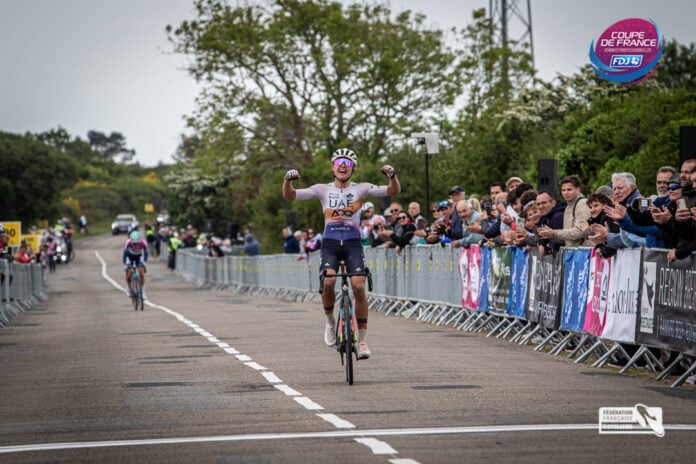
The Pointe du Raz Ladies Classic 2026 takes place on Sunday 6 September, with a 130.7km route that pushes the Breton race further towards the rough-road identity it established so successfully last year.
Starting beside the Pointe du Raz at Plogoff and finishing in Plouhinec, the fourth edition contains approximately 1,440 metres of climbing and 18km of ribinoù, the unsurfaced Breton tracks that have rapidly become the defining feature of the event. There are 13 different rough-road sectors, three classified climbing points and a demanding final circuit that sends the riders across the same three ribinoù six times.
That represents another major step for a race that only joined the UCI calendar in 2025. The Pointe du Raz Ladies Classic has been promoted from 1.1 to 1.Pro for 2026, moving into the Women’s ProSeries after Paula Blasi won the first international edition with a late solo attack.
The beginner’s guide to Pointe du Raz Ladies Classic 2026 explains the unusual surfaces and how the event works. The route itself shows why positioning, bike handling and repeated acceleration should matter at least as much as conventional climbing ability.
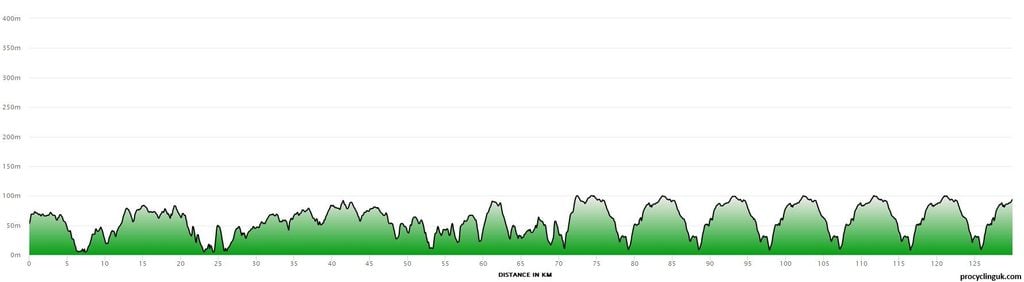
Pointe du Raz Ladies Classic 2026 route at a glance
| Detail | 2026 race |
|---|---|
| Date | Sunday 6 September 2026 |
| Start | Pointe du Raz, Plogoff |
| Finish | Plouhinec |
| Distance | 130.7km |
| Elevation gain | Approximately 1,440m |
| Ribinoù | Approximately 18km |
| Distinct rough-road sectors | 13 |
| Final circuit | 6 laps of 9.32km |
| Climbing per final lap | Approximately 103m |
| Classified climbing points | 3 |
| UCI classification | 1.Pro / Women’s ProSeries |
| Defending champion | Paula Blasi |
The race begins with the neutralised departure from the Sémaphore de la Pointe du Raz before the competitive start in Plogoff. From there the route explores the Cap Sizun peninsula before eventually reaching Plouhinec, where almost 56km of the race takes place on the finishing circuit.
More ribinoù make the 2026 race considerably more technical
The headline number is 18km of unsealed roads.
That is substantially more than the first UCI edition in 2025 and confirms that the organisers see the ribinoù as central to the long-term identity of the race rather than as a novelty to be gradually removed as its status increases.
There are 13 distinct sectors, but that does not mean the riders encounter rough roads only 13 times. The final three sectors form part of the Plouhinec circuit and are crossed on each of the six laps.
Across the whole race, that creates 28 separate rough-road passages.
It is the repetition that should make the second half especially difficult. A rider who handles one 500-metre track comfortably may feel very different when she reaches the same sector for the fifth or sixth time after more than 100km of constantly changing rhythm.
The history of the Pointe du Raz Ladies Classic shows how quickly the rough roads have become central to an event that began as a completely different two-day domestic race only three years ago.
The Pointe du Raz provides a spectacular but exposed start
The race begins at one of the most recognisable locations on the Breton coast.
The neutralised departure takes place from the Sémaphore de la Pointe du Raz, with the riders rolling away from the exposed western edge of Finistère before the racing begins near Plogoff.
That geographical position matters tactically.
The Cap Sizun peninsula is open to Atlantic weather, and the difficulty of the route can change considerably depending on the wind. A relatively modest rolling section can become much harder if a strong crosswind begins splitting the field before the first ribinoù have even had an effect.
There is also very little prolonged flat terrain on which a peloton can switch off. The profile continually rises and falls, with repeated accelerations out of corners and through villages.
The result should be a nervous opening hour even before the most difficult rough-road sectors arrive.
The first half crosses the heart of Cap Sizun
From Plogoff, the route heads through the western Finistère landscape around Cléden-Cap-Sizun, Goulien, Beuzec-Cap-Sizun, Audierne, Pont-Croix, Confort-Meilars and Mahalon before eventually reaching Plouhinec.
The profile never becomes mountainous, but it rarely offers much rest either.
Short climbs are mixed with descents, narrow roads and increasingly frequent ribinoù. That combination makes it difficult for teams to control the race in the same way they might on a conventional rolling Classic.
A breakaway can be caught on a normal road only for another split to appear almost immediately on the next rough sector.
Mechanical problems also matter more. A puncture on a wide main road can often be repaired with the rider paced back through the convoy. A puncture or chain problem on a narrow ribin can leave a rider with no immediate access to the team car while the race disappears ahead.
That makes avoiding trouble almost as important as creating it.

Three climbing points add another incentive to attack
The route includes three points towards the best climber competition, positioned at approximately 25km, 61km and 72km.
They are listed by the organiser as:
| Climbing point | Approximate race distance |
|---|---|
| Kerodeven | 25km |
| Ty Guen | 61km |
| Le Pape Environnement | 72km |
None should be viewed as a decisive mountain climb in its own right.
Their importance is tactical. The second and third come shortly before the race reaches the final circuit, precisely when riders who do not want to wait for six laps around Plouhinec may begin forcing the pace.
The classified competition also gives smaller teams another reason to place a rider in the early break.
That can complicate the race for the favourites because a strong group chasing climbing points may contain riders capable of continuing deep into the finale rather than simply surrendering once the classification has been decided.
The 13 Pointe du Raz ribinoù
The organiser grades each distinct sector for difficulty, from the more straightforward tracks to the five-star Spéciale Patrick Kerroc’h.
| Sector | Ribin | Length |
|---|---|---|
| 13 | Feunteun Go | 310m |
| 12 | Vieux Presbytère | 1,410m |
| 11 | Penharn | 1,200m |
| 10 | Tromao | 700m |
| 9 | Lennard | 1,650m |
| 8 | Lesmeilleurs | 700m |
| 7 | Spéciale Patrick Kerroc’h | 1,260m |
| 6 | Kergoff | 330m |
| 5 | Larin | 770m |
| 4 | Trohonan | 740m |
| 3 | Gwendréz | 550m |
| 2 | Flibéré | 560m |
| 1 | Penteven | 370m |
The final three sectors are repeated on every lap of the finishing circuit, bringing the total amount of off-road racing to almost exactly 18km.
There is considerable variation within that list. Several sectors are short enough to be ridden almost like a prolonged sprint for position, while Vieux Presbytère, Penharn, Lennard and Spéciale Patrick Kerroc’h are long enough for genuine gaps to develop.
Lennard is the longest single sector
At 1.65km, Lennard is the longest individual ribin on the route.
It also carries a four-star difficulty rating, making it one of the sections where the race can begin breaking apart well before Plouhinec.
Length changes the way a rough-road sector is raced.
On a 300-metre stretch, a rider badly positioned at the entrance can sometimes survive simply by accepting a small gap and closing it once the tarmac returns. Over more than a kilometre and a half, the front of the race has much more time to increase the pace while riders behind are repeatedly forced to choose poorer lines.
Dust could become a problem if conditions are dry.
Mud and wheel slip become the concern if it rains.
Either way, entering Lennard near the back of the peloton carries considerable risk.
Spéciale Patrick Kerroc’h is the hardest-rated ribin
The most intimidating rating belongs to sector seven, Spéciale Patrick Kerroc’h.
At 1.26km, it is shorter than Lennard and Vieux Presbytère, but the organisers have awarded it the maximum five-star difficulty rating.
That immediately makes it one of the obvious tactical points of the race.
Teams with riders confident on gravel or cyclocross-style terrain have every reason to increase the speed before the entrance. Even if no favourite attacks directly, simply forcing rivals to approach at maximum pace increases the chance of gaps opening naturally through the sector.
The danger is multiplied because Pointe du Raz does not contain isolated gravel sections separated by long periods of recovery. Another technical challenge is rarely far away.
A rider can negotiate Spéciale Patrick perfectly and still be forced to fight for position almost immediately afterwards.
Vieux Presbytère and Penharn create another difficult sequence
Sectors 12 and 11 come relatively early but should contribute heavily to the first serious selection.
Vieux Presbytère measures 1.41km, while Penharn is another 1.2km. Both receive four-star difficulty ratings.
Two long rough-road sections in relatively close succession create a different problem from one standalone ribin.
Teams cannot simply burn a domestique to position their leader before the first sector and assume the job is finished. Riders have to regroup, move forward again and repeat the process.
Those repeated battles cost energy even when a rider never technically loses contact.
It is one reason the modest overall climbing figure of 1,440 metres understates the difficulty of the race.
The power demanded by accelerating into and out of the ribinoù does not appear on an elevation profile.
Paula Blasi showed in 2025 why the race rewards complete riders
The first UCI edition provided the clearest evidence of what these roads can do.
The 2025 route contained ten rough-road sectors and produced a decisive five-rider group containing Paula Blasi, Lauren Dickson, Anneke Dijkstra, Sarah van Dam and Célia Gery.
The peloton had already been heavily reduced when Dickson attacked late and briefly appeared to be riding towards the biggest victory of her career.
Blasi responded differently.
Knowing she did not want to wait for a sprint, the Spaniard bridged across, rode past Dickson and continued alone to the finish.
The full report on Paula Blasi’s 2025 Pointe du Raz victory showed how thoroughly the ribinoù had dismantled normal team structures. The main peloton eventually arrived almost three minutes behind the leaders.
That is the biggest warning for teams in 2026.
Once the race splits properly, there may be no large organised peloton left to repair the situation.

The finishing circuit begins with nearly 56km still to race
The route reaches Plouhinec after roughly 75km, but that does not mean the difficult part is finished.
Instead, the riders begin six laps of a 9.32km finishing circuit, accounting for almost 56km of the entire race.
Each lap contains approximately 103 metres of climbing, so the circuit alone contributes more than 600 metres of elevation.
It also contains three ribinoù:
- Penteven, 370m
- Flibéré, 560m
- Gwendréz, 550m
Those three sectors total 1.48km per lap.
Across six laps, riders therefore complete almost 9km of rough-road racing on the finishing circuit alone.
That is where Pointe du Raz becomes especially attritional.
Gwendréz is the hardest sector on the final circuit
Of the three repeated finishing sectors, Gwendréz is rated three stars, making it noticeably more difficult than Penteven and Flibéré.
The sector runs close to the Plage de Gwendrez and comes within a circuit that also passes the archaeological site of Menez Dregan.
At 550 metres, Gwendréz is not long enough to guarantee enormous gaps on the first passage.
The sixth passage is another matter.
By then the riders will already have completed more than 120km, crossed every earlier ribin and spent much of the final hour repeatedly accelerating around the same demanding circuit.
The surface does not become harder.
The riders arriving at it do.
That makes Gwendréz an obvious place for a late attack, particularly for riders who believe they would lose a sprint on Rue Jean Guillou.
Penteven and Flibéré make recovery difficult
The other two final-circuit sectors are less highly rated but tactically just as important because of how often they return.
Penteven is 370 metres and Flibéré 560 metres.
Neither looks intimidating in isolation.
Together with Gwendréz, they ensure there is no comfortable lap on which the peloton can simply reorganise.
Every circuit requires another fight for position, another transition from tarmac onto a loose surface and another acceleration once the riders return to conventional roads.
That repeated disruption is likely to gradually reduce the usefulness of team numbers.
A squad that enters the circuit with six riders may have four together after two laps, three after four laps and only its leader remaining by the final passage.
That is exactly the type of race in which tactical freedom increases as the kilometres disappear.
The Plouhinec circuit favours attacks more than a conventional sprint
The 9.32km loop drops towards the coast around Gwendrez before gradually climbing back towards Plouhinec.
That profile is important.
There is no one huge ascent where everybody knows the winning attack must happen. Instead, riders have several opportunities on each lap to use the terrain or the rough roads.
The race can therefore become increasingly difficult to control.
An attack before a ribin forces rivals to chase over the rough surface.
An attack immediately after one can exploit the moment when riders behind are still reorganising.
A move on the rising roads back towards Plouhinec can test who still has climbing strength.
The best Classics teams may use those options sequentially rather than waiting for one leader to attack on the final lap.
Why positioning could decide the race before strength does
The greatest tactical mistake at Pointe du Raz may be entering a sector too far back.
A rider can have winning form and still lose the race because 30 riders enter a narrow ribin ahead of her.
The concertina effect is severe. The leaders carry speed into the entrance, while riders further back brake before the corner and then have to accelerate again on a loose surface.
A small split becomes five seconds.
Five seconds becomes 15 when another attack comes immediately afterwards.
And if the riders ahead include several different teams, there may be no coordinated reason for them to slow down.
The race therefore rewards riders who can anticipate danger before it becomes visible on television.
Mechanical luck will matter
Rough-road racing always introduces an element that cannot be completely controlled.
Punctures are the obvious threat, but they are not the only one.
Chain drops, damaged wheels and problems created by vibration can all become more consequential when the team car cannot immediately reach a rider.
The neutral service vehicles also cannot travel through every ribin in the same way as the riders. The technical guide includes dedicated diversions for vehicles around the rough-road sections.
That can leave a rider waiting longer for assistance than she would on an ordinary road.
It is one reason teams may consider equipment choices carefully even though Pointe du Raz remains fundamentally a road race rather than a gravel event.
Slightly greater puncture protection may be worth more than marginal aerodynamic gains.
Wind could be as important as the ribinoù
The route’s location makes the weather an essential part of any final race forecast.
The Pointe du Raz sits directly against the Atlantic and the Cap Sizun roads contain numerous exposed sections.
If the wind is strong, teams can begin splitting the race before the rough surfaces have completed the job.
That creates an especially dangerous combination.
A rider already fatigued from fighting through crosswinds then has to contest position into a ribin. A team caught behind one split may have no opportunity to reorganise before the next technical section arrives.
Rain would change the race differently.
The smoother ribinoù could become slippery, while muddy sections would increase the importance of line choice and bike handling.
Dry weather makes speed and dust more important.
There is almost no weather scenario in which the rough roads become irrelevant.
Célia Gery should feel at home on this terrain
The confirmed presence of Célia Gery immediately gives the race another rider with obvious Pointe du Raz credentials.
Gery was fourth in 2025 after making the decisive five-rider selection and has since developed from an outstanding cyclocross prospect into a proven WorldTour road winner.
Her 2026 season includes victory at Brabantse Pijl Women, where she beat Mischa Bredewold and Silvia Persico from a selective finale.
The connection with Pointe du Raz is obvious. Gery can handle technical terrain, accelerate repeatedly and still carry finishing speed after a hard race.
Her presence also shows how much the event has developed. A rider who finished fourth as a 19-year-old prospect in 2025 returns a year later as a French champion and established WorldTour winner.
The 2026 route is slightly shorter but arguably harder to control
The 2025 UCI edition covered 143km.
This year’s race is shorter at 130.7km, but the reduction in total distance should not be interpreted as making the event easier.
The rough-road content has increased to 18km and the structure of the Plouhinec circuit means the technical difficulty continues almost until the finish.
A shorter race can also encourage greater aggression.
There is less reason to conserve energy during the opening hours when the entire event should be completed in a little over three hours.
Teams without a clear favourite can begin attacking early knowing that the decisive final circuit arrives quickly.
The likely result is greater intensity rather than an easier race.
Pointe du Raz is now firmly a rough-road Classic
The most important conclusion from the 2026 route is what it says about the race’s long-term direction.
Pointe du Raz began in 2023 as a two-day French domestic event containing an individual time trial.
In 2024 it remained a stage race.
The transformation came last year when it entered the UCI calendar as a one-day 1.1 Classic and made the ribinoù central to the course.
That identity has now been strengthened rather than diluted.
The race has been promoted to 1.Pro.
The rough-road distance has increased.
The finishing circuit repeatedly uses three more sectors.
The strongest teams are being given a course that asks for bike handling and tactical aggression rather than a predictable final sprint.
Few races have established such a recognisable identity so quickly.
-
 Photo Credit: A.S.O./Gaëtan Flamme

What type of rider does the route suit?
The obvious answer is an all-terrain Classics rider.
Pure sprinters face too many opportunities to be isolated or dropped before Plouhinec.
Pure climbers cannot rely on one long ascent to create the decisive selection.
The ideal winner instead needs to combine several qualities: positioning, technical confidence, repeated power, resilience on short climbs, endurance and the tactical ability to recognise when a fragmented race has reached the point where waiting becomes more dangerous than attacking.
Blasi was a perfect example in 2025.
Gery’s cyclocross background makes obvious sense.
Riders accustomed to Strade Bianche, Paris-Roubaix Femmes or gravel racing should find parts of the course familiar, even though the Breton ribinoù have their own character.
The race should particularly suit anyone comfortable attacking from a group of fewer than ten rather than relying on a full bunch sprint.
Where will Pointe du Raz Ladies Classic 2026 be decided?
There are three obvious phases.
The first is the sequence of longer ribinoù through Cap Sizun, particularly Vieux Presbytère, Penharn, Lennard and Spéciale Patrick Kerroc’h. Those sectors can remove riders who arrive badly positioned and create the first genuinely dangerous front group.
The second comes around 60-75km, where the final climbing points and last rough-road sections before Plouhinec provide an opportunity to attack before the circuit begins.
The third is the six-lap finale.
If a group of 30 or 40 riders reaches Plouhinec together, it is unlikely to remain that size. Eighteen further ribin passages across the circuit give the strongest riders repeated opportunities to attack.
By the final lap, there may no longer be anything resembling a peloton.
Pointe du Raz Ladies Classic 2026 route verdict
The 130.7km Pointe du Raz Ladies Classic 2026 route looks more demanding than its distance or 1,440 metres of climbing initially suggest.
The numbers that matter are elsewhere: 18km of ribinoù, 13 distinct sectors, 28 rough-road passages and six laps of a technical Plouhinec circuit.
The first UCI edition already showed how quickly these roads can destroy normal team structures. Blasi won alone, the decisive group formed around 40km from the finish and the peloton ultimately arrived minutes behind.
The organisers have responded by adding even more of the characteristic that produced that race.
That should make Pointe du Raz harder to predict and easier to recognise.
A rider can survive the climbing and still lose through poor positioning. She can handle every ribin and still puncture at the wrong moment. A favourite can have several team-mates with 50km remaining and find herself isolated two laps later.
The strongest rider may ultimately win.
At Pointe du Raz, she will first have to survive everything else.

