
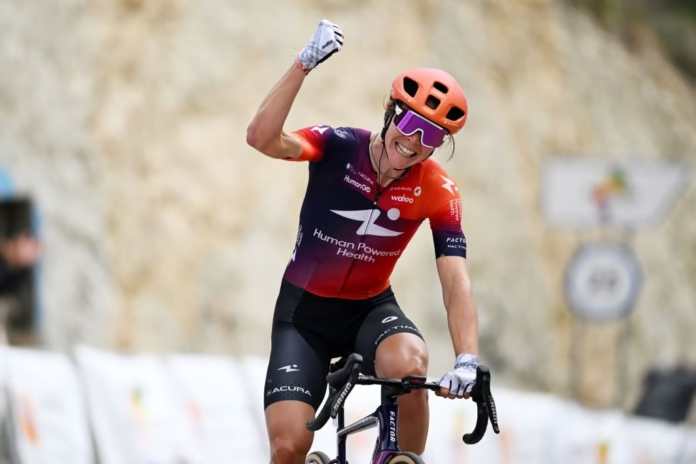
Thalita de Jong has extended her contract with Human Powered Health through the end of 2028, giving the Dutch rider another two seasons with the Women’s WorldTour team.
The 32-year-old joined Human Powered Health ahead of the 2025 season after rebuilding her career with Lotto Dstny Ladies. Her first two years with the American team have included victories, strong stage-race performances and difficult periods disrupted by injury and illness, but both sides have chosen to continue a partnership that has increasingly given De Jong opportunities to develop as a general classification rider.
The extension also provides continuity as Human Powered Health continue to develop their Women’s WorldTour programme around a changing roster.
De Jong believes she has contributed more than results during her first two seasons.
“It’s nice to hear that I brought experience to the team, and it’s nice to hear that I brought the team a step further,” she said.
De Jong’s resilience central to new contract
Human Powered Health general manager Ro De Jonckere pointed towards De Jong’s response to setbacks as one of the qualities that has made her particularly valuable.
“What I value most about Thalita goes far beyond what she can do on the bike,” De Jonckere said.
“She has had some tough moments over the last two years, but I have always admired the way she keeps fighting and keeps believing. Giving up simply is not in her character.
“At the same time, we have seen some really strong performances from her and how much she has continued to develop as a rider, especially in stage races.”
That resilience has been tested repeatedly since De Jong joined the team.
Her first Human Powered Health season began strongly. She won Trofeo Binissalem-Andratx in January 2025, attacking on the steep final climb and dropping Cédrine Kerbaol before the finish at Port d’Andratx.
A broken collarbone at Trofeo Alfredo Binda interrupted that progress, but De Jong returned at La Vuelta Femenina only six weeks later and gradually rebuilt her form. She went on to finish fifth at Itzulia Women and third at Durango-Durango before illness brought another abrupt stop to her season.
De Jong later described the unexplained muscle problems that followed, including inflammation levels high enough that even walking short distances became difficult. Her attempt to leave those problems behind became one of the main themes heading into 2026, when she spoke about starting again after a season dominated by illness.
“My character makes me strong and defines who I am,” De Jong said. “Giving up is not an option.”
Stage racing has become a bigger part of De Jong’s ambitions
De Jong’s career has never fitted neatly into one category.
She is a former cyclocross world champion with the speed to win reduced sprints, enough climbing ability to survive demanding stage races and a record of attacking when opportunities appear. Her time with Human Powered Health has increasingly added general classification racing to that mix.
That development did not begin with the team. Her resurgence in 2024 included two stage victories and overall success at the Tour Cycliste Féminin International de l’Ardèche, where she won the opening stage before winning again on Stage 2.
Those results helped secure her move to Human Powered Health for 2025 and 2026.
Two years later, De Jong believes there is still room to push further into stage racing without abandoning the type of opportunistic racing that has produced many of her best results.
“I would certainly like to aim for a strong general classification in a few stage races, while balancing opportunities to race for stage wins in other events,” she said.
That provides Human Powered Health with useful flexibility. De Jong does not need an entire programme built around protecting a GC position, but she can become an overall option when the race develops in her favour.
Her 2026 season has provided further evidence of that ability. De Jong finished 13th overall at the Tour de France Femmes, giving Human Powered Health one of its strongest GC results of the race and continuing a progression that has increasingly made longer stage races a realistic target rather than simply a collection of opportunities for individual stages.
The result can be seen in the final 2026 Tour de France Femmes standings, where De Jong finished ahead of several riders whose seasons had been built much more explicitly around general classification ambitions.
Learning to race for the team
For De Jong, becoming a stronger stage racer has gone alongside learning how to use her experience within the wider team.
That matters to Human Powered Health as much as the individual results.
De Jonckere believes the rider who returned to the Women’s WorldTour in 2025 has developed into an important part of the team’s internal structure, particularly through the way she responds when races or entire seasons move away from the original plan.
“That combination of resilience, experience and ambition makes her a very important part of our team,” De Jonckere said.
“And just as importantly, she is the kind of person who genuinely cares about the team. That is exactly what we want to stand for.
“We have built a strong relationship over the past two seasons, and I am very happy that Thalita will be with us until 2028. I’m looking forward to seeing her continue to challenge herself and, hopefully, share many more good moments and successes.”
Human Powered Health are also changing around her. The team have been active in building their 2027 roster, including the signing of Marta Lach from SD Worx-Protime.
De Jong’s extension gives the team an experienced constant alongside those additions.
Performance testing remains part of the process
Human Powered Health’s Performance Labs will continue to feature heavily in De Jong’s preparation over the next two seasons.
The programme uses physiological and movement testing to establish detailed individual baselines for its riders. That includes VO2 max and lactate threshold testing alongside body composition, strength, bike fit and functional movement assessments.
For De Jong, who has had to manage substantial periods of both injury and illness during the last two years, that information has particular value.
“The Performance Labs are really helpful because you get a lot of information about yourself as a rider,” she said.
“It gives us a good baseline and helps the team understand where we are and where we can improve. It shows how much the team invests in us, not only to perform better, but also to stay healthy and understand our bodies.”
The next stage is therefore not a reinvention.
De Jong has already shown that she can win races for Human Powered Health, contribute to teammates and compete for overall positions in stage races. Her new contract gives both rider and team two more seasons to see how far that combination can go.
For De Jong, the principle behind it remains straightforward.
“Giving up is not an option.”

