
Univega Pro Cycling Team existed under that name for only two seasons, but its place in women’s cycling history is much larger than the short lifespan suggests. The Swiss-registered squad arrived in 2005 with a roster built around proven stage racers and time-trial specialists, then added Nicole Cooke for 2006 and became the highest-ranked women’s team in the world. Its importance also lies in what followed. The same organisation continued through Raleigh-Lifeforce, Cervélo-Lifeforce, Cervélo TestTeam and finally Garmin-Cervélo, creating a line that connected the mid-2000s women’s peloton with one of the strongest professional structures of the following decade.
How Univega entered the women’s peloton
Univega entered elite women’s road racing in 2005, with the team registered in Switzerland. The first roster already had considerable depth. Priska Doppmann, Karin Thürig, Christiane Soeder, Sereina Trachsel and Emma Rickards gave the squad riders capable of winning stage races, national championships and time trials rather than relying on a single leader.
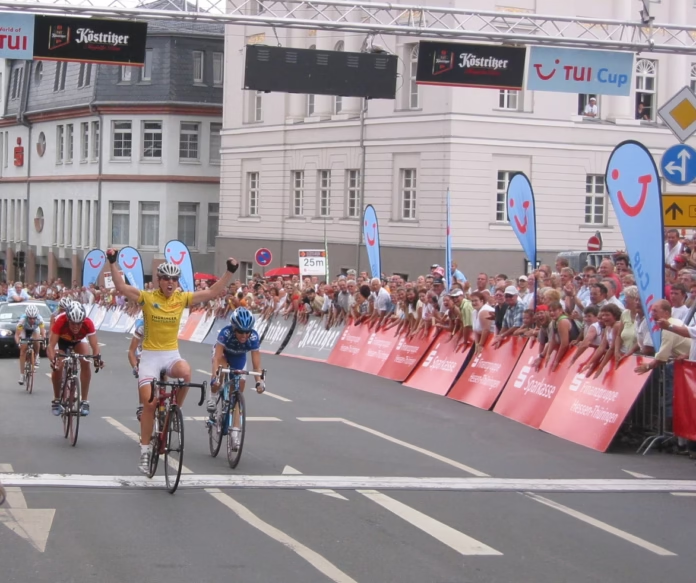
That balance was obvious in the first season. Thürig won the Souvenir Magali Pache and time-trial stages at the Tour de l’Aude, while Soeder also won against the clock there. The Grande Boucle Féminine Internationale brought the team a much larger collective success. Doppmann won the overall classification, with Rickards, Edwige Pitel and Soeder among the stage winners. At a time when the women’s calendar had lost much of the stability and scale enjoyed by the men’s sport, the Grande Boucle remained one of the most important stage-racing targets available.
The season then finished with a rainbow jersey. Thürig won the elite women’s individual time trial at the 2005 World Championships, confirming both her position among the outstanding specialists of the period and Univega’s immediate ability to operate at the highest level. The result also fitted the character of the original team: it was technically strong, internationally recruited and particularly effective in races where pacing and climbing mattered.
Nicole Cooke changes the scale of the project
The decisive move came before the 2006 season. Nicole Cooke left Safi-Pasta Zara and joined Univega, with Raleigh involved in the deal and providing her bikes. Cooke was already one of the outstanding one-day racers in the world, but she was also capable of winning stage races. Adding her to a squad that already contained Thürig and Doppmann gave Univega several different ways to control major races.
Cooke’s wider career is covered in our Nicole Cooke rider history, but 2006 stands out even within that record. Her spring included victory at La Flèche Wallonne Féminine, where she caught and passed Oenone Wood on the Mur de Huy, and another World Cup victory at GP Castilla y León. Those results shifted Univega from being a strong stage-racing team to a squad capable of shaping the season-long World Cup.
The support structure mattered. Thürig could attack or force rivals to respond, Doppmann remained a major stage-race presence, and Joanne Kiesanowski added another option across varied terrain. Univega was not simply surrounding Cooke with domestiques. It had riders whose own results demanded attention, which made controlling the British rider considerably harder for opposing teams.
The 2006 season that put Univega on top
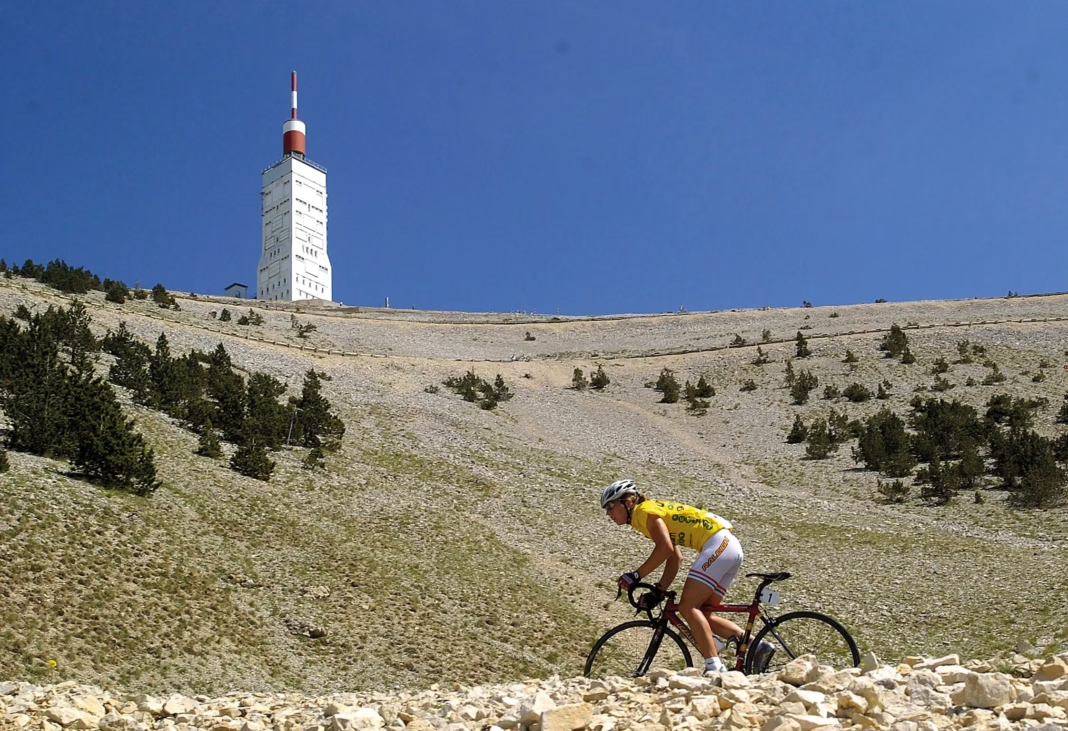
Cooke carried that spring form into the stage-racing summer. She won the Grande Boucle Féminine Internationale, taking yellow from the opening stage and retaining it through a race that included Mont Ventoux. It was an important victory in its own right, but it also gave Univega consecutive overall wins in the event after Doppmann’s success in 2005.
The result was not built around Cooke alone. Earlier in the season, Doppmann won stages 2 and 6 at the Tour de l’Aude and finished fourth overall, while Kiesanowski added another stage victory. Those results showed the depth that made Univega difficult to control: rivals could not focus entirely on Cooke without leaving other proven winners room to move.
The Thüringen Rundfahrt added another emphatic result. Cooke won four stages and the overall classification, extending a season in which she was also building an unassailable position in the World Cup. By the end of 2006 she had won the UCI Women’s Road World Cup overall and finished as the number one rider in the UCI world ranking. Univega completed the double by finishing first in the UCI team ranking, ahead of Buitenpoort-Flexpoint and Nürnberger Versicherung.
That distinction is worth separating from a simple count of victories. Women’s cycling in this period did not have the modern Women’s WorldTour structure, so the UCI ranking and World Cup carried particular weight as measures of season-long performance. Univega finished 2006 ahead of established programmes including Buitenpoort-Flexpoint, Nürnberger Versicherung, Bigla and T-Mobile. For a team in only its second season, that was a rapid rise.
Why the roster worked
Univega’s strongest feature was the variety of its leaders. Cooke could win on steep finishes, in Classics and across stage races. Thürig was one of the defining time triallists of her generation. Doppmann brought stage-racing consistency, while Soeder combined climbing with time-trial ability. Kiesanowski, Trachsel and the rest of the roster gave the team options that were valuable long before women’s squads had the depth of today’s leading teams.
There was also a useful tactical effect. A rival trying to isolate Cooke could not simply allow Thürig or Doppmann a large advantage. That was demonstrated especially clearly after the Univega name disappeared, when the same core organisation raced as Raleigh-Lifeforce in 2007. At the Tour of Flanders, Thürig’s aggression forced Cooke’s rivals to spend energy before Cooke finished the job herself. The jersey had changed, but the racing logic had not.
The period also illustrates how much women’s professional teams depended on changing commercial relationships. Sponsorship names could disappear quickly even when the sporting organisation remained healthy. That is one reason a team such as Univega can look like a brief footnote when viewed only through season-by-season team names. Our women’s cycling team history hub puts those changing identities into a wider chronology.
From Univega to Raleigh and Cervélo
The Univega name left the peloton after 2006, but the team did not simply vanish. Raleigh International took over the title sponsorship for 2007, when the squad became Raleigh-Lifeforce-Creation. Cooke, Doppmann, Thürig, Kiesanowski and several other riders remained, preserving substantial continuity from the team that had topped the 2006 rankings.
Cervélo became title sponsor for 2008, creating Cervélo-Lifeforce. Cooke had already left before the 2008 season to lead the new Halfords Bikehut team, but the organisation continued to recruit major talent. The later Cervélo TestTeam years included Emma Pooley, Kirsten Wild and Claudia Häusler, with Häusler winning the Giro d’Italia Femminile in 2009. Pooley’s career, including her major victories with the Cervélo structure, is covered in our Emma Pooley rider history.
The final identity was Garmin-Cervélo in 2011. Funding problems brought the team to an end after that season, with several riders moving to AA Drink-Leontien.nl for 2012. By then, however, the organisation that began as Univega had spent seven seasons near the front of women’s professional racing and had developed far beyond the original sponsor name.
Univega’s place in women’s cycling history
Univega matters because its two seasons captured an important stage in the professionalisation of women’s road racing. The team was international, performance-focused and capable of assembling several genuine leaders at a time when budgets and race programmes were much less secure than they are for modern top-tier teams. It won a world title in its first season and finished its second as the number one team in the UCI rankings.
Its results also connect several strands of the era. Thürig represented the increasing specialisation of elite time trialling. Doppmann was a major figure in the stage races that sustained women’s cycling before the current Tour de France Femmes era. Cooke brought the combination of Classics speed and climbing ability that made her one of the defining riders of the 2000s.

Looking only for the Univega name therefore misses much of the story. The sponsor disappeared after 2006, but the sporting project carried on, first with Raleigh and then Cervélo. Its later riders and victories are part of the same organisational lineage. In a period when women’s teams frequently changed identity or disappeared altogether, that continuity was unusually valuable.
Univega’s peak was short and very clear: two seasons, a world time-trial title, consecutive Grande Boucle victories and the top UCI team ranking in 2006. The longer legacy is the structure it left behind, which continued producing major results until 2011 and helped bridge two distinct eras of elite women’s cycling.

