
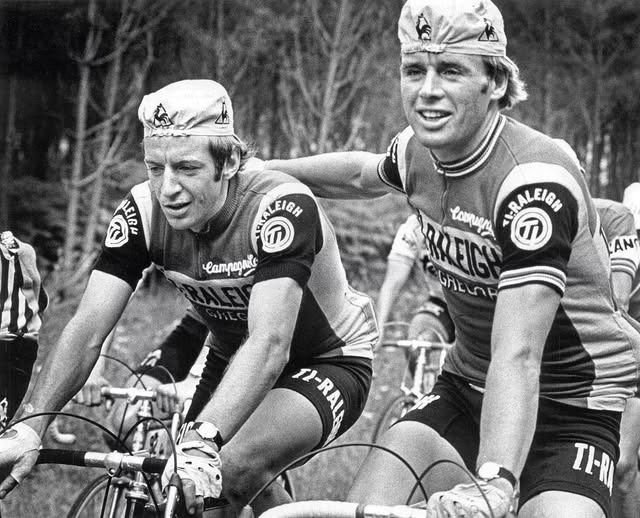
José De Cauwer has occupied several different positions in Belgian cycling without ever fitting neatly into one of them. He was a professional rider from 1973 to 1980, a trusted domestique, a Grand Tour stage winner, a directeur sportif, Belgium’s national coach and later one of the country’s most familiar television voices. His racing palmarès alone does not explain why he remained relevant for so long.
Born in Temse on 25 September 1949, De Cauwer came through an era when Belgian professional cycling was crowded with riders capable of winning hard one-day races but also expected to work for established leaders. His career developed in that environment. He was good enough to take his own results, yet much of his value came from reading races, protecting leaders and doing work that rarely survives in a list of victories.
From Temse to the professional peloton
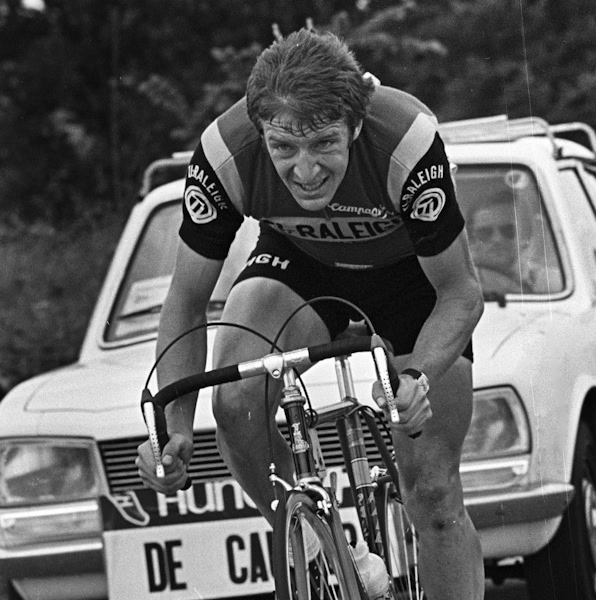
De Cauwer raced the Tour de l’Avenir as an amateur in 1970 and turned professional in 1973. His early seasons established the pattern of his career. He was competitive in Belgian and northern French races, finishing second in the 1974 Grand Prix de Denain and third in the 1975 Omloop Het Volk, while also becoming useful across stage races and the cobbled calendar.
Paris-Roubaix provided one of his better Monument results when he finished 12th in 1975. That placing is useful context. De Cauwer was not simply a rider hanging on to a place in the professional bunch. He could survive the races that defined Belgian cycling, but his career increasingly moved towards the role of a high-level domestique rather than a protected Classics leader.
He rode five Tours de France between 1975 and 1979 and finished all five. His best overall result was 46th in 1977, a year in which his work for Hennie Kuiper mattered far more than his own classification. Kuiper finished second to Bernard Thévenet, and De Cauwer became closely associated with the Dutchman’s Tour campaigns.
A Vuelta stage win and life as a super-domestique
The clearest individual success of De Cauwer’s career came at the 1976 Vuelta a España. He won a stage and spent three days leading the race. Two years later he added a stage of the Tour of Belgium. He also shared in team time-trial victories at the Tour de France with TI-Raleigh, a team that became one of the reference points for collective organisation in that period.
Those results sit alongside the work for Kuiper. De Cauwer has often been described as a super-domestique, a label that makes sense when his career is viewed as a whole. He could get deep enough into major races to be useful when the pressure was highest, and he understood the difference between having the legs to ride for himself and having a job that improved somebody else’s chance of winning.
Modern databases naturally favour wins, podiums and classifications, while much of a domestique’s contribution disappears. De Cauwer’s five completed Tours, his work around Kuiper and his own results show why teams continued to value him through eight professional seasons. He retired from racing after 1980 with a modest win total but a substantial education in how successful teams functioned.
The move into the team car
De Cauwer’s second career gave his reputation a different scale. As a directeur sportif with ADR, he was involved in a team that produced an extraordinary sequence of results. In 1988 Eddy Planckaert won the Tour of Flanders and the Tour de France points classification, while Dirk Demol won Paris-Roubaix. The following summer put De Cauwer inside a race that became part of Tour folklore.
Greg LeMond arrived at the 1989 Tour de France with uncertainty around both his form and his team. ADR was not built with the depth of the dominant squads, yet LeMond emerged into a duel with Laurent Fignon that went all the way to the final time trial in Paris. His eight-second victory remains the smallest winning margin in Tour history. Our Greg LeMond rider history looks in more detail at the comeback and the 1989 Tour.
ADR also contained a young Johan Museeuw, who would go on to become one of Belgium’s defining Classics riders. That made the team an unusual meeting point between generations. De Cauwer had raced in the Merckx-era peloton, was directing LeMond at the peak of his comeback, and was watching the early development of a rider who would shape Belgian racing through the 1990s.
Belgium’s national coach
De Cauwer later moved into the Belgian federation structure, initially working with younger riders before taking responsibility for the professional national team. The job carries unusual weight in Belgium. World Championships selection is scrutinised closely, leadership disputes can dominate the build-up, and a national coach has to turn riders who spend most of the season as rivals into a functioning one-day team.
His period with the federation included several major championship results across age groups. Jurgen Van Den Broeck won the junior time trial world title in 2001, Johan Vansummeren took silver in the under-23 road race in 2003, and Peter Van Petegem earned elite road-race bronze at the same Hamilton championships. Axel Merckx then took Olympic road-race bronze in Athens in 2004.
The defining result came in Madrid in 2005. Tom Boonen arrived as one of the obvious favourites after winning both the Tour of Flanders and Paris-Roubaix earlier that season. Belgium delivered him to the decisive sprint and Boonen won the rainbow jersey. De Cauwer stepped down as national coach after the victory. The broader lineage of rainbow-jersey winners can be followed in our World Championships winners and records guide.
Why De Cauwer became such a recognisable television voice
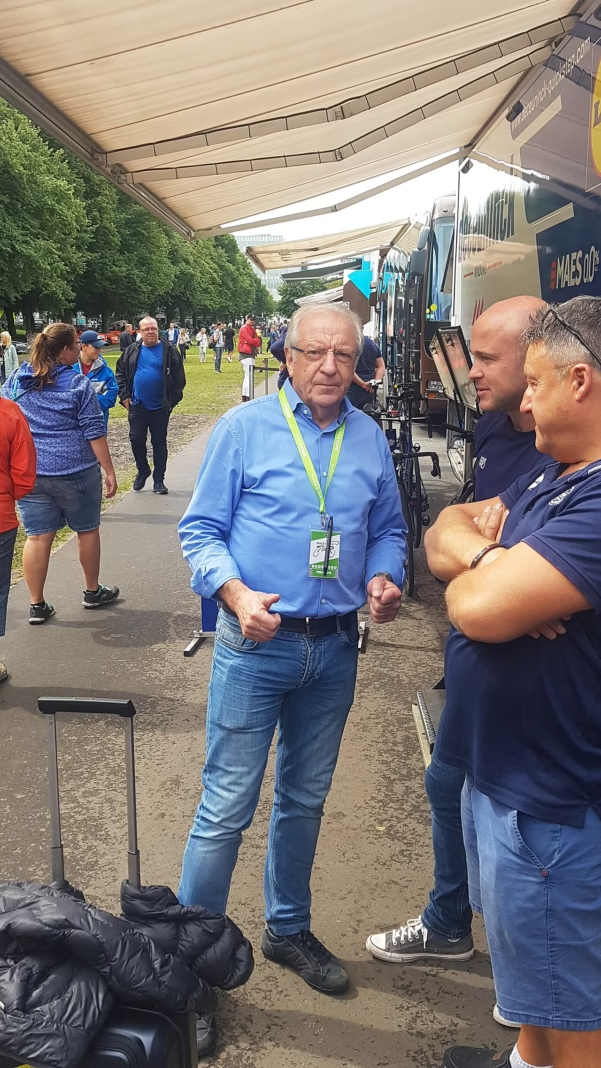
For a later generation of Belgian cycling followers, De Cauwer is as familiar from broadcasting as he ever was from racing or management. His work as a co-commentator for VRT gave him another way to use the same experience. He had seen races from inside the bunch and from the team car, and he had dealt with national-team politics as well as the mechanics of building a championship plan.
That background changes the way a former professional can explain a race. A commentator who has only raced can describe the physical and positional demands, while a former director can add what teams are likely to know, what information reaches the car and why a move that looks irrational on television may make sense within a team plan. De Cauwer had both perspectives before becoming a long-term broadcaster.
His longevity also gave him an unusually broad frame of reference. He raced the Tour in the 1970s, directed in the 1980s and 1990s, worked with Belgium through the rise of Boonen and then analysed a sport transformed by radios, power meters, increasingly specialised preparation and a much more international calendar.
A career better understood through influence than statistics
De Cauwer’s rider statistics are respectable rather than overwhelming: a Vuelta stage, a Tour of Belgium stage, five completed Tours and strong one-day placings. If his story ended in 1980, he would be remembered mainly as a capable Belgian professional and an important lieutenant for Kuiper. Everything that followed altered the scale of that career.
He was present in the ADR car when LeMond completed his 1989 Tour comeback, helped guide Belgian national teams through a productive championship period and finished his spell as elite selector with Boonen becoming world champion. Broadcasting then kept him close to the sport long after most of his contemporaries had disappeared from its daily conversation.
That makes De Cauwer a useful bridge across several eras of men’s professional cycling. His story links the domestique culture of the 1970s with the increasingly organised team structures of the 1980s, the tactical pressures of national-team management and the modern business of explaining races live to a knowledgeable audience.

