
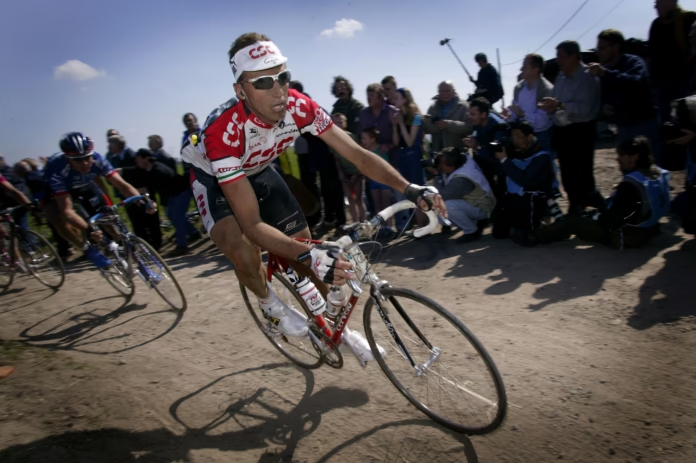
Andrea Tafi looked as though he had been designed for Paris-Roubaix.
The Tuscan was powerful enough to drive across broken pavé for hour after hour, aggressive enough to attack before a race settled into an obvious finish and stubborn enough to keep going once the gaps had opened. At Mapei, surrounded by some of the finest Classics riders of the 1990s, those qualities made him far more than another strong domestique.
Tafi won three different Monuments: Il Lombardia in 1996, Paris-Roubaix in 1999 and the Tour of Flanders in 2002. He also won Paris-Tours, the Italian road championship and several other major one-day races.
That range is important. Tafi is remembered primarily as a cobbled specialist, and understandably so, but his palmarès stretches much further than northern France and Flanders.
Even so, Paris-Roubaix remains the race that explains him best.
ProCyclingUK’s history of men’s Paris-Roubaix is filled with riders whose careers became inseparable from the cobbles. Tafi belongs firmly in that group.
 Photo Credit: AFP/Pascal Pavani
From Tuscany to the northern Classics
Tafi was born in Fucecchio, Tuscany, in 1966 and turned professional in 1989.
Nothing about his geography made him an obvious future specialist in Belgian and northern French racing. Italy had its own deep one-day culture, but the cobbled Classics demanded different skills: positioning before sectors, confidence on poor surfaces, repeated high-power accelerations and the ability to keep producing force after six hours of racing.
Tafi gradually proved unusually well suited to all of it.
He also had more range than the image of a heavy cobbles rider might suggest. During the first half of the 1990s he collected victories in Italian one-day races and gradually became more important within the Mapei structure.
By the middle of the decade, he was part of a Classics team unlike almost anything the sport had seen before.
Mapei gave Tafi both opportunity and competition
Understanding Tafi means understanding Mapei.
The team contained Johan Museeuw, Franco Ballerini, Gianluca Bortolami, Wilfried Peeters, Michele Bartoli and, later, Paolo Bettini among a roster deep enough to turn the biggest one-day races into internal tactical contests.
ProCyclingUK’s Mapei team history looks at how completely the squad came to dominate the spring.
For Tafi, that strength worked both ways.
He benefited from having several team-mates capable of forcing selections and neutralising attacks. He also had to earn opportunities in a squad where almost every rider around him had the ability to win.
Paris-Roubaix demonstrated both sides better than anywhere else.
Paris-Roubaix 1996 showed how strong Tafi already was
The centenary edition of Paris-Roubaix in 1996 produced one of the most famous team performances in Classics history.
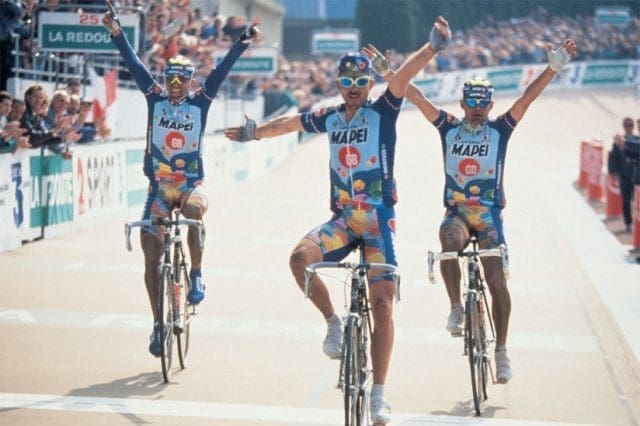
With around 86km remaining, four Mapei riders moved clear: Museeuw, Bortolami, Tafi and defending champion Ballerini.
Ballerini’s punctures eventually removed him from the front, leaving Museeuw, Bortolami and Tafi alone.
The result was effectively decided long before Roubaix.
What happened next became controversial.
Mapei managing director Giorgio Squinzi contacted team management and instructed that Museeuw should win. Tafi and Bortolami complied, eventually waiting when Museeuw punctured before entering the velodrome together.
Museeuw crossed first, Bortolami second and Tafi third.
Our flashback to Mapei’s 1996 Paris-Roubaix podium sweep revisits one of the most extraordinary demonstrations of collective strength the race has produced.
For Tafi, third place did not tell the full story.
He had been one of the three strongest riders in Paris-Roubaix and knew it.

Il Lombardia was actually Tafi’s first Monument
One important part of Tafi’s career is often obscured by his later cobbled victories.
His first Monument was not the Tour of Flanders.
It was Il Lombardia in 1996.
That victory arrived six months after the Mapei domination at Roubaix and showed that Tafi could win on completely different terrain.
Lombardia rewards repeated climbing, technical descending and the ability to remain strong after a long season. It bears very little resemblance to Paris-Roubaix.
Tafi nevertheless won both types of race at the highest level.
His Lombardia victory also came during an excellent autumn in which he won Paris-Brussels, Giro del Lazio, Trofeo Melinda and Coppa Placci.
The idea that Tafi was simply a large rider who happened to be good on cobbles never really fitted the evidence.
He was an unusually durable one-day racer.
Second at Roubaix in 1998
Two years after the famous 1996 result, Tafi returned to the Paris-Roubaix podium.
Once again, Mapei occupied every position.
This time Ballerini produced a dominant solo victory, finishing more than four minutes ahead of Tafi. Peeters completed the podium a few seconds later.
Ballerini’s own place within that period is covered in ProCyclingUK’s look at his two Paris-Roubaix victories and wider legacy.
For Tafi, the progression at Roubaix was becoming difficult to ignore.
Third in 1996.
Second in 1998.
The obvious position remained.
Paris-Roubaix 1999 was finally Tafi’s race
On 11 April 1999, Tafi got his turn.
The race covered 273km, and unlike some of the famously wet editions of Paris-Roubaix, conditions were relatively normal: fine during the morning before becoming cool and overcast.
Tafi did not need mud to make the race difficult.
He escaped from a seven-rider group with 29km remaining and committed completely.
That was the version of Tafi that suited Roubaix best. He did not wait for a sprint or attempt to manage several rivals inside the final kilometres. Once the opportunity appeared, he turned the remainder of the race into a test of whether anybody could catch him.
Nobody did.
Tafi reached the Roubaix velodrome alone and won by 2:14 over Wilfried Peeters, with Tom Steels third at 2:26.
Mapei had completed another 1-2-3, its third in four editions.
This time there was no discussion over team orders and no stronger team-mate ahead of him.
Tafi had won Paris-Roubaix exactly as he wanted to win it: alone.
 Photo Credit: Getty
Why Paris-Roubaix fitted Tafi so well
Tafi’s nickname, Il Gladiatore, became particularly appropriate in northern France.
There was a visible physicality to the way he raced. He did not float over cobbles. He attacked them.
But strength alone does not explain a Paris-Roubaix winner.
The race requires positioning before every major sector, enough technical confidence to maintain momentum over uneven stones and the judgement to know which attacks matter after 200km of attrition.
Tafi could do all of that.
Most importantly, he was comfortable committing from distance.
That mattered during a period when Mapei’s numerical superiority meant rivals often had several threats to monitor. If one rider attacked, another could sit behind. Chase Tafi too aggressively and Museeuw or Ballerini might counter.
Fail to chase him and Tafi was capable of doing exactly what he did in 1999.
Tafi was much more than a Roubaix specialist
The Paris-Roubaix victory is the centrepiece, but it should not flatten the rest of his career.
Tafi became Italian road champion in 1998, wearing the tricolore through the season that led into his Roubaix victory.
In 2000, he won Paris-Tours, another World Cup race but one demanding very different tactics from Roubaix.
The victory added to a collection of major one-day wins that already included Lombardia, the Wincanton Classic and multiple Italian semi-Classics.
Tafi was rarely a contender in Grand Tour general classifications and was never supposed to be.
His strength was surviving races long enough to turn endurance into aggression.
The harder and longer the day became, the more useful that characteristic was.
Tour of Flanders finally arrived in 2002
Tafi was 35 when he won the 2002 Tour of Flanders.
The timing made the victory particularly satisfying.
By then, his Paris-Roubaix triumph was three years old and Mapei itself was approaching the end of its time in professional cycling.
The final selection contained Tafi, Museeuw, Peter Van Petegem, George Hincapie and Tafi’s Mapei team-mate Daniele Nardello.
Museeuw and Van Petegem repeatedly tested one another but could not get clear.
Tafi waited.
With around four kilometres remaining, he attacked.
The hesitation behind was brief but decisive. Nardello’s presence complicated the chase, while Museeuw and Van Petegem were reluctant to do all the work for one another.
Tafi kept going and crossed the line 21 seconds ahead of Museeuw, with Van Petegem third.
It was his third Monument.
The beginner’s guide to the men’s Ronde van Vlaanderen explains the combination of cobbled climbs, positioning and endurance needed to win the race. Tafi had been built around precisely those qualities for years.
Flanders was simply the last major confirmation.
Three Monuments on completely different terrain
Tafi’s three Monument victories deserve to be viewed together.
Il Lombardia, 1996 required climbing and endurance.
Paris-Roubaix, 1999 required sustained power across the pavé.
Tour of Flanders, 2002 required a mixture of cobbled climbing, positioning and tactical judgement.
Very few riders win across that range.
Tafi never accumulated the total Monument numbers of Museeuw or Bartoli, but his victories were unusually varied.
They also came six years apart, demonstrating how long he remained capable of winning at the highest level.
-
 Photo Credit: A.S.O./Billy Ceusters
Andrea Tafi’s major career victories
The results that best define Tafi include:
- 1996 Il Lombardia
- 1999 Paris-Roubaix
- 2002 Tour of Flanders
- 2000 Paris-Tours
- 1998 Italian road championship
- 1997 Wincanton Classic
- 1996 Paris-Brussels
- 1994 and 1997 Grand Prix de Fourmies
- Three Giro del Lazio victories
- Second at Paris-Roubaix in 1998
- Third at Paris-Roubaix in 1996
That list makes the Roubaix reputation understandable without making it exclusive.
A rider who looked right on the pavé
Tafi retired in 2005, but Paris-Roubaix never really stopped being attached to him.
Years later, he even explored the possibility of returning to the race at 52 to mark the 20th anniversary of his victory. The comeback never happened, but the idea itself felt entirely in character.
Roubaix had become part of Tafi’s identity.
He had stood on its podium while Mapei dictated the order in 1996, finished second behind Ballerini in another team sweep in 1998 and then returned in 1999 to make certain there was no question about who should win.
Three Monument victories show that Andrea Tafi was more versatile than the label of cobbled specialist suggests.
Paris-Roubaix still feels like his race.
Not because it was the only place he could win, but because nowhere else matched his strengths so completely.

