
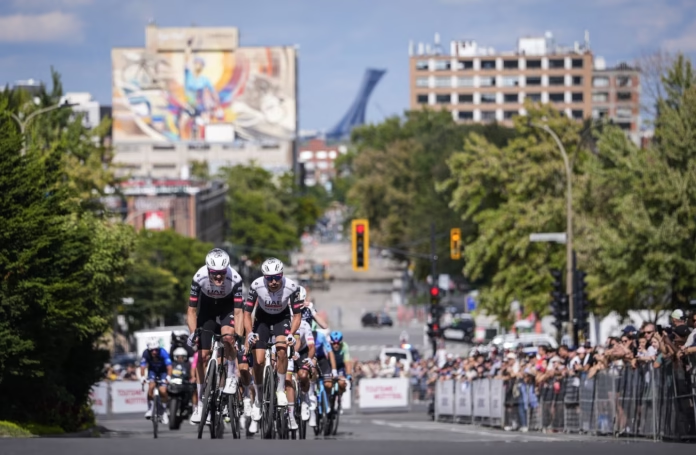
The Grand Prix Cycliste de Montréal is normally the harder half of Canada’s WorldTour double-header. In 2026 the difference is particularly clear. Sunday’s race covers 214.4km across 16 laps of the new 13.4km Mount Royal circuit, accumulating approximately 4,304 metres of climbing through repeated ascents of Camillien-Houde, Côte de la Polytechnique and Avenue Pagnuelo.
That changes the team calculations from Friday’s GP Québec. A durable sprinter can still survive Québec and wait for the uphill finish. Montréal requires much more climbing strength, particularly once the race reaches the final three or four laps and riders who coped comfortably earlier begin disappearing. The GP Montréal 2026 route guide breaks down how the repeated climbs and new urban section fit together.
There is another reason for such a strong field. The UCI Road World Championships begin in Montréal on 20 September, with the elite men’s road race on 27 September. That race will use 12 laps of the same Mount Royal circuit after its opening section through Montérégie. Sunday is therefore the only opportunity for many of the rainbow jersey contenders to race those roads at full intensity before Worlds.
Tadej Pogačar’s season-ending Vuelta crash removes the rider who won here in 2022 and 2024, while Mathieu van der Poel has chosen the Tour de Luxembourg rather than the Canadian races for his Worlds preparation. That leaves Remco Evenepoel, Isaac del Toro, Paul Seixas, Tom Pidcock, Brandon McNulty and Juan Ayuso among the strongest riders testing themselves on Mount Royal.
For UK viewers, our GP Montréal 2026 live viewing guide has the broadcast schedule and the best times to tune in.
Why Montréal requires a different team plan
The individual climbs are not enormous, but their repetition changes the race. Camillien-Houde is approximately 1.8km at 8%, Polytechnique contains around 200 metres above 11% and Pagnuelo adds another 534 metres at roughly 7.5%. By three laps to go, the peloton has already accumulated more climbing than many major one-day races contain in total.
Teams therefore need to preserve riders for longer than they might in Québec. A domestique used repeatedly to control attacks during the opening 150km may disappear exactly when the leader needs support. Equally, protecting seven riders all afternoon is pointless if the strongest teams begin attacking with 40km remaining and nobody is prepared to follow.
UAE Team Emirates-XRG have the deepest collection of potential winners, which places pressure on everyone else. The most important tactical question may be how many teams can still put two riders into the decisive group when UAE begin using their numbers.
 Photo Credit: Getty
UAE Team Emirates-XRG
Key riders: Isaac del Toro, Brandon McNulty, Jhonatan Narváez, Tim Wellens, Adam Yates
UAE arrive with the strongest squad and the defending champion. Brandon McNulty won here in 2025 after he and Tadej Pogačar eventually rode away from Quinn Simmons and Neilson Powless, continuing a remarkable run that has seen UAE win every edition since 2022.
McNulty can therefore be treated as a genuine winning option rather than simply support for Isaac del Toro. That matters because Del Toro is arguably their strongest rider on current form. His 2026 season has established him among the best stage racers in the world, and Montréal’s repeated climbing suits a rider capable of producing hard accelerations after several hours of attrition.
The rest of the roster makes choosing one leader unnecessary. Jhonatan Narváez can survive a hard race and still finish quickly. Tim Wellens is particularly effective on repeated short climbs, while Adam Yates gives them another genuine climber who cannot simply be given freedom. Florian Vermeersch and Felix Großschartner add further strength.
The ideal UAE race is one where other teams are forced to chase them. McNulty attacking with two laps remaining is not obviously a decoy. Neither is Narváez or Wellens moving ahead before Del Toro. If two UAE riders reach the final circuit in a group of eight or ten, the tactical advantage becomes substantial.
Red Bull-Bora-hansgrohe
Key riders: Remco Evenepoel, Maxim Van Gils
Remco Evenepoel has perhaps the clearest individual route to disrupting UAE’s numerical advantage.
Montréal offers him more scope than Québec for a sustained attack because the climbing gradually removes organised chasers. Waiting until the final few hundred metres would leave him racing against riders with more explosive finishes, so Red Bull-Bora-hansgrohe should want the decisive phase to begin well before Avenue du Parc.
Camillien-Houde is the obvious place for Evenepoel to apply sustained pressure, but the better move may come after the summit. Riders expecting attacks on the recognised climbs can become vulnerable when somebody continues pushing through the transition rather than sitting up to recover.
Maxim Van Gils gives Red Bull a useful second card. He is quicker than Evenepoel from a small group and can afford to wait while his team-mate attacks. That prevents rivals from assuming every Evenepoel move must be chased immediately by Red Bull if it comes back.
The World Championships provide useful context without changing the basic objective. Evenepoel will learn where the circuit is most selective, but winning Montréal would be significant in its own right. There is little reason for him to hide his condition two weeks before the rainbow jersey is decided.
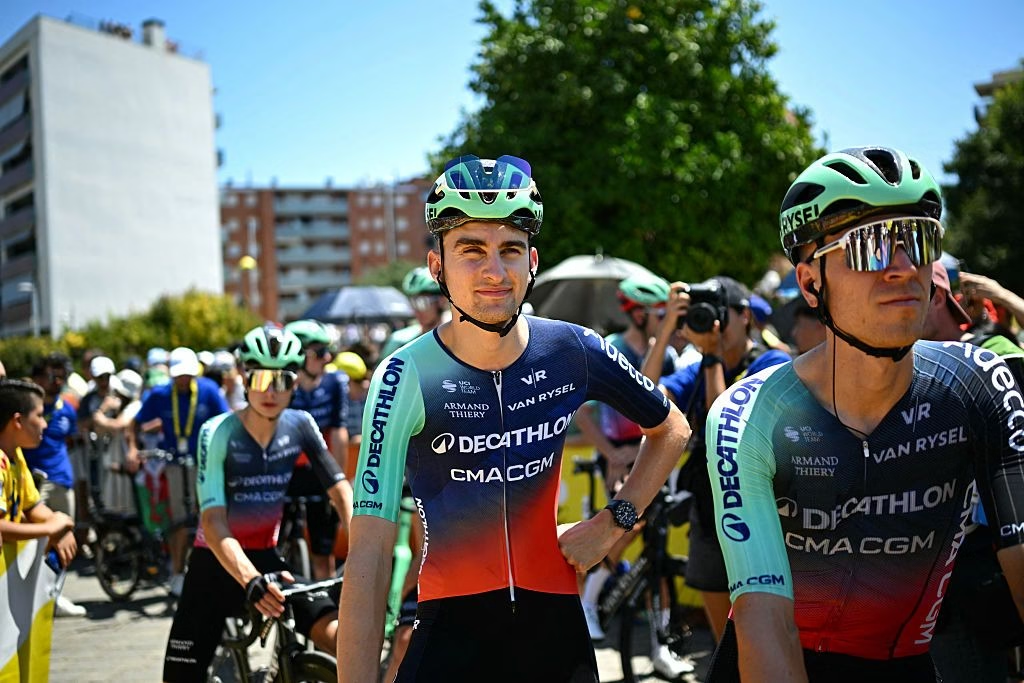
Decathlon CMA CGM Team
Key riders: Paul Seixas, Tiesj Benoot, Paul Lapeira
Montréal looks considerably better for Paul Seixas than Québec.
The 19-year-old has already shown in 2026 that his age is no barrier to winning major races, and more than 4,300 metres of climbing pushes Sunday’s race firmly towards his strongest qualities. He does not need one long mountain ascent. Repeated hard climbs and a progressively smaller group suit him just as well.
Decathlon’s problem is UAE’s depth. If Seixas has to personally respond to Del Toro, McNulty, Narváez and Yates, his race can be lost even if none of those attacks succeeds. Tiesj Benoot is therefore particularly important. He can follow dangerous moves, drive the pace himself and give Seixas someone to use tactically rather than leaving him isolated against several UAE riders.
Paul Lapeira provides the alternative if the race proves less selective than expected. A larger finishing group is better for him than Seixas, while Nicolas Prodhomme gives the team another strong climber.
Decathlon should not rush to nominate one fixed plan. If the repeated climbs eliminate the quicker riders, everything can move towards Seixas. If 25 or 30 riders remain late, keeping Lapeira available gives them another way to finish the race.
Pinarello-Q36.5 Pro Cycling Team
Key riders: Tom Pidcock, Quinten Hermans
Tom Pidcock arrives with immediate evidence of form after winning GP Industria & Artigianato at Larciano. Montréal suits him better than many 4,300-metre climbing races would because the difficulty comes through short efforts, technical transitions and repeated changes of pace rather than one extended mountain.
Pidcock can win in several ways. He can follow an acceleration from Evenepoel or Del Toro, attack himself on Polytechnique or Pagnuelo, or wait for a small-group finish if the strongest climbers fail to create full separation.
That makes overprotecting him unnecessary. Pinarello-Q36.5 should benefit from allowing Pidcock to read the race rather than forcing every decision through a rigid plan.
Quinten Hermans provides useful support because his own characteristics fit the circuit. He can survive repeated short climbs and has enough one-day experience to occupy a dangerous move rather than simply work until Pidcock is isolated.
The team’s difficulty is numbers relative to UAE and Lidl-Trek. Pidcock may ultimately need to decide which attacks deserve his energy because chasing all of them is impossible.
 Photo Credit: Getty
Lidl-Trek
Key riders: Juan Ayuso, Giulio Ciccone, Quinn Simmons, Derek Gee-West
Lidl-Trek arguably have the strongest collection of alternatives to UAE.
Juan Ayuso provides their highest-level climbing option, Giulio Ciccone should welcome a race containing more than 4,000 metres of ascent and Quinn Simmons has already shown exactly how useful an anticipatory attack can be in Montréal. He finished third here in 2025 after making the decisive four-rider move with McNulty, Pogačar and Powless.
That experience makes Simmons especially valuable. He does not need to wait until the final Camillien-Houde ascent and may actually be more dangerous moving with 30 or 40km remaining, before the bigger favourites are prepared to commit.
Ayuso and Ciccone can then remain behind and make other teams chase.
Derek Gee-West adds another strong engine for a difficult one-day race, while Matteo Sobrero and Toms Skujiņš increase the team’s depth further.
Their strength is that no single rider has to cover everything. A Simmons attack can be genuine rather than sacrificial. If it fails, Ayuso and Ciccone still have their race. Against UAE, that ability to place credible threats into different moves is essential.
Team Visma | Lease a Bike
Key riders: Matteo Jorgenson, Louis Barré, Bart Lemmen
Matteo Jorgenson gives Visma | Lease a Bike an obvious leader for a long, attritional race, but waiting until the finish is unlikely to maximise his chances.
Jorgenson is at his best when endurance and repeated climbing reduce the field, yet he does not possess the sprint of Pidcock or Van Gils if a small group reaches Avenue du Parc together. Visma therefore need separation rather than simply survival.
Louis Barré is particularly useful because he gives the team another rider who can remain competitive when the race becomes selective. Bart Lemmen and Wilco Kelderman add further climbing strength, while Victor Campenaerts offers the ability to attack before the obvious final moves.
That should encourage Visma to anticipate UAE rather than follow them. A Campenaerts or Barré move before the main favourites attack forces somebody else to make a decision and allows Jorgenson to stay protected.
The worst outcome would be reaching the final lap with Jorgenson isolated alongside two or three UAE riders. Their entire tactical effort should be aimed at preventing that scenario.
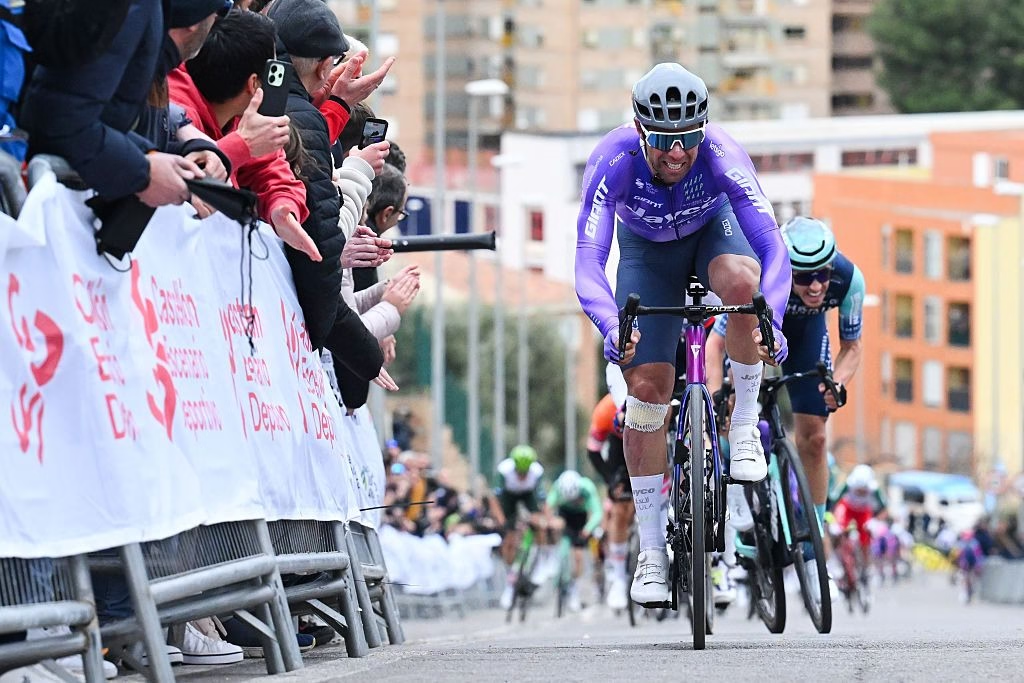 Photo Credit: Getty
Team Jayco AlUla
Key riders: Michael Matthews, Mauro Schmid
Michael Matthews is the clearest rider trying to keep Montréal from becoming too difficult.
He won here in 2018 and remains one of the best riders in the peloton at retaining a sprint after substantial climbing. The problem is that recent editions have moved increasingly towards genuine climbers. Pogačar won in 2022 and 2024, Adam Yates in 2023 and McNulty in 2025.
The revised 2026 route still offers Matthews a chance, but almost every rival knows that taking him into the final kilometre is dangerous.
Jayco therefore face a difficult balancing act. They cannot chase every move from 50km out because doing so would strip Matthews of the support he needs later. They also cannot allow a group containing Del Toro, Evenepoel, McNulty or Pidcock to gain 30 seconds and assume it will return naturally.
Mauro Schmid gives them a useful way around that problem. He can follow attacks rather than forcing Jayco to close them, and he is strong enough to become a genuine contender if the move survives.
Matthews needs a difficult race that remains controlled. Everyone else has an incentive to push it just beyond that point.
EF Education-EasyPost
Key riders: Ben Healy, Kasper Asgreen
Neilson Powless finished fourth here in 2025 after joining the decisive move, but EF arrive with a different attacking card this year through Ben Healy.
Few riders in the field are better suited to a finale where the tactical structure begins breaking apart. Healy does not want a neat sprint or a final climb approached with every major favourite still surrounded by team-mates. He wants gaps, hesitation and riders making individual decisions.
Montréal provides enough terrain for that to happen.
Kasper Asgreen can be particularly useful before Healy commits. An attack from a rider with Asgreen’s engine cannot simply be ignored, especially on the flatter transitions between climbs where a powerful move can gain ground while the favourites watch each other.
Alex Baudin and Sean Quinn give EF further options to survive into the final hour.
They do not have UAE’s depth, but they do not need to control the race. Their best chance comes from being represented when somebody else’s control fails.
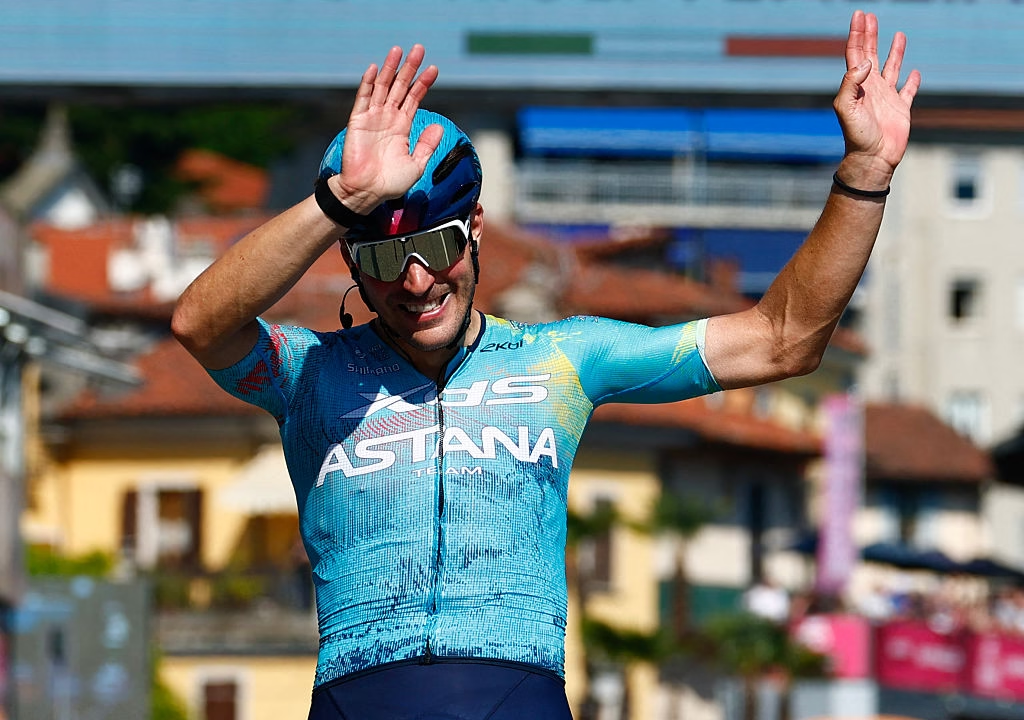
XDS Astana Team
Key riders: Alberto Bettiol, Sergio Higuita, Harold Martín López
Alberto Bettiol gives XDS Astana an experienced one-day leader who should be more comfortable racing aggressively than waiting for a final sprint.
The repeated climbing is severe enough to test him, particularly if UAE begin forcing the pace early, but Bettiol has spent his career producing some of his best results when a Classic becomes tactically complicated rather than following a predictable pattern.
Sergio Higuita offers a more climbing-focused option. If the final three laps become too hard for Bettiol’s preferred race, Higuita can survive deeper into the selection and gives Astana a reason not to commit everything to one leader.
Harold Martín López adds another climber, while Arjen Livyns can contribute earlier in the race.
Their opportunity is likely to come from timing rather than control. Nobody expects Astana to carry responsibility with UAE, Red Bull and Decathlon present. That allows them to let stronger teams spend riders before using Bettiol or Higuita when the race has already narrowed.
Bahrain Victorious
Key riders: Afonso Eulálio, Alec Segaert, Edoardo Zambanini
Bahrain Victorious bring several riders capable of surviving a hard race but no single name who forces the peloton to organise around them.
That can be useful in Montréal.
Afonso Eulálio gives them the strongest climbing profile, while Alec Segaert has the power to attack during the transitions and Edoardo Zambanini provides more finishing speed if the selection remains larger.
Those different qualities should push Bahrain away from simply protecting one rider all afternoon. If Segaert gets into a dangerous group before the final two laps, teams with stronger favourites have to decide whether to chase. If the move returns, Eulálio and Zambanini can still remain available.
The crucial point is entering the last 40km with options. Bahrain are unlikely to beat UAE by trying to match their pace-setting from the front. They can make themselves much harder to manage by forcing UAE to account for different riders in different situations.
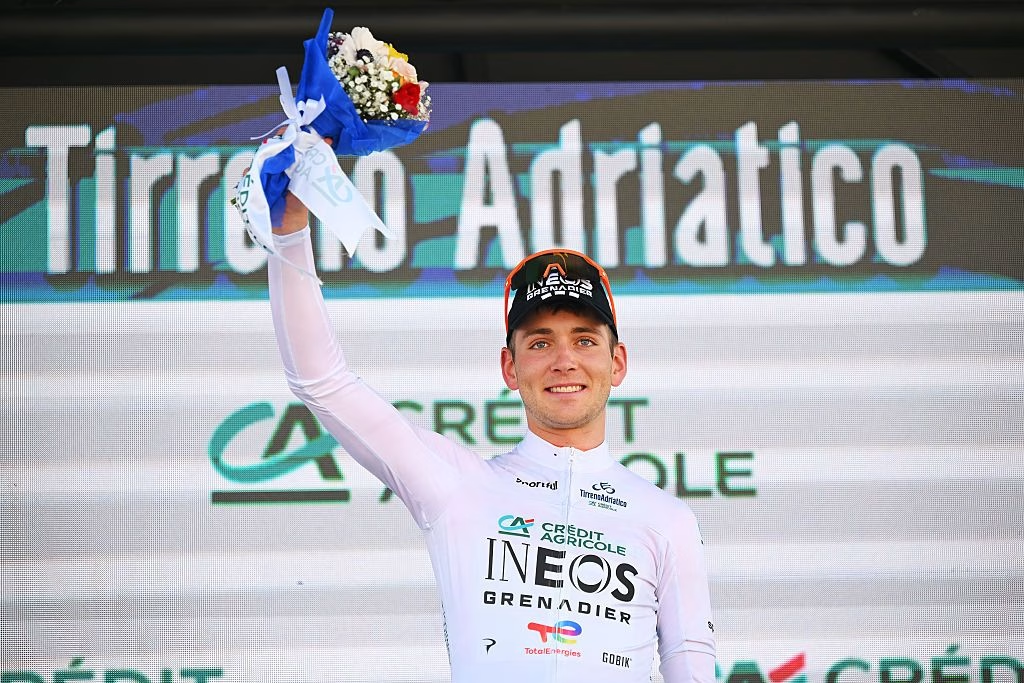 Photo Credit: Getty
Netcompany INEOS
Key riders: Magnus Sheffield, Michał Kwiatkowski, Thymen Arensman
Netcompany INEOS arrive with an unusually balanced group.
Magnus Sheffield has the power and climbing ability for an aggressive one-day race, Michał Kwiatkowski brings enormous Classics experience and Thymen Arensman gives them a rider capable of handling the accumulated elevation if the race becomes particularly selective. Tobias Foss adds another strong engine.
What they lack is one obvious rider who begins among the top three favourites. That should encourage them to use the depth rather than concentrate everything around a single leader.
Kwiatkowski is particularly valuable tactically. He has spent more than a decade reading races where committing at the wrong moment can be as costly as not attacking at all. Sheffield can provide the more direct aggression once the field starts thinning.
INEOS need to avoid becoming a team with three riders in a 20-man group who all wait for Evenepoel or Del Toro to move. Their numbers only matter if they use them before everyone else is reduced to isolated leaders.
Soudal Quick-Step
Key riders: Ilan Van Wilder, Maximilian Schachmann, Steff Cras
Soudal Quick-Step arrive without the obvious race-defining leader they would once have had through Evenepoel, but their seven-rider group is well suited to a hard Montréal.
Ilan Van Wilder has the climbing strength to survive late, while Maximilian Schachmann brings a stronger one-day racing profile and Steff Cras adds another option if the race becomes especially difficult. Louis Vervaeke can help keep those riders positioned through the repeated climbing.
The lack of one overwhelming leader may actually make their tactics simpler.
Soudal have no reason to spend 180km protecting one rider for a finish against Del Toro, Pidcock or Van Gils. They can use the final four or five laps to enter moves and see which option develops.
Schachmann may be particularly useful in that role. A powerful attack between the recognised climbs can force other teams to chase without requiring Van Wilder to expose himself.
Their race should be built around participation rather than reaction.

Lotto-Intermarché
Key riders: Lennert Van Eetvelt, Jenno Berckmoes
Arnaud De Lie’s withdrawal through illness changes the Canadian weekend considerably for Lotto-Intermarché.
De Lie would have been much better suited to Québec, where his ability to survive short climbs and sprint uphill made him a genuine favourite. Montréal was always the more difficult challenge, but his absence removes the temptation to keep the race organised for a fast finish. Our update on De Lie missing GP Québec and GP Montréal covers the illness setback.
Lennert Van Eetvelt now becomes particularly interesting in Montréal. The climbing total is substantial enough to move the race towards his strengths, although the individual ascents remain short enough that positioning and repeated accelerations matter as much as pure climbing.
Jenno Berckmoes gives Lotto another possibility if more riders survive. He has enough speed to finish from a reduced group and does not require the same aggressive scenario as Van Eetvelt.
That leaves Lotto free to follow the race rather than control it. Van Eetvelt can attack if the climbing becomes selective, while Berckmoes remains useful if it does not.
Groupama-FDJ United
Key riders: Ewen Costiou, Quentin Pacher, Thibaud Gruel
Groupama-FDJ United should gain more from retaining several riders late than from committing to one designated leader from the start.
Ewen Costiou and Quentin Pacher both suit a race where the final hour becomes attritional and attacks begin before the last lap. Neither needs to wait for the finishing straight, while Thibaud Gruel gives the team a quicker option if a larger group remains together.
The French-speaking setting adds visibility, but there is little value in simply placing somebody into the early break for that reason. Groupama have enough quality to aim further into the race.
Their opportunity may come around laps 13 and 14. By then the opening support riders from the stronger squads should be disappearing, yet Evenepoel, Del Toro and Seixas may still be reluctant to personally close every attack.
That is where Costiou or Pacher needs to be willing to commit.

Movistar Team
Key riders: Davide Formolo, Pelayo Sánchez, Michel Hessmann
Montréal suits Movistar considerably better than a race built around a conventional sprint.
Davide Formolo is the most obvious attacking option. His chances increase as the race becomes harder, but he is unlikely to beat the fastest remaining riders if everything comes back together for Avenue du Parc. He therefore needs movement before the final kilometres.
Pelayo Sánchez offers another strong one-day option, while Michel Hessmann can contribute as the group begins shrinking.
Movistar should be particularly interested in the phase immediately after Camillien-Houde. The obvious attacks will often come on the climb itself, but a rider prepared to continue once everyone briefly looks for recovery can create separation without needing to outclimb Evenepoel or Seixas directly.
That type of anticipation is more realistic than trying to control a 4,300-metre race from the front.
Team Picnic PostNL
Key riders: Frank van den Broek, Warren Barguil, Alexy Faure Prost
Team Picnic PostNL have a roster more likely to benefit from severe attrition than from a large finishing group.
Frank van den Broek is particularly interesting because he combines enough climbing ability to survive a hard race with the willingness to move before the obvious favourites. Warren Barguil brings greater experience and can remain useful if the climbing turns the final laps into a more conventional selection.
Alexy Faure Prost gives them another young climber capable of using the race as more than a survival exercise.
Picnic’s danger is patience. Reaching the final ascent alongside Evenepoel, Del Toro, Seixas and Pidcock without having attempted anything is unlikely to produce their best result.
They need somebody ahead of that moment.

Alpecin-Premier Tech
Key riders: Kaden Groves, Luca Vergallito
Alpecin-Premier Tech’s race changed when Mathieu van der Poel decided to skip Québec and Montréal and prepare for the World Championships through the Tour de Luxembourg instead.
Without him, Alpecin lose one of the few riders who could have started Montréal with a realistic claim to matching the headline favourites. They also lose the responsibility that comes with having him.
Kaden Groves is likely to find 4,304 metres of climbing beyond his ideal range if the race is ridden aggressively, although surviving deeper than expected would immediately make his sprint important. Luca Vergallito offers a more climbing-oriented route.
That should encourage Alpecin to race without waiting for one predetermined finish. They are no longer the team everybody expects to respond when a dangerous move goes.
Using that freedom is more valuable than trying to imitate the strategy they would have used with Van der Poel.
NSN Cycling Team
Key riders: Corbin Strong, Riley Sheehan, Pier-André Côté
Corbin Strong gives NSN Cycling Team a rider who could become increasingly relevant if the climbing is hard without completely breaking the field apart.
Strong has the finish to beat many of the climbers from a reduced group, which means NSN do not necessarily have to help make the race as severe as possible. Their task is allowing other teams to do the hard work without leaving Strong isolated when the important attacks begin.
Riley Sheehan provides a more aggressive option, while Pier-André Côté and Guillaume Boivin bring significant Canadian experience.
That home representation matters, but NSN should be aiming considerably higher than early visibility. Strong is a legitimate WorldTour-level finisher and a group of 15 or 20 reaching the final kilometre gives him a real opportunity.
The difficulty is surviving the final two Camillien-Houde ascents while UAE and Red Bull are actively trying to prevent exactly that scenario.
 Photo Credit: Getty
Uno-X Mobility
Key riders: Anthon Charmig, Ådne Holter, Alexander Kamp
Uno-X Mobility have no reason to wait for the principal favourites to decide how the race should be ridden.
Anthon Charmig arrives with a profile well suited to repeated climbing, while Ådne Holter and Alexander Kamp give the team alternatives for different levels of selection.
Charmig’s recent third place at GP Industria & Artigianato also provides useful evidence that he can compete in a difficult one-day race when the strongest riders begin attacking.
Uno-X’s best results often come from collective positioning rather than waiting behind one protected star. Montréal offers the same opportunity. If they can retain two riders when several larger teams are down to one leader, they can begin attacking rather than simply trying to follow.
That matters particularly in the penultimate lap, when a 26.8km move is long enough to create hesitation but no longer qualifies as speculative.
Tudor Pro Cycling Team
Key riders: Marc Hirschi, Yannis Voisard
Marc Hirschi is one of the most naturally suited riders outside the headline group.
Repeated short climbs, an attritional final hour and the possibility of a reduced sprint all fit his strengths. The problem is that everyone knows it. Hirschi is unlikely to be given much freedom once the race reaches its final two laps.
Tudor therefore need to use the riders around him.
Yannis Voisard offers a climbing option who can move earlier, while Aivaras Mikutis has the power to contribute during the less selective parts of the circuit. If Tudor simply escort Hirschi towards the last Camillien-Houde ascent, he risks being forced to respond to teams with several riders still available.
Their recent Montréal history gives them another reason to be ambitious. Julian Alaphilippe’s victory for Tudor in 2025 at GP Québec showed how effectively the team can use an invitation when it races to win rather than simply occupy the peloton.
Hirschi gives them the rider to attempt the same mentality in Montréal.
Modern Adventure Pro Cycling
Key rider: Stefan de Bod
Modern Adventure Pro Cycling face a different challenge from the WorldTour teams.
Simply making the early break would give the ProTeam valuable exposure, but Montréal also offers an unusually useful measure of how far its strongest riders can survive against one of the deepest fields of the season.
Stefan de Bod is the obvious rider to preserve for that job.
His climbing and time-trial background make him better suited to the accumulated difficulty than many riders from smaller teams, and surviving until the race reaches the final few laps would carry more sporting value than using him purely to establish the day’s first escape.
Modern Adventure can still target the break with another rider. The stronger strategy is keeping de Bod available to see whether he can enter the real race once Mount Royal begins reducing the field.
Team Canada
Key rider: Michael Woods
Michael Woods gives the Canadian national selection a genuine late-race option rather than simply a reason to animate the opening kilometres.
His return comes with the World Championships firmly in mind, and the repeated Mount Royal climbs are well suited to a rider whose career has been built around steep gradients and explosive climbing. The question is race sharpness rather than suitability.
That makes Montréal valuable regardless of the final result, but Woods is too accomplished to treat Sunday solely as preparation.
The rest of the Canadian selection includes Jérôme Gauthier, Samuel Couture, Jacob Roy, Gabriel Seguin, Adam Smith and Jonas Walton. For those riders, getting into the early break is an obvious objective, particularly in front of a home crowd.
Woods should be handled differently. If he can reach the final three laps in the main selection, Canada have a rider capable of responding when the race moves onto the steepest gradients.
Canada are still waiting for a winner of the modern GP Montréal. Ryder Hesjedal came closest with podium finishes in 2010 and 2013.
-
 Photo Credit: Belga/AFP via Getty Images
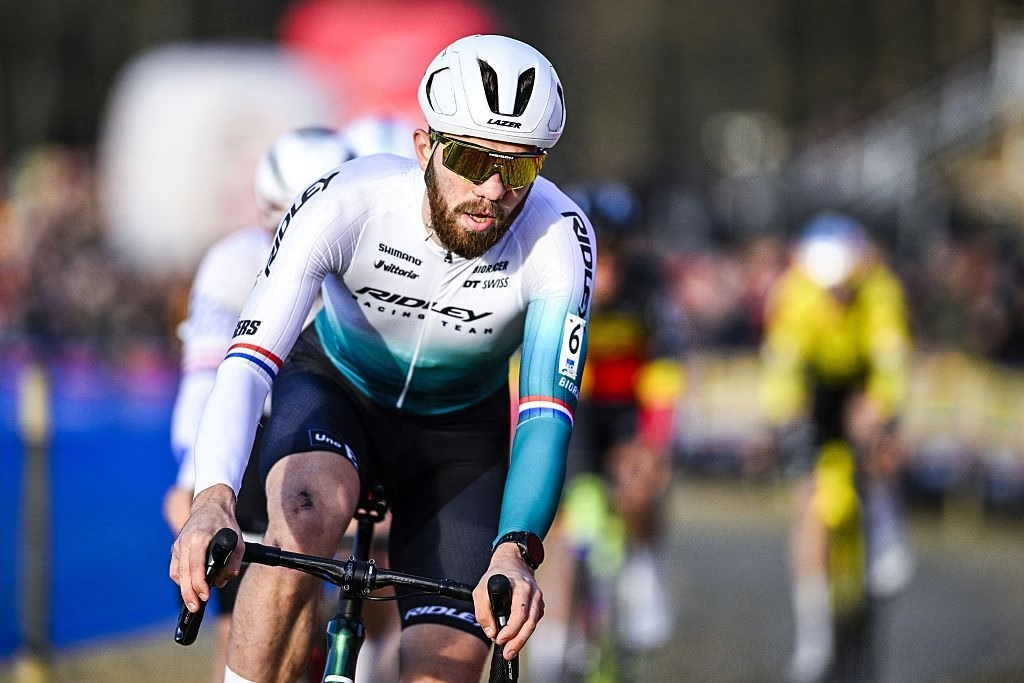

Why UAE’s numbers are the central tactical problem
The individual favourite may be Evenepoel, Del Toro or Seixas depending on how the race develops. The strongest team is easier to identify.
UAE can put several riders into the final 40km without weakening their winning chances.
If McNulty attacks, Del Toro can sit behind. If Del Toro moves, McNulty is the defending champion waiting for somebody else to chase. Narváez, Wellens and Yates are all strong enough that rivals cannot automatically treat their moves as preparation for somebody else.
That forces teams with one clear leader into repeated bad choices.
Evenepoel cannot personally close five UAE attacks. Pidcock cannot follow everything without blunting his own finish. Seixas may be able to match the strongest riders physically but still find himself outnumbered tactically.
Lidl-Trek are probably best equipped to answer through Ayuso, Ciccone and Simmons. Visma have enough depth to anticipate rather than chase. Red Bull have Van Gils alongside Evenepoel.
Those secondary riders could decide the race before the principal favourites ever make their own attacks.
Montréal is the best Worlds test available, but it is not the World Championships
The connection with the World Championships is impossible to ignore.
The Championships begin one week after GP Montréal, while the elite men’s road race takes place exactly two weeks later on Sunday 27 September. Anyone racing this weekend will complete 16 competitive laps of a circuit that will return for 12 decisive laps in the rainbow jersey race.
That provides information unavailable from reconnaissance.
Riders can learn where the bunch compresses before Camillien-Houde, how much energy can be recovered on the descent, how difficult Polytechnique feels after four hours and whether an attack over Pagnuelo can create enough separation before Avenue du Parc.
They will also learn about each other.
If Seixas repeatedly looks comfortable when the pace rises, Belgium and Mexico will notice. If Evenepoel attacks and only Del Toro can follow, every national coach watching will record it. If somebody struggles after 3,500 metres of climbing, two weeks is not a long time to solve the problem.
The beginner’s guide to GP Montréal explains how Mount Royal has shaped the race since its creation in 2010, while the history of the Grand Prix Cycliste de Montréal traces the city’s much older connection with championship cycling.
Sunday still needs to be judged on its own terms.
GP Montréal is a WorldTour victory, not a training session, and its recent winners include Pogačar, Yates and McNulty. The strongest riders have little reason to protect themselves for an event that remains two weeks away.
If anything, the Worlds connection should make the racing harder. Everyone wants to know what the circuit does when the best riders stop saving energy.
By the final three laps, they should have their answer.

