
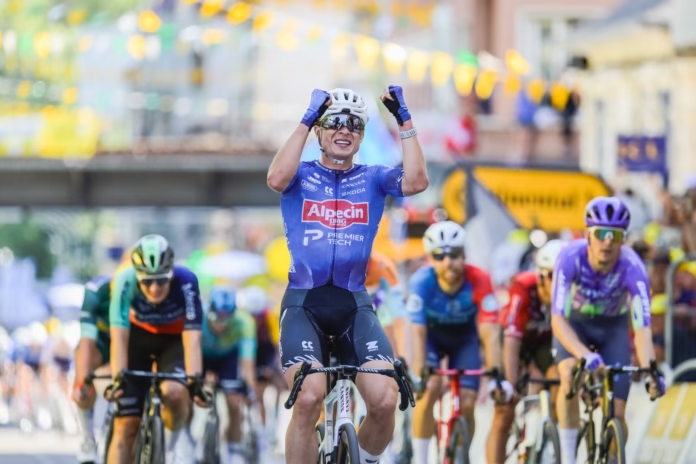
Jasper Philipsen won stage 17 of the 2026 Tour de France in Voiron, finally taking his first victory of this year’s race after Alpecin-Premier Tech turned a wild breakaway stage into a reduced sprint.
The Belgian beat Mauro Schmid and Olav Kooij after a brutal 174.7-kilometre stage from Chambéry that was raced like a classics day from the opening kilometres. Lewis Askey finished fourth for NSN Cycling Team, with Rick Pluimers fifth for Tudor.
Philipsen’s win was his 11th Tour de France stage victory and came after several near misses in this race. More importantly for the green jersey fight, it moved him to within 7 points of Mads Pedersen, who remains in the points lead after taking maximum intermediate sprint points and finishing eighth.
A stage built for chaos
Stage 17 looked like one of the strangest days of the Tour on paper. It was not a high-mountain stage, not a standard sprint stage and not an obvious GC day. Instead, the route packed its climbing into the opening half, with the Côte de Bassa, Côte de Rossillon, Col des Prés and Côte de Saint-Jean d’Arvey all coming before a long run towards Voiron.
That made the stage difficult to read and even harder to control. The early terrain was ideal for a large breakaway, but the final 100 kilometres gave fast riders a reason to believe they could still contest the win if they survived the opening fight.
Tadej Pogačar began the day safely in yellow, with Remco Evenepoel second after his time-trial win in Thonon-les-Bains and Isaac del Toro still in white. For the general classification riders, the main priority was avoiding trouble after a brutal run of mountain stages and the loss of Jonas Vingegaard from the race.
For the sprinters and classics riders, this was something else entirely: probably one of the last realistic chances before the race returned to the high mountains.
Veistroffer and Abrahamsen start the attacks
The stage began exactly as expected, with attacks almost as soon as the flag dropped. Baptiste Veistroffer and Jonas Abrahamsen were the first riders to go clear, continuing the aggressive pattern both riders have shown during this Tour.
They did not get much room. Kasper Asgreen and Marco Haller tried to move across, then a much larger wave of riders followed. The peloton was stretched through Aix-les-Bains, with road furniture and constant accelerations adding to the tension.
Davide Ballerini crashed after a roundabout early in the stage, while more attacks came from Kévin Vauquelin, Ben Healy, Julian Alaphilippe and others. It was already clear that no small, harmless move would be allowed to settle.
The first categorised climb, the Côte de Bassa, only increased the pressure. Vauquelin attacked, Pedersen and Valentin Paret-Peintre moved near the summit, and Paret-Peintre took the first KOM point of the day.
Crashes and splits in a furious opening hour
The early aggression soon brought trouble. A crash in the peloton involved Tom Pidcock, Lenny Martinez, Fred Wright, Marc Hirschi, Rob Stannard, Dylan van Baarle and Alexandre Delettre. Pidcock and Martinez were quickly back up, but Wright appeared more heavily affected, checking a wound on his hand after sliding on the road.
The racing barely paused. Max Walker, Harold Tejada, Ion Izagirre, Anthony Turgis and Healy formed another move on the Côte de Rossillon, only to be brought back as Richard Carapaz took the KOM point over the top.
After 37 kilometres, the race had already covered the ground at around 45km/h, mostly on rising roads, and still had no settled breakaway. Lidl-Trek were among the most active teams, with Pedersen, Quinn Simmons and Mathias Vacek all involved in the early moves.
Their strategy was clear. Pedersen wanted to make the stage hard enough to distance some of the pure sprinters while keeping himself close enough to score heavily in the green jersey battle.
Van der Poel lights the race up
Mathieu van der Poel then entered the action, and that changed the tone of the race. A large group of around 20 riders opened a gap, including Van der Poel, Simmons, Matteo Jorgenson, Josh Tarling, Egan Bernal, Jasper Stuyven, Tiesj Benoot, Pablo Castrillo and Clément Braz Afonso.
Pedersen had missed the initial move and countered alone on the Col des Prés, with George Bennett, Vlad Van Mechelen and Tim Marsman among those trying to go with him. Simmons even dropped back from the front group to help the Dane, but the move came back together near the top after Van der Poel had led over the summit.
The repeated attacking split the race again. At one point, around 40 riders were in the first group, including Pogačar, Evenepoel, Seixas, Ayuso and Skjelmose. Del Toro, Pidcock, Jordan Jegat and Yannis Voisard were in a second group behind before the race later came back together among the main favourites.
That mattered for the overall race, but the day was rapidly becoming about the breakaway and the points battle.
Sixteen riders finally get away
After more than 70 kilometres of attacking, a break finally began to form. Sixteen riders emerged: Per Strand Hagenes, Jai Hindley, Simmons, Baudin, Benoot, Mohorič, Bernal, Tarling, Stuyven, Van der Poel, Engelhardt, Castrillo, Rubio, Braz Afonso, Guillaume Martin-Guyonnet and Pluimers.
It was a powerful group, but it was still not the end of the fight. Decathlon CMA CGM began working behind because Kooij was still in the peloton and had a genuine chance if the stage came back together. Uno-X Mobility also had an interest in Søren Wærenskjold, while Alpecin-Premier Tech had to manage the awkward balance of Van der Poel up front and Philipsen still chasing behind.
Three more riders, Jorgenson, Healy and Mathis Le Berre, bridged across to make 19 leaders. Then Pedersen attacked again, bridged to the front group and immediately lifted the pace.
That was the move that properly reshaped the stage. Pedersen had brought himself into the winning race and put pressure on everyone else.
Sprinters chase behind Pedersen
Once Pedersen joined the leaders, counter-attacks came behind. A strong chasing group formed with Campenaerts, Denz, Benoot, Kooij, Tejada, Kwiatkowski, Planckaert, Emiel Verstrynge, Michael Matthews, Askey, Jordan Jegat, Joris Delbove and Robbe Dhondt.
Philipsen was initially in another group further back, which looked dangerous for his stage hopes and for his green jersey ambitions. Biniam Girmay was even further back, in a group with several other fast riders including Kanter, Phil Bauhaus, Pascal Ackermann, Milan Fretin and Pavel Bittner.
For a time, Pedersen was the only major sprinter at the very front of the race. That looked like an ideal situation for Lidl-Trek. The Dane could chase points, attack the stage and potentially distance both Philipsen and Girmay.
But Alpecin-Premier Tech were not finished. The Philipsen group eventually merged with the Kooij and Matthews group, giving the Belgian a route back into the stage.
Pedersen takes maximum intermediate points
The intermediate sprint in Colombe became the green jersey flashpoint. Before the sprint, the front group had been working well, with Pedersen doing a huge share of the turns alongside Kwiatkowski and Stuyven.
That collaboration ended when the points came into view. Pedersen dominated the sprint from the leading group and took the full 25 points. Planckaert crossed second, Healy third, Kwiatkowski fourth and Stuyven fifth. Philipsen, delayed in the chasing group, could only take seventh for 9 points.
That was a major win for Pedersen in the classification. He had forced the race, made the front, taken maximum points and limited what Philipsen could score at the sprint.
But there was still the finish. With 50 points on offer for the stage winner, Philipsen still had a path back into the green jersey battle if Alpecin could bring the race together.
Stuyven attacks after the sprint
Almost immediately after the intermediate sprint, Stuyven attacked. It was a smart move. Pedersen had just taken the points he wanted and would not necessarily want to chase hard straight away, while the rest of the break looked at one another.
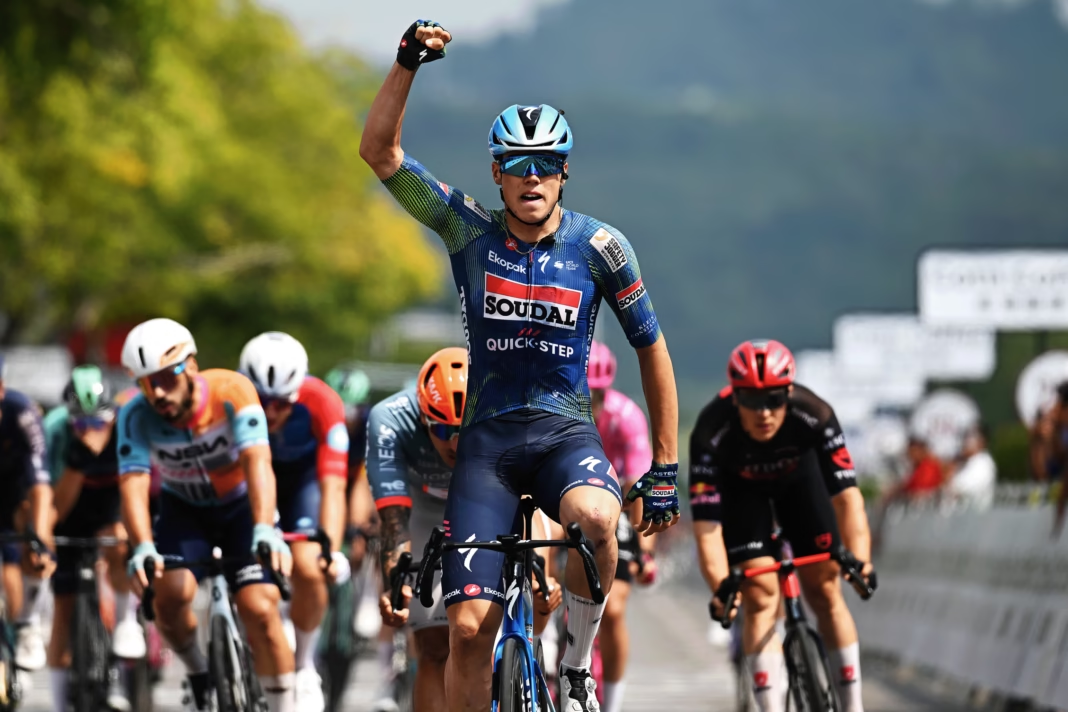
Stuyven opened a gap and committed fully. The Soudal Quick-Step rider has long been one of the strongest classics riders in the peloton, with Milan-San Remo, Omloop Het Nieuwsblad and Kuurne-Brussels-Kuurne already on his palmarès, but a Tour de France stage win had always escaped him.
His move looked dangerous. With around 20 kilometres to go, he had around 20 seconds on the Pedersen group and close to a minute on the group containing Philipsen and Kooij. By the time the race entered the final 15 kilometres, his lead had stretched towards 45 seconds.
For a moment, it looked like Stuyven might finally get the Tour win he has spent years chasing.
Alpecin pull the race back
The chase behind eventually reorganised. Alpecin-Premier Tech had Planckaert and Verstrynge contributing, while Jayco AlUla, Lidl-Trek and Decathlon CMA CGM also had riders with reasons to bring the move back.
The final run-in to Voiron was not completely flat. The riders still had to deal with the Côte de la Commanderie, an unclassified rise of 2.6 kilometres at around 4 per cent before the final kilometres. That gave attackers one last chance and made Stuyven’s solo effort harder to judge.
His gap began to fall. It was 32 seconds with 10 kilometres remaining, 23 seconds with 5 kilometres to go, and then the attacks behind started to fly. Jayco tried through Engelhardt, Lidl-Trek pushed with Derek Gee-West, and Castrillo made a move for Movistar.
Stuyven was finally caught just inside the final 4 kilometres. It was a cruel end to a brave attack, especially after he had looked close enough to survive. He was swallowed by the front group and almost came to a standstill as the race immediately shifted into the next phase.
Van der Poel delivers Philipsen
The final kilometres were still chaotic. Per Strand Hagenes attacked for Team Visma | Lease a Bike, followed by Van der Poel, Gee-West and Simmons. Then Tarling tried a late raid for Netcompany INEOS, using his time-trial power to open a small gap.
Van der Poel shut it down. The Dutchman had spent the day attacking, covering moves and managing Alpecin’s options, but by the final kilometre his role was clear. He was riding for Philipsen.
Tarling led through the final corner, but Van der Poel came to the front and launched the sprint perfectly. It was the kind of lead-out Philipsen has often used to turn difficult finales into simple-looking victories.
Once Philipsen opened up, nobody came close. Schmid finished second, Kooij third, Askey fourth and Pluimers fifth, all on the same time.
Philipsen finally gets his win
Philipsen had been close several times in this Tour without winning. He had finished fifth, fifth, fourth and third twice in earlier sprint stages, and the pressure had been building. In Voiron, he finally delivered.
This was not a standard bunch sprint win. It came from a breakaway stage that had been raced flat out for hours, with sprinters scattered across different groups and Alpecin-Premier Tech forced to play both Van der Poel and Philipsen at different moments.
That made the victory more significant. Philipsen did not simply survive to the line. He stayed in the race when Pedersen forced the split, relied on teammates to close Stuyven and Tarling, then finished with the authority of the fastest rider in the group.
It was his 11th Tour stage win and means he has now won at least one stage in each of the last five editions of the race. That consistency matters, especially in a Tour where he had spent more than two weeks chasing the first one.
Green jersey fight tightens again
The other major outcome was the green jersey battle. Pedersen was named the most combative rider after a huge day of attacking, working and point-scoring. He took the intermediate sprint and finished eighth, but Philipsen’s stage win changed the balance again.
After stage 17, Pedersen leads the points classification with 452 points, only 7 ahead of Philipsen on 445. Girmay sits third on 361, now further adrift after being distanced early and missing the decisive part of the race.
That sets up a much tighter final week than looked possible earlier in the Tour. Pedersen has been the most consistent rider across different types of stages, but Philipsen’s win has reopened the competition at exactly the point where every remaining sprint and intermediate sprint matters.
The stage also showed the contrast between the two. Pedersen tried to win green through aggression and workload. Philipsen won the stage through survival, positioning and a perfect Alpecin lead-out.
Both approaches worked in different ways. The result is a seven-point gap with Paris still to come.
-
 Photo Credit: Getty
GC riders stay out of trouble
For the GC contenders, the stage was difficult but not decisive. Early splits put Del Toro and several other top-10 riders briefly behind, while Pidcock and Martinez were caught in an early crash, but the main favourites eventually came back together.
Pogačar, Evenepoel, Seixas, Ayuso and Skjelmose were all present in the front GC selection during the early chaos, and Del Toro later returned. With the stage race moving towards the mountains again, none of the overall contenders needed to chase the win once the breakaway battle had settled.
Adam Yates had a more concerning day, dropping well behind and appearing to struggle badly. Tim Wellens dropped back to help him, with UAE Team Emirates-XRG clearly keen to keep an important climbing domestique in the race before the final mountain stages.
There was no major change to the yellow jersey fight, but stage 17 still took energy from almost everyone. It was far too hard to be dismissed as a transition day.
Alpecin master the mess
This was a stage that could easily have slipped away from Alpecin-Premier Tech. Van der Poel was in the moves early. Philipsen was caught behind Pedersen at key moments. Stuyven went clear after the intermediate sprint. Tarling attacked late. The race repeatedly looked like it was moving away from a sprint.
Instead, Alpecin kept enough riders in the right places to salvage and then win it. Planckaert took points away from Pedersen at the intermediate sprint. Verstrynge worked deep into the final. Van der Poel chased the final attacks and delivered the decisive lead-out. Philipsen finished it.
The result was a sprint win from a breakaway day, which is not a contradiction so much as the perfect summary of stage 17. It was wild, fragmented, aggressive and exhausting, but in the end the fastest rider still won.
Philipsen is back, Pedersen is still in green, and the points classification has suddenly become one of the sharpest battles left in the race.
Tour de France 2026 stage 17 result
| Position | Rider | Team | Time/gap |
|---|---|---|---|
| 1 | Jasper Philipsen | Alpecin-Premier Tech | 3:41:13 |
| 2 | Mauro Schmid | Team Jayco AlUla | same time |
| 3 | Olav Kooij | Decathlon CMA CGM Team | same time |
| 4 | Lewis Askey | NSN Cycling Team | same time |
| 5 | Rick Pluimers | Tudor Pro Cycling Team | same time |
| 6 | Clément Russo | Groupama-FDJ United | same time |
| 7 | Huub Artz | Lotto Intermarché | same time |
| 8 | Mads Pedersen | Lidl-Trek | same time |
| 9 | Michael Matthews | Team Jayco AlUla | same time |
| 10 | Aaron Gate | XDS Astana Team | same time |
Main photo credit: ASO

