
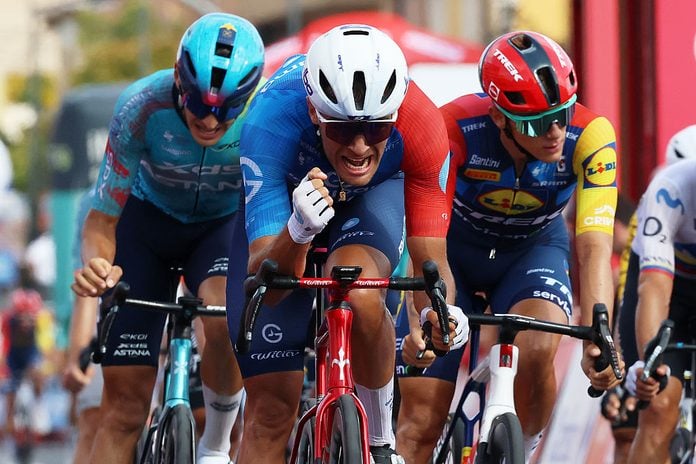
Bastien Tronchon won stage 10 of the 2026 Vuelta a España in Elche de la Sierra, sprinting to victory after a chaotic finale where the last late attackers were caught almost on the line.
The Groupama-FDJ United rider timed his finish perfectly after a messy final kilometre, beating Magnus Cort Nielsen of Uno-X Mobility and Thibau Nys of Lidl-Trek. Wout van Aert finished fourth for Team Visma | Lease a Bike, with Alessandro Romele fifth for XDS Astana Team.
Xabier Mikel Azparren was sixth after being part of the final late move, ahead of Finn Fisher-Black, Orluis Aular, Jordan Labrosse and Hugo Hofstetter.
Enric Mas finished safely in the main group and retained the red jersey. The Movistar rider continues to lead Primož Roglič by 1:18, with Felix Gall third at 1:39 and Oscar Onley fourth at 2:20.
A second-week stage that refused to settle
Stage 10 took the Vuelta from Alcaraz to Elche de la Sierra over 184.7 kilometres, a stage that looked on paper like it should suit the punchier sprinters.
It was not flat, but it was not a full GC mountain stage either. The route included three categorised climbs, the Puerto del Peralejo, Puerto de Ayna and Puerto de Socovos, before a rolling, awkward run towards the finish. The final climb came far enough from the line to give the sprinters hope, but close enough to invite attacks.
That balance defined the whole day. Team Visma | Lease a Bike and Cofidis wanted control for Van Aert, Matthew Brennan and Bryan Coquard. The breakaway wanted to exploit the lumpy final third. The GC teams wanted to keep their leaders safe after a brutal opening week that had already removed Tadej Pogačar from the race.
The result was a stage that looked controlled for long periods, then unravelled completely inside the final 35 kilometres.
The breakaway forms after early chaos
The opening kilometres were restless.
Several moves went clear and came back before the day’s breakaway finally took shape. An early group containing riders such as Finlay Pickering, Rémy Rochas, Jesús Herrada, Cort, Domen Novak and Jay Vine briefly tried to escape, but it was not allowed to settle.
The move that stuck formed later, with Enzo Paleni, Michael Gogl, Jasha Sütterlin, Fabian Weiss, Sinuhé Fernández and Iván Cobo going clear. Fredrik Dversnes chased across alone and eventually joined them, creating a seven-rider breakaway that would shape the stage deep into the finale.
Dversnes was an obvious danger because of his recent Giro d’Italia breakaway success, while Paleni gave Groupama-FDJ United representation up the road on a day that would later come back to them in very different fashion.
The peloton allowed the gap to settle, but never gave the move full freedom.
Paleni takes early mountains points
The breakaway reached the first climb, the Puerto del Peralejo, with a lead approaching 3 minutes.
Paleni went over the top first, taking the mountain points ahead of Weiss and Fernández. The climb was not hard enough to split the race decisively, but it gave the breakaway a chance to establish rhythm and gave the peloton a reason to keep the gap under watch.
Behind, Mas’ Movistar team did not need to chase the stage. Their priority was to protect the red jersey after his Alto de Aitana victory on stage 9. Mas had started the second week with a 1:18 advantage over Roglič and had no reason to turn this into a stressful GC day unless the race forced him to.
That left the stage control mainly to the sprint-interested teams.
Team Visma | Lease a Bike and Cofidis both began to organise behind, with Steven Kruijswijk and Sergio Samitier among the riders visible in the chase.
Team Visma | Lease a Bike and Cofidis share the chase
The stage became a long balancing act for Team Visma | Lease a Bike and Cofidis.
Team Visma | Lease a Bike had two obvious cards. Van Aert was in green and wanted another stage opportunity, while Brennan had already won twice in the race and had the kind of durability that made him dangerous on a lumpy finish. Cofidis, meanwhile, were working for Coquard after his stage 8 victory in Xeraco.
Both teams had reasons to chase, but neither wanted to spend the whole day alone on the front. That gave the breakaway enough space to believe, while keeping the race close enough that the bunch could still bring it back.
The gap moved between 1:30 and 2:30 through much of the stage. Weiss took the intermediate sprint at Hellín ahead of Sütterlin, Gogl, Cobo and Paleni, with the peloton still close enough to keep the stage under control.
For a while, it looked like a standard chase.
The race changes before Socovos
The calm began to break before the final categorised climb.
The Puerto de Socovos was not savage, at 9.8 kilometres and 3.5 per cent, but it came after a lumpy approach and before a rolling finale. That made it the obvious place for riders to start racing before the sprint teams could organise fully.
Sütterlin, Weiss and Fernández were dropped from the break on the uncategorised uphill roads before the climb, leaving Paleni, Gogl, Cobo and Dversnes at the front. Weiss later fought back, but the original unity of the move had gone.
Behind, attacks started to come from the peloton. Brennan himself reacted to some of the moves, a sign that Team Visma | Lease a Bike’s control was beginning to blur. Instead of simply setting up Van Aert or Brennan, they were now having to cover attacks as the race fragmented.
Mads Pedersen was among those distanced, removing another fast-finishing threat and increasing the sense that this would not become a clean bunch sprint.
Dunbar and Paret-Peintre go on the move
Eddie Dunbar and Valentin Paret-Peintre attacked as the race hit the decisive phase.
The Pinarello-Q36.5 rider and the Soudal Quick-Step climber opened a gap from the peloton as the bunch began to splinter. Dunbar then pressed on, dropping Paret-Peintre and chasing towards the remains of the break, while Will Barta tried to bridge across.
It was the kind of move that made the sprint teams uncomfortable. The breakaway was close enough to catch, but the counter-attacks meant the peloton could no longer work in a straight line. Every acceleration forced a reaction, and every reaction invited another rider to go.
Gogl also pushed on from the break, while Dversnes remained one of the strongest survivors. The front of the race was no longer one group and the peloton was no longer fully settled.
That was exactly when the stage began to escape the sprinters’ control.
Vermaerke forces Mas to react
Kevin Vermaerke then opened another dangerous move from the bunch.
When the UAE Team Emirates-XRG rider attacked, Richard Carapaz and Mattias Skjelmose followed, forcing Mas to respond in the red jersey. That moment briefly shifted the focus from stage win to GC safety.
Mas did not panic, but he did move. That mattered. On a day where he wanted to avoid trouble, he still had to close down an attack that contained riders capable of disrupting the GC order if the race split at the wrong time.
There were around 20 riders left in the reduced bunch at that point, with the attackers still half a minute ahead. Decathlon CMA CGM were also present and alert around Gall, while Netcompany Ineos Cycling Team had to look after Onley in the reduced group.
The Vuelta had entered one of those awkward finales where stage hunters, sprinters and GC riders were all suddenly fighting for the same piece of road.
Dversnes leads over the final climb
Dversnes took maximum points over the Puerto de Socovos, ahead of Gogl and Cobo.
The Uno-X Mobility rider had been aggressive from the start and remained one of the strongest from the breakaway as the race crested the final categorised climb. But the situation behind was becoming increasingly complicated.
Vermaerke attacked again and was followed by Nys. Brennan bridged across with Tobias Halland Johannessen, while Axel Laurance also joined the chasing movement. Those counters brought fresh energy into the front of the race, but they also made it harder for Team Visma | Lease a Bike to impose a simple chase.
By the time the race moved beyond the final climb, the last breakaway riders were only just ahead. The peloton was close, but it was no longer smooth.
That gave Dversnes and Gogl a chance to continue teasing the bunch.
Dversnes and Gogl refuse to disappear
Inside the final 12 kilometres, Gogl and Dversnes still had a small advantage.
It was never more than a handful of seconds, but that was enough to keep the finale unstable. Christophe Laporte had to work hard for Team Visma | Lease a Bike, even on the downhill, to bring the race closer. The two leaders were still making the chase uncomfortable, especially with the road continuing to rise and fall.
Eventually Gogl was distanced, leaving Dversnes as the last survivor before Iñigo Elosegui joined him. Milan Vader then tried to bridge, with Sepp Kuss on his wheel, creating another dangerous move in the final 7 kilometres.
That was not what the sprint teams wanted. Instead of a neat lead-out, the final 10 kilometres became a chain of late attacks and short-lived front groups.
The breakaway had lost the stage, but it had succeeded in breaking the peloton’s rhythm.
Calzoni goes solo late
Walter Calzoni made the next serious move.
With Kuss and Vader having bridged and the gaps still small, Calzoni attacked into the final 4 kilometres and briefly opened daylight. Team Visma | Lease a Bike tried to respond, while the bunch behind remained stretched and nervous.
Calzoni’s move was dangerous because of its timing. The peloton had already spent kilometres closing down fragments of the break, counters and bridging moves. The finish was close enough that hesitation could have been fatal.
But he was caught with around 2 kilometres remaining, just as Brennan was seen setting the pace with Mas on his wheel. That image summed up the strange finale. A double stage winner was working on the front, the race leader was placed immediately behind him, and the sprint teams were still trying to decide who had the clearest card.
The stage still had one more attack left.
Fedorov and Azparren almost steal it
Yevgeniy Fedorov and Xabier Mikel Azparren attacked in the final 2 kilometres.
Their move came after Calzoni had been brought back and before the bunch had properly reorganised. It was the perfect moment to try. Netcompany Ineos Cycling Team then took over under the flamme rouge, while the attackers still dangled just ahead on the rising road into Elche de la Sierra.
The final kilometre was tense. There were bends, a right-hand turn around 400 metres from the line and just enough uphill drag to make the chase difficult. The bunch could see the attackers, but seeing them was not the same as catching them.
Fedorov and Azparren came agonisingly close. They were only brought back on the line, just as the punchier sprinters launched from behind.
It was a brutal way to lose the stage, but it gave the finale the drama that the earlier chase had threatened to remove.
Tronchon times it perfectly
Tronchon came through at exactly the right moment.
The Groupama-FDJ United rider launched his sprint from the reduced bunch as the attackers were caught, then drove all the way to the line. He did not even raise his arms immediately, unsure whether anyone had still been ahead after the last-gasp catch.
There was no doubt on the result sheet. Tronchon had won in 4:07:41, taking only the third victory of his WorldTour career and one of the biggest wins of his professional life.
He said afterwards that the previous two days had been hard for him, but that he felt good on the stage and had told Guillaume Martin to go full gas until he was empty. Groupama-FDJ United had started the day with Paleni in the break and ended it with Tronchon winning from the bunch.
That made the victory more than opportunism. The team had been present early and then sharp enough late.
Cort and Nys complete the podium
Cort finished second for Uno-X Mobility, continuing a strong race for the Norwegian team after its stage 7 one-two at Aramón Valdelinares.
The Dane had spoken before the stage about this being his last Grand Tour and about wanting to enjoy the remaining opportunities. Second place was another reminder of how suited he remains to unpredictable Vuelta stages: hard enough to drop pure sprinters, open enough for late attacks, and chaotic enough for experience to matter.
Nys took third for Lidl-Trek, a strong result after Pedersen had been distanced on the final climb. Once the race became too hard for Lidl-Trek’s original sprint card, Nys gave the team another option and proved again how effective he can be when the finish sits between puncheur terrain and a reduced sprint.
Van Aert was fourth, close but not winning, while Romele capped another aggressive day with fifth.
Team Visma | Lease a Bike miss their chance
Team Visma | Lease a Bike did a huge amount of work, but left without the stage.
That will sting. They helped control the break, used Laporte in the chase, had Brennan covering late moves and still had Van Aert in position for the finish. On another day, that is exactly the sort of platform that ends with a win.
Instead, the finale became too messy. Brennan spent energy closing attacks rather than being held back as a sprint option, while Van Aert could not produce the final punch needed to beat Tronchon, Cort and Nys.
The Belgian still strengthened his position in the points classification, and fourth place is not a disaster. But with Brennan already a double stage winner and Van Aert carrying the green jersey, the team’s tactical split was hard to ignore.
They had the numbers and the talent. They did not quite have the clean finish.
Cofidis lose control after working for Coquard
Cofidis also had reason to be frustrated.
After Coquard’s stage 8 victory, the team committed riders to the chase and tried to bring the race towards another punchy sprint. Samitier did long work in the peloton and the team helped keep the breakaway within reach through the middle of the stage.
But as the final climb and the late attacks fractured the race, Coquard’s path to another victory disappeared. The team had helped close the early move, but the finish became too chaotic for their sprinter to repeat his Xeraco win.
That is the risk of stages like this. Chasing is necessary, but it does not guarantee control. Cofidis contributed to bringing the race back, yet the eventual reward went elsewhere.
Groupama-FDJ United were the team that made the late chaos work.
Mas keeps red through a tricky day
Mas avoided trouble and kept the red jersey.
That was the priority for Movistar. Stage 10 was not a day where Mas needed to attack, but it was still dangerous. The final climb, the counters, the reduced bunch and the rising finale all created opportunities for a poorly positioned GC rider to lose time or be caught behind a split.
Mas was alert when Vermaerke’s move drew Carapaz and Skjelmose across, and he stayed well placed in the final kilometres. He finished safely, with the general classification unchanged at the top.
That leaves him 1:18 ahead of Roglič, 1:39 ahead of Gall and 2:20 ahead of Onley. Carapaz remains fifth at 3:26, with Skjelmose sixth at 3:55 and Kuss seventh at 4:09.
After the emotional shock of taking red through Pogačar’s abandon and then the effort of winning on Alto de Aitana, this was a useful day for Mas: no time lost, no crash, no unnecessary stress in the standings.
A stage won from the mess
Stage 10 looked for much of the day like it would become a controlled reduced sprint.
The breakaway was never allowed a decisive lead. Team Visma | Lease a Bike and Cofidis worked steadily. The final climb was manageable enough for the punchier fast men. Mas and the other GC contenders had little reason to attack seriously.
Then the race turned messy, and that changed everything.
Dversnes and Gogl refused to disappear. Dunbar attacked. Vermaerke forced Mas to chase. Brennan covered moves. Kuss and Vader bridged. Calzoni went solo. Fedorov and Azparren nearly stole the stage in the final kilometre.
Tronchon won because he read that chaos better than everyone else. He did not need to control the stage. He only needed to be in the right place when the last move came back.
On a day built for control, the rider who handled disorder won.
Vuelta a España 2026 stage 10 result
| Position | Rider | Team | Time/gap |
|---|---|---|---|
| 1 | Bastien Tronchon | Groupama-FDJ United | 4:07:41 |
| 2 | Magnus Cort | Uno-X Mobility | same time |
| 3 | Thibau Nys | Lidl-Trek | same time |
| 4 | Wout van Aert | Visma | Lease a Bike | same time |
| 5 | Alessandro Romele | XDS Astana Team | same time |
| 6 | Xabier Azparren | Pinarello-Q36.5 Pro Cycling Team | same time |
| 7 | Finn Fisher-Black | Red Bull-BORA-hansgrohe | same time |
| 8 | Orluis Aular | Movistar Team | same time |
| 9 | Jordan Labrosse | Decathlon CMA CGM Team | same time |
| 10 | Hugo Hofstetter | NSN Cycling Team | same time |
Main photo credit: Getty

