
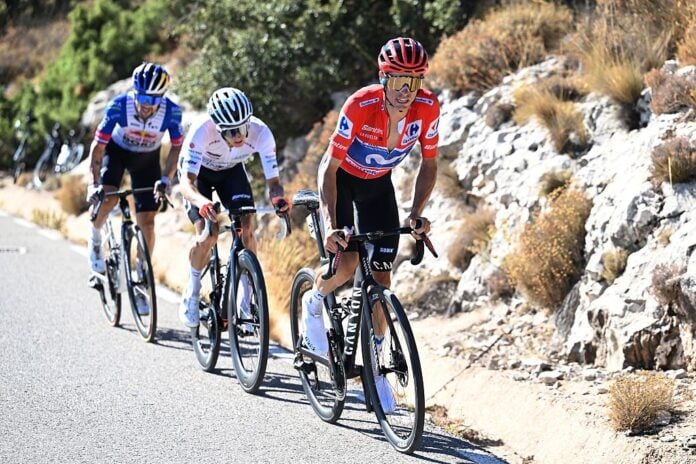
The Vuelta a España returns to the high mountains on Thursday with a stage that should tell us much more about whether Enric Mas really has established himself as the strongest climber in the race.
Stage 12 covers 166.6km from Vera to the Calar Alto observatory, climbing from close to the Mediterranean coast to a finish at 2,153 metres above sea level. Around 4,500 metres of ascent are packed into the route, with the decisive difficulty concentrated into an intimidating final 45km over the Alto de Velefique and Calar Alto.
At the start of Wednesday’s Stage 11 from Cartagena to Lorca, Mas held 1:18 over Primož Roglič, 1:39 over Felix Gall and 2:20 over Oscar Onley, with Richard Carapaz at 3:26 and Mattias Skjelmose at 3:55. Those gaps were established on Alto de Aitana, where Mas did more than simply defend the red jersey he inherited following Tadej Pogačar’s crash. He attacked and won the stage.
Thursday provides the next examination. The Alto de Velefique climbs for 13.1km at 7.2% before a short descent and the 16.9km ascent to Calar Alto. Waiting until the final kilometre may not be enough for riders already more than a minute behind Mas.
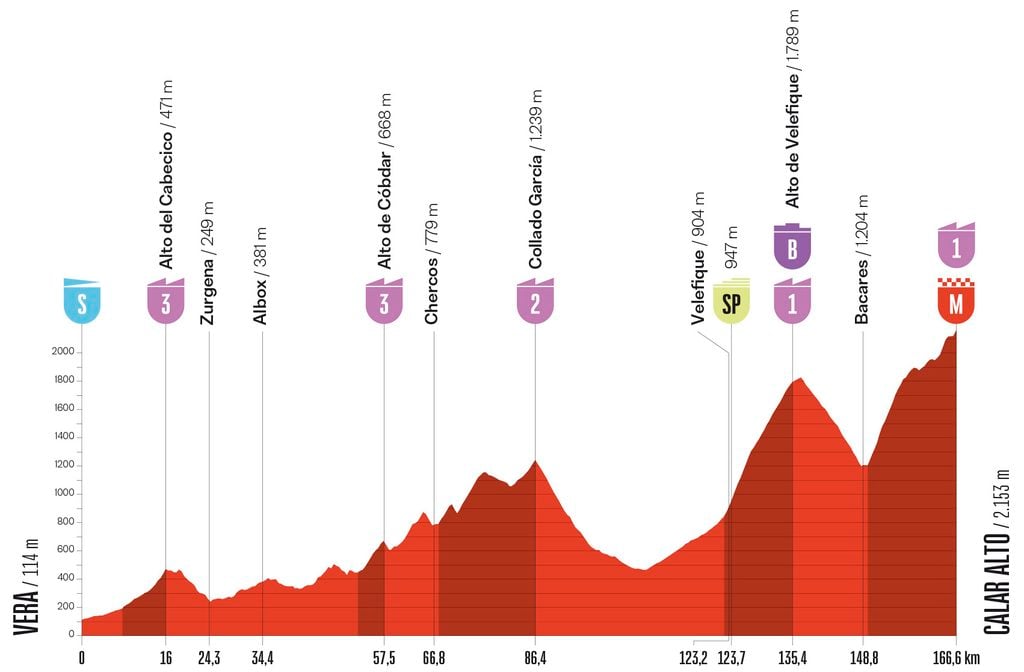
Vuelta a España 2026 Stage 12 at a glance
| Detail | Stage 12 |
|---|---|
| Date | Thursday 3 September 2026 |
| Start | Vera |
| Finish | Calar Alto |
| Distance | 166.6km |
| Stage type | Mountain |
| Elevation gain | Around 4,500m |
| Categorised climbs | 5 |
| Category 1 climbs | Alto de Velefique and Calar Alto |
| Alto de Velefique | 13.1km at 7.2% |
| Final climb | 16.9km at 5.6% |
| Finish altitude | 2,153m |
| Scheduled start | Around 12:07 BST |
| Expected finish | Around 16:16-16:44 BST |
The stage forms one of the key mountain days in the 2026 Vuelta route, although the profile is more complicated than simply describing Calar Alto as a summit finish. Velefique immediately beforehand means riders can arrive at the foot of the final climb already isolated and under pressure.
The climbing begins almost immediately from Vera
There is no long neutral opening to Stage 12.
The first classified ascent begins after only 7.7km, with the Alto del Cabecico measuring 8.3km at 3.3%. Its summit comes at kilometre 16, already 471 metres above sea level.
It is not remotely difficult enough to trouble Mas, Roglič or Gall, but its position should make the opening fight for the breakaway considerably harder.
This is precisely the sort of stage where dozens of riders can identify a route towards victory. Strong climbers already well outside the general classification know Movistar have no obvious reason to chase them all afternoon, while the mountains classification offers another incentive to attack.
That can produce a very different opening from a conventional mountain stage where five riders quietly disappear on flat roads. If the first serious attacks come as the road begins climbing, it may take 30 or 40km before a group finally establishes itself.
Movistar’s job will be deciding who can safely go.
Alto de Cóbdar adds another early test
The second classified ascent is the Alto de Cóbdar, a Category 3 climb measuring 4.9km at 4.5%.
Its summit comes after 57.5km.
Again, the GC riders are unlikely to notice the climb itself. The accumulated effort is more important. Anyone who spent the opening hour repeatedly attacking to reach the break will already have completed two ascents before the stage reaches its halfway point.
That should begin reducing the number of domestiques available later.
Stage 12 is unusual because its headline climbs come at the end but the route never gives the peloton a truly easy first half. Even relatively gentle gradients are adding fatigue that becomes expensive once Velefique begins.
Collado García is a long drag into the mountains
The third climb is the Collado García, officially 18.5km at an average of 2.4%.
That figure makes it look almost insignificant, but spending nearly 19km gradually gaining altitude is another drain on a stage already heading towards more than 4,000 metres of climbing.
The summit comes at kilometre 86.4 and an altitude of 1,239 metres.
This is unlikely to be a place for direct GC attacks. Its value lies in continuing the attrition and giving a strong breakaway an opportunity to build a substantial advantage before the race descends towards the final mountain sequence.
By this point Movistar should have a clear idea of whether the stage win is going ahead or remaining with the favourites.
Mas has little reason to demand a victory at Calar Alto. If a group containing riders 20 or 30 minutes down receives six minutes, allowing it to contest the stage could actually make Movistar’s job easier by removing bonus seconds from his direct rivals.
Alto de Velefique is where Stage 12 really begins
Everything changes with 44.3km remaining.
The Alto de Velefique measures 13.1km at 7.2%, gains 951 metres and reaches a summit altitude of 1,789 metres with 31.2km left to race.
This is the climb where the GC teams can properly dismantle one another.
Its average gradient is considerably higher than Calar Alto’s and there are fewer opportunities for riders to hide behind easier sections. A sustained high tempo should quickly expose anyone having a bad day.
For Gall, Roglič and Carapaz, that creates an obvious tactical question. Do they use Velefique simply to remove domestiques before attacking on Calar Alto, or do they begin putting Mas himself under pressure?
The conservative answer favours the race leader.
Mas has already shown that reaching the decisive part of a mountain stage with his strength intact is a dangerous situation for everyone else. His Stage 9 victory on Alto de Aitana came after Gall and Carapaz had helped make the race difficult, yet it was Mas who still had the strongest attack available near the finish.
Simply repeating that scenario on Calar Alto is unlikely to produce a different result.
Velefique gives Gall his best reason to attack early
No rider among the leading contenders has more incentive to make Stage 12 aggressive than Felix Gall.
He begins only 1:39 behind Mas and 21 seconds behind Roglič, but his route towards winning the Vuelta is very different from the Slovenian’s.
Roglič still has the 32.1km individual time trial to Jerez on Stage 18. Gall does not want to reach that day already behind both Mas and Roglič and then try to defend his position against the clock.
His opportunities come in the mountains.
Calar Alto is therefore not simply another stage where finishing with the favourites represents a good result. Decathlon CMA CGM need to start converting Gall’s climbing strength into actual time.
The most effective way may be to make Velefique difficult from the lower slopes rather than waiting for one acceleration near its summit. If Gall can force Mas to lose teammates before the descent, the final climb becomes a much more direct contest.
The descent gives little time to reorganise
The Alto de Velefique tops out with 31.2km remaining.
From there the race descends towards Bacares, which comes with 17.8km left, before the Calar Alto climb starts less than a kilometre later.
That short transition increases the value of anything achieved on Velefique.
A leader who crests alone does not face 30km of flat road where an organised chase can simply bring him back. A rider who loses his final domestique cannot necessarily wait five minutes for teammates to return. The race moves almost directly from one first-category climb into another.
Teams can use riders placed in the break to particularly good effect here.
If Gall, Carapaz or another contender has a teammate waiting beyond Velefique, that rider can help on the descent and approach to Calar Alto. Without somebody ahead, leaders may find themselves doing a surprising amount of work themselves before the final climb has even started.
For Movistar, maintaining numbers over Velefique is therefore almost as important as Mas following the attacks.
Calar Alto is much harder than its 5.6% average suggests
The final climb officially measures 16.9km at 5.6%, gaining 952 metres on its way to the Calar Alto Astronomical Observatory.
An average gradient of 5.6% makes it look almost gentle by modern Vuelta standards.
It is not.
The opening kilometres from Bacares contain some of the climb’s hardest ramps, repeatedly reaching double figures. The first six kilometres are the section where riders can be genuinely put into difficulty before the road becomes much more irregular higher up.
That second half alternates harder climbing with gentler gradients, false flats and short sections where a rider can regain momentum.
It creates an interesting tactical contradiction.
The steep opening section provides the best terrain for actually dropping rivals, but attacking there means committing with more than 10km remaining. Waiting until the upper part saves energy but increases the chance that dropped riders use the easier gradients to return.
That should reward somebody prepared to take a risk.
A GC group of eight riders reaching the final 3km together would be a very good outcome for Mas. His rivals need to try to prevent that.
The finish at 2,153 metres adds another test
Calar Alto rises to 2,153 metres above sea level, making altitude another part of the difficulty.
It is high enough for the reduced oxygen availability to have a noticeable effect, especially after roughly 4,500 metres of climbing.
The consequences are rarely dramatic in isolation, but the difference appears when riders are already close to their limit. An acceleration that might normally be manageable becomes considerably more expensive when the body is operating above 2,000 metres after four hours of racing.
Calar Alto has hosted three previous Vuelta finishes.
Roberto Heras won in 2004, Igor Antón in 2006 and Miguel Ángel López in 2017.
The López victory provides the most useful modern comparison. He attacked on the final climb and finished 14 seconds ahead of a group containing Chris Froome, Vincenzo Nibali and Wilco Kelderman.
That result illustrates the character of Calar Alto. The climb can produce differences between the favourites, but huge gaps are not automatic. The race needs to be hard before the final ascent if Thursday is going to become a major GC reckoning.
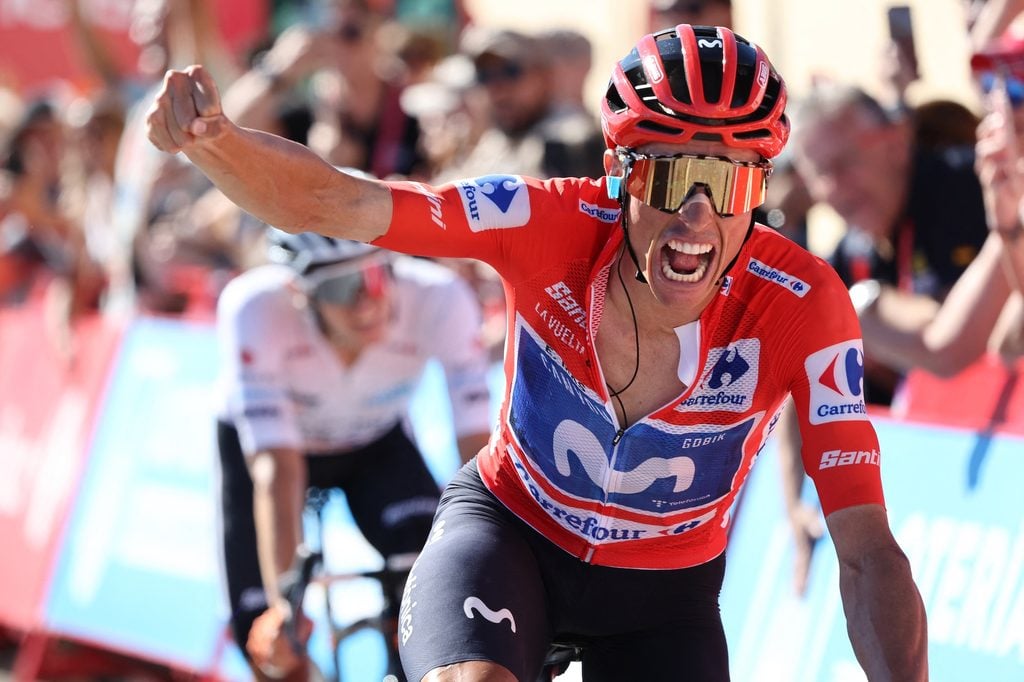
Enric Mas has changed the way the race must be viewed
Before Stage 8, the central question of this Vuelta was how anyone could possibly beat Pogačar.
His race-ending crash on the road to Xeraco changed that completely.
Mas initially inherited red in circumstances nobody wanted. He then made the jersey his own on Aitana.
That distinction matters.
A rider can move into a Grand Tour lead because somebody ahead crashes without necessarily becoming the strongest rider in the race. Mas removed that uncertainty when he attacked with around 3km remaining on Stage 9 and won ahead of Onley.
Roglič lost another 12 seconds and Gall another 18.
The GC picture after Stage 9 consequently changed from an open contest created by Pogačar’s withdrawal into a race where Mas has earned the right to be treated as the reference point.
Calar Alto is his opportunity to reinforce it.
Primož Roglič cannot keep conceding small amounts of time
Roglič remains extremely dangerous at 1:18.
That gap is not remotely decisive, particularly with a long individual time trial still to come. If the race reached Jerez with exactly the current difference, Roglič would have every reason to believe he could transform the classification against the clock.
The problem is the direction of travel.
Aitana was an opportunity to reduce his deficit after Pogačar’s withdrawal. Instead, Mas added another 12 seconds.
Roglič can afford to race more conservatively than Gall because his time trial gives him an important weapon later. He cannot afford to repeatedly lose ten or 15 seconds every time the Vuelta reaches a major summit finish.
Thursday should therefore tell us plenty about his condition.
If Red Bull-Bora-Hansgrohe can put Mas under pressure on Velefique and Roglič attacks on Calar Alto, the 1:18 gap could suddenly look very small.
If Mas rides away again, the time trial begins looking increasingly like something Roglič needs rather than simply something that favours him.

Oscar Onley has become a genuine podium contender
Oscar Onley may have been the most important positive surprise from Aitana.
The Netcompany INEOS rider did not simply limit his losses. He finished second behind Mas on the same time, moving to 2:20 overall and strengthening his position among the genuine podium contenders.
Calar Alto should suit him again.
The irregular final climb rewards a rider capable of handling sustained climbing before responding explosively when the gradients increase. Onley can also afford to race slightly differently from Gall because he does not carry the same expectation to initiate the main attacks.
That may become an advantage.
If Gall and Roglič spend energy attacking one another while Mas responds, Onley can concentrate on following the strongest wheels and waiting for the moment when the race begins slowing.
Another performance comparable to Aitana would make his podium challenge increasingly difficult to dismiss.
A victory or time gained on Roglič would start raising a bigger question.
Richard Carapaz needs to create disorder
At 3:26, Richard Carapaz remains close enough to matter but far enough behind that another conservative mountain stage does little for his overall prospects.
Following Mas to the summit and losing no time would still leave him more than three minutes down.
That makes Carapaz one of the riders most likely to benefit from attacking before Calar Alto.
His career has repeatedly shown how effective he can be when a Grand Tour becomes tactically confused. He does not need one overwhelming acceleration if he can identify a moment where the riders ahead hesitate over who should chase.
Velefique is ideal for that approach.
If Carapaz attacks and reaches the summit 20 seconds ahead, Mas can reasonably ask whether a rider more than three minutes down is really his responsibility. Roglič may want Movistar to chase. Gall may prefer to save energy for Calar Alto.
Twenty seconds can quickly become a minute while everyone calculates.
Carapaz needs those situations.
Skjelmose now carries even more Lidl-Trek responsibility
Mattias Skjelmose starts the mountain stage 3:55 behind Mas and remains close enough to fight for the podium.
His role within Lidl-Trek has also become much clearer after Mads Pedersen abandoned the Vuelta through illness before Stage 11.
Pedersen’s departure removes one of the team’s major stage and points objectives. Skjelmose’s GC position consequently becomes an even greater focus for the second half of the race.
Stage 12 is difficult enough to reveal how realistic his podium ambitions are.
He does not necessarily need to attack Mas. At 3:55, remaining with Gall, Roglič and Onley while somebody ahead struggles would already move him closer to the podium.
Losing another minute would leave the remaining mountain stages looking much more like opportunities to attack for stages than a route back into the overall contest.
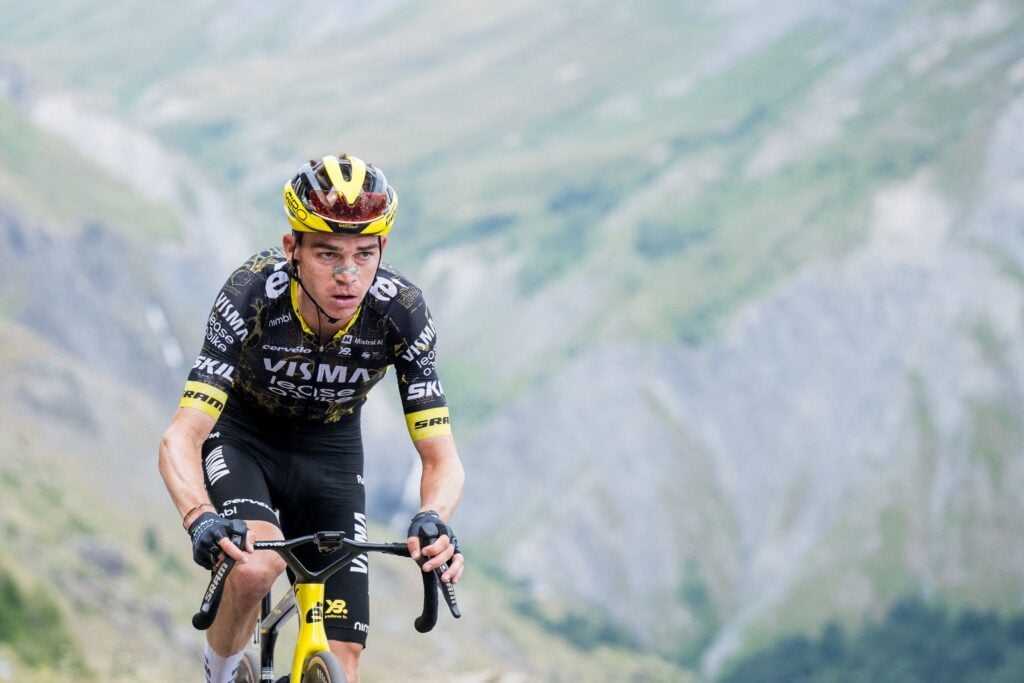
Sepp Kuss can start using his GC deficit tactically
Sepp Kuss sits only 14 seconds behind Skjelmose at 4:09, which creates an interesting situation for Visma | Lease a Bike.
He remains too close for Movistar to completely ignore.
He is also far enough behind that Mas does not necessarily want to react personally every time Kuss moves.
That middle ground can be useful.
An attack from Kuss on Velefique would force Movistar to decide whether four minutes is still a dangerous enough deficit to chase immediately. If they hesitate, the 2023 Vuelta winner has more than enough climbing ability to turn a small advantage into something substantial.
Visma also have fewer reasons to ride conservatively around the GC than the teams protecting riders currently on the podium.
That freedom can make Kuss more dangerous than his position initially suggests.
The breakaway has a serious chance of winning Stage 12
A mountain stage this difficult does not automatically mean the GC riders will contest the victory.
Mas does not desperately need the ten-second winner’s bonus, particularly if allowing the break to survive removes bonuses from Roglič and Gall as well.
That creates a clear opportunity for strong climbers already far outside the overall battle.
Santiago Buitrago is an obvious candidate because he has both the climbing ability and an interest in the mountains classification. Riders such as Pavel Sivakov can also use the break as a route towards salvaging a major stage result after UAE Team Emirates-XRG’s race was transformed by Pogačar’s withdrawal.
The decisive issue is the break’s composition.
A group of six containing several serious climbers could receive substantial freedom. A 20-rider escape containing somebody within ten minutes of Mas is much more likely to force Movistar to control.
The opening climbs make forming the right break particularly difficult.
Everyone interested in the stage knows it needs to be made early, which could produce an extremely aggressive first hour.
The mountains classification adds another fight
Five categorised climbs make Stage 12 one of the most valuable days of the Vuelta for riders targeting the mountains jersey.
The early Category 3 climbs offer points without requiring the break to survive until the finale, while Velefique and Calar Alto carry much larger rewards.
That should encourage riders interested in the classification to attack almost immediately.
It also creates tension inside the eventual break. A rider such as Buitrago may want to collect points from every climb, while another stage hunter would prefer to conserve as much energy as possible for the final 45km.
Those different objectives can weaken cooperation.
They can also make the break much harder to control when several riders have reasons to keep attacking even after the original escape has formed.
The weather should leave the mountains to decide the race
The forecast is considerably calmer than some of the conditions riders have already faced during this Vuelta.
Vera should be around 28°C with sunshine, while temperatures at Calar Alto are expected to fall towards approximately 21°C. Winds should remain relatively light, particularly around the summit.
That means there is currently no obvious weather threat capable of overshadowing the terrain.
No hailstorm. No major crosswind forecast. No high-altitude rain expected to change equipment choices or descending tactics.
The heat during the opening half still contributes to fatigue, particularly on a stage that climbs more than 4,000 metres before finishing above 2,100 metres, but Thursday should primarily be decided by climbing strength and tactics.
Given the extraordinary sequence covered in our Vuelta week one review, a straightforward mountain battle would almost count as a novelty.
Calar Alto is important without being the final opportunity
The temptation will be to treat Thursday as one of the definitive GC stages.
It is important, but plenty remains afterwards.
Friday’s road from Almuñécar to Loja is classified as medium mountain before the race finishes on Sierra de La Pandera on Stage 14. After the second rest day come the 32.1km Jerez time trial, Peñas Blancas and the huge penultimate mountain stage to Collado del Alguacil.
That broader structure influences how the contenders approach Calar Alto.
Roglič does not need to gamble everything with an attack 40km from the finish because the route still contains terrain that strongly favours him.
Gall has substantially more reason to spend energy.
Mas can afford to defend intelligently rather than chase every stage victory.
Carapaz needs to make opportunities appear before the number of remaining stages starts shrinking.
The Vuelta will not be won outright on Thursday, but somebody can certainly make it much harder to win.
How Stage 12 is likely to unfold
The first hour should be aggressive because the Alto del Cabecico arrives almost immediately and there are too many quality climbers outside the GC battle for a harmless three-rider break to establish itself without a fight.
Once Movistar are satisfied with the composition, the gap could increase quickly. They have little reason to control the stage victory if everybody ahead is safely distant overall.
The first three climbs should gradually weaken both the peloton and break before the race finally settles on the approach to Velefique.
That is where the GC stage begins.
Decathlon CMA CGM have the strongest incentive to increase the pace for Gall. EF Education-EasyPost may try something more ambitious with Carapaz, while Red Bull can decide whether to help make the race hard or conserve Roglič for the final climb.
A conservative Velefique should leave a relatively large group reaching Calar Alto. The steep opening kilometres can still produce attacks, but the irregular upper section increases the likelihood of regrouping and limits the size of the final gaps.
An aggressive Velefique produces an entirely different race. Mas could begin Calar Alto isolated, riders already close to their limit would immediately hit the steepest part of the final climb and the easier upper kilometres might arrive too late to repair the damage.
That is the scenario Gall and Carapaz should want.
Mas has already shown what happens when the GC favourites arrive at the decisive climb without having properly weakened him first.
On Alto de Aitana, he waited, attacked and won.
The responsibility on Stage 12 belongs to everyone behind him. Calar Alto is their next chance to prove Enric Mas can be cracked before his advantage begins to look much more serious.

