

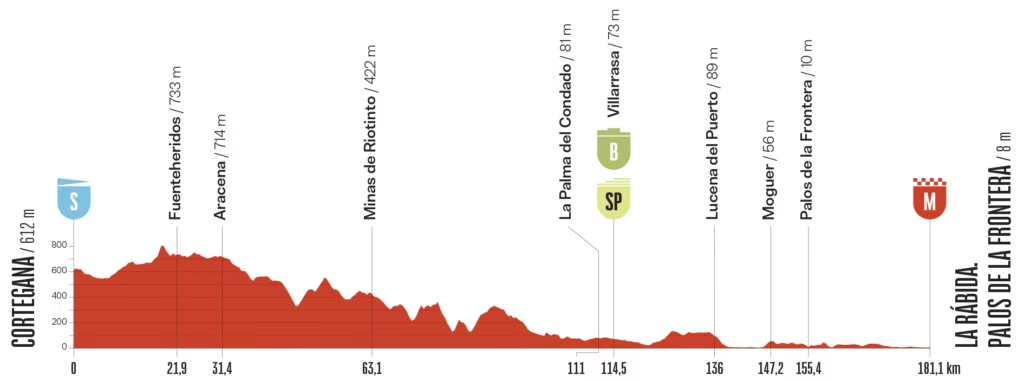
The Vuelta a España returns from its second rest day on Tuesday 8 September with a 181.1km stage from Cortegana to La Rábida, Palos de la Frontera, giving Matthew Brennan one of his last clear opportunities to add to his three stage victories.
The riders leave Cortegana in the neutralised zone at 12:05 BST, with the official start at 12:18 BST. UK live coverage is scheduled from 13:30 BST on TNT Sports and HBO Max, by which point around 50km of the stage should already have been completed.
The official timetable puts the finish between 16:19 and 16:42 BST, depending on the speed of the race.
For anyone unable to watch the whole afternoon, 15:30 BST is the best time to tune in. That should give you the final 45-50km, including the increasingly exposed roads towards Moguer and Palos de la Frontera where the wind could turn what looks like a sprint stage into something much less controlled.
The wider tactical picture, including why Brennan starts as the obvious favourite, is covered in our Vuelta a España 2026 Stage 16 preview.
 Photo Credit: Getty
Vuelta Stage 16 key UK viewing times
| Stage 16 point | Approximate UK time |
|---|---|
| Neutralised start in Cortegana | 12:05 BST |
| Official race start | 12:18 BST |
| Aracena | 13:03-13:07 BST |
| TNT Sports/HBO Max coverage begins | 13:30 BST |
| Campofrío | 13:31-13:38 BST |
| Minas de Riotinto | 13:44-13:52 BST |
| Berrocal section | 14:00-14:10 BST |
| La Palma del Condado | 14:50-15:05 BST |
| Intermediate sprint at Villarrasa | 14:54-15:10 BST |
| Lucena del Puerto | 15:22-15:40 BST |
| Moguer | 15:36-15:56 BST |
| Palos de la Frontera, 25.7km remaining | 15:47-16:07 BST |
| 11.9km remaining | 16:05-16:27 BST |
| Expected finish at La Rábida | 16:19-16:42 BST |
The timetable is calculated around average speeds of 41, 43 and 45km/h. A finish somewhere close to 16:30 BST is therefore the useful working estimate, but viewers interested in seeing the sprint should not treat that as a fixed appointment.
What time does Vuelta Stage 16 start?
The neutralised rollout from Cortegana begins at 13:05 local time, or 12:05 BST.
The flag drops 13 minutes later at 12:18 BST.
That means there will be more than an hour of racing before the UK broadcast begins. Normally that would not be particularly significant on a stage expected to finish in a sprint, but Tuesday’s opening terrain makes the missing kilometres more important.
Cortegana sits around 650 metres above sea level and the road begins rising and falling almost immediately through Almonaster la Real, Castaño del Robledo, Fuenteheridos and Aracena.
There are no categorised climbs anywhere on Stage 16, yet the opening half is far from flat. It is exactly the sort of terrain where repeated attacks can produce a much stronger breakaway than the sprint teams would like.
By the time television pictures arrive, one of the biggest tactical questions of the day may already have been answered.
How to watch Vuelta Stage 16 in the UK
Stage 16 is available live through TNT Sports and HBO Max, with coverage scheduled from around 13:30 BST.
The main UK options are:
Live television: TNT Sports
Live streaming: HBO Max
Coverage begins: Around 13:30 BST
Official race start: 12:18 BST
Expected finish: 16:19-16:42 BST
For the complete three-week broadcast arrangements, including the free highlights option, see our guide to watching the Vuelta a España 2026 in the UK.
There is no full free-to-air live broadcast of the stage in the UK. DMAX remains the free option for daily highlights.
UK coverage misses most of the breakaway fight
When TNT Sports and HBO Max join Stage 16 at around 13:30 BST, the riders should already be approaching Campofrío with roughly 130km remaining.
They will therefore have completed almost the entire opening section through the Sierra de Aracena.
That is potentially where the stage is hardest to control.
Visma | Lease a Bike would be perfectly happy with three or four riders escaping early, particularly if none represents a serious threat to Brennan in a reduced finish. A 12 or 15-rider group containing powerful rouleurs from several teams creates a very different problem.
The final half of the stage is much easier, but catching a large group still requires riders and commitment.
That makes the composition of the break more important than its initial time advantage.
If television coverage begins with three riders two minutes ahead, Brennan’s prospects should look good.
If there are 15 riders three or four minutes up the road, Visma have a much longer afternoon ahead.
Villarrasa is the first important television marker
The intermediate sprint at Villarrasa comes after 114.5km, leaving 66.6km to La Rábida.
It should be reached between approximately 14:54 and 15:10 BST.
By then the stage should have moved almost completely out of the rolling opening terrain and onto the flatter roads towards the coast.
That makes 14:45 BST a useful earlier tune-in time for anyone wanting more than simply the final hour.
The size of the breakaway advantage at Villarrasa should tell us plenty.
If the escape has already been brought within a couple of minutes, Visma and the other sprint teams have almost 70 flat kilometres to complete the job.
If the leaders still have four or five minutes, someone will need to start working much harder.
The sprint also gives Wout van Aert another opportunity to add to his commanding lead in the points classification, although Visma may decide there is little reason to spend energy chasing intermediate points with Brennan targeting the stage.
Why 15:30 BST is the best time to start watching
For viewers interested mainly in who wins Stage 16, 15:30 BST is the best point to join.
On the middle timetable, the peloton should be around Lucena del Puerto with approximately 45km remaining.
There are no mountains waiting later in the afternoon. From this point the main questions are whether the break can survive, whether the wind begins splitting the bunch and which sprint teams still have enough riders to control the finale.
The race then heads through Moguer before reaching Palos de la Frontera with 25.7km remaining.
Waiting until 16:00 BST is much less comfortable.
On a fast schedule, the riders could already be approaching the final 15km. More importantly, any serious crosswind action is likely to begin before the race reaches the finishing straight rather than during it.
If the exposed roads are going to change Stage 16, viewers should be watching before the final half-hour.
Wind is the main danger in the final 30km
The profile becomes increasingly straightforward as the stage progresses.
The roads do not necessarily become safer.
The approach towards Palos de la Frontera and La Rábida is much more exposed than the wooded roads used earlier in the stage, giving teams a reason to keep their GC leaders close to the front even though there are no classified climbs.
A direct headwind would favour a conventional sprint and make the breakaway’s task considerably harder.
A meaningful crosswind creates a different race.
The peloton can split very quickly on open roads if one strong team commits, particularly late in a Grand Tour when riders are tired and fewer domestiques remain capable of closing gaps.
Visma are well equipped for that scenario. Van Aert brings obvious experience in crosswinds, while Brennan has repeatedly been positioned well during chaotic finishes.
For Movistar, Decathlon CMA CGM and Red Bull-Bora-Hansgrohe, the priority is simpler: keep Enric Mas, Felix Gall and Primož Roglič in the front group and avoid losing GC time on a day where none of them should need to attack.
Brennan gets another chance after Van Aert’s Córdoba win
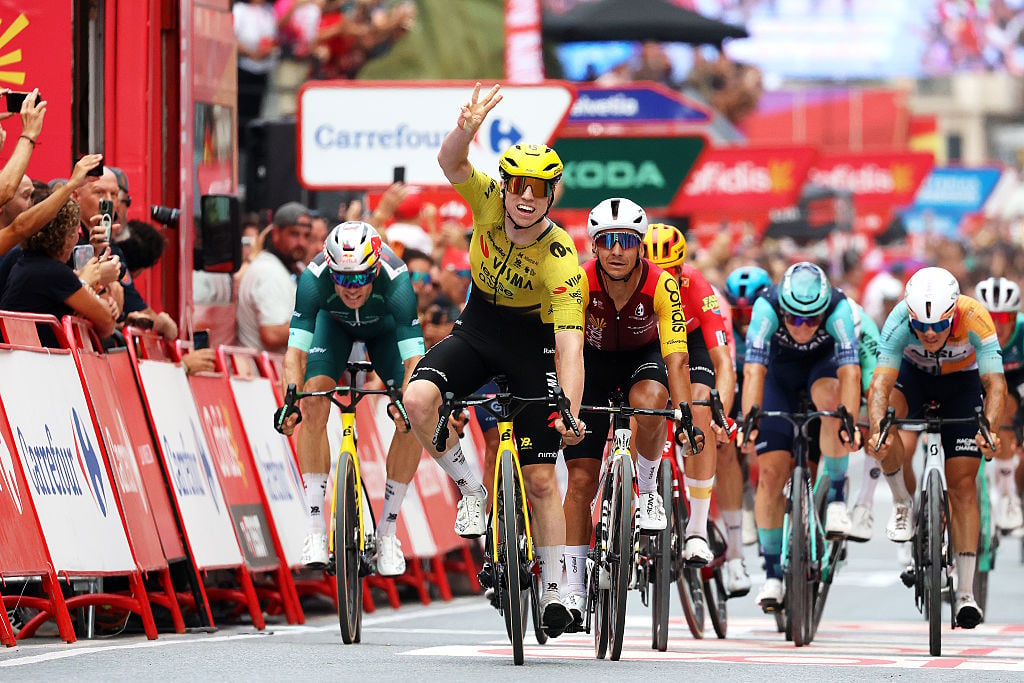
Visma resume the race with five stage victories already secured.
Brennan has three.
Van Aert has two.
Their latest came on the shortened Stage 15 into Córdoba, where Visma initially controlled the race with Brennan in mind before Van Aert recognised an opportunity around the intermediate sprint and attacked into the decisive five-rider move.
He eventually beat Alessandro Romele and Thibau Nys to take his second win in three stages.
The Stage 15 race report showed why Visma have been so difficult to race against during the second week.
When the race favours Brennan, Van Aert can work.
When the race becomes too unpredictable for a normal sprint, Van Aert can simply start racing for himself.
Tuesday gives them the same flexibility.
Brennan is clearly the first option if the bunch remains together. Van Aert gives the team another route if crosswinds or aggressive racing make that plan impossible.
The final week begins with Mas defending 2:06
There was no change among the principal GC riders in Córdoba, meaning Mas resumes the Vuelta with 2:06 over Gall and 2:10 over Roglič.
Carapaz remains fourth at 4:24, while Oscar Onley holds fifth at 5:44.
Tuesday and Wednesday should be the two least important GC stages of the final week, but that does not make them irrelevant. Losing 30 seconds in a crosswind would be particularly damaging when the race already has a 32.1km time trial and two major mountain finishes waiting.
Our state of the race heading into the final week explains why Mas’ two-minute advantage is strong without yet being decisive.
Gall has been climbing better than Roglič.
Roglič has the time trial.
Mas has to defend against both.
Tuesday should simply be about reaching the finish without changing any of those calculations.
Onley has his own reason to stay out of trouble
The same applies to Onley.
The British rider reaches the final week fifth overall and still leads the young rider classification, but Jakob Omrzel is only 30 seconds behind him.
Tuesday offers no obvious route for Onley to gain anything.
It provides several ways to lose it.
A crash, mechanical problem or badly timed split could turn what should be a straightforward transition day into a significant GC setback. Netcompany INEOS therefore have every reason to keep Onley near the front during the exposed finale without asking him to spend energy unnecessarily.
The wider British picture is covered in our look at Oscar Onley’s top-five position heading into the final week.
His real opportunities and dangers arrive from Thursday onwards.
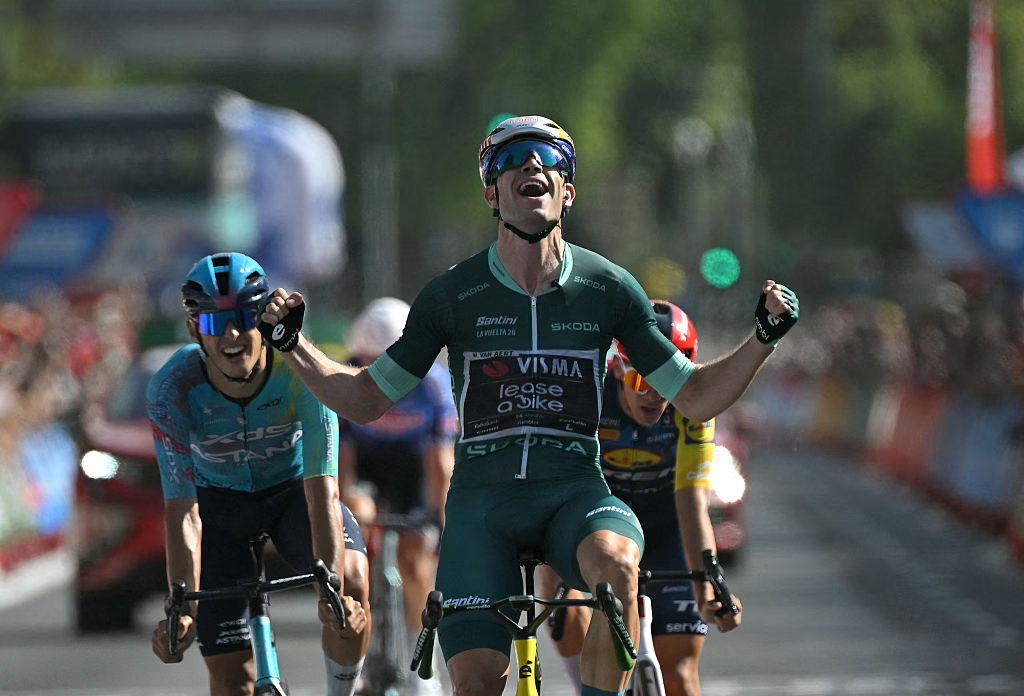 Photo Credit: Getty
Stage 16 comes after a second week that changed the race
The Vuelta that restarts in Cortegana is different from the one that began the second week.
Mas has increased his advantage.
Gall has moved ahead of Roglič.
Van Aert has won twice in three stages.
Brennan already has three victories.
And extreme weather has now forced organisers to intervene twice, first with the Stage 3 hailstorm and then with Sunday’s heat-shortened Córdoba stage.
Our week-two Vuelta retrospective looks at how those separate threads have changed the race before its final six stages.
Stage 16 should be calmer.
That does not necessarily mean uneventful.
-
 Photo Credit: Cor Vos

When will Vuelta Stage 16 finish?
There are three official finishing scenarios:
45km/h average: approximately 16:19 BST
43km/h average: approximately 16:30 BST
41km/h average: approximately 16:42 BST
For planning purposes, 16:30 BST is the sensible target.
Anyone only interested in seeing the final kilometres should nevertheless be watching by around 16:10 BST. On the fastest schedule, the peloton would already be inside the final 12km by then.
A hard opening breakaway fight and a fast chase through the flatter second half could easily pull the stage towards the earlier end of the range.
Vuelta Stage 16 live viewing summary
Date: Tuesday 8 September 2026
Route: Cortegana to La Rábida, Palos de la Frontera
Distance: 181.1km
Stage type: Hilly
Categorised climbs: None
Neutralised start: 12:05 BST
Official start: 12:18 BST
TNT Sports/HBO Max coverage: From around 13:30 BST
Intermediate sprint: Villarrasa, approximately 14:54-15:10 BST
Recommended tune-in: 15:30 BST
Moguer: Approximately 15:36-15:56 BST
Palos de la Frontera: Approximately 15:47-16:07 BST
Expected finish: 16:19-16:42 BST
Main stage favourite: Matthew Brennan
The television window misses much of the terrain where the breakaway should form, but it covers everything that matters in the chase.
Tune in around 15:30 BST and there should still be enough road to see whether Visma have successfully set up Brennan’s fourth victory attempt or whether the breakaway and coastal wind have already pushed Stage 16 away from the expected script.

