
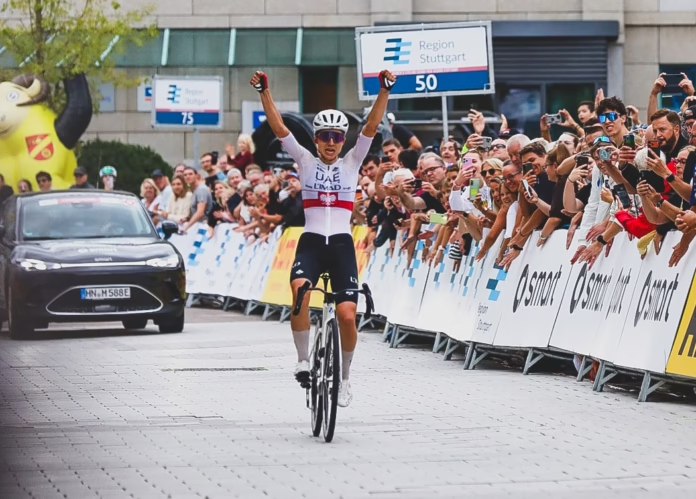
Dominika Włodarczyk’s victory at the 2026 Women’s Cycling Grand Prix Stuttgart & Region fits neatly with the direction of her season. The Polish champion did not wait for Elisa Balsamo in Tamm, attacked from the reduced race and stayed away, giving UAE Team L’IMAD a third consecutive win at the event without relying on two-time defending champion Eleonora Gasparrini.
That makes the result more useful than a simple late-season victory. Włodarczyk has moved from high-level support rider to a rider capable of deciding major races herself, UAE again showed why depth is such a powerful one-day weapon, and Balsamo’s second place confirmed the tactical cost of carrying the fastest finish in a selective group. With the World Championships close, Stuttgart supplied several clear form signals.
Włodarczyk’s 2026 season has changed her place in the hierarchy
Włodarczyk’s win should not be treated as a surprise produced by a weak field or a fortunate escape. Her year already included two Women’s WorldTour stage victories at Itzulia Women, both Polish national titles and seventh overall at the Tour de France Femmes. Stuttgart adds a ProSeries one-day victory to a season that has steadily broadened the types of races she can win.
The important change is tactical. Earlier in her career, rivals could afford to interpret a Włodarczyk attack partly through the riders behind her. If a teammate had a faster finish, the move could look like pressure rather than the final decision. That is no longer safe. Her back-to-back Itzulia stage wins showed that she can convert late aggression herself, and Stuttgart provided another example.
That development gives Poland another serious option for selective championships and gives UAE a rider whose value is no longer dependent on protecting somebody else. The Stuttgart race report showed how quickly the tactical burden shifted once she was clear.
 Photo Credit: Getty
UAE’s third straight win says more than Gasparrini’s old course record
Eleonora Gasparrini won this race in 2024 and 2025, first from a small selection and then with a late attack. The switch to a new Tamm-based course could easily have ended UAE’s run because the previous victories had been so closely associated with Gasparrini’s finishing speed and timing.
Instead, the team found a third route to the same outcome. The 2026 Stuttgart route placed most of the climbing before the final three local circuits, which encouraged stronger all-rounders to attack before the race became easier to organise. Włodarczyk used exactly that transition.
UAE’s strength was that they did not need one predetermined scenario. Gasparrini remained dangerous if a reduced group reached the finish, while Włodarczyk, Silvia Persico and Karlijn Swinkels gave the team alternatives if the race became more aggressive. When Włodarczyk escaped, UAE could stop contributing behind and leave Lidl-Trek and the other sprint teams with the chase.
That is the kind of depth that repeatedly wins modern one-day races. It reduces the need for a single leader to respond to every move and forces rivals to make decisions before they know which UAE rider will ultimately be protected.
Balsamo’s second place confirms the problem of being the obvious sprinter
Elisa Balsamo did much of what Lidl-Trek needed. She survived a route containing roughly 1,700 metres of climbing, remained in contention through the repeated attacks and then won the sprint from the group behind Włodarczyk. The problem was that everybody else understood what would happen if the race came back together.
That changes the economics of a chase. Lidl-Trek had a clear reason to close the gap, but teams without a rider capable of beating Balsamo had far less incentive to spend their remaining domestiques helping. Włodarczyk did not need a huge advantage; she needed enough separation to create hesitation behind.
The result therefore should not be read as evidence that Balsamo lacked form. It points in the opposite direction. Her finishing speed was strong enough to make rival teams reluctant to cooperate, and second place was the consequence of being tactically feared. The pre-race contenders analysis identified that tension before the start.
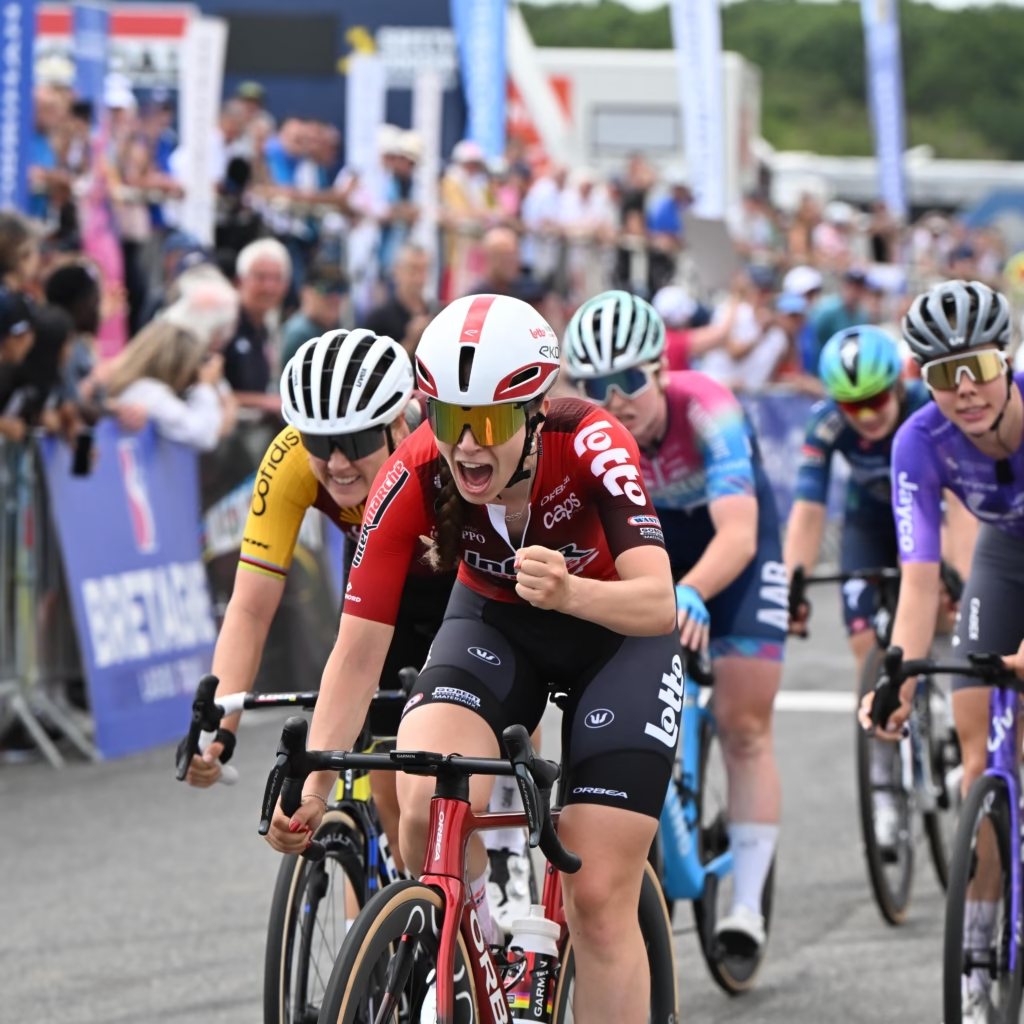 Photo Credit: Bretagne Ladies Tour
Sandrine Tas continues to turn opportunities into serious results
Sandrine Tas taking third for Lotto Intermarché Ladies was another significant result. The Belgian was not the most heavily marked rider in the field, but she stayed with the decisive race and still had enough speed to make the podium after a demanding 134.7km.
For riders outside the very largest teams, late-season ProSeries races can be particularly valuable because the fields are strong enough for the result to carry weight without being completely dictated by one dominant WorldTour structure. Tas used Stuttgart to place herself directly behind two established international winners.
That sort of performance matters when teams are assessing 2027 roles and when national selectors are looking for riders who can survive hard one-day racing. It is not the same as winning, but repeated presence near the front is how status changes over a season.
-
 Photo Credit: Telenet Superprestige
 -
 Photo Credit: Nieuwsblad
 -
Photo Credit: Wahoo

The new Tamm course has given the event a stronger tactical identity
The first three editions of the race were point-to-point affairs into Stuttgart. For 2026, Tamm hosted both start and finish and the riders completed two larger loops followed by three 11.8km finishing circuits. The redesign altered the geography without making the race easier to control.
Most of the climbing came before kilometre 100, which meant teams reached the finishing circuits after already spending riders and absorbing repeated accelerations. A flatter final section does not automatically produce a sprint if the teams capable of organising one have already been weakened.
Włodarczyk’s win gives the new format immediate credibility. It continued the pattern described in ProCyclingUK’s history of the Women’s Cycling Grand Prix Stuttgart & Region: all four editions have rewarded riders willing to race actively rather than wait for a large peloton to reach the line.
For Montréal, the form signal is stronger than the course comparison
Stuttgart is not a miniature version of the World Championships. Montréal will be longer and substantially harder, so none of the podium riders can simply transfer this result into a forecast for the rainbow jersey.
The form signal still matters. Włodarczyk is climbing well, racing aggressively and finishing moves after a long season. Balsamo is surviving enough climbing to remain dangerous deep into selective one-day races. Those are useful pieces of information for national teams deciding how early they need to attack and which riders can be protected into the final laps.
Stuttgart’s biggest lesson is about Włodarczyk rather than one championship. She has reached the point where allowing her a gap can decide a race. UAE already knew that from Itzulia. The rest of the peloton has now had another reminder on a very different course.

