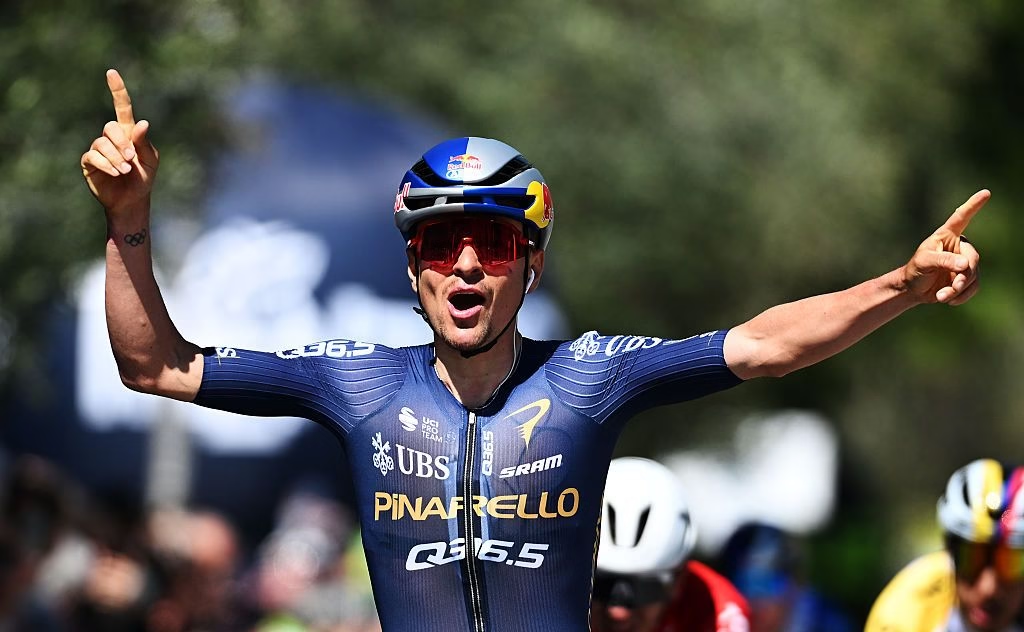
Tom Pidcock arrives at the Tour de France 2026 in one of the most interesting positions of his road career. He is no longer simply the spectacular multi-discipline rider who can descend better than almost anyone, win from breakaways and light up a mountain stage when the race breaks open. After finishing 3rd overall at the 2025 Vuelta a España, he now has a Grand Tour podium on his record. That changes the question completely.
The issue is no longer whether Pidcock can win a Tour de France stage. He has already done that, memorably, on Alpe d’Huez in 2022. The real question for 2026 is sharper: should he race this Tour as a stage hunter with freedom, or as a genuine general classification outsider?
The answer is probably somewhere between the two. Pidcock has enough evidence behind him now to be taken seriously as a top-10 contender, and perhaps more if the race opens up. Yet the 2026 Tour route, the strength of the leading GC field, and the tactical reality of racing for Pinarello-Q36.5 may still make stage hunting his most dangerous weapon.
For the wider race context, our Tour de France 2026 full route guide explains how the Barcelona start, early Pyrenees, mid-race mountain blocks and double Alpe d’Huez finale shape the 113th edition.
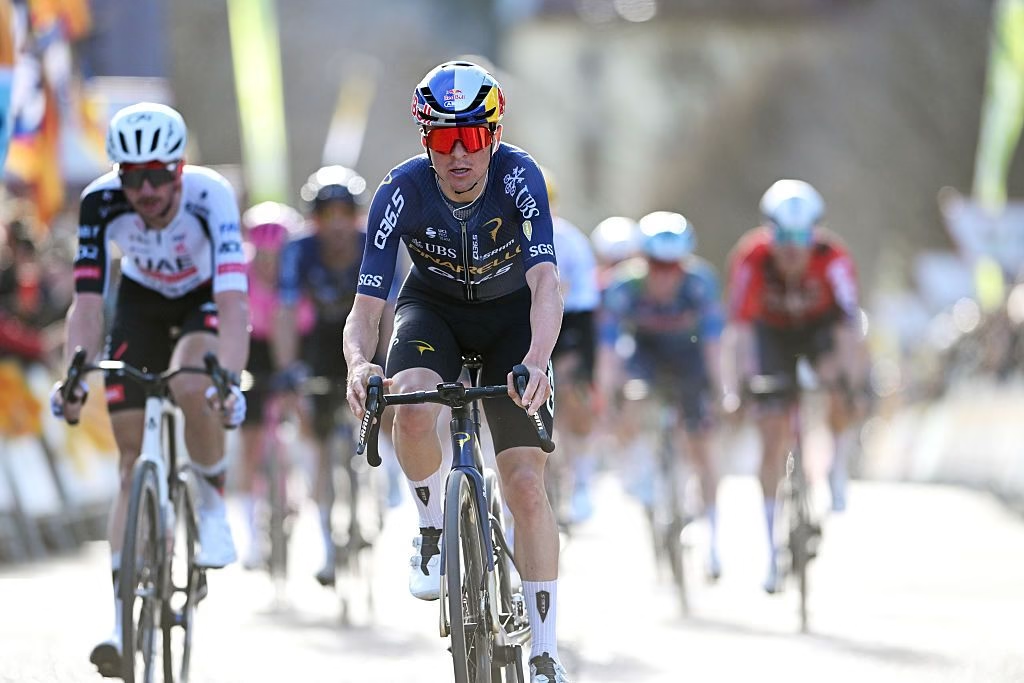
Tom Pidcock at the Tour de France 2026 at a glance
| Question | Answer |
|---|---|
| Team | Pinarello-Q36.5 Pro Cycling Team |
| Tour role | Stage hunter and GC outsider |
| Best Tour de France stage result | 1st on stage 12 to Alpe d’Huez in 2022 |
| Best Grand Tour GC result | 3rd overall at the 2025 Vuelta a España |
| Key 2026 route fit | Hilly stages, technical descents, mountain breakaways, Alpe d’Huez |
| Main GC question | Can he maintain three-week consistency against stronger WorldTour teams? |
| Most realistic target | Stage win and top-10 GC |
| Upside scenario | GC top five if the race becomes chaotic and he avoids a bad day |
| Risk | Losing time early, then being caught between GC ambition and stage freedom |
Why Pidcock is different from a normal Tour outsider
Pidcock is not a conventional Grand Tour rider. That has always been part of his appeal. His road career has often been interrupted, enriched and complicated by cyclocross, mountain biking and Olympic ambitions. He does not fit neatly into the usual mould of a Tour de France GC rider who spends the whole season building around July.
That makes him harder to categorise. His best days can be spectacular. He can descend with uncommon confidence, read technical roads quickly, sprint from small groups, survive hard mountain terrain and attack with the explosiveness of a Classics rider. Those qualities make him ideal for certain Tour stages.
The question has always been whether he can repeat that level every day for three weeks. The 2025 Vuelta podium moved that debate on. It showed that Pidcock could stay in a Grand Tour GC fight, manage the pressure of a classification race, and finish with a result that belonged in the same conversation as the sport’s established stage-race leaders.
That does not automatically make him a Tour de France podium contender. The Tour is deeper, more controlled and more unforgiving than the Vuelta. But it does make him more than a wildcard. He now starts from a different place.
Our best British riders to watch at the Tour de France 2026 guide places Pidcock in a wider British context, alongside riders with very different Tour roles and expectations.
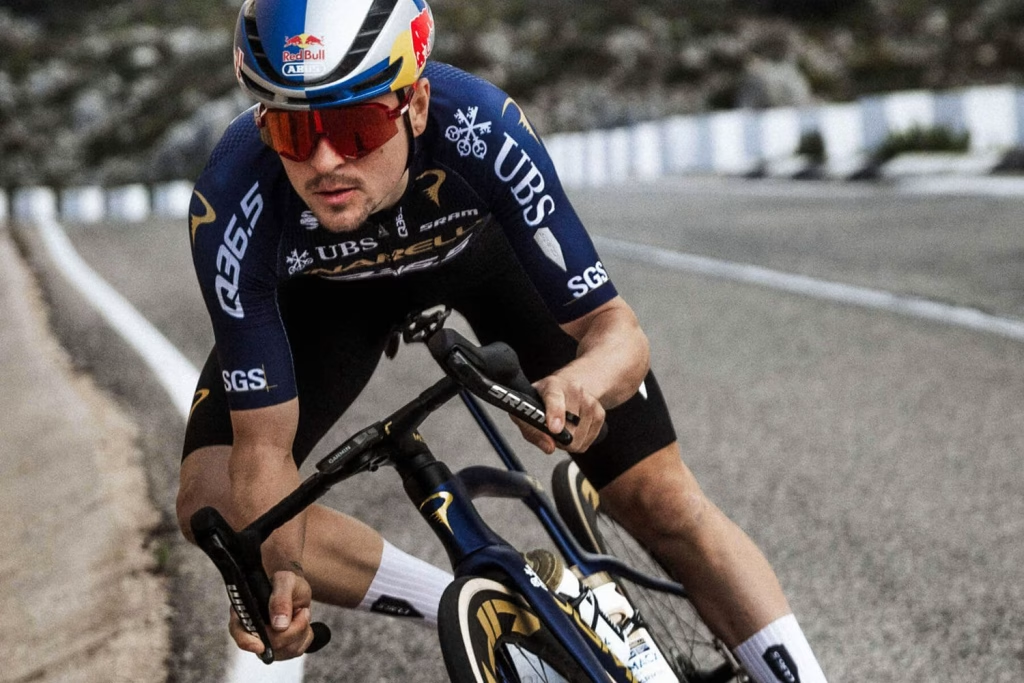
Why the 2025 Vuelta changed the conversation
Before the 2025 Vuelta, the argument around Pidcock as a Grand Tour rider was still loaded with caveats. He had the talent, but did he have the consistency? He had the climbing ability, but could he do it over three weeks? He had the bike-handling and explosiveness, but could he survive the daily grind of positioning, heat, transfers, recovery and controlled mountain stages?
His 3rd place overall at the Vuelta did not answer every question, but it answered enough of them. A Grand Tour podium is never accidental. It requires resilience, recovery, tactical discipline and a team capable of keeping a rider in position through the difficult days. For Pinarello-Q36.5, it was also a major step in the team’s evolution, showing that Pidcock’s move had not simply been about giving him freedom, but about allowing the whole project to grow around him.
That result gives his Tour de France 2026 campaign credibility. It means he can stand on the start line in Barcelona without being dismissed as a rider who only belongs in breakaways. He has earned the right to test the GC waters.
The harder question is whether that is the best way to use him.
The case for Pidcock as a stage hunter
The stage-hunter argument is simple: Pidcock is at his most dangerous when he is not trapped by caution.
His 2022 Tour de France stage win on Alpe d’Huez remains the perfect example. He used the descent off the Galibier brilliantly, bridged across, rode with confidence, then finished the job on one of the most famous climbs in cycling. It was not just a physical win. It was a Pidcock win, built on instinct, technical skill, nerve and timing.
The 2026 route gives him several opportunities to race that way again. The early hilly stages around Catalonia, the Pyrenean terrain, the Massif Central, the Vosges and Jura, and the final Alpine block all include days where a rider with his profile could turn difficulty into opportunity.
The strongest version of Pidcock is not always the rider sitting eighth in a GC group, calculating time losses. It is the rider who senses hesitation, attacks on a descent, follows the right move on a hilly day, or gets into a breakaway that the yellow jersey teams are happy to let go.
For a ProTeam like Pinarello-Q36.5, a Tour stage win would be enormous. A Pidcock victory in the mountains, especially on a route that returns to Alpe d’Huez, would probably carry more public impact than a quiet 8th overall. That matters. Teams do not race only for spreadsheet outcomes. They race for visibility, sponsors, momentum and the kind of moments that define a season.
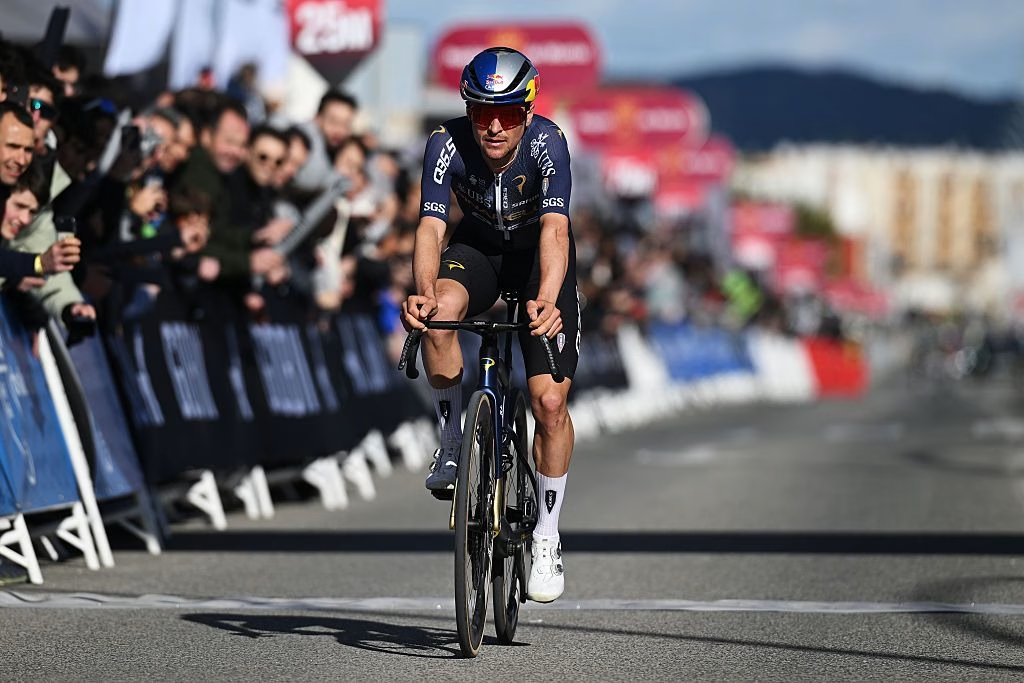
The case for Pidcock as a GC outsider
The counterargument is equally clear: riders do not finish 3rd at the Vuelta by accident, and Pidcock should not voluntarily lower his ceiling before the Tour has even begun.
A GC approach would give him structure. It would force Pinarello-Q36.5 to protect him from stage 1, ride the Barcelona team time-trial seriously, keep him out of trouble through the early Spanish stages, and treat every mountain day as part of a three-week accumulation.
The 2026 route is hard enough to reward durability, but varied enough to suit a rider who is not a pure diesel climber. Pidcock can benefit from technical roads, explosive finishes, difficult descents and stages where the race becomes messy. The Tour is not only won and lost on summit finishes. Time can go in crosswinds, poor positioning, downhill pressure, bonus seconds, short climbs and transition days.
He also has one obvious advantage over some traditional GC riders: he can win things. If Pidcock is still close overall and gets into a reduced group, he has a fast finish. On certain stages, he can combine GC defence with stage ambition. That is a valuable trait, particularly in the first half of the Tour.
Our Tour de France 2026 dark horses for the general classification piece looks at the riders who could sit just outside the main yellow jersey favourites. Pidcock belongs in that group, but with a more volatile profile than most.
Where the 2026 route suits him
The 2026 Tour route is unusually good for a rider who combines climbing, descending and punchy road instincts. It is not a simple climber’s Tour, even with the huge Alpine finale. There are enough technical, transitional and medium-mountain days to reward a rider who can read a race.
The Barcelona Grand Départ immediately matters. Stage 1 is a team time-trial, so Pidcock’s GC hopes could be helped or damaged before the first road stage. A strong Pinarello-Q36.5 ride would keep him close enough to race freely. A poor one would force an early decision: chase GC from behind, or pivot towards stages.
Stage 2, returning from Tarragona to Barcelona with Montjuïc in the finale, looks far more suited to Pidcock. It has the kind of punchy, technical, high-pressure character where bike-handling and repeated accelerations can matter as much as pure climbing. If the finish becomes selective, he is exactly the type of rider who could be in the front group. Our Tour de France 2026 Grand Départ guide covers that opening Catalan block in more detail.
The early Pyrenees are another important checkpoint. Pidcock does not need to beat Pogačar or Vingegaard there to keep his Tour alive. He needs to avoid the bad day. If he reaches the first rest-day phase still close enough to the top 10, the GC route remains open.
The mid-race terrain may be even more interesting. Stages through the Massif Central, Vosges and Jura could offer the right kind of controlled chaos. These are the days where Pidcock can gain from aggression without needing to outclimb the purest mountain specialists on a long summit finish. Our Tour de France 2026 route analysis highlights why those middle blocks could be more influential than they first appear.
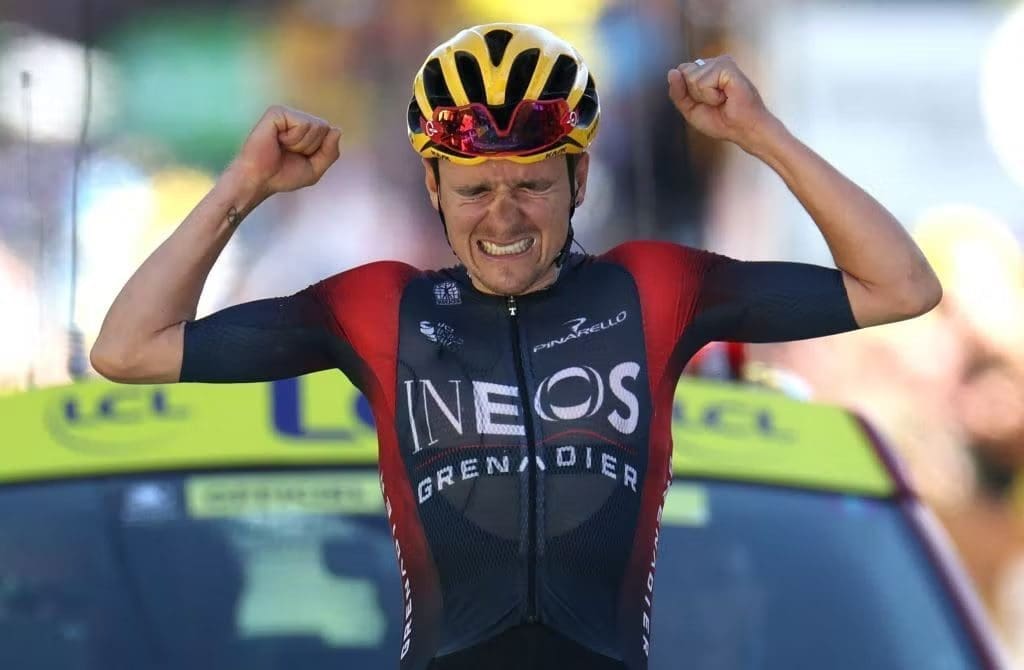 Photo Credit: A.S.O./Charly López
Why Alpe d’Huez changes the story
Alpe d’Huez will follow Pidcock into this Tour whether he wants it to or not.
His 2022 win there was one of the clearest demonstrations of his road potential. It also created a lasting association between him and the climb. In 2026, the Tour returns to Alpe d’Huez twice in the final mountain block, with stage 19 finishing there after a shorter Alpine stage and stage 20 taking on a much harder route before ending on the same climb.
That creates obvious narrative weight. Pidcock back at the Tour. Pidcock back on Alpe d’Huez. Pidcock with a Grand Tour podium already behind him. It is easy to see why that would become one of the race’s storylines.
But the double Alpe d’Huez finish cuts both ways. It gives him a stage-hunting target that fits his history, but it also comes deep into the race, when GC fatigue is at its highest. If he is still riding for overall position, he may not have the freedom to attack early. If he has lost time by then, he could be far more dangerous in a breakaway.
Stage 20 is particularly severe, with the Galibier, Sarenne and Alpe d’Huez forming the final major mountain examination of the race. Our Tour de France 2026 queen stage guide looks at why that day could decide the Tour.
That is the central tension of his Tour. The more successful his GC campaign is, the less freedom he may have. The more time he loses, the more dangerous he becomes as a stage hunter.
The team question: can Pinarello-Q36.5 support a GC bid?
Pidcock’s own level is only part of the equation. The other question is whether Pinarello-Q36.5 can support a serious Tour GC bid against the biggest WorldTour structures.
That does not mean the team is weak. It has clearly grown around Pidcock, and the 2025 Vuelta podium showed that it can function around him in a Grand Tour. But the Tour de France is different. The daily fight for position is more intense. The GC teams are deeper. The race is harder to control. The pressure on every transition stage is higher.
A Pidcock GC campaign needs more than mountain support. It needs protection in the opening week, strength in the team time-trial, riders who can position him before climbs, and enough depth to avoid leaving him isolated too early. That is a big ask for a ProTeam, even one with ambition and momentum.
There is also an opportunity cost. If the whole team rides around Pidcock’s GC, it narrows the tactical playbook. If he loses time, the team may have spent valuable days defending a position that was not truly sustainable. If they allow more flexibility, Pidcock and his teammates may be able to chase stage wins more aggressively.
The best solution may be a hybrid approach: protect Pidcock early, see where the first mountain stages leave him, then decide whether the race is still worth treating as a GC project.
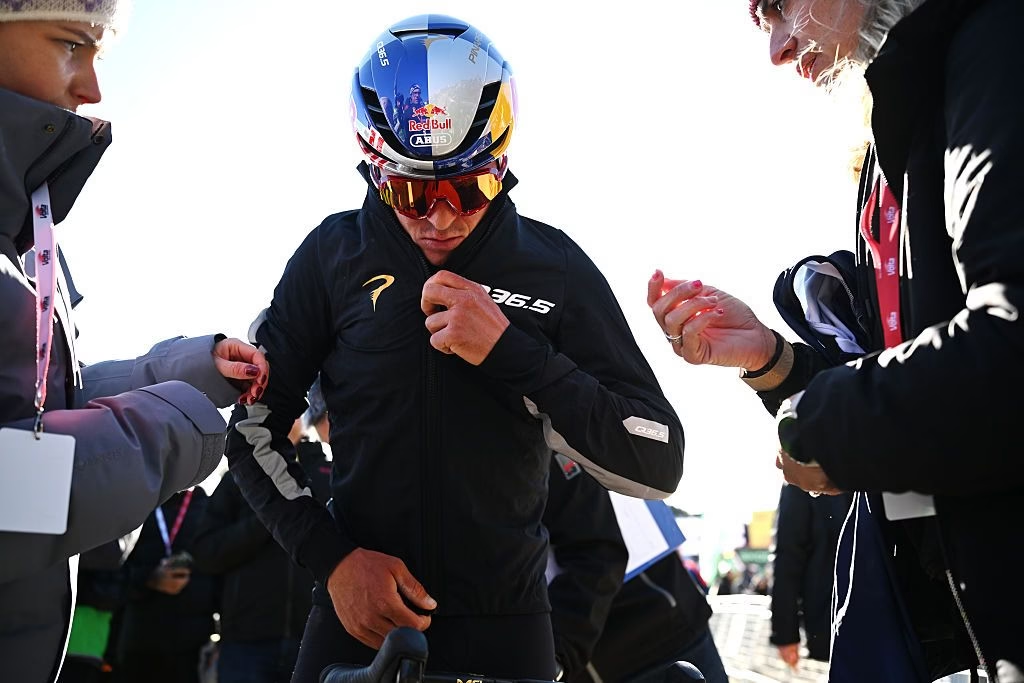
The time-trial issue
The 2026 Tour contains two time-trial questions for Pidcock. The first is the team time-trial in Barcelona. The second is the 26km individual time-trial from Évian-les-Bains to Thonon-les-Bains on stage 16.
The team time-trial is the more immediate concern. A strong squad ride could put him in a useful early GC position. A weak one could leave him chasing from day one. This is where riding for a ProTeam creates risk, because the biggest WorldTour teams may bring deeper collective time-trial engines.
The stage 16 individual time-trial is different. By then, the race will already have passed through multiple mountain ranges and reached the second rest-day phase. Pidcock is not a specialist in the mould of Evenepoel, but he is not helpless against the clock either. The key is whether he can limit losses rather than gain time.
For a stage-hunting Tour, the time-trial is just another hard day. For a GC Tour, it is a major stress point. Our Tour de France 2026 team time-trial explained piece explains why the Barcelona opener is particularly important for any rider with overall ambitions.
Stage hunter or GC outsider?
Pidcock should start the Tour as a GC outsider, but he should not become a prisoner of that ambition.
That is the most balanced reading of his profile. His Vuelta podium means he has earned a protected start. It would be too cautious to throw away the GC option before the race begins. He has enough climbing class, technical quality and resilience to see what happens.
Yet the Tour de France is not the place to spend three weeks defending 9th overall at the cost of every other opportunity. Pidcock’s biggest value is still his ability to win stages that other riders cannot win in the same way. If he is close to the GC lead after the Pyrenees, the team can keep backing the overall plan. If he loses meaningful time, the pivot should be immediate and aggressive.
That pivot could make him even more dangerous. A Pidcock who is five minutes down but climbing well is exactly the kind of rider the GC teams might hesitate to chase, especially if his overall threat has faded. That is when he can use his instincts, descending and explosive climbing to go after the kind of stage that defines a Tour.
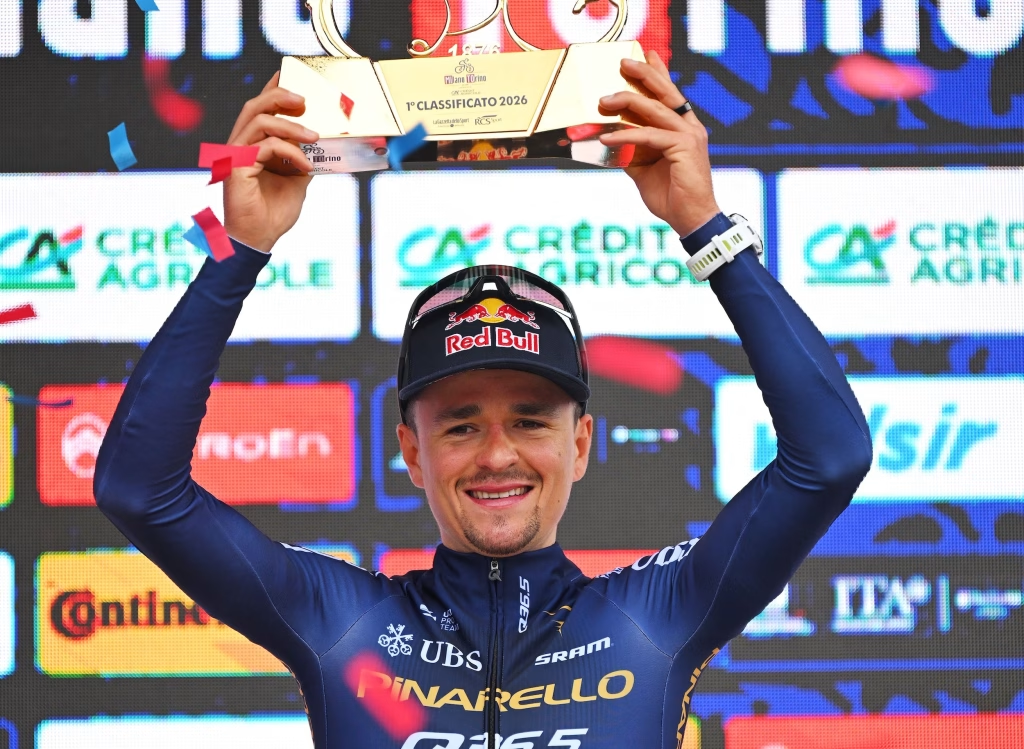
Where Pidcock could win a stage
Pidcock’s best stage-winning chances are unlikely to be pure bunch sprints or long, steady summit finishes where the strongest GC climbers ride tempo until only the favourites remain. His opportunities are more specific.
He needs stages with one or more of the following ingredients: technical descending, medium-mountain terrain, a selective final climb, uncertain GC control, or a breakaway with enough quality to survive.
That makes the Catalan opening weekend interesting, though difficult. It makes the Pyrenean stages possible if he has freedom. It makes the Massif Central and Vosges/Jura blocks very attractive. It also makes Alpe d’Huez impossible to ignore.
The 2026 Tour has enough days where the race could split between GC logic and stage-win instinct. Pidcock thrives in that grey area. He is not simply a climber, not simply a puncheur, not simply a descender. He is most dangerous when the stage asks riders to be several things at once.
Our guide to the best days for GC attacks at the Tour de France 2026 is useful here, because several of the stages most likely to open the GC race are also the kind of terrain where Pidcock’s aggression could become a stage-winning asset.
What would count as a successful Tour?
For Pidcock, success should not be defined by only one outcome. His Tour de France 2026 has three realistic success tiers.
| Outcome | What it would mean |
|---|---|
| Stage win | A clear success, especially for Pinarello-Q36.5 |
| Top-10 GC | Confirmation that the Vuelta podium was part of a broader Grand Tour progression |
| Top-five GC | A major breakthrough at Tour level |
| Stage win and top-10 GC | Probably the ideal realistic Tour |
| Podium | Possible only if the race becomes highly chaotic and several bigger favourites falter |
A quiet 8th overall with no stage win would still be respectable, but it might not feel like the best use of Pidcock’s strengths. A stage win and a top-10 overall would carry more weight. A stage win on Alpe d’Huez and a strong GC finish would be the dream version.
-
 Photo Credit: Getty
Tom Pidcock Tour de France 2026 FAQ
Is Tom Pidcock racing the Tour de France 2026?
Tom Pidcock is set to return to the Tour de France in 2026 with Pinarello-Q36.5 Pro Cycling Team. It would be his first Tour appearance since 2024.
Has Tom Pidcock won a Tour de France stage?
Yes. Tom Pidcock won stage 12 of the 2022 Tour de France, finishing solo on Alpe d’Huez. It remains one of the defining road victories of his career.
Can Tom Pidcock win the Tour de France?
Winning the Tour de France outright looks unlikely in 2026 given the strength of riders such as Tadej Pogačar, Jonas Vingegaard and Remco Evenepoel. A top-10 finish, stage win, or outside push towards the top five are more realistic targets.
Is Tom Pidcock a GC rider now?
Pidcock is now a credible Grand Tour GC rider after finishing 3rd overall at the 2025 Vuelta a España. The Tour de France is a harder test, but he has earned the right to start as a GC outsider.
Is Pidcock better as a stage hunter?
Pidcock may still be most dangerous as a stage hunter because his best qualities are aggression, descending, technical skill, explosiveness and tactical instinct. If he loses time overall, he could become one of the most dangerous breakaway riders in the race.
Does the Tour de France 2026 route suit Pidcock?
Yes, in parts. The route includes hilly stages, technical terrain, medium mountains and two Alpe d’Huez finishes. The team time-trial and long high-mountain days are the bigger challenges.
Could Pidcock win on Alpe d’Huez again?
It is possible, especially if he has freedom to attack from a breakaway. If he is still high on GC, it may be harder because the main favourites will mark each other closely on the Alpe d’Huez stages.
The verdict: Pidcock should keep both doors open
Tom Pidcock’s Tour de France 2026 should not be reduced to a single label before the race has started. He is too good to be treated only as a stage hunter, but too instinctive and versatile to be locked into a rigid GC campaign if the race begins to move away from him.
The right approach is to start with GC respect, then race with stage-winning intelligence. Protect him through Barcelona. Test the first mountains. See whether the team time-trial, Pyrenees and early hilly stages leave him inside a realistic top-10 picture. If they do, keep building. If they do not, release him.
That flexibility is what makes Pidcock fascinating. He can still be a Grand Tour outsider without becoming a conventional Grand Tour rider. He can chase GC without losing the ability to win stages. He can use the Tour not only to prove what he is, but to test how far his range now extends.
The most likely version is a stage win and a top-10 challenge. The most intriguing version is a Pidcock who reaches the final Alpine block close enough overall to matter, but free enough to race with instinct. On a route that returns to Alpe d’Huez, that would be a dangerous combination.
For wider race build-up, the Tour de France hub brings together the latest route guides, rider analysis, start-list coverage and explainers for the 2026 edition.